


Let's get one thing straight: true passive income isn't some "get rich quick" fantasy. It's about building smart systems that make money for you long after the initial work is done. It’s a fundamental shift from trading your time for a paycheck to creating assets that work around the clock.
This guide lays out a modern, creator-focused path for how to create passive income streams, but with a powerful shortcut to get you started faster.
Building Your Passive Income Foundation
The old way of building a creator business is a brutal grind. Most people spend months, sometimes years, trying to build an audience from zero before they ever see a dime. That initial climb is where most people burn out and give up. It’s a broken model.
There’s a much smarter way to do it.
Imagine starting with a social media account that's already monetized. This completely flips the script. For faceless creators, this is a total game-changer. Instead of spending all your energy fighting for those first 1,000 followers, you can focus on making money from day one. You're not just buying an account; you're acquiring an asset with an audience and monetization ready to go.
The Modern Creator's Income Streams
With this foundation in place, you can immediately begin weaving together several income streams. Your pre-monetized account acts as the engine, driving traffic and cash flow to everything else you build.
Here's what that looks like in practice:
- Ad Revenue: This becomes your immediate, baseline income. Every view on your content puts money in your pocket from the moment you hit "publish."
- Affiliate Marketing: You can start sharing relevant products with your new audience right away and earn a commission on every sale. No waiting period required.
- Digital Products: Your content becomes a funnel, guiding followers directly to your own products—think templates, guides, or presets—creating an income source that scales infinitely.
This "ecosystem" approach is incredibly powerful because each stream feeds the others. The ad revenue gives you immediate cash flow, affiliate links provide quick monetization wins, and your digital products build your brand and long-term wealth. To really make this work, you need to understand the bigger picture of how to monetize content and build a creator business from the ground up.
To help you visualize this, here's a quick breakdown of the most common passive income streams for creators.
Creator-Focused Passive Income Streams At A Glance
| Income Stream | Initial Setup Effort | Passive Potential | Example |
|---|---|---|---|
| Ad Revenue | Low (with a monetized account) | High | Earning from views on YouTube videos or TikToks. |
| Affiliate Marketing | Low to Medium | Medium | Promoting a software tool and getting a 30% cut of sales. |
| Digital Products | Medium | Very High | Selling a Notion template or an ebook on your website. |
| Online Courses | High | Very High | Creating a pre-recorded course on a topic you master. |
| Licensing | Low to Medium | High | Selling rights to your photos, videos, or music. |
Each of these streams offers a different balance of effort and reward, but when combined, they create a resilient and scalable business.
The biggest difference in a successful approach isn’t just the platforms—it’s the mindset. You must focus on projects that add energy and build assets, instead of just trading hours for dollars.
The end goal is a finely tuned system where your content does the heavy lifting 24/7. A single video can earn ad revenue, drive affiliate sales, and lead a customer to your digital store—all at the same time, long after you’ve moved on to the next project. That's the power of building a true passive income engine.
Your First 90 Days: A Passive Income Action Plan
It's one thing to talk about passive income, but it's another thing entirely to build it. Real momentum comes from a clear, step-by-step roadmap. This 90-day plan is designed to take you from day one to a fully automated system, transforming your pre-monetized account into a genuine income-generating asset.
Forget about vague, overwhelming goals. This is all about taking small, deliberate steps each week that build on the last.
The whole journey starts with a mental shift. You're no longer just trading your time for money. Instead, you're building assets that work for you around the clock.
This is the core idea—moving from active work to building systems that generate income on their own.
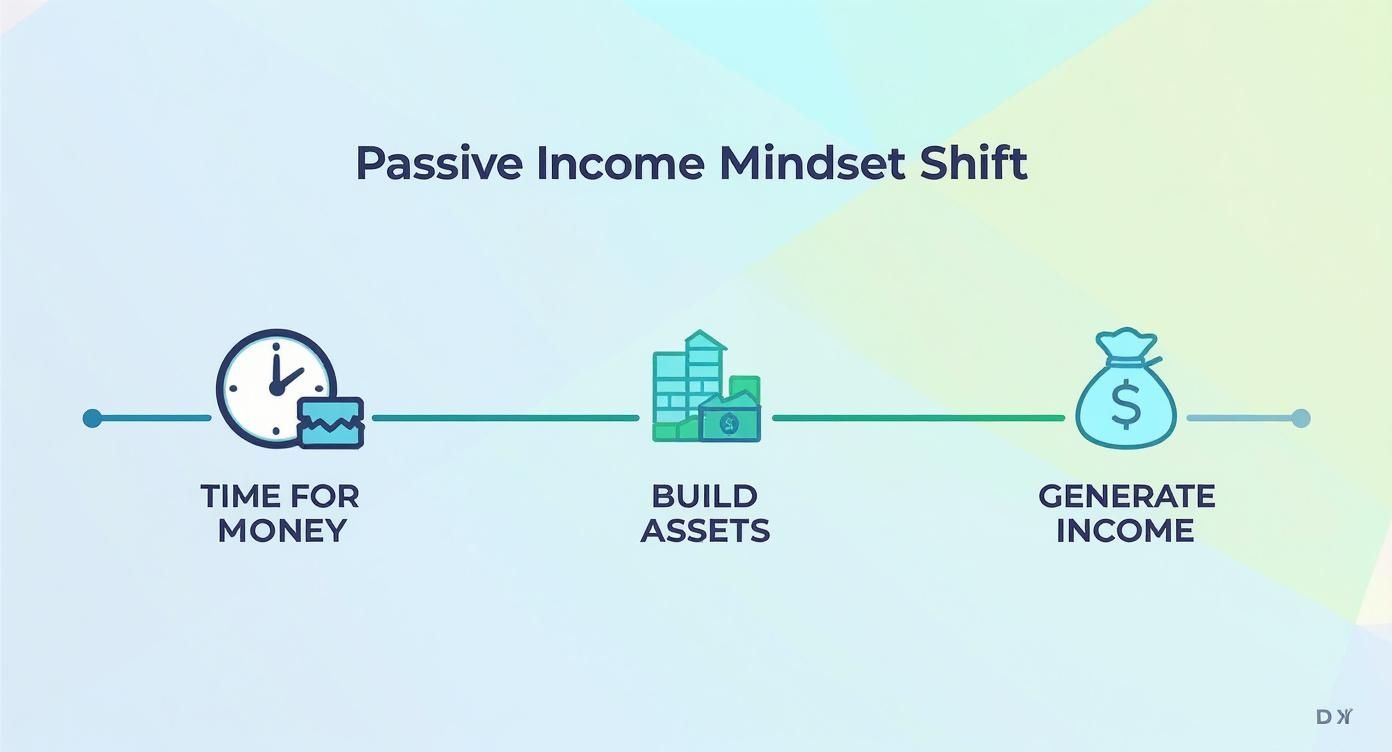
This illustrates that essential switch from being an active earner to a passive income strategist. Your main job becomes creating and fine-tuning these income-producing systems.
Month 1: Activation and First Wins (Days 1-30)
The first month is all about getting the foundation right and, most importantly, getting your first dollars in the door. The goal here is speed and simplicity. You need to prove to yourself that your niche is viable and that this new asset can actually make money.
You’ll be focusing on two things: getting the ad revenue flowing from the account and launching your first affiliate partnerships. This approach gives you immediate cash flow from ads while you build up a second, more targeted income stream.
Your Game Plan for Month 1:
- Week 1: Get your monetized account and nail down the branding. This means creating a simple logo, writing a bio that grabs attention and has a clear call-to-action, and deciding on your main content themes.
- Week 2: Find and apply to 3-5 solid affiliate programs that fit your niche. Only choose products you actually believe in and that have a good reputation. Platforms like ClickBank or ShareASale are great places to start, but don't overlook direct partnerships.
- Week 3: It's time to create and schedule your first 10-15 pieces of content. Consistency is everything. For a faceless account, this could be simple text-on-screen videos, screen recordings, or curated clips that fit your niche and naturally lead into your affiliate promotions.
- Week 4: Add your main affiliate link to your bio and start weaving it into your content. Pay close attention to what people are engaging with. The goal is simple: get that first affiliate click and, with any luck, your first sale.
Trust me on this: the first dollar is the hardest one to earn. Getting that initial sale is a massive proof of concept. It validates your entire strategy and gives you the motivation you need to keep going.
Month 2: Systemize and Create (Days 31-60)
Okay, your account is live and you've dipped your toes into affiliate marketing. Month two is all about building a content machine that runs without you and starting to think about your own product. This is where you graduate from manual effort to creating repeatable systems.
You'll take what you learned in month one and refine your content strategy. At the same time, you'll start outlining a simple digital product that solves a real problem for your audience. This little asset will become a huge part of your long-term income plan.
Your Game Plan for Month 2:
- Weeks 5-6: Lock in your content workflow. Use a scheduling tool to batch-create and automate your posts for the next month. This buys you back so much time to focus on bigger things.
- Week 7: Brainstorm your first digital product. Start small but valuable—think a checklist, a template pack, or a short, punchy guide. The goal isn’t perfection; it’s a minimum viable product (MVP) you can get out the door quickly.
- Week 8: Start building your digital product with simple tools like Canva or Google Docs. While you’re doing that, set up a basic sales page on a platform like Gumroad or Stan Store.
Month 3: Scale and Automate (Days 61-90)
The final month of this initial sprint is all about launching your product and optimizing everything for growth. You’ll connect all your income streams into one smooth ecosystem where your content automatically sends people to both your affiliate offers and your own product.
This is where the "passive" part of passive income really starts to shine. Your focus shifts from creating to optimizing—seeing what works and doing more of it.
Your Game Plan for Month 3:
- Launch Your Digital Product: It's time. Announce your new product to your audience. Create a series of posts and videos explaining the problem it solves and why they need it.
- Build a Simple Sales Funnel: Make sure your link-in-bio page is a powerhouse. It should feature both your top affiliate offer and your new digital product, giving you two chances to make a sale from a single click.
- Analyze and Optimize: Dive into your analytics. Which posts are driving the most affiliate sales? What’s the best time to post? Use this data to make your content strategy even smarter for the next 90 days.
- Plan Your Next Move: With your first product launched and affiliate marketing running smoothly, start thinking about what’s next. This could be a more advanced course, a YouTube channel, or a niche blog to expand your reach.
By the end of these 90 days, you won't just have a monetized account; you'll have a multi-stream, income-generating asset. You will have learned how to build systems that make money, not just how to make content.
Mastering Affiliate Marketing As A Faceless Creator
If you're starting with a monetized account, affiliate marketing is easily the quickest path to cash flow. The concept is simple: you promote another company’s stuff, and when someone buys through your unique link, you get a cut.
What's great about this is you don't have to deal with the headaches of creating products, managing inventory, or handling customer support. Your entire job is to be the trusted middleman connecting your audience to things they'll actually find useful.
This is a godsend for faceless creators. You don’t need to be on camera to build authority. Your power comes from the quality of your content and the trust you've earned. The trick is to weave in promotions so naturally they feel less like an ad and more like a helpful recommendation from a friend.
Finding Affiliate Programs That Actually Convert
So, where do you find these golden opportunities? Most creators make the classic mistake of signing up for every affiliate program under the sun. That shotgun approach almost never works.
You’re much better off finding a small, curated list of products that solve a real problem for your audience.
Relevance is everything. If your account is all about AI productivity hacks, trying to push a fashion brand is just going to confuse people and tank your credibility. Stay in your lane.
Here's a simple process I use to find winners:
- Start with what you already use. The most authentic promotions come from a place of genuine experience. What software, tools, or services are already part of your daily life? Chances are, your audience will love them too.
- Dive into the big networks. Marketplaces like ShareASale, ClickBank, and Amazon Associates are massive databases of affiliate programs. They make it easy to find and apply for partnerships in just about any niche you can imagine.
- Go straight to the source. Lots of companies, especially in the SaaS world, run their own affiliate programs. Just scroll to the footer of their website and look for a link that says "Affiliates" or "Partners."
Quick tip: Don't get blinded by high commission rates. A product with a 20% commission that perfectly matches your audience's needs will always make you more money than a random product with a 50% commission that doesn't.
Weaving Promotions Into Your Content
Once you're approved for a few programs, the real art begins. Your goal isn't just to drop links—it's to create content that helps your audience, with the product positioned as the key to their success. This is fundamental to building passive income streams that don't fizzle out.
Let’s say you’re promoting video editing software. Instead of a lazy "buy this" post, try this:
- Short-Form Video Idea: Put together a quick "before-and-after" video showing how you transformed a boring clip using one killer feature of the software. Your call to action is simple: "Want the tool I used for this? Link in bio."
- Carousel Post Idea: Create a step-by-step tutorial in a carousel format. Walk your audience through a simple editing technique, with each slide showcasing a different software feature. The final slide is your call to action with the affiliate link.
Always remember this: You're not selling a product; you're selling a solution. The product is just the tool that gets them there.
Essential Tools For Affiliate Success
To keep this from turning into a full-time job of managing links, you need to build a system. Manually updating links across hundreds of old posts is a nightmare.
This is where a link management tool becomes non-negotiable. Services like Linktree or Stan Store give you a single, clean "link-in-bio" page to house all your top affiliate offers. Now, if you want to swap out a promotion, you only have to change it in one place.
These tools also provide basic analytics, letting you see exactly which links are getting clicks. This data is gold. It helps you double down on what’s working and ditch what isn’t, turning a decent affiliate strategy into a seriously profitable one.
And if you want to really hit the ground running, you can explore our resources on finding the best monetized accounts for affiliate marketing to get a head start.
From Idea To Income: Creating And Selling Digital Products
Affiliate marketing can get you some quick wins, but if you want to build real, long-term wealth, you need to create your own digital product. This is the ultimate creator asset. You build it once, and it can sell over and over again while you sleep.
The best part? The business model is incredibly simple. There's no inventory to manage, no boxes to ship, and you keep nearly 100% of the profit.
Your journey starts with one solid idea. Don't fall into the trap of thinking you need a 300-page ebook or a 20-hour video course. In fact, you should actively avoid that. The smart move is to launch a Minimum Viable Product (MVP)—a small, focused solution that solves one specific problem for your audience.
Brainstorming Your First Profitable Product
The best product ideas come directly from your audience's pain points. Pay close attention to the questions they're always asking and the frustrations they share. Your first product should be the exact shortcut they've been looking for.
Here are a few high-value, low-effort ideas that are perfect for a first launch:
- Template Packs: Think Notion dashboards, Canva graphic templates, or video editing presets. People happily pay for these because they save a massive amount of time.
- Checklists and Planners: A detailed checklist for launching a podcast or a 30-day content planner is an easy-to-create product that delivers immediate value.
- Short Guides or Ebooks: Get laser-focused. Instead of "A Guide to Social Media," you'll sell more with "The 15-Minute Daily Plan for TikTok Growth." Specificity is everything.
- Toolkits or Resource Libraries: Package up a curated list of the best tools, prompts, or resources for a specific task. You're selling your expertise and research.
Online courses are another massive opportunity. The global e-learning market is already worth over $300 billion, and it's driven by people wanting to learn very specific skills. Data from SurveyMonkey.com shows just how much this kind of side hustle is booming. A well-structured course can bring in thousands a year with very little work after the initial setup.
Choosing The Right Platform To Sell
Once your product is ready, you need a dead-simple way to sell it. Don't get lost trying to build a complex website. For your first product, you just need a platform that’s fast, easy, and handles the payment and file delivery for you.
Two of the best options for creators are:
- Gumroad: A long-time favorite for a reason. Its simplicity is unmatched. You can get a product page live in minutes, and it takes care of everything from the checkout process to sending the files to your customer.
- Stan Store: This is an all-in-one "link-in-bio" tool with a storefront built right in. It's brilliant for keeping your links, funnels, and products all in one clean place.
Building Your Automated Sales Funnel
This is where the true "passive" part of passive income kicks in. An automated sales funnel is a system you set up once to guide people from discovering you to buying from you, all without you lifting a finger. As a faceless creator, this is your entire business model.
Your content's job is to attract the right people. Your link-in-bio's job is to convert them. Your digital product's job is to deliver value automatically. When all three work together, you have a true passive income machine.
A basic, effective funnel looks like this:
- Content (Top of Funnel): Your videos, posts, and stories attract viewers interested in your niche.
- Call to Action (CTA): In your content, you consistently point people to your "link in bio."
- Sales Page (Middle of Funnel): Your Gumroad or Stan Store page clearly explains what your product does and whose problem it solves.
- Checkout & Delivery (Bottom of Funnel): The platform handles the payment and instantly sends the product to your new customer.
This simple, automated flow means you're open for business 24/7. You can make sales while you're working, sleeping, or planning your next piece of content. When you start sending traffic to this funnel from a powerful asset like a pre-approved monetized YouTube channel, your earning potential really starts to take off.
Automating And Scaling Your Income Ecosystem
Having a few income streams is a great start, but the real game-changer is automation. This is how you make your income truly passive. We're talking about building a business that practically runs itself, freeing you from the daily grind so you can think bigger. It's the shift from working in your business to working on it.
An automated system keeps the engine running—publishing content, nurturing your audience, and making sales—without you having to be there for every little thing. This is the secret to making more money without piling on more hours.
Build a Content Machine That Never Sleeps
First things first, you have to get your content pipeline on autopilot. If you're manually posting every single day, you're on a fast track to burnout. You need a system.
The idea is to create content in big, focused batches and then schedule it all to go live when your audience is most active. This keeps you consistent, which is everything when it comes to growing an engaged following.
Content schedulers are a must-have. Tools like Later, Buffer, or Planoly are perfect for this. You can knock out an entire month's worth of content in one productive afternoon. It's a massive time-saver and, honestly, the quality of your work goes up when you're in that creative zone.
Here are a few workflows I'd set up right away:
- Batch & Schedule: Pick one day a week. That’s your content day. Create and schedule everything. Now you're covered, even on your busiest days.
- Repurpose with AI: Take one great piece of content—like a blog post—and use AI tools to spin it into a dozen smaller assets. Think TikToks, Instagram carousels, or quote cards.
- Automate Your Welcome: When someone new joins your email list, they should immediately get a welcome sequence that introduces your brand, points them to your best stuff, and maybe presents a top affiliate offer. Set it and forget it.
Weave Your Income Streams Together
A properly scaled business isn't a collection of separate projects; it's an interconnected system. Each income stream should feed and support the others, creating a flywheel that picks up speed on its own.
Think about it: the ad revenue from your pre-monetized account isn't just profit. It’s fuel. You can take that cash and reinvest it into targeted ads that promote your digital product. Suddenly, your passive income is generating more passive income.
The real magic happens when your system works for you 24/7. A single piece of content can earn ad revenue, drive affiliate sales, and funnel customers to your digital product simultaneously—all while you're focused on your next big idea.
This is where you start automating your workflows for efficiency. Tools like Zapier or Make act as the digital glue holding your entire business together.
For instance, you can set up a "Zap" that automatically adds a new customer from Gumroad to a specific email list in ConvertKit. No manual data entry, no missed opportunities.
This screenshot shows how a trigger—a new sale—can kick off an entire automated sequence without you lifting a finger. It's incredibly powerful.
Use Data to Double Down on What Works
Automation does more than just save you time—it gathers crucial data. Every tool you use is tracking what works and what doesn't. This information is your roadmap to getting better results.
Make it a habit to check your analytics. You're looking for the winners.
- Which posts are driving the most affiliate clicks?
- What time of day are people most engaged?
- Which digital product converts the best?
Answering these questions helps you stop guessing. You can cut out the stuff that isn't working and pour your energy into the things that are. This is how your passive income doesn't just chug along; it grows, month after month. Find the 20% of your efforts that are delivering 80% of your results and focus right there.
Got Questions About Building Passive Income? Let's Talk.
Jumping into the world of passive income can feel like stepping into the unknown. It’s natural to have a bunch of questions pop up, and sometimes those "what ifs" can stop you from ever getting started. Let’s clear up some of the most common worries I hear from creators.
How Much Can I Realistically Make in the First Year?
This is the million-dollar question, right? The honest, no-fluff answer is: it depends. A lot. Your income is tied directly to your niche, how good your content is, and most importantly, how consistently you show up.
That said, a dedicated creator who follows the roadmap can realistically expect to be making anywhere from a few hundred to a few thousand dollars per month by the end of year one.
It all starts small. In the beginning, you might only see $50-$200 a month from some affiliate links and early ad revenue. But as you add a digital product and get your automation dialed in, that number starts to climb fast. Think of it like a real business—your revenue grows as the assets you've built start working for you.
Remember this: those first few dollars are your proof of concept. That first affiliate sale isn’t just a few bucks; it’s validation that your entire strategy works. It’s the fuel you need to keep building.
Can I Really Do This With No Money Upfront?
Yes, you absolutely can. But there's a trade-off you need to be honest about: what you save in cash, you'll spend in time.
Starting with zero investment means you're on the hook for building an audience from scratch, and that organic grind can take months, sometimes even a year or more. The good news is that the income streams themselves don't require a big bankroll.
- Affiliate marketing is free to join. Your only investment is the time it takes to create content that people trust.
- You can design a killer digital product using free tools like Canva or even a simple Google Doc.
- Selling it on a platform like Gumroad costs nothing to set up. They just take a small cut from each sale you make.
Buying a pre-monetized account is simply a shortcut. It lets you skip the line. But starting from zero is totally possible if you’re ready to put in the hours and be patient.
What Are the Biggest Mistakes People Make?
I see creators stumble on the same few things over and over. If you can sidestep these common traps, you’ll be way ahead of the game. The single biggest mistake is inconsistency. So many people get discouraged and quit if they aren't seeing massive results in the first 30 days. Passive income is a marathon, not a sprint. It rewards patience.
Another huge error is trying to do everything at once. Don't try to launch five different income streams in your first month. You’ll burn out. Instead, master one, get it running smoothly, and then add the next. Nail affiliate marketing first, then turn your focus to that digital product.
Finally, don't just chase a niche because you think it's profitable. If you have zero genuine interest in it, that lack of passion will bleed into your content. You'll get tired of faking it. Authenticity is what connects with an audience and ultimately drives sales. For more on this, check out some of the other articles on the MonetizedProfiles blog.
Just How "Passive" Is This, Really?
Let’s get one thing straight: "passive income" does not mean "no work ever." Not even close. There's a ton of work you have to do upfront—creating the content, building the product, and setting up all the automated systems. The heavy lifting is all at the beginning.
The "passive" part kicks in later. Once those systems are built and humming along, they generate income with very little day-to-day effort from you. You might spend a few hours a week checking in, looking at your data, or batch-creating some new content. But it's a completely different world from a 9-to-5 where you're constantly trading your time for money. You build the machine first, then your job is just to give it a tune-up now and then.
Ready to skip the long, slow grind of building an audience from scratch? At MonetizedProfiles, we provide monetization-approved social media accounts that let you start earning from day one. Find your perfect monetized account today!


