


Thinking about buying a monetized YouTube channel? It’s a tempting idea. You get to jump the line, skipping the months—or even years—it takes to grind your way into the YouTube Partner Program. This isn't just a shortcut; it's a strategic move to buy an asset that's already making money and has an audience waiting.
Why Buy a Monetized Channel Instead of Starting From Scratch?
Let's be real: getting a new YouTube channel monetized is a marathon. You have to consistently churn out content just to hit those magic numbers: 1,000 subscribers and 4,000 watch hours in a year. Many creators call this the "YouTube sandbox," a long haul where you're putting in all the work for zero immediate financial reward.
Buying a channel lets you bypass all of that. Instead of starting at zero, you're taking over a channel that's already crossed the finish line. That gives you a few powerful advantages right out of the gate.
The Instant Benefits of Acquisition
Think of it like buying a business that’s already up and running. The lights are on, and customers are already walking in. The main perks are pretty clear:
- Immediate Revenue Generation: Your videos can start earning money from AdSense on day one. You're already in the YouTube Partner Program, so there's no waiting period for approval.
- Established Subscriber Base: You’re not talking to an empty room. You inherit an audience that's already interested in the channel's niche, giving your new content instant momentum.
- Existing Content Library: Most established channels have a backlog of videos that keep pulling in views and generating a trickle of passive income. This library of evergreen content is a valuable asset.
It all boils down to trading money for time. Building a channel from the ground up is a rewarding journey, but buying one is a calculated business decision to fast-track your way into the creator economy.
Of course, this shortcut isn't a walk in the park. The risks are very real, and you need to go in with your eyes wide open.
Understanding the Inherent Risks
While the benefits are compelling, buying a monetized YouTube channel comes with some serious risks. The biggest one? Audience mismatch. The subscribers you inherit might not vibe with your new content or personality, which can cause engagement and views to tank.
Then there are the hidden skeletons in the closet. A channel could have old copyright strikes or community guideline violations the seller "forgot" to mention, putting you at risk of demonetization right after the sale.
The numbers don't lie. While buying can be a huge boost, it's no guarantee. Some analyses show that post-2023 algorithm changes have led to a 15% increase in channels being flagged for policy violations. Even worse, some new owners see a 20-30% drop in channel value when they discover the engagement they paid for wasn't authentic. You can dig into more YouTube trends and creator statistics to see just how important this is.
All this just hammers home one critical point: you absolutely have to do your homework.
Your Pre-Purchase Due Diligence Checklist
Buying a monetized YouTube channel without doing your homework is like buying a used car without ever looking under the hood. It might look shiny on the outside, but you could be buying a heap of problems. This checklist is your roadmap to digging deep and uncovering the real story behind any channel before you put your money down.
The big appeal, of course, is speed. You get to skip the long, uncertain grind of building from scratch.
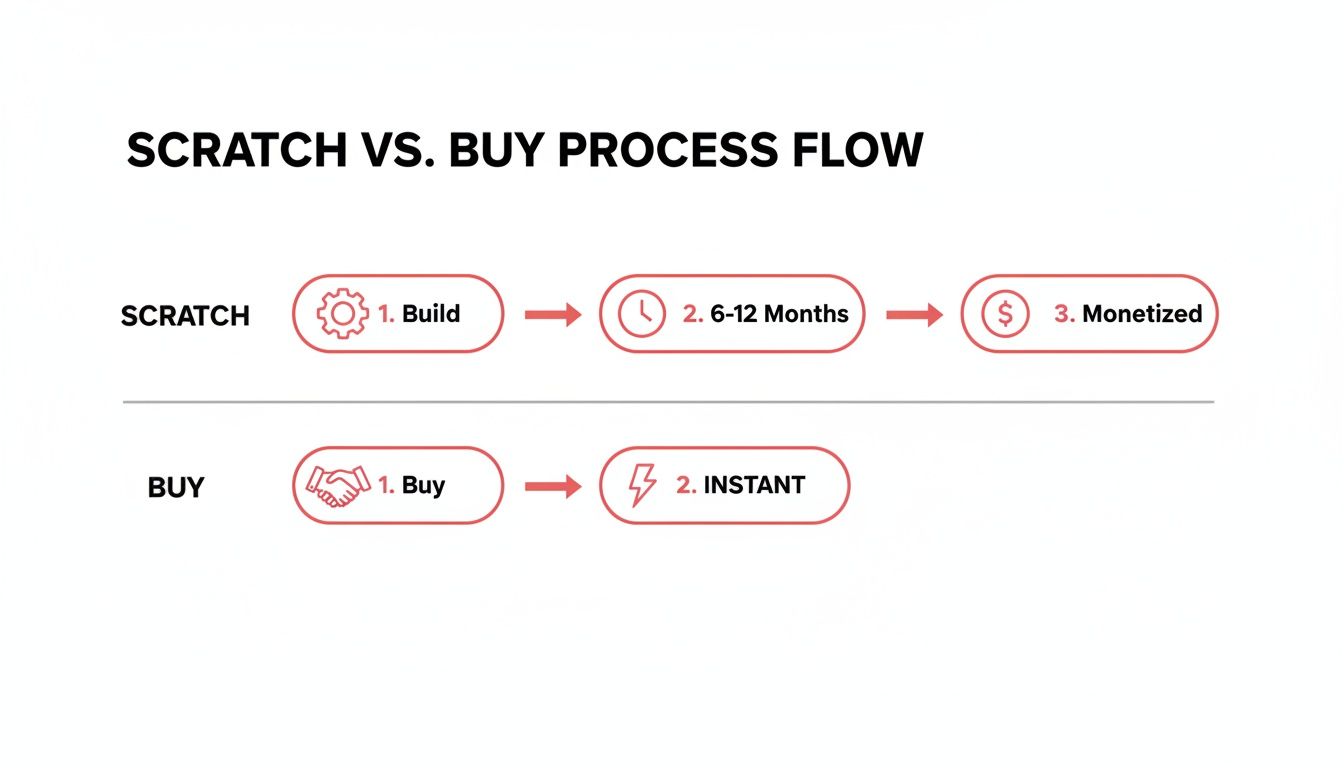
As you can see, you’re essentially trading money for time, bypassing the typical 6-12 month journey to monetization.
Scrutinizing the Channel's Health
First things first, you need to get inside the channel’s dashboard. Any serious seller should be willing to grant you temporary, read-only "Viewer" access to their YouTube Studio. If they hesitate or refuse, that’s a massive red flag. Just walk away.
Once you’re in, here’s what to look for:
- Monetization Status: Go straight to the "Earn" tab. Don't take their word for it—you need to see with your own eyes that it officially states the channel is in the YouTube Partner Program.
- Copyright & Community Guideline Strikes: Check the channel’s record. Any active strikes are a huge risk, as just one more could get the channel terminated. Even expired strikes tell a story about the kind of content the previous owner was posting.
- Audience Demographics: Who’s actually watching? Dive into the analytics to see the audience's age, gender, and, most importantly, location. A channel where 70% of viewers are from a low-CPM country will earn a fraction of what a channel with a primarily US-based audience makes.
This isn’t just about numbers; it’s about making sure the audience is a good fit for your own content plans and that it can actually generate the revenue you expect.
Analyzing Performance and Engagement Metrics
Next up, you need to play detective and figure out if the channel's numbers are legit. Fake engagement is everywhere, and buying a channel propped up by bots is a fast-track to failure.
Look for consistency. A video with 500,000 views but only 20 comments and 1,000 likes just doesn't add up. Real engagement is proportional. A sudden, massive jump in subscribers without a viral video to explain it is another classic sign of bought followers.
Watch time is the golden metric. Subscribers can be bought, views can be faked, but consistent, high watch time is the clearest sign of a real, engaged audience that the YouTube algorithm loves.
Evaluating Content Quality and Originality
Now it's time to actually watch the videos. Is the content original, or is it just a mashup of other people's stuff? Channels built on reused content—like movie clips or generic stock footage with a robot voiceover—are constantly at risk of being demonetized by YouTube.
Understanding content rights is critical for the channel's long-term health. This covers everything from video clips to the background music in every single upload. For a comprehensive guide on legally integrating music into YouTube videos, this is an excellent resource and a must-read for any potential owner.
Also, think about the content's "evergreen" potential. Is the video library full of passing trends that will be irrelevant next month? Or is it packed with valuable tutorials and information that will keep pulling in views for years? An evergreen library is a far more valuable asset.
Finally, before you commit, get familiar with the terms of the sale and what happens if things go south. For instance, reviewing a marketplace's refund policy is a crucial due diligence step. A transparent policy, like the one found at https://monetizedprofiles.com/refund-policy, shows you what protections are in place if the channel isn't what was advertised. This kind of prep work ensures you’re covered from every angle.
How to Accurately Value a Monetized YouTube Channel
Figuring out what a monetized YouTube channel is really worth can be tricky. You might see a channel with 100,000 subscribers listed for $5,000 and another with just 20,000 for a whopping $15,000. It’s not about the vanity metrics; it's about the engine running under the hood.
The real value comes down to three things: profitability, audience quality, and growth potential. If you miss these, you're just gambling. Let's break down how to put a real price tag on a channel before you even think about making an offer.
The Foundational Valuation Formula
The most common starting point is the monthly profit multiplier. It’s a simple concept: most channels are valued at a multiple of their average monthly net profit, usually looking back over the last 6 to 12 months.
This gives you a baseline for its current earning power. The standard range you’ll see is between 24x and 48x the average monthly profit.
Let's do the math. A channel earning $500 per month on average might be valued anywhere from $12,000 (24 x $500) on the low end to $24,000 (48 x $500) on the high end.
So, why the big gap? That final multiplier comes down to the channel’s stability, niche, and where it’s headed. A channel with dying viewership will struggle to get a 24x multiple, while one with a clear upward trend and evergreen videos could easily justify a 48x valuation or more.
A channel's valuation is a story told by its numbers. Monthly revenue sets the plot, but the niche, audience, and content quality determine whether it’s a short story or an epic saga with a profitable ending.
Why Niche and CPM Are Everything
Let's get one thing straight: not all views are created equal. A channel's niche is probably the single biggest factor in its value because it directly dictates the CPM (Cost Per Mille)—how much advertisers are willing to pay per 1,000 views.
A gaming channel might pull in millions of views but have a rock-bottom CPM. On the flip side, a channel focused on personal finance or software tutorials could have a tiny audience but a sky-high CPM. Its viewers have more disposable income, making them a goldmine for advertisers.
Look at this comparison:
- Gaming Channel: 1 million views/month at a $4 CPM = $4,000 AdSense revenue.
- Finance Channel: 200,000 views/month at a $25 CPM = $5,000 AdSense revenue.
The finance channel is more profitable and far more valuable, despite having 80% fewer views. When you buy a monetized YouTube channel, what you're really buying is access to an audience advertisers will pay top dollar to reach.
Beyond AdSense Revenue
A smart buyer never just looks at AdSense. You need to look at the entire revenue picture and, more importantly, its potential. Does the channel have other ways of making money?
Here are the things that add a serious premium to the final price:
- Affiliate Income: A proven history of generating sales from affiliate links in video descriptions.
- Brand Sponsorships: Existing relationships with brands and a track record of paid promotions.
- Digital Products or Merch: An engaged community that actually buys things from the creator.
- A Strong Email List: This is a huge one. It’s an off-platform asset that gives you a direct line to the most loyal fans.
If a channel is 100% reliant on AdSense, its value is limited. But if it has several income streams, it’s a much more durable and valuable business. The presence of these streams is what justifies paying a higher multiple.
To give you a clearer picture, here’s a quick breakdown of what to look for when assessing a channel's price tag.
Channel Valuation Factors At a Glance
| Valuation Factor | What to Look For | Impact on Price |
|---|---|---|
| Monthly Profit | Consistent earnings over the last 6-12 months. | The foundation of the 24x-48x multiplier. |
| Niche/CPM | High-value topics like finance, tech, business. | High CPMs drastically increase the base valuation. |
| Audience Location | Majority of viewers in Tier-1 countries (US, UK, CA, AU). | Significantly boosts ad revenue and overall value. |
| Content Library | A large back-catalog of "evergreen" videos. | Adds long-term, passive income potential. |
| Growth Trajectory | Increasing views, watch time, and subscribers. | Justifies a higher multiplier (closer to 48x). |
| Revenue Diversity | Income from affiliates, sponsors, merch, etc. | Creates a more stable asset, commanding a premium price. |
Each of these factors tells a piece of the story. A channel that checks all these boxes is a premium asset that will command a premium price.
Audience Location and Content Library
Drilling down further, the geography of the audience is critical. A channel where 80% of viewers are from the United States is incredibly valuable because US-based audiences have some of the highest CPMs in the world. The same channel with an audience scattered across lower-CPM regions would be worth significantly less.
Finally, take a hard look at the video library. Is it full of evergreen content like how-to guides, tutorials, or in-depth reviews? This kind of content is a digital annuity, generating views and income for years. On the other hand, a channel built on viral trends or breaking news has a very short shelf life and is a much riskier buy. This is why looking for an aged YouTube channel with a solid content foundation can be a smart move: https://monetizedprofiles.com/products/aged-youtube-channel
In the end, market data suggests a solid mid-tier channel with around 50,000 subscribers and consistent performance can sell for anywhere between $10,000 to $50,000. The final price always comes down to the details, especially a profitable niche where high CPMs and smart monetization create a powerful return. To see how these trends are playing out, you can discover more insights about current YouTube market statistics on awisee.com.
How to Handle the Purchase and Transfer Without Getting Scammed
You’ve done the hard work of vetting channels and negotiating a price. You've found the one. Now comes the most critical part of the entire deal: the actual payment and handover. This is where the risk is highest, and one wrong move could cost you everything.
Getting this right isn't about being a tech genius; it's about being methodical and patient. If you rush this part or take a seller’s word for it, you're setting yourself up for a potential disaster. Let's walk through exactly how to lock down your new channel securely.
Use an Escrow Service—No Exceptions
Let me be crystal clear: never send money directly to a seller. I don't care if it's PayPal, a wire transfer, or crypto. Those methods offer you absolutely zero protection as a buyer. If the seller ghosts you after you pay, your money is gone for good.
This is why an escrow service is non-negotiable. It acts as a trusted middleman. You give them the money, they hold it, and they only release it to the seller after you confirm you have full control of the channel. It protects you, and it also protects the seller from a buyer who might back out.
The process is pretty straightforward:
- Seal the Deal: You and the seller finalize the price and terms.
- Fund the Escrow: You send the payment to the secure escrow account. The seller gets a notification that the money is there, but they can't touch it.
- Seller Transfers the Channel: With the payment secured, the seller begins the process of making you the owner.
- You Verify Everything: You get a short window (usually 24-48 hours) to log in, kick the tires, and confirm the channel is exactly as promised and you have full control.
- Release the Cash: Once you're satisfied, you give the escrow service the green light to release the funds to the seller.
Using a reputable escrow service is the industry standard. It takes trust out of the equation and makes the whole financial side of things nearly foolproof.
The Nitty-Gritty of the Channel Transfer
Here's something many first-time buyers don't realize: you can't technically "buy" a YouTube channel. What you're actually buying is the Google Brand Account that the channel is connected to. It’s a crucial difference.
Brand Accounts are designed to be managed by multiple people, which is what makes a transfer possible. The seller will add your Google account as an "Owner" of their Brand Account. It’s not an instant click-and-done process; Google has built-in security delays.
Crucial Insight: There's a mandatory 7-day waiting period after a new owner is added to a Brand Account before they can become the "Primary Owner" and remove other owners. You absolutely cannot skip this.
This 7-day waiting period is why escrow is so important. For that week, both you and the seller will have owner-level access to the channel. The seller doesn't get their money until that week is up and you've successfully removed them from the account.
Your Final Handover Checklist
Once that 7-day waiting period is over, it’s time to take complete control. Don't delay—do this as soon as you're able.
Here’s your final to-do list:
- Claim Primary Ownership: Head into the Brand Account settings and switch your Google account to the "Primary Owner."
- Remove Old Owners: The very next step is to remove the seller's account from the Brand Account. Remove any other managers you don't recognize, too.
- Change the Password: Immediately change the password on the Google account you're using to manage the channel.
- Set Up 2FA: Lock the account down with Two-Factor Authentication. Link it to your phone and an authenticator app.
- Update Recovery Info: Change the recovery phone number and email address to your own. This prevents the old owner from ever trying to reclaim the account.
Following these steps methodically will give you a clean handoff and protect your new investment. If this all sounds a bit daunting, there are simpler ways. Some marketplaces do the heavy lifting for you by pre-vetting every channel. For instance, you can buy a monetized YouTube channel through a service like MonetizedProfiles, where the security checks and transfer protocols are already handled, making for a much safer and smoother experience.
Your First 90 Days as the New Channel Owner
The deal is done, the keys are in your hand, and the channel is officially yours. What you do next is everything. The first three months will make or break your investment, determining whether you keep the audience you paid for or watch it all slip away.
This is your grace period. It's all about building trust, showing up authentically, and locking down your new digital home. A clumsy, jarring transition can trigger a mass exodus of subscribers and send your engagement off a cliff, erasing the value you just bought. Let's walk through a solid plan for a smooth takeover.
Phase One: The First 30 Days of Ownership
Your first month is about two things: security and a gentle introduction. Before you even dream of uploading your first video, lock down the account. If you haven't already, make sure two-factor authentication (2FA) is active and every piece of recovery information is updated to your own.
Now, you can turn your attention to the community. Don't just appear out of nowhere. A great way to start is by creating a short, transparent video introducing yourself.
- Acknowledge the Change: Kick things off by thanking the previous owner and recognizing what they built.
- Share Your Vision: Briefly tell everyone who you are and why you're genuinely excited about the channel's niche. Reassure them you respect the content they already love.
- Outline What's Next: Give them a little taste of what to expect, making it clear you'll keep making the kind of videos they signed up for.
This is not the time for a big rebrand. Your job is to be a steady hand on the wheel. Think of it like taking over a beloved local shop—you want to keep the regulars happy long before you think about changing the decor.
Don't underestimate the power of a simple "hello." Acknowledging the existing community and showing respect for the channel's history is the single best way to minimize subscriber churn in the first month.
Phase Two: Content and Integration in Month Two
Okay, introductions are out of the way. Month two is about proving you can deliver. Your content strategy should be an evolution, not a revolution. Start by making videos that feel very similar in style, topic, and format to the channel's greatest hits. This shows the audience you get it.
As you get into a rhythm, you can start to slowly inject your own personality. Maybe you introduce a fun new segment, tweak the editing style just a bit, or cover a related sub-topic. The key is to be gradual. A sudden leap from "Top 10 Gadget Reviews" to personal vlogs is a recipe for disaster.
During this time, become a student of the channel's analytics. This data is your new best friend.
- Top-Performing Videos: What themes, formats, and titles have historically crushed it? Find the patterns.
- Audience Retention Graphs: Look at the most popular videos and see exactly where viewers are dropping off. This tells you what's engaging and what's boring.
Your analytics dashboard is the roadmap to creating content the existing audience will actually embrace while you find your own voice.
Phase Three: Optimization and Growth in Month Three
By the third month, you should have a solid workflow, and the audience should be getting used to you. Now it's time to think bigger. Let's talk optimization and expanding your income beyond just AdSense. With a built-in audience, the potential is huge.
It's a fact that 87% of viewers globally make purchases after seeing brands on YouTube. This turns monetized channels into goldmines for affiliate marketing and sponsorships. A channel with 100,000 monthly views might earn around $1,800 annually from ads, but smart optimization could scale that to $18,000 or more. You can dig into more of these powerful YouTube monetization statistics on awisee.com.
Here's where to focus your energy:
- Update Old Descriptions: Go through your top 20 most-viewed videos. Add relevant affiliate links or links to your own products, website, or social media. This is instant, passive income potential.
- Use the Community Tab: Start conversations. Post polls and ask questions to get direct feedback and ideas for what to create next.
- Introduce a New Revenue Stream: This could be as simple as a low-cost digital product, a Patreon page for die-hard fans, or actively pitching your first brand sponsorship.
Following this 90-day plan allows you to become the new owner seamlessly. You’ll build on the channel's solid foundation while setting it up for even bigger and better things.
Common Questions About Buying YouTube Channels
Even with a solid plan, buying a digital asset like a YouTube channel can feel a little murky. It’s completely normal to have questions and run through all the “what-if” scenarios. Let’s clear up some of the most common concerns so you can move forward with confidence.
Is It Against YouTube's Rules to Buy a Channel?
This is the big one, and the answer isn't exactly black and white. YouTube's Terms of Service do state that you can't directly sell or transfer accounts. However, the workaround that has become standard practice is selling the Google Brand Account that the YouTube channel is linked to.
Brand Accounts are specifically designed to have multiple owners and managers, which is how these transactions are able to happen. While it’s the go-to method, it’s not entirely without risk. YouTube can still demonetize or terminate a channel if it detects fishy activity or if the new content you post violates their policies. This is why a secure process with a trusted escrow service is so critical—it's all about protecting your investment.
The reality is, thousands of channels are bought and sold this way every year. The key isn't so much whether it's "allowed," but whether you follow a professional, secure process that minimizes risk for everyone involved.
When you start looking around, you'll find services like the Vidfarm platform that have built their business around structuring these types of deals.
What Are the Biggest Red Flags to Watch For?
Spotting a bad deal early can save you a ton of money and an even bigger headache. Your main job during due diligence is to sniff out any signs of a channel that's been artificially inflated or is just plain unhealthy.
Here are the top red flags that should be on your radar:
- Mismatched Metrics: A video with 100,000 views but only 50 likes and 10 comments? That screams fake engagement. Real human interaction is always proportional.
- Sudden Subscriber Jumps: Always ask to see the channel's lifetime analytics. If the graph shows a massive, vertical spike in subscribers out of nowhere—with no viral video to explain it—you're likely looking at a channel propped up by purchased, low-quality followers.
- A Secretive Seller: If the seller refuses to give you temporary, read-only "Viewer" access to their YouTube Studio analytics, walk away. Don't even hesitate. Transparency is non-negotiable.
- A Sketchy Content Library: Be wary of channels built on reused content, movie clips, or robotic text-to-speech voice-overs. These are always on the chopping block for demonetization.
How Long Does It Take to Recoup Your Investment?
Your return on investment (ROI) all comes down to three things: the channel's price, its consistent monthly revenue, and what you do with it after you take over. A common valuation is 24-48 times the average monthly profit, which suggests you could break even in two to four years if you just let it run as-is.
But a smart owner never just lets things be. By optimizing old content, adding new income streams like affiliate links or brand sponsorships, and of course, creating great new videos, many new owners aim to get their money back much faster—often within 12 to 18 months.
Can You Change a Channel's Niche After Buying It?
Technically, you can do whatever you want with the channel once it’s yours. But making a drastic niche change is almost always a terrible idea. The channel's biggest asset is its built-in audience, and those people subscribed for a very specific type of content.
If you pivot from a "car repair" channel to a "vegan cooking" channel, you can expect a mass exodus of subscribers. Your views will plummet, and you’ll completely confuse the YouTube algorithm. A much better approach is to evolve the content slowly. You could introduce related topics bit by bit or just broaden the existing niche, bringing your audience along for the ride instead of leaving them in the dust.
Ready to skip the grind and acquire a channel that's already earning? At MonetizedProfiles, we provide pre-vetted, organically grown YouTube channels that are fully monetized and ready for you to take over. Find your perfect channel and start earning from day one.


