


You might see the average YouTube video length floating around 11.7 minutes, but that number is just the tip of the iceberg. Don't treat it as a hard-and-fast rule. Instead, think of it as the starting line for a much deeper strategy.
Why Video Length Is Your Most Important Metric

Getting a handle on video length is non-negotiable if you're serious about growing your channel—and it's absolutely crucial if you're running faceless or automated content. This isn't just about the clock. It's about the delicate dance between viewer attention spans, the YouTube algorithm, and your ability to actually make money.
Believe it or not, this one number influences almost everything your channel does. How long you make your video sends a direct signal to the YouTube algorithm, which then decides whether to show your content to more people or let it fade into obscurity.
The Connection Between Length and Performance
When you boil it down, YouTube has one primary goal: keep people on the platform. That's it. And longer videos, when they’re done well, are the perfect tool for the job. A video that can keep someone engaged for 12 minutes is far more valuable to YouTube than one that only holds them for two.
This is where Watch Time enters the picture. It’s the total amount of time people spend watching your videos, and it’s one of the most powerful ranking factors YouTube uses. Longer videos simply have more potential to rack up a ton of watch time.
Think about it like this: a 15-minute video with a 50% audience retention rate earns 7.5 minutes of watch time from a single viewer. A much shorter 5-minute video, even with a fantastic 80% retention, only gets 4 minutes. The longer video wins the watch time game, hands down.
Why the 11.7 Minute Average Matters
That 11.7-minute figure didn't just appear out of thin air. It's a balance point discovered across billions of videos. An analysis of over 3.9 billion uploads reveals that this duration often hits the sweet spot—it’s long enough to provide real value but short enough to respect our shrinking attention spans.
Ultimately, mastering video length is the first step toward building a predictable and profitable channel. It’s about creating content that satisfies both your audience and the platform itself.
This balance becomes even more important when we talk about money. As we’ll get into later, your video has to be over 8 minutes long to be eligible for mid-roll ads, which can seriously boost your revenue.
To give you a clearer picture, here's a quick breakdown of how different video lengths tend to perform.
Video Length Impact at a Glance
This table summarizes how different video durations typically align with certain goals and performance metrics on YouTube.
| Video Length | Best For | Potential Impact |
|---|---|---|
| Under 5 Mins | Quick tips, news updates, shorts, viral content | High retention percentage, but lower total watch time. Good for fast-paced channels. |
| 5-8 Mins | Standard tutorials, listicles, product reviews | A common middle-ground. Can build watch time but misses out on mid-roll ad placement. |
| 8-12 Mins | In-depth explanations, vlogs, educational content | The "sweet spot" for many. Eligible for mid-roll ads, balances depth and retention. |
| 12-20 Mins | Deep dives, documentaries, expert interviews | High watch time potential but requires strong storytelling to maintain retention. |
| Over 20 Mins | Podcasts, live stream replays, comprehensive guides | Excellent for super-fans and authority building. Can generate massive watch time. |
Of course, these are just general guidelines, and the right length always depends on your specific niche and audience.
So, while that average figure is a good starting point, your real mission is to find the perfect length for your content. The goal is to create videos long enough to:
- Deliver real, satisfying value to your viewers.
- Maximize total Watch Time to get on the algorithm's good side.
- Unlock key monetization features to increase your earnings.
Once you start thinking about length through this lens, you can move past the averages and start making strategic choices that lead to real, sustainable channel growth.
The 10-Minute Sweet Spot: Why It Still Works
While averages give us a bird's-eye view, there's a specific video length that has been a creator's best friend for years. It's the sweet spot for a reason—it just plain works. For a long time, the 10 to 15-minute mark was the gold standard for channels serious about growth, and it still holds incredible power today.
Think of a video in this range like a great episode of a TV show. It's long enough to pull you in, tell a complete story, and deliver real value, leaving you feeling like your time was well spent. It’s not so short that it feels fluffy, but it’s not so long that it feels like a huge commitment.
This length gives your video enough room to breathe and accomplish two of the most critical goals on YouTube: racking up Watch Time and keeping your Audience Retention high. These are the powerful signals that tell the YouTube algorithm, "Hey, people love this video—show it to more of them!"
The Psychology Behind a Click
When someone sees a 12-minute video in their feed, it feels doable. It’s a small slice of their day they're willing to give up, unlike a 45-minute documentary that might make them think twice. That sweet spot gets more people to click, giving you the perfect window to hook them in the first 30 seconds.
Simple math shows why this works. A 12-minute video that keeps someone watching for six minutes gives you way more watch time than a 4-minute video they watch all the way through. That's the kind of math the algorithm loves. Your job is to create content that earns its runtime, and the 10-15 minute range is the perfect canvas.
The 10-minute mark isn't just a random number. It's a strategic target that understands how viewers think and what the algorithm wants, giving you a reliable formula for growth.
By structuring your content well within this timeframe, you can build a solid narrative, present your points, and wrap things up with a satisfying conclusion—all things that keep viewers glued to the screen.
Unlocking More Ad Revenue
Beyond just pleasing the algorithm, this length is also a game-changer for your wallet. For years, 10 minutes was the magic number you had to hit to place mid-roll ads (the ads that play in the middle of a video). YouTube eventually lowered this to 8 minutes, but the strategy is the same: longer videos mean more ad slots.
A 12-minute video can easily fit one or two mid-roll ads without annoying your audience, which can seriously boost your earnings per thousand views (RPM). If your video is just shy of that 8-minute mark, you're stuck with ads only at the beginning and end, leaving a lot of money on the table.
Here’s a quick breakdown of the benefits:
- The Algorithm Loves It: Longer videos with good retention mean more total watch time, which is YouTube's favorite ranking signal.
- You Can Deliver More Value: You have enough time to actually teach something, solve a problem, and show you know your stuff.
- More Money in Your Pocket: Once you cross the 8-minute threshold, you unlock mid-roll ads. A 10-15 minute video lets you place them strategically without hurting the viewer experience.
A Blueprint for Consistent Growth
If you're trying to get a new channel off the ground, aiming for that 10-15 minute mark is a proven way to build momentum. It forces you to get good at structuring your content and cutting out the fluff.
Even as some trends push toward super long-form content, this classic sweet spot is still one of the most reliable targets for any creator. It’s the perfect middle ground between what your audience wants to watch and what YouTube wants to promote.
The Big Shift: Why Long-Form Content is Dominating YouTube
While the classic 10-minute video still holds its ground, a major change is happening across YouTube. Viewers aren't just dropping in for quick clips anymore. They're getting comfortable and settling in for longer, more in-depth content. This growing hunger for long-form videos—think 30 minutes or more—is a huge opportunity for creators ready to dive deep into their topics.
This isn't about padding out a five-minute idea to hit a certain length. It’s about understanding that for the right topic, viewers are happy to invest their time. It's like the difference between scanning a news headline and watching a full-length documentary. Both are useful, but only one delivers a truly immersive experience.
Why Are People Watching for So Long?
The demand for substantial, high-value content is exploding. Recent data revealed that long-form videos now account for a massive 73% of all YouTube viewing time in the US. That's a huge leap from 65% just one year before. The trend is even stronger with younger viewers aged 18-24 on mobile, where long-form viewing shot up from 58% to an incredible 79%. You can dig into these powerful viewership trends to see just how much the platform is changing.
So, what's behind this shift? It comes down to a few key things:
- A Fair Trade of Value: People commit to long videos to master a skill, untangle a complex idea, or lose themselves in a great story. When a creator delivers on that promise, the viewer feels their time was well spent.
- The "Second Screen" Habit: A lot of people have YouTube running in the background while they work, study, or just chill out. Long videos like podcasts, ambient soundscapes, or recorded live streams are perfect for this kind of passive watching.
- Building Real Connection: Longer videos give creators the space to build a genuine relationship with their audience. You have more time to share personal stories, let your personality shine, and establish yourself as a true expert in your niche.
Niches Where Longer is Better
Some content types just naturally work better in a long-form format. The subject matter itself demands the extra time, offering a level of detail that a short video could never achieve. For creators—especially those running faceless or automated channels—figuring this out can be a goldmine.
The rise of long-form content is sending a clear message: if you give viewers enough value to justify the time, they will stick around. This turns a single video from a quick hit into a lasting, revenue-generating asset.
Here are a few niches where going long is a winning strategy:
- In-Depth Tutorials and Guides: A video on building a website from scratch or mastering a complex software needs time. A comprehensive 45-minute tutorial is infinitely more valuable than a rushed 10-minute summary.
- Documentaries and Video Essays: These formats are built on deep research and compelling storytelling. A 30-minute to one-hour runtime is often the minimum needed to do the subject justice.
- Gaming Walkthroughs and "Let's Plays": Gamers want to see the entire journey. Long, lightly edited gameplay sessions make viewers feel like they're right there with the creator.
- Ambient and Relaxation Videos: Channels that post hours of rain sounds, study music, or scenic fireplace loops are built for long-haul viewing. A single eight-hour video can rack up thousands of watch hours.
- Podcasts and Interviews: Full-length conversations with fascinating people thrive here. These videos often run an hour or more, attracting a loyal and highly engaged audience.
For any creator trying to build a sustainable channel, long-form content is no longer just a niche strategy—it’s essential. If you're just starting out or want to speed up your growth, building on a solid foundation can make all the difference. Looking into options like an aged YouTube channel can give you an immediate boost, helping your high-value, long-form videos get discovered faster. By tapping into this powerful trend, you can supercharge your watch time, ad revenue, and your channel's authority on the platform.
How Video Length Directly Impacts Your Revenue
Let's talk about how the length of your videos translates directly into dollars. It’s one thing to get views and subscribers, but understanding how your content’s runtime affects your bottom line is what turns a fun hobby into a sustainable business.
The most important number you need to burn into your memory is eight minutes. This is YouTube's magic threshold. Why? Because once your video crosses this mark, you unlock the single most powerful monetization tool available to creators: mid-roll ads.
Think about it. A video that clocks in at 7 minutes and 59 seconds can only show an ad at the beginning (pre-roll) and maybe one at the end (post-roll). But add just one more second to make it 8:00, and suddenly you can place multiple ad breaks during the video. This multiplies the number of ads a single viewer can see, dramatically increasing your earning potential.
The Power of Mid-Roll Ads
Hitting that 8-minute mark isn't just about more ads; it's about giving you control. You can either let YouTube automatically find natural breaks for commercials or you can go in and manually place them exactly where you want. This is a total game-changer for your channel's profitability.
It’s simple math, really. More ad slots mean more revenue. A viewer who sticks around for a 12-minute video might see three or four ads, while someone watching a 7-minute video will only see one or two. When you scale that up over thousands or millions of views, the difference in your AdSense account becomes massive.
And people are definitely watching. The data shows that viewers are on the platform consistently, ready to consume content if you can grab their attention.
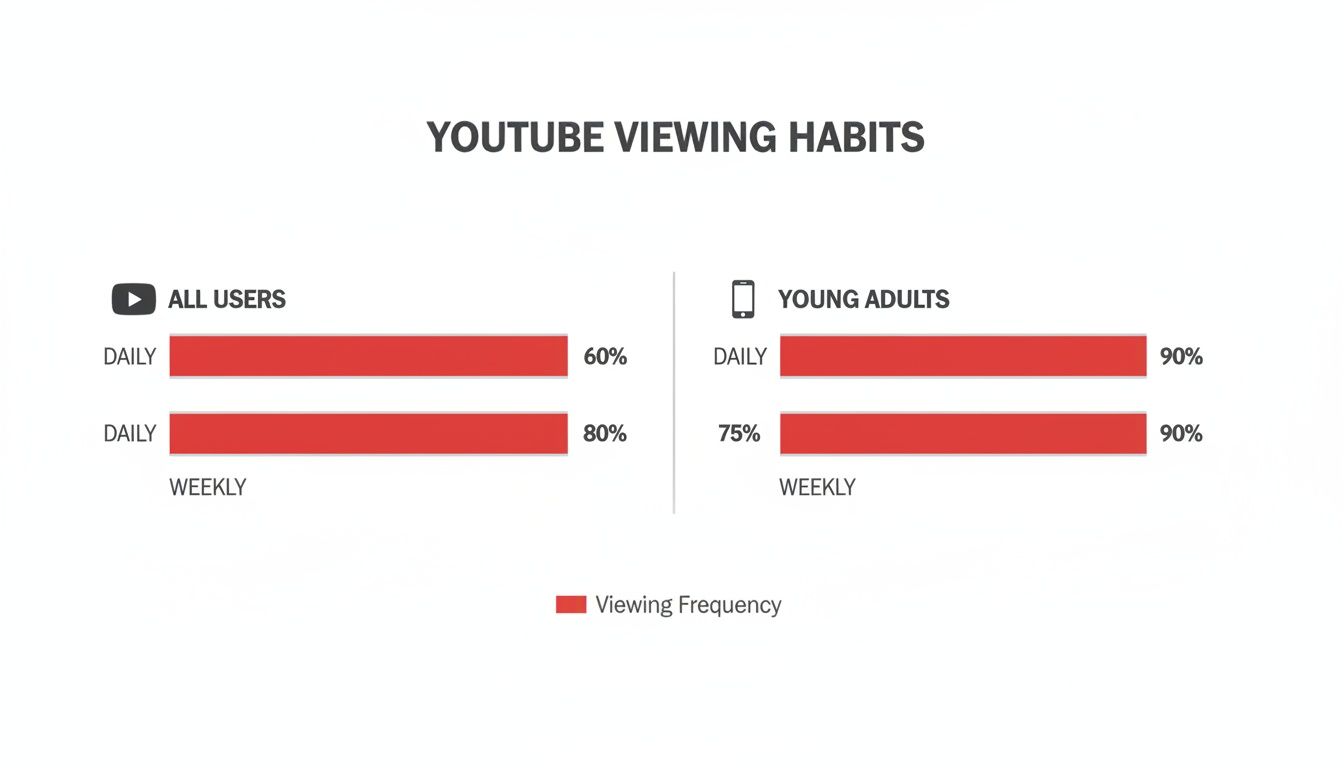
The opportunity is there. Viewers are actively looking for videos every single day. The key is creating content that's worth their time.
Getting a Grip on Your Earnings Metrics
This is where you'll hear creators talk about CPM and RPM. They sound similar, but they tell you two very different things.
-
CPM (Cost Per Mille): Think of this as the "advertiser's price." It’s what companies pay for 1,000 ad impressions on your videos. A high CPM means your audience is a hot commodity.
-
RPM (Revenue Per Mille): This is the number that really matters to you. It’s your actual earnings per 1,000 video views after YouTube takes its 45% cut. This is what lands in your pocket.
Longer videos with great retention are the secret to a higher RPM. When someone watches more of your video, they naturally encounter more of those mid-roll ads. More ad impressions per view drives your RPM up. An engaging 15-minute video can easily have double the RPM of an equally good 7-minute video, purely because it has more chances to make money.
Longer, high-retention videos aren't just a signal to the algorithm; they're a direct instruction to the monetization system to pay you more for every single view.
Of course, you have to get monetized first, and that initial grind can be tough. For those looking to skip the long wait for the YouTube Partner Program, an option like a pre-approved monetized YouTube channel can let you start earning from day one, so you can focus on making that revenue-driving longer content right away.
Video Length and Revenue Potential
Let's break down exactly how video length impacts your ability to earn. The table below shows a clear side-by-side comparison.
| Video Length | Mid-Roll Ads Available? | Ad Placement Control | Potential RPM Impact |
|---|---|---|---|
| Under 8 Mins | No | None (Only pre-roll/post-roll) | Lower. Fewer ad slots mean a hard cap on your earnings per view. |
| Over 8 Mins | Yes | Full (Auto or manual placement) | Higher. Multiple ads can dramatically increase revenue potential. |
The takeaway here is crystal clear. If you're serious about making money on YouTube, aiming for the 8-minute mark should be a core part of your content strategy. By planning your videos to deliver enough value to justify that length, you’re not just making better content—you're building a far more profitable channel.
Finding the Right Video Length for Your Niche
Forget about finding a single "perfect" video length. It just doesn't exist. While the platform-wide averages give you a ballpark figure, the real secret is realizing that the ideal length is all about your niche and what your viewers expect. What crushes it for a gaming channel will completely flop for someone covering financial news.
Making that mental shift from generic advice to a niche-specific strategy is what separates the creators who get stuck from the ones who succeed. You have to match your video's length to what the viewer is trying to accomplish. Someone looking for a quick software tutorial is in a totally different mindset than someone settling in for a deep-dive documentary.
Decoding What Works in Different Niches
Every niche has its own viewing culture. A person's willingness to stick around is directly tied to the value they think they're going to get. This is especially true for faceless and automation channels, where understanding these expectations is how you build a content machine that just stacks up watch time.
Let's break down a few popular niches to see how this plays out:
- Gaming Walkthroughs & Let's Plays (20-40 minutes): Gamers are a different breed; they're committed. They don't just want the highlight reel, they want the full experience. Longer videos let them get completely immersed in a mission or a full gameplay session without feeling like anything was cut out.
- Educational Deep Dives (15-25 minutes): If you're tackling a complex topic—a historical event, a scientific theory, a business strategy—you simply need more time. This length gives you enough runway to explore the subject, build a solid case, and leave the viewer feeling like they truly learned something.
- Ambient & Relaxation Channels (1-10 hours): For content like rain sounds, lofi study beats, or those cozy fireplace loops, longer is always better. The whole point is background immersion. People put these on and let them run for hours while they work, study, or sleep, which can rack up an insane amount of watch time.
This just goes to show how misleading the average YouTube video length can be if you don't look at it through the lens of your specific niche. Your main job is to figure out what your audience actually wants to watch.
The most successful creators aren't following generic advice on video length. They become experts on their own audience, digging into the data to find that sweet spot that keeps people watching and coming back for more.
A Simple Framework for Your Niche Research
To really nail this down, you have to understand how to find your target audience, because their habits dictate everything. Once you know who you’re making videos for, you can start building a strategy based on data, not just feelings.
Here’s a practical, step-by-step way to figure out the best video length for your channel:
- Analyze Your Top Competitors: Find five successful channels in your space. Don't just glance at their sub count; look at their recent videos that are getting a lot of views. What's the average length of their best-performing content? Jot down any patterns you see.
- Study Their Greatest Hits: Head over to their video tabs and sort by "Most Popular." This is a goldmine that shows you their all-time winners. How long are those videos? This data tells you what has historically worked best with the exact audience you're trying to reach.
- Dig Into Your Own Analytics: If you're already publishing, YouTube Studio is your new best friend. Go to Analytics > Content and start living in your Audience Retention graphs. Do people consistently bail at the 6-minute mark on all your 10-minute videos? That’s not a coincidence; it's a signal.
- Test and Measure: Armed with this research, start experimenting. If your competitors are killing it with 18-minute videos, make a few around that length. Then, track their performance like a hawk, paying close attention to Average View Duration and Average Percentage Viewed. See how your audience responds.
When you follow a process like this, you stop guessing. You start making smart decisions backed by actual data from your niche. That’s how you create videos perfectly tuned to hold your audience's attention, which is the key to boosting watch time, satisfying the algorithm, and growing your channel.
How to Maximize Retention on Any Video Length
Here's a hard truth: a 20-minute video that people ditch after two minutes is a channel killer. It's way worse than a tight, seven-minute video they watch from start to finish. The real goal isn't just making longer videos; it's earning every single second of that runtime by keeping your audience hooked. That's the secret to growth.
This all starts before anyone even clicks play and carries through every frame. It doesn't matter what the average YouTube video length is in your niche—your job is to deliver so much value that viewers feel their time was well spent.
Hook Them in the First 15 Seconds
Those first few seconds of your video are everything. This is your one shot to make a powerful promise to the viewer about what’s in it for them. Forget the long, flashy intro sequences or slow, rambling starts.
You have to grab their attention immediately. A few ways to do this:
- Ask a provocative question that piques their curiosity.
- Flash a sneak peek of the incredible final result from the end of the video.
- State a bold claim or call out a common problem you're about to solve.
This hook is like a contract with your audience. It promises a payoff, and the rest of your video needs to deliver on that promise.
Maintain Interest with Pattern Interrupts
Even the most fascinating subject gets boring if the delivery is flat. To fight off viewer fatigue, you need to constantly reset their attention with pattern interrupts. These are just small, intentional changes to what they're seeing or hearing that break the monotony and keep their brains locked in.
Think of them as little surprises sprinkled throughout your video. Simple but super effective pattern interrupts include:
- B-roll Footage: Cut away to relevant clips that show what you're talking about.
- On-Screen Graphics: Use text, icons, or simple animations to emphasize key points.
- Sound Effects: Add subtle "whooshes" or "dings" to accent an action or transition.
- Zooming In or Out: A simple digital zoom creates movement and draws focus.
For faceless and automation channels, this stuff is absolutely critical. A dynamic voice-over, moving text, and a constant stream of fresh visuals are the only way you'll hold on to your audience and keep retention high.
A great video justifies its length by packing every minute with so much value and engagement that the viewer never feels the urge to click away. It’s about respecting their time above all else.
Beyond just the content itself, a professional setup makes a huge difference. For anyone just starting, figuring out the right gear and software is a huge first step. You can find some great guides on optimizing your overall content creation setup that can give you a leg up.
Structure for Success with Chapters
Finally, make your videos easy for people to get around in by using YouTube Chapters. When you break down your content into logical, timestamped sections, viewers can see the entire roadmap at a glance. It lets them jump straight to the parts they care about most.
This simple bit of organization dramatically improves the user experience, especially for longer, more in-depth videos.
By using these strategies, you can turn your videos from something people passively watch into an experience that holds their attention all the way to the end. For more tips on growing and monetizing your channel, check out the articles over on the MonetizedProfiles blog.
Common Questions About YouTube Video Length
When you're trying to figure out your YouTube strategy, it's easy to get bogged down with questions. New creators, in particular, often get stuck on the same handful of things when deciding on the perfect average YouTube video length for their channel.
Let's cut through the noise and get you some quick, practical answers to the questions we see pop up all the time. Think of this as your cheat sheet for making smarter decisions right from the start.
What Is a Good Starting Length for a New Channel?
If you're just starting out, aim for that sweet spot between 8 and 15 minutes. Honestly, it's the perfect training ground. This length forces you to get straight to the point and pack your video with value, which is exactly what you need to do to hook a new audience.
The best part? Hitting that 8-minute mark makes your videos eligible for mid-roll ads as soon as you get monetized. So, you're not just learning to be a better creator; you're setting yourself up for more income down the road. It’s the perfect balance between giving viewers real substance and respecting that they don't know you yet.
Should I Focus on Shorts or Long-Form Videos?
Why choose? The smartest creators use both, but they use them for different jobs. Think of YouTube Shorts as the flashy trailers for your channel. They’re incredible for getting discovered, pulling in new eyeballs, and quickly turning those viewers into subscribers.
Your long-form videos are the main feature. This is where you really connect with your audience, build a loyal community, and, crucially, rack up the watch time that drives most of your ad revenue. A successful channel uses Shorts to get people in the door and long-form content to convince them to stay for the long haul.
A lot of people think it's an either/or situation, but that's a huge misconception. The top channels know that Shorts and long-form videos are a powerful duo—one builds awareness, the other builds authority and income.
How Do I Make Longer Videos Without Sacrificing Quality?
Making a longer video isn't about stretching a five-minute idea thin. Nobody wants to watch that. Instead, it’s about digging deeper and adding more genuine value. Before you even think about hitting record, just ask yourself: "How can I make this even more helpful?"
Here are a few simple ways to add depth:
- Show More Examples: Don't just tell them; show them. Walk through multiple scenarios.
- Cover Common Mistakes: Help your viewers sidestep the frustrations you already went through.
- Add a Q&A Segment: Think about the questions people are likely to have and answer them right in the video.
When you focus on adding more substance, the length takes care of itself. You'll end up with a longer video that people actually want to watch because every minute is justified.
Ready to fast-track your YouTube journey and start earning from day one? MonetizedProfiles specializes in providing fully monetized YouTube accounts, allowing you to skip the grind and focus on creating amazing content. Check out our ready-to-go channels at https://monetizedprofiles.com.


