


Hitting 100,000 subscribers on YouTube is a huge milestone, but what does it actually mean for your wallet? While it's a massive achievement, YouTube doesn't write you a check based on your subscriber count. Instead, a channel of this size can realistically earn between $2,000 to $5,000 per month just from AdSense ads. But that number isn't a given—it all comes down to your video views and how engaged your audience is.
What a 100k Subscriber Channel Actually Earns
Crossing that 100k sub mark is an incredible feeling. You've built a real community, your content has found its footing, and you've earned that coveted silver play button. But when it's time to pay the bills, your subscriber count is more about your potential audience than a direct line to your bank account.
Think of it like this: your subscribers are the people who've RSVP'd to your party. Your video views are the people who actually show up. YouTube pays you for the attendees, not the guest list.
This is a really important distinction to grasp. It’s why one creator with 100,000 subscribers might be pulling in a full-time income while another is barely making a few hundred dollars. The key metric that dictates your AdSense paycheck is your Revenue Per Mille (RPM), which is simply how much you earn for every 1,000 views.

From Subscribers to a Stable Income
So, how do you turn those views into a reliable paycheck? Once you're in the YouTube Partner Program, it's all about consistency. Creators with 100k subs who consistently upload 2-3 videos a week and maintain good viewer retention are the ones who typically land in that $2,000 to $5,000 monthly ad revenue range. For more detail, you can dig into the specifics of how YouTube pays its creators to see what that means for your channel's future.
But remember, this income isn't guaranteed. It's a direct reflection of how well you can keep your audience watching. A handful of key factors can dramatically change what each of those views is actually worth.
Why Your Niche Can Make or Break Your Paycheck
The biggest lever on your earnings is, without a doubt, your channel's niche. Advertisers will pay top dollar to get their products in front of audiences interested in high-value topics. It's a simple matter of supply and demand.
Let’s look at a couple of examples:
- Finance and Tech Channels: These creators attract advertisers selling things like trading software, high-end electronics, or business services. Their RPMs can easily soar to $15-$30 or even higher.
- Gaming and Prank Channels: While these niches can get massive view counts, the ads are often for lower-priced products like mobile games or snacks. This results in a much lower RPM, often sitting in the $2-$6 range.
What this means in practice is that a finance channel could earn ten times more than a gaming channel, even if they have the exact same number of subscribers and views. Understanding this from the get-go helps you set realistic goals and build a content strategy that works for you.
To give you a clearer picture, let's break down how those numbers might look in the real world. The table below shows potential monthly AdSense earnings for a 100k subscriber channel based on different view counts and RPMs.
Estimated Monthly Ad Revenue for a 100k Subscriber Channel
| Monthly Views | Low RPM ($2) | Average RPM ($5) | High RPM ($10) |
|---|---|---|---|
| 250,000 | $500 | $1,250 | $2,500 |
| 500,000 | $1,000 | $2,500 | $5,000 |
| 1,000,000 | $2,000 | $5,000 | $10,000 |
| 2,000,000 | $4,000 | $10,000 | $20,000 |
As you can see, the difference is staggering. A channel getting a million views per month could earn $2,000 or $10,000 from the same amount of work, all depending on the niche and audience. This is why focusing only on subscribers is a mistake—your real goal is to build an engaged audience that advertisers want to reach.
Understanding What You Actually Get Paid: CPM vs. RPM
When you start digging into your YouTube earnings, you'll see two acronyms pop up everywhere: CPM and RPM. They sound almost the same, but they tell completely different stories about your money.
Getting this right is crucial. Think of it like this: CPM is the sticker price of a car, while RPM is the actual amount you drive off with after all the fees and taxes. One looks good on paper, but the other is what hits your bank account.
What is CPM?
CPM means Cost Per Mille (mille is Latin for thousand). In simple terms, this is what advertisers are willing to pay for every 1,000 times their ad is shown on videos like yours. It’s purely an advertiser-facing number.
If a company has a $10 CPM, they're shelling out $10 for every 1,000 ad views. A high CPM is a great signal—it means advertisers see your audience as valuable. But here's the catch: that $10 isn't going directly to you.
Why RPM is the Number You Should Actually Watch
This is where RPM, or Revenue Per Mille, comes in. This is the metric that truly matters to you as a creator. RPM shows your total earnings for every 1,000 video views, and it's calculated after YouTube takes its cut.
The YouTube revenue split is a big part of the equation. For ads run through AdSense, YouTube keeps 45% of the revenue. You, the creator, get the remaining 55%. Your RPM already has this split baked in, so it’s a true measure of what you earn per 1,000 views.
This is exactly why your RPM will almost always be lower than your CPM. CPM is the gross spend from advertisers; RPM is your net take-home pay. If you want to grow your AdSense income, your goal should be to increase your RPM. We share a ton of strategies for this on our creator-focused blog.
Since creators keep 55% of the ad revenue, it means for every $100 an advertiser spends, you get $55. This results in a huge range for RPMs, from as low as $1 to over $10 depending on your niche and audience. For a typical channel, a realistic RPM is often between $3 and $5 per 1,000 views. For a channel with 100k subs, that could translate to a baseline of $2,000-$5,000 a month. You can find more in-depth industry analysis on YouTuber earnings.
Let's break it down with a quick example:
- Scenario: Your video gets 100,000 views, and the advertiser CPM was $12.
- Total Ad Spend: This works out to about $1,200 (100,000 views / 1,000 * $12).
- YouTube's Cut (45%): YouTube takes its share, which is roughly $540.
- Your Share (55%): You're left with about $660.
- Your RPM: To find your RPM, you take your earnings ($660) and divide it by the number of thousands of views (100). This gives you an RPM of $6.60.
See the difference? Even with a strong $12 CPM, your actual pay rate—your RPM—was $6.60. By keeping your eyes on RPM, you get a crystal-clear picture of how your channel is really performing financially.
The Four Factors That Control Your YouTube Paycheck
Ever wondered why two channels, both with 100,000 subscribers, can have wildly different bank balances? It’s not a secret formula. It all boils down to four key factors that directly control your RPM. If you can get a handle on these, you can stop just earning money and start strategically building a more profitable channel.
Think of these variables as dials on your channel's income potential. A small tweak to one can make a huge difference in your monthly AdSense deposit.
Let's break down how the money flows from an advertiser's pocket to yours. This visual shows the basic journey, highlighting the difference between what advertisers pay (CPM) and what you actually see (RPM).
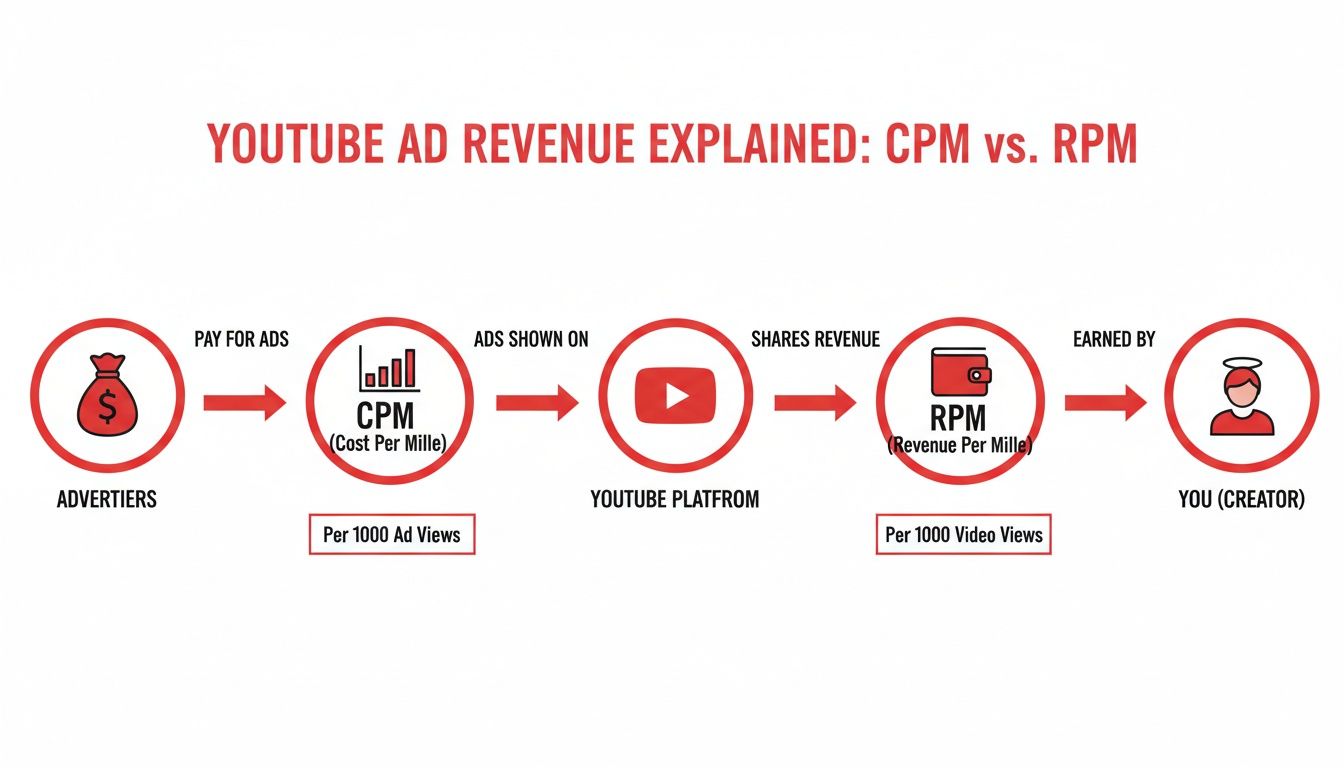
As you can see, you're at the end of a chain that starts with the advertiser. That’s why your final take-home (RPM) is never the same as the initial ad bid (CPM).
Channel Niche: Your Content Category
If there’s one thing that matters more than anything else, it's your channel niche. It's the single biggest driver of your earning potential. Why? Because advertisers will pay a premium to get in front of audiences with specific interests and money to spend.
Someone watching a video on stock investing is a much more valuable lead for a financial services company than someone watching a funny cat video. This creates a clear food chain for ad rates.
- High-RPM Niches: Think personal finance, tech reviews, real estate, and business tutorials. Advertisers in these spaces sell high-ticket products and services, so they bid aggressively. It's not uncommon to see RPMs of $10 to $30+.
- Low-RPM Niches: General vlogging, comedy, and most gaming channels fall here. They can get massive viewership, but the ads are for lower-cost, mass-market products, resulting in RPMs often in the $1 to $5 range.
Audience Geography: Where Your Viewers Live
Not all views are created equal. Where your audience is watching from has a massive impact on what you earn, simply because advertisers budget differently for different countries. An advertiser targeting customers in the United States has a much deeper pocket than one in a smaller, developing market.
Key Takeaway: A single view from an English-speaking, developed country like the United States, United Kingdom, Canada, or Australia can be worth 5 to 10 times more than a view from another region.
This is why a channel with a huge global following might have a surprisingly low RPM. If a big chunk of your audience is in countries where ad spending is low, your average earnings will reflect that.
To give you a clearer picture, here’s how much your niche and your audience’s location can swing your earnings.
How Niche and Geography Impact Your RPM
| Factor | Example | Typical RPM Range | Earning Potential |
|---|---|---|---|
| High-Value Niche, Tier-1 Country | A US-based finance channel | $15 - $40 | Very High |
| High-Value Niche, Tier-2 Country | An Indian finance channel | $5 - $15 | Moderate to High |
| Low-Value Niche, Tier-1 Country | A US-based gaming channel | $2 - $8 | Moderate |
| Low-Value Niche, Tier-2 Country | An Indian gaming channel | $0.50 - $2.50 | Low |
As you can see, the best-case scenario—a high-value topic targeted at an audience in a high-spending country—can earn dramatically more than the opposite.
Video Length and Watch Time
This one is simple: longer videos can fit more ads. Once your video crosses the eight-minute mark, YouTube lets you place mid-roll ads. These are commercial breaks that can run in the middle of your content, not just before it starts.
Mid-rolls are a total game-changer for your revenue. A 10-minute video with a couple of well-placed mid-rolls can easily earn double or triple what a 5-minute video does with the same number of views.
When you combine this with a high watch time (how long people stick around), you send a powerful signal to YouTube that your content is engaging. The algorithm loves this and may reward you with more favorable ad placements.
Ad Types: Your Monetization Choices
Finally, you have direct control over the types of ads that run on your videos, and some pay much better than others.
- Skippable Video Ads: The classic "skip ad" button. You only get paid if someone watches for at least 30 seconds (or the whole thing if it's shorter).
- Non-Skippable Video Ads: These are shorter ads (up to 15 seconds) that viewers have to watch. They usually have higher CPMs.
- Bumper Ads: Quick, 6-second, non-skippable ads. They pay less but are also less disruptive for your audience.
Most top creators just enable everything. This ensures they get as many ad opportunities as possible.
When you put all four of these factors together, the income for a 100k subscriber channel can range anywhere from $1,800 to $13,000 per month just from ads. Channels with a strong US audience often see their CPMs hit $5 to $10, but those top-tier finance and tech creators can pull in rates three times higher. You can dig deeper into these YouTube earning models and how they are projected to work through 2026 to get a better sense of where things are headed.
Growing Your Income Beyond AdSense
Relying solely on YouTube AdSense is like trying to build a house on a single support beam. It might hold up for a while, but it’s a risky setup. Ad revenue is notoriously unpredictable—it can swing wildly based on the time of year, advertiser budgets, or the latest YouTube algorithm tweak.
But here's the good news: a channel with 100,000 subscribers is so much more than an AdSense machine. It’s a powerful asset with a built-in audience that knows you, likes you, and trusts you. They're often ready and willing to support you in other ways.
Diversifying your income streams is how you turn a YouTube hobby into a stable, predictable business. Each new source of revenue acts as a safety net, meaning a bad ad month won’t sink your entire operation.
Secure Sponsorships and Brand Deals
For many creators, sponsorships are where the real money is. At 100k subs, you've built a community that genuinely values your opinion. That trust makes you an incredibly attractive partner for brands trying to reach people in your niche.
Frankly, a single sponsored video can often bring in more cash than an entire month of AdSense.
To get started, pull together a professional media kit. This is just a simple document showing off your channel stats, audience demographics, and any past collaborations. You can then reach out to brands that feel like a natural fit for your content or sign up for influencer marketing platforms to have them come to you. Pro tip: negotiate your rates based on your average views and engagement, not just your subscriber count.
Leverage Affiliate Marketing
Affiliate marketing is probably the most natural way to earn money without making your channel feel like one big commercial. All you're doing is recommending products or services you already use and love. When someone buys through your unique link, you get a small commission.
This could be the camera you film with, the editing software you swear by, or even a book you found helpful. The key to making it work is authenticity. Your audience will see right through a recommendation you don't actually believe in.
- Amazon Associates: This is the easiest place to start. You can earn a commission on almost anything on Amazon, making it super versatile.
- Dedicated Affiliate Programs: Look for companies in your niche that run their own programs. Software, course, and gear companies often offer much higher commissions, sometimes in the 20-50% range.
Drop your affiliate links in your video descriptions, a pinned comment, and maybe even a dedicated page on a personal website. If you want to dive deeper, you can learn all about how to start affiliate marketing with no money and apply those same ideas to your channel.
A channel with a loyal following of 100,000 subscribers has built significant trust. By recommending relevant, high-quality products, you're not just selling—you're providing value to your audience while creating a powerful, passive income stream that works 24/7.
Sell Your Own Merchandise or Digital Products
Nothing brings a community together like a sense of identity, and merch is the perfect way to do that. With an audience of 100,000 people, you definitely have a big enough base to launch your own products successfully.
Services like Fourthwall or Spring (formerly Teespring) make it ridiculously easy to design and sell custom t-shirts, mugs, and hoodies with almost no upfront cost.
But don't stop at physical products. Think about creating digital goods. These are a game-changer because you make them once and can sell them forever.
Consider creating:
- E-books or short guides
- Video editing presets or LUTs
- Online courses or exclusive workshops
- Stock music or footage packs
The profit margins on digital products are massive compared to physical merchandise, making them incredibly scalable.
Activate Channel Memberships and Super Chats
Finally, don't forget about the tools YouTube gives you to let your biggest fans support you directly. These features are designed to turn casual viewers into true patrons of your work.
Channel Memberships let your audience pay a small monthly fee for special perks like custom emojis, badges, or members-only videos. This creates a predictable, recurring revenue stream you can count on.
Super Chats and Super Thanks are ways for viewers to pay to highlight their comments during live streams or in the comment section of your videos. It’s a great way for them to get your attention and show some love. While these features might not become your biggest earners, they provide a consistent and welcome financial boost straight from your most dedicated supporters.
Actionable Strategies to Maximize Your Channel Revenue

Knowing the theory behind your earnings is one thing. Actually putting that knowledge to work to build a profitable channel is another game entirely. Hitting 100,000 subscribers proves you've built a solid foundation; now it’s time to fine-tune your strategy to squeeze more value out of every single view.
This isn't about chasing fleeting trends or overhauling your content. These are practical, targeted tweaks you can make right now to boost your RPM and turn your channel into a well-oiled revenue machine.
Master the Eight-Minute Mark
One of the most direct ways to bump up your AdSense revenue is to make your videos longer than eight minutes. This is the magic number. It unlocks mid-roll ads, which lets you place ad breaks during your video, not just before it.
Think about it: a single 10-minute video with a couple of well-placed mid-rolls can easily earn double or even triple what a seven-minute video does, even with the exact same view count. The trick is to create content that naturally holds attention for that long without feeling padded or boring. Do that, and you'll boost your watch time, too.
Target High-Value Keywords
Advertisers bid on keywords, just like they do in Google Search. When you include high-CPM keywords in your video titles, descriptions, and tags, you're sending a clear signal to YouTube that your content is a great fit for more expensive ads.
Start doing a little research on terms in your niche. If you run a tech channel, keywords like "best budget laptop 2024" or "video editing software review" will almost always attract higher-paying advertisers than a generic title like "New Gadget Unboxing."
By strategically placing relevant, high-value keywords, you’re essentially raising your hand and telling premium advertisers, "My audience is interested in what you're selling." This simple optimization can lead to a noticeable increase in your channel’s average RPM over time.
Of course, this doesn't mean you should stuff keywords where they don't make sense. Authenticity always comes first. But a bit of research before you hit publish can go a very long way. This is a core skill for any creator, whether you're just starting or buying a monetized YouTube channel to get a head start.
Design Content for Higher Watch Time
Above all else, YouTube’s algorithm loves engagement. A high audience retention rate—the percentage of your video people actually watch—is a massive signal that your content is valuable. This not only gets your videos recommended more often but also directly fattens your wallet.
Videos with high retention keep people on the platform longer, which gives YouTube more chances to show them ads. Your job is to create a compelling hook in the first 15-30 seconds, use strong visual storytelling to keep things interesting, and build your video toward a satisfying payoff.
Here are a few simple tactics that work wonders for retention:
- Use Pattern Interrupts: Switch camera angles, drop in some B-roll, or use on-screen text and graphics. Anything to break the monotony and reset the viewer's attention.
- Tell a Story: Even if it's a tutorial, give it a clear beginning, middle, and end. A narrative structure is naturally engaging.
- Tease What’s Coming: Early on, hint at an exciting point you'll be covering later in the video. It gives people a reason to stick around.
Optimize Your Calls to Action
Maximizing revenue isn't just about ads. It's about how effectively you guide viewers to your other income streams. The way you present an affiliate link or mention channel memberships can be the difference between a few random clicks and a serious revenue boost.
Instead of just dropping links in the description and hoping for the best, integrate your call-to-action (CTA) right into the video. Reviewing a camera? Flash some on-screen text with "Link in description" right when you're talking about its best feature. Context is everything.
For channel memberships, sell the value. Show off the exclusive emojis or give a quick peek at a members-only video. Make your audience feel like they're joining a special community, not just handing over money. To get a broader view of your options, it's worth exploring different strategies on how to make money as a content creator.
Got More Questions About Your YouTube Earnings?
Even with the big picture in mind, it’s the little details about YouTube pay that often trip creators up. Hitting that 100,000 subscriber milestone is amazing, but it also brings up a whole new set of questions. Let's tackle some of the most common ones I hear.
Think of this as clearing up the lingering confusion so you can build a solid income strategy for your channel.
Do I Make More Money if a YouTube Premium Subscriber Watches My Video?
You bet. When someone with a YouTube Premium subscription watches your video, you get a cut of their monthly fee. YouTube puts all that subscription money into a big pot and then pays it out to creators based on how much watch time they got from Premium members.
For a lot of channels, a single view from a Premium member is worth way more than a view from someone who just saw an ad. It's a really nice, often overlooked, boost to your total income.
How Much Do YouTube Shorts Pay for 100k Subscribers?
This is where things get really different. YouTube Shorts don't earn money like regular videos. Instead, all the ad revenue from the Shorts feed gets pooled together, and you get a small slice based on your share of the total views. This means the RPM for Shorts is tiny, usually somewhere between $0.03 and $0.07 per 1,000 views.
Takeaway: You could get millions of views on a Short and still only make a fraction of what a single long-form video earns. That's why most creators use Shorts to get discovered and funnel viewers to their main channel, not as a primary way to make money.
If I Upload More Videos, Will I Make More Money?
You can, but it's a double-edged sword. Pumping out more videos means more chances for people to watch and see ads, which can definitely increase your total paycheck. But there's a huge catch.
If you start sacrificing quality just to upload more frequently, your audience retention will drop, and your RPM could take a nosedive. The goal is to find a sustainable rhythm—maybe two or three really good videos a week—that keeps your audience engaged without burning you out. Consistency is key, but quality is king.
Can My Earnings Go Down Even if I’m Gaining Subscribers?
Absolutely, and it happens all the time. Your income isn't tied to your subscriber count; it's tied to your views and your RPM. It’s totally possible to see your subscriber number climb while your bank account shrinks. This usually happens for a few common reasons:
- Your total number of views for the month went down, even though you have more subs.
- You started making videos about a topic with a much lower CPM.
- The majority of your new viewers are from a country with lower ad rates.
This is exactly why you can't rely on AdSense alone. The smartest creators are always thinking about diversifying their income. If you want to see the full picture of how creators earn money on different platforms, check out this excellent guide on how influencers get paid.
Ready to skip the grind and start earning from day one? MonetizedProfiles offers fully approved YouTube accounts that are ready to generate revenue immediately. Check out our selection of monetized channels and fast-track your journey as a content creator.


