


So, you're thinking about buying a social media account. It's a tempting shortcut, right? Instead of grinding for months or years to build a following, you can just buy your way to an already-engaged audience. That's the core idea behind the world of account selling sites.
What's the Deal with Account Selling Sites?
These are essentially online marketplaces where people buy and sell digital real estate—pre-built social media profiles, monetized YouTube channels, or established e-commerce accounts. For a content creator or business, this is all about getting a massive head start. You skip the painful early days of shouting into the void and jump straight to an account with history, followers, and sometimes, even existing revenue.
This isn't some tiny, niche corner of the internet. It's a byproduct of a massive global e-commerce market, which is expected to hit somewhere between $6.4 trillion and $7.4 trillion by 2025. With more than 28 million e-commerce sites out there and new ones popping up constantly, an account with a solid track record is a valuable asset. If you want to see just how big this world is, checking out some recent e-commerce statistics can be a real eye-opener.
Different Kinds of Marketplaces
Not all marketplaces are built the same. Far from it. Knowing where you're shopping is the first and most critical step to avoiding a disaster. They generally break down into two main types.
- Open Forums and General Marketplaces: Think of these as the digital equivalent of a flea market or a sketchy back alley. You'll find accounts for sale in sub-sections of large forums (often related to gaming or marketing) or on generic digital goods sites. There's virtually no oversight, it's all peer-to-peer, and frankly, scams are everywhere. It’s the wild west.
- Curated, Secure Platforms: On the other end of the spectrum, you have specialized providers like MonetizedProfiles. These platforms are built specifically for selling high-value, monetization-ready accounts. They act as a trusted middleman, vetting the accounts, handling payments through secure escrow, and guiding you through the ownership transfer. It's a much safer, more professional environment designed for serious buyers.
To make it even clearer, let's break down the main differences in a quick table.
Marketplace Types at a Glance
This table gives you a quick snapshot of where you might be shopping, highlighting the risks and best-case uses for each type of platform.
| Platform Type | Typical Security Level | Best For | Primary Risk Factor |
|---|---|---|---|
| Curated Providers | High | Serious investors buying high-value, monetized accounts. | Higher initial cost due to vetting and security services. |
| Open Forums | Very Low | Speculative, low-cost account flips (high-risk tolerance needed). | Extremely high prevalence of scams and account pullbacks. |
| General Marketplaces | Low to Medium | Broader variety of accounts, but security is inconsistent. | Misrepresented metrics and lack of seller accountability. |
Knowing these distinctions helps you match your risk tolerance with the right kind of marketplace. For a high-stakes purchase, a curated provider is almost always the smarter play.
The Big Promise and The Hidden Dangers
Let’s be real, the appeal is obvious. Imagine launching your new brand with an audience of 50,000 people from day one. Or starting a YouTube automation project with a channel that’s already approved for monetization. That’s the dream, and it’s what drives this entire market.
But for every success story, there's a cautionary tale. The risks are very real, especially if you venture into those less-reputable forums.
Here’s what can go wrong:
- Straight-Up Scams: You send the money, and the seller vanishes. Poof.
- Account Pullbacks: The seller hands over the account, waits for your payment to clear, and then uses recovery emails or phone numbers to snatch it right back.
- Platform Violations: The account's impressive follower count was built with bots, which is a major violation of the platform's rules. One day, you log in to find the account has been permanently banned.
- Fake Metrics: The numbers look great, but the engagement is fake and the followers are bots. The account is essentially worthless for reaching real people.
The goal here isn't to avoid risk completely—that's impossible. The key is to manage it smartly. You have to go into every potential deal with a healthy dose of skepticism and a plan for doing your homework.
Once you understand the different types of marketplaces and the traps to watch for, you're in a much better position to find a legitimate deal and protect your investment.
Finding and Sourcing Quality Accounts
Knowing where to even start looking for a quality account is half the battle. You’ve got everything from professional services that feel like a real estate agency for digital assets to sketchy, unregulated forums where it's the Wild West. Where you choose to shop will pretty much determine your security, the quality of the account you get, and how well you sleep at night.
The world of account selling sites is massive. At one end, you have dedicated marketplaces and curated providers who vet their listings and offer secure payment. At the other, you've got open social media groups and forums where every transaction is a gamble, leaving you wide open to scams.
The Good, The Bad, and The Ugly of Sourcing Channels
You have to know the pros and cons of each place you look. A private broker might have access to incredible, high-value accounts, but they'll charge a hefty fee. A public forum, on the other hand, could have a diamond in the rough for cheap, but you'll have to dig through a mountain of fraudulent listings to find it.
-
Curated Marketplaces: These are usually your safest bet. Their entire business model is built on trust and security. You'll want to look for platforms that proudly advertise their use of an escrow service—this is an absolute must. They hold your money safely until you've confirmed you have complete control of the account.
-
Private Brokers: If you're looking to make a serious investment (we're talking six-figure YouTube channels), a good broker can be a game-changer. They often know about accounts that aren't even publicly listed and can handle tricky negotiations. The catch? You have to vet the broker just as thoroughly as you would the account.
-
Social Media and Forums: Welcome to the high-risk zone. Yes, you can find deals here, but this is also where most "pullback" scams and horror stories originate. If you decide to venture here, only deal with sellers who have a long, verifiable track record and insist on using a well-known, independent escrow service.
My Two Cents: The single most critical piece of this puzzle is the mandatory use of a trusted, third-party escrow service. If any seller or platform tries to talk you out of it, that's your cue to walk away. No exceptions. It’s a massive red flag.
How to Spot a Credible Seller from a Mile Away
Once you've picked a place to shop, it's time to vet the sellers. A legit seller operates with transparency. They have a history of positive transactions, their listings are detailed, their communication is professional, and they don't rush you when you ask for verification.
Scammers, on the other hand, thrive on creating a false sense of urgency. They'll give you vague answers, get annoyed with your questions, and push back on basic due diligence, like refusing a quick screen-share to verify analytics.
Here’s a quick cheat sheet for sizing up a listing on the fly:
| Promising Listing Signs | Red Flag Listing Signs |
|---|---|
| Detailed description with clear stats | Vague or "too good to be true" claims |
| High-quality, recent screenshots of analytics | Outdated or blurry screenshots |
| Positive, verifiable transaction history/reviews | No history or generic, unverified reviews |
| Willingness to use a reputable escrow service | Pushing for direct payment (crypto, PayPal F&F) |
| Clear and professional communication | Evasive answers and high-pressure tactics |
This initial filtering process will save you a ton of time and keep you from even starting a conversation with the wrong people.
If all that sourcing and vetting sounds like too much of a headache, you're not alone. For creators focused on YouTube, providers like MonetizedProfiles offer a much simpler path. They do all the hard work for you, offering pre-vetted, monetization-approved YouTube channels that are ready to go. It essentially combines the sourcing and vetting into one secure, straightforward purchase.
Your Pre-Purchase Due Diligence Checklist
So, you've found a promising account and the seller seems legit. Now for the most important part. Never, ever take a seller's word at face value. The numbers they show you in screenshots? They can be faked in minutes. What looks like a buzzing community could actually be a digital ghost town propped up by bots.
This is your money on the line. You need to treat this next phase like a forensic investigation.
Think of it this way: you wouldn't buy a house without getting an inspection. This checklist is your inspection. Following it will help you spot the hidden problems and walk away from a bad deal before you lose a dime.
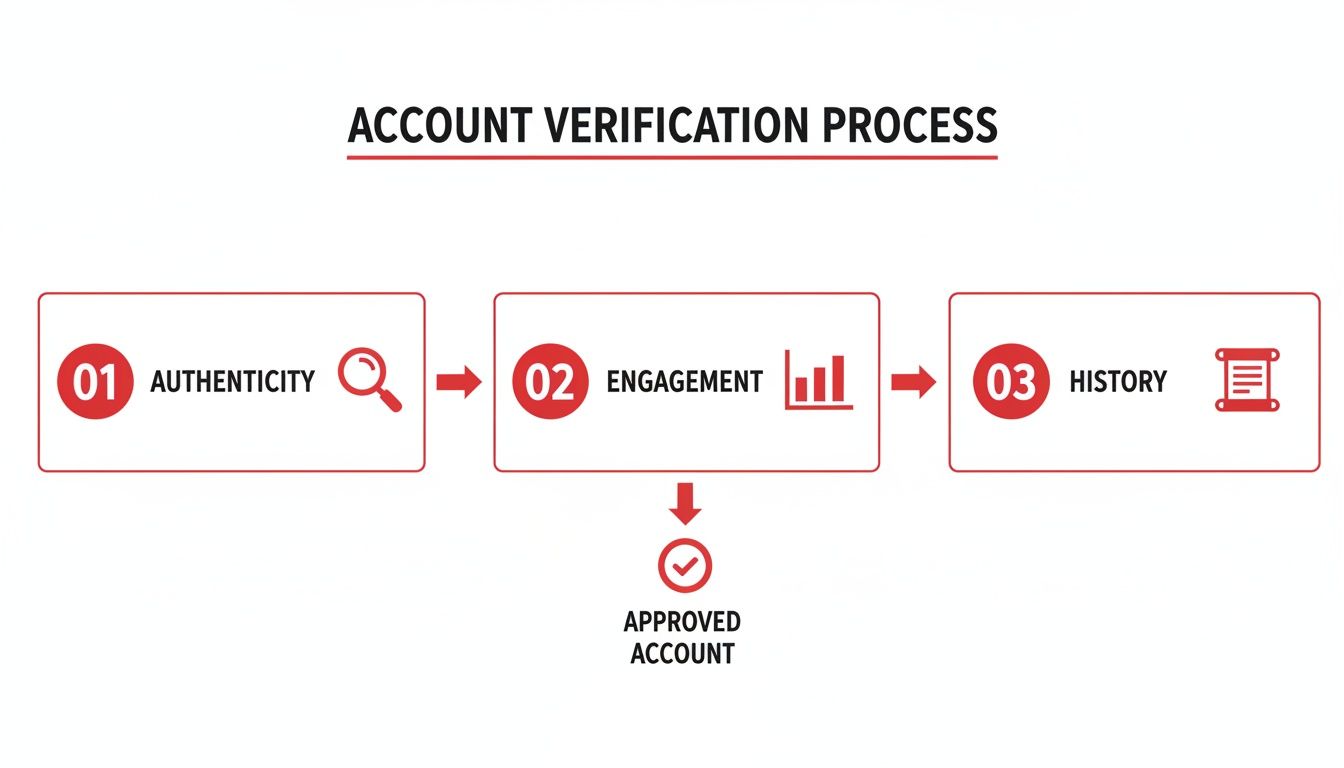
Verifying Follower Authenticity and Engagement
First things first, let's look at the audience. A huge follower count is completely meaningless if those followers aren't real, breathing humans. On shady marketplaces, it's common for sellers to inflate their numbers with bots to make an account look way more valuable than it is.
Your job is to find the signs of genuine human interaction.
- Check the Follower-to-Engagement Ratio: See a channel with 100,000 subscribers but only 50 likes and maybe 2 comments per video? That’s a massive red flag. Healthy, real accounts have a consistent and believable ratio of viewers to people actually engaging with the content.
- Snoop Through the Comments: Are the comments all generic junk like "Great video!" or "Nice post!" spammed by different users? Or are they specific, thoughtful, and conversational? Bots leave shallow, repetitive comments. Real people ask questions, share opinions, and start conversations.
- Spot-Check Follower Profiles: This one only takes a few minutes. Click on a handful of random follower profiles. Look for the classic signs of a fake account: no profile picture, a jumble of numbers in the username, zero posts, and following thousands of accounts while having almost no followers of their own.
A truly valuable account isn't about the follower count. It’s about the quality and responsiveness of the audience. I'd take a smaller, highly engaged community over a massive, silent one any day of the week.
Digging into the Account's History and Health
Every social media account has a history, and sometimes that history includes warnings, copyright strikes, or even shadowbans that a seller might "forget" to mention. You have to uncover these issues to make sure you're not buying a damaged asset.
The big one is the account's official standing with the platform. For a YouTube channel, for instance, you have to verify its status in the YouTube Partner Program (YPP). Don't accept a screenshot. Ask for a live screen share where the seller walks you through the "Earn" tab in their YouTube Studio. It’s the only foolproof way to confirm it's monetized and has a clean record.
As you look at different places to buy accounts, a little understanding third-party risk management can go a long way in protecting yourself.
Confirming Monetization and Revenue Claims
The social commerce market is huge—we're talking an estimated $1.17–$3.57 trillion in recent years. With that much money at stake, you absolutely have to verify any and all revenue claims.
Again, static images of earnings reports are a no-go. You need to insist on a live, screen-shared tour of the monetization dashboards, whether it's YouTube Studio, the TikTok Creator Fund, or an Amazon Associates account. While you're on the call, ask the seller to refresh the page and change the date ranges right in front of you. This proves the data is live, not a cleverly edited picture.
Here’s what you should be looking for during that live verification call:
- Consistent Earnings: You want to see stable or growing revenue. Huge, random spikes followed by dead flatlines can be a sign of paid, inorganic traffic or a one-hit-wonder viral video that doesn't reflect the account's real earning power.
- Revenue Sources: Pinpoint where the money is actually coming from. Is it ad revenue? Brand deals? Affiliate sales? Knowing this helps you figure out if the income is sustainable and if it even fits with what you want to do.
- Audience Demographics: Pay close attention to the analytics that show the audience's age, gender, and location. If your goal is to sell a product to an American audience, an account with 90% of its followers in India isn't the right fit, no matter how good the price is.
This whole process might feel a bit tedious, but it's the single most important part of buying an account. It's what separates a smart investment from a very expensive mistake. For extra peace of mind, working with providers that have clear standards and guarantees can make all the difference. It's always a good idea to check out the fine print beforehand, which is why we're transparent about our own commitment in the MonetizedProfiles refund policy.
Making the Purchase Without Getting Burned
You've done your homework, vetted an account, and agreed on a price. Now comes the moment of truth: the transaction. This is where most deals go sideways, but a smart, structured approach will protect you from the vast majority of scams.
First thing's first: forget about direct payments. If a seller asks for PayPal Friends & Family, a crypto transfer, or a wire, it's a giant red flag. Those methods offer zero buyer protection, and once your money is gone, it’s gone for good.
Your Best Friend: The Escrow Service
The entire deal should live or die by one simple rule: use an escrow service.
Think of escrow as a neutral third party holding the cash. You send the payment to them, and they lock it away safely. The seller can see the money is secured, which gives them the confidence to hand over the account details.
Only after you’ve gained access, changed all the passwords, and confirmed everything is exactly as promised do you give the escrow service the green light. They then release the funds to the seller. It’s the single best way to protect both of you. If a seller refuses to use a reputable escrow service, walk away. No exceptions.
Taking Full Control and Locking the Seller Out
Once the escrow is funded and you have the login details, the clock starts ticking. Your goal is to completely and irreversibly lock the original owner out. This prevents a common scam called a "pullback," where the seller reclaims the account right after you've released the payment.
You need to move quickly and methodically. The table below outlines the exact steps to take to secure your new account.
Secure Account Transfer Protocol
This checklist ensures you sever all ties the original owner has to the account, making it fully yours. Follow these steps immediately after the seller provides the initial login credentials.
| Step | Action Required | Purpose |
|---|---|---|
| 1. Change the Email | Swap the account's registered email to one that you exclusively control. | This is the primary key to the account; changing it is your most important move. |
| 2. Update the Password | Create a long, complex, and unique password. | Prevents the seller from simply logging back in with the old credentials. |
| 3. Secure Recovery | Change all recovery phone numbers and backup emails to your own. | Eliminates the seller's ability to use "Forgot Password" to regain access. |
| 4. Enable 2FA | Set up Two-Factor Authentication linked to your personal device. | Adds a critical security layer that makes unauthorized logins nearly impossible. |
| 5. Review App Access | Go to settings and revoke access for any unrecognized third-party apps. | Closes potential backdoors that could be used to manipulate the account. |
Once every item on this checklist is complete, you can confidently log back into the escrow service and approve the payment release.
The rise of the account-flipping market has, unfortunately, brought a surge in fraud. Recent e-commerce security trends and statistics on SellersCommerce.com highlight how account takeovers are a major issue, which is why a strict security protocol isn't just a suggestion—it's essential.
Every platform has its own set of rules, and understanding them is part of your due diligence. For a good example of how professional providers handle this, check out the MonetizedProfiles terms of service to see how responsibilities are clearly defined.
What to Do Immediately After You Buy an Account
Alright, you’ve got the login details. Don't pop the champagne just yet—this is where the real work begins. The first 24 to 72 hours after you get access are make-or-break. If you rush in and start changing everything at once, you'll trip every security wire the platform has, and you could get the account locked or even banned.
Think of it like this: you've just been handed the keys to a new house. You wouldn't immediately start knocking down walls and repainting everything, would you? You’d spend a little time getting a feel for the place. The same principle applies here. You need to ease into ownership so the platform's algorithms don't think you're a hacker who just stole the account.
The "Slow and Steady" Takeover
Changing the email, password, profile picture, and bio all in the same hour is the digital equivalent of a blaring alarm bell. Platforms like YouTube and Instagram are built to detect that exact pattern. Your job is to make the transition feel natural by "warming up" the account to its new owner—you.
It’s all about showing legitimate activity over time. In fact, knowing how to properly warm up a new YouTube account is a crucial skill that prevents suspensions and is a must-read for any new owner. The goal is to look like a legitimate change of hands, not a hostile takeover.
Here's a rough game plan for your first week:
- Day 1: Just log in. Seriously, that's it. Use your main device, browse around, watch a few videos, or like a few posts. Let the platform get used to seeing a new IP address and device associated with the account. Don't change a thing.
- Days 2-3: Make one tiny, non-critical change. Maybe you tweak the bio slightly or add a link. Steer clear of any core security settings.
- Days 4-5: Now you can do something a bit more noticeable, like swapping out the profile picture or banner to match your brand.
- Days 6-7: It's finally time. You can now start changing the recovery email and phone number. Do them one at a time, and wait at least 24 hours between each change.
The single biggest mistake I see buyers make is rushing the security updates. Be patient for that first week. It’s your best insurance policy against an automated account suspension.
Staying Compliant and Switching Monetization
While you're slowly taking over, you need to get smart about the platform's rules. Let's be honest—buying and selling accounts is a gray area in most Terms of Service. While it's a common practice on many account selling sites, platforms don't officially approve of it. The key is to fly under the radar and not do anything that would trigger a manual review.
One of the most delicate post-purchase tasks is updating the monetization details. For a YouTube channel, for instance, you have to disconnect the seller's AdSense account and link your own. This has to be done perfectly.
Your AdSense Transition Checklist
Follow these steps to move the revenue stream over to you without causing any issues.
- Get Your AdSense Ready: Make sure your own AdSense account is fully approved and in good standing before you even think about linking it. If it's new or unverified, you could be in for weeks of headaches and lost revenue.
- Coordinate the Handoff: The seller has to be the one to disconnect their AdSense from the channel. They'll do this from the "Earn" tab in YouTube Studio. You can't do this step for them.
- Wait for the "All Clear": Don't do anything until you see the status update in YouTube Studio confirming that no AdSense account is linked. This can take a few hours to update, so be patient.
- Link Your Account: Once it's disconnected, you can go into the "Earn" tab and follow the prompts to link your own approved AdSense account.
- Verify and Watch: It can take up to 48 hours for the new connection to register fully. Keep a close eye on the "Earn" tab to make sure monetization stays green and your AdSense ID shows up correctly.
By taking this careful, step-by-step approach, you'll properly secure your new asset, avoid algorithmic red flags, and ensure the money starts flowing to you without a hitch.
Your Top Questions About Buying Accounts, Answered
If you're new to the world of buying and selling social media accounts, you probably have a lot of questions. That’s a good thing. It’s smart to get the lay of the land before you jump in. Let's walk through some of the most common concerns I hear from buyers.
Is It Actually Legal to Buy a Social Media Account?
This is the big one, and the answer isn't a simple yes or no. In a legal sense, as in, will you go to jail? No. Buying an account isn't a criminal act.
However, it almost certainly breaks the Terms of Service (ToS) of whatever platform you're on, whether that’s YouTube, TikTok, or Instagram. This is the real risk. The platform can, and often will, suspend or just outright terminate an account if they find out it's been sold. There's no way around this risk entirely, but you can manage it with smart handling after the purchase.
What's the Safest Way to Pay?
There's only one right answer here: a trusted third-party escrow service. End of story.
Don't ever let a seller talk you into paying them directly through a wire transfer, crypto, or even something like PayPal Friends & Family. Those methods leave you with absolutely no recourse if things go south. An escrow service is the industry standard for a reason—it protects everyone involved.
Here’s how it works:
- You pay the escrow company, not the seller. They hold your money safely.
- The seller sees the funds are secured and hands over the account details to you.
- You get in, change everything over, and confirm you have full control.
- Only then do you tell the escrow service to release the payment to the seller.
If a seller pushes back on using escrow, walk away. It's a massive red flag and a classic sign of a potential scam.
What if the Seller Tries to Take the Account Back?
This is a very real scam known as a "pullback," and it’s a huge problem on sketchy marketplaces. The original owner waits for you to pay, then uses their old recovery information to reclaim the account, leaving you with nothing.
Your best defense is to be fast and thorough the second you get access. A pullback only works if the seller has a backdoor to get back in. Your job is to lock every single one of them down immediately.
This means changing the primary email, the password, all recovery phone numbers, and any backup emails. The final step—and this is non-negotiable—is setting up Two-Factor Authentication (2FA) that is linked only to your device. Once you control every possible recovery path, it’s practically impossible for them to snatch it back.
Can I Change the Account's Niche?
Absolutely, but you have to be strategic about it. A sudden, jarring change is the worst thing you can do. If you buy a popular cat meme account and suddenly start posting about cryptocurrency trading, you're going to have a bad time.
An abrupt shift will confuse and alienate the existing audience, leading to a huge drop in engagement and a flood of unfollows. More importantly, it can raise a red flag for the platform's algorithm, which might see the sudden change as suspicious activity and suspend the account for a review.
The smart play is to transition slowly. Gradually introduce your new content over several weeks or months. Blend it with the old style, then slowly phase the old stuff out. This gives the audience time to adjust and keeps your account in good standing.
Navigating all these details can feel overwhelming, but you don't have to go it alone. At MonetizedProfiles, we handle all the vetting and security for you. We offer fully monetized, secure accounts so you can skip the guesswork and risk. Check out our available profiles at https://monetizedprofiles.com and start with confidence.


