


So, what's the magic number for YouTube video length? The short answer is: it depends entirely on your format and your goals. But generally, Shorts should stay under 60 seconds, standard videos hit a sweet spot between 6–12 minutes, and deep dives can go for 20–30+ minutes to really pull viewers in and boost your earnings.
Your Quick Guide to Ideal Video Lengths
Think of video length like a toolbox—you need the right tool for the job. You wouldn't use a sledgehammer to hang a picture frame, right? Same idea here. Each format on YouTube serves a different purpose, and matching your content to the right length is crucial for keeping your audience hooked.
Here's a quick breakdown to help you pick the right duration for your next video:
- Shorts (Under 60 seconds): These are designed for quick, punchy content. Their goal is to grab attention fast and get people to hit that replay button.
- Standard Videos (6–12 minutes): This is the sweet spot for many creators. It's long enough to build a connection and fit in a few ad breaks, but short enough to hold a viewer's attention without them getting bored.
- Long-Form Videos (20–30+ minutes): Perfect for documentaries, deep tutorials, or detailed storytelling. Longer videos are a goldmine for increasing total watch time, which the YouTube algorithm absolutely loves.
- Livestreams (30–90 minutes): The focus here is all about real-time engagement. Livestreams build a strong sense of community and keep your most dedicated fans coming back for more.
To make it even clearer, I've put together a simple table you can reference anytime.
Optimal YouTube Video Lengths by Format
This table gives you a quick reference for the recommended video lengths for different YouTube formats and highlights why each one works.
| Format | Recommended Length | Key Benefit |
|---|---|---|
| Shorts | Under 60 seconds | Immediate hook and high replay value |
| Standard Videos | 6–12 minutes | Balances ad revenue with viewer retention |
| Long-Form | 20–30+ minutes | Drives deep engagement and session watch time |
| Livestreams | 30–90 minutes | Fosters direct audience interaction and loyalty |
Sticking to these guidelines helps you meet viewer expectations for each format, which is a huge step toward building a loyal audience.
As you can see from the data below, there's a clear connection between how long a video is and how long people actually stick around to watch it.

This graph really drives home the point that videos in that 5–15 minute range often hit the sweet spot for average watch time.
Matching your content to the right duration is like picking the perfect gear on a bike: the right one makes the ride smooth and efficient, while the wrong one makes it an uphill battle.
How to Find Your Channel's Perfect Length
So, how do you put this into practice? These aren't hard-and-fast rules, but rather a starting point. Your own audience will tell you what works best.
- Dive into your analytics. Look at your past videos and pinpoint where viewers tend to drop off. Is there a consistent pattern?
- Run some tests. Create two videos on a similar topic but with different lengths. Then, head over to YouTube Analytics and compare the audience retention graphs side-by-side.
- Be ruthless with your script. Before you even hit record, comb through your script and cut out any fluff. Every sentence should serve a purpose to keep the story moving.
The key is to experiment, pay close attention to your data, and adjust your strategy over time. What works today might need a tweak in six months.
Think of it like tailoring a suit—a perfect fit makes a world of difference. Start by testing the waters with a single video, and once you find a length that consistently resonates with your viewers, you can confidently scale up your production.
Why Does Video Length Actually Matter?
So, why are we even talking about how long your videos should be? It’s not about pulling a random number out of a hat. Getting the length right means you’re speaking the YouTube algorithm's language. Think of it like a conversation: a quick, witty comment gets a laugh, but a longer, captivating story builds a real connection with your audience.
The length of your video sends a powerful signal to YouTube about the value you're delivering. When you can hold someone's attention for a longer period, you're telling the algorithm that your content is top-notch and keeps people on the platform. This is where two crucial metrics, Watch Time and Audience Retention, come into play. They’re the bedrock of your channel’s growth.
The Link Between Length and Watch Time
Let's break down Watch Time. It's simply the total amount of time people have spent watching your videos. For YouTube, this is one of its most important ranking factors. Why? Because YouTube’s goal is to keep people on the site as long as possible. Content that helps them do that gets a massive boost.
Naturally, a longer video has the potential to rack up more watch time from a single viewer. Imagine someone watches 50% of your video. If it’s a 4-minute video, that’s 2 minutes of watch time. But if it’s a 12-minute video, that’s 6 minutes of watch time. Suddenly, that one view is three times more valuable to the algorithm.
But here’s the catch: you can't just drag out your videos for the sake of it. The real magic is in Audience Retention—the percentage of your video that people actually watch. A long, rambling video that people ditch after 30 seconds will hurt your channel far more than a short, punchy one they watch from start to finish.
Your goal isn't just to make longer videos. It's to make content so good that viewers want to stick around for the whole thing. High retention on a longer video is the ultimate green light for the YouTube algorithm.
This isn’t just a theory, either. We’ve seen a clear shift towards more substantial content over the years. Back in 2019, trending videos on YouTube were already 9.5 times longer than they were in 2010. Today, the average video length sits somewhere between 11.7 and 12.26 minutes, which points to a huge move toward more in-depth content. You can dive deeper into these trends by exploring the latest YouTube statistics.
How Length Affects Your Ad Revenue
Video length is also directly tied to your wallet. For anyone in the YouTube Partner Program, the eight-minute mark is a game-changer. Once your video crosses that threshold, you unlock the ability to place mid-roll ads.
Mid-rolls are ads that pop up in the middle of your video, not just before or after. This opens up way more ad slots in a single video, which can seriously increase your AdSense revenue.
Here’s a simple breakdown of how it works:
- Under 8 Minutes: You’re stuck with pre-roll ads (before the video) and post-roll ads (after). Your earning potential is limited to just those two spots.
- 8 Minutes or More: You can now place mid-roll ads. You can either let YouTube place them for you automatically or you can manually pick spots where they feel most natural and less disruptive.
This is exactly why you see so many creators pushing their videos to be just over eight minutes long. It’s a smart, calculated move that balances providing a good experience for the viewer with the financial reality of being a creator. A well-placed mid-roll ad in a genuinely helpful 10-minute video is a win-win: your audience gets what they came for, and you get paid for your effort.
Matching Your Video Length to Your Format
Let’s be real: there’s no single magic number for the perfect YouTube video length. A 30-minute deep dive would be a total disaster as a Short, and a 60-second clip isn't going to cut it for someone who wants a detailed tutorial.
Think of it like a chef choosing the right cooking method. You wouldn't try to slow-cook a steak in 60 seconds. Matching your video's duration to its format is the first step toward making something your audience will actually want to watch.
Each format on YouTube has its own unwritten rules and audience expectations. People scrolling through Shorts want a quick hit of dopamine, not a lecture. On the flip side, someone searching for a detailed product review expects you to get into the nitty-gritty, not just skim the surface. Get this alignment right, and you're already on the path to growth.
The Under 60-Second Sprint: Shorts
YouTube Shorts are all about hitting hard and fast. These vertical videos are built for the endless scroll, so you're fighting for a split-second of attention. Your only job is to deliver maximum impact in minimum time.
For Shorts, you're aiming for that sweet spot between 15 and 60 seconds. This tight window forces you to be ruthless with your editing and laser-focused on one single, powerful idea.
- 15-30 Seconds: This is perfect for viral dance trends, lightning-fast tips, funny skits, or one mind-blowing fact. This length is incredibly replayable, and a high replay rate is a massive green light for the YouTube algorithm.
- 30-60 Seconds: Got a slightly more complex story to tell? This is your zone. It’s just enough time for a mini-tutorial, a quick before-and-after, or a tiny story with a clear beginning, middle, and end.
With Shorts, your goal isn't just to get a view—it's to get a re-view. If your video is so good that someone watches it two or three times, YouTube will take notice and push it out to more people.
Keep in mind, making money from Shorts is a different ballgame than with longer videos. It’s based on a creator fund, not the ads you're used to. To get the full scoop, check out our guide on how to monetize YouTube Shorts for a proper breakdown.
The 8 to 15-Minute Sweet Spot: Standard Videos
This is the bread and butter for most channels. Videos in the 8 to 15-minute range hit that perfect balance between giving your audience real value and not asking for a huge time commitment. A new viewer is far more likely to click on a 10-minute video than a 45-minute one.
This length gives you enough runway to really dig into a topic, tell a great story, or just connect with your audience on a deeper level. Most importantly, it gets you over the magic 8-minute mark that allows you to place mid-roll ads, which can seriously boost your revenue.
Here are a few formats that absolutely kill it in this time frame:
- Top 5 or Top 10 Lists: These are great because they have a built-in structure that keeps people hooked, waiting to see what’s next on the list.
- How-To Guides: It's plenty of time to walk someone through a process step-by-step without making them feel rushed or overwhelmed.
- Commentary and Opinion Videos: You have the space to build your argument, back it up with a few points, and wrap it all up with a strong conclusion.
- Product Reviews: This length lets you unbox, show off the features, talk about the good and the bad, and give your final verdict.
Think of this length as the perfect TV episode. It’s long enough to feel satisfying but short enough to leave your audience wanting more.
The 20-Minute+ Deep Dive: Long-Form Content
If you want to position yourself as the go-to expert in your niche and rack up serious watch time, long-form content is your best friend. Videos that push past the 20-minute mark are perfect for those big, complex topics that just can't be rushed.
These videos aren't for the casual scroller. You're creating content for a dedicated audience that is actively looking for a deep, comprehensive answer. It’s a bigger ask of your viewer, but the reward is huge. Getting high audience retention on a long video tells the YouTube algorithm that your content is pure gold.
This format is a natural fit for things like:
- Documentaries: Taking a deep dive into a historical event, a scientific discovery, or a cultural trend.
- Full Tutorials and Masterclasses: Teaching a complex skill from A to Z.
- Video Podcasts and Interviews: Having long, in-depth conversations where you can really explore different ideas.
- Gaming Walkthroughs: Guiding players through an entire level or section of a game in detail.
These same principles apply outside of YouTube, too. For example, the strategies used in creating and selling online courses often involve breaking down huge topics into smaller, more manageable video lessons—a technique that works wonders for structuring long-form YouTube content. The key is to add chapters or timestamps to help viewers navigate easily and find exactly what they're looking for.
Using Analytics To Find Your Perfect Length
Guesswork is tempting, but your channel already holds the clues. Think of YouTube Analytics as a treasure map: instead of gold, it points to the exact video length your audience craves.
At the heart of that map is the Audience Retention graph—a simple line chart that reveals, second by second, how many viewers stick around. It’s like peeking over your viewers’ shoulders to see exactly where they click away or lean in.
Decoding Your Audience Retention Graph
When you dive into retention data, look for recurring patterns. Do half your viewers bail in the first 30 seconds? That’s a clear signal to sharpen your introduction. Notice a dip at the 12-minute mark? Scrub to that timestamp and pinpoint what’s losing attention—maybe a slow segment or a heavy-handed transition.
Pay attention to:
- A Gradual Slope: A gentle decline shows you’re keeping people engaged throughout.
- Sharp Dips: These red flags highlight moments where interest plummets.
- Spikes or Bumps: If parts of your video get re-watched, you’ve struck pure gold—those are your most compelling moments.
By comparing these graphs across several uploads, you’ll spot your personal sweet spot. Perhaps viewers stay strong for about 10 minutes before fading out. That window becomes your target.
Your audience retention graph doesn’t lie. It’s unfiltered feedback showing exactly when viewers start to drift. Use it to refine your strengths and fix your weak points.
Testing And Comparing Different Lengths
Armed with retention insights, set up a simple experiment:
- Produce Paired Videos: Create two videos on a similar topic—one at 8 minutes, another at 15 minutes.
- Keep Everything Else Consistent: Use matching titles, thumbnails, and promotion methods so length is the only variable.
- Analyze The Results: After a week, compare Average View Duration alongside retention curves. A shorter video with a stronger finish can rack up more total watch time than a longer one viewers abandon early.
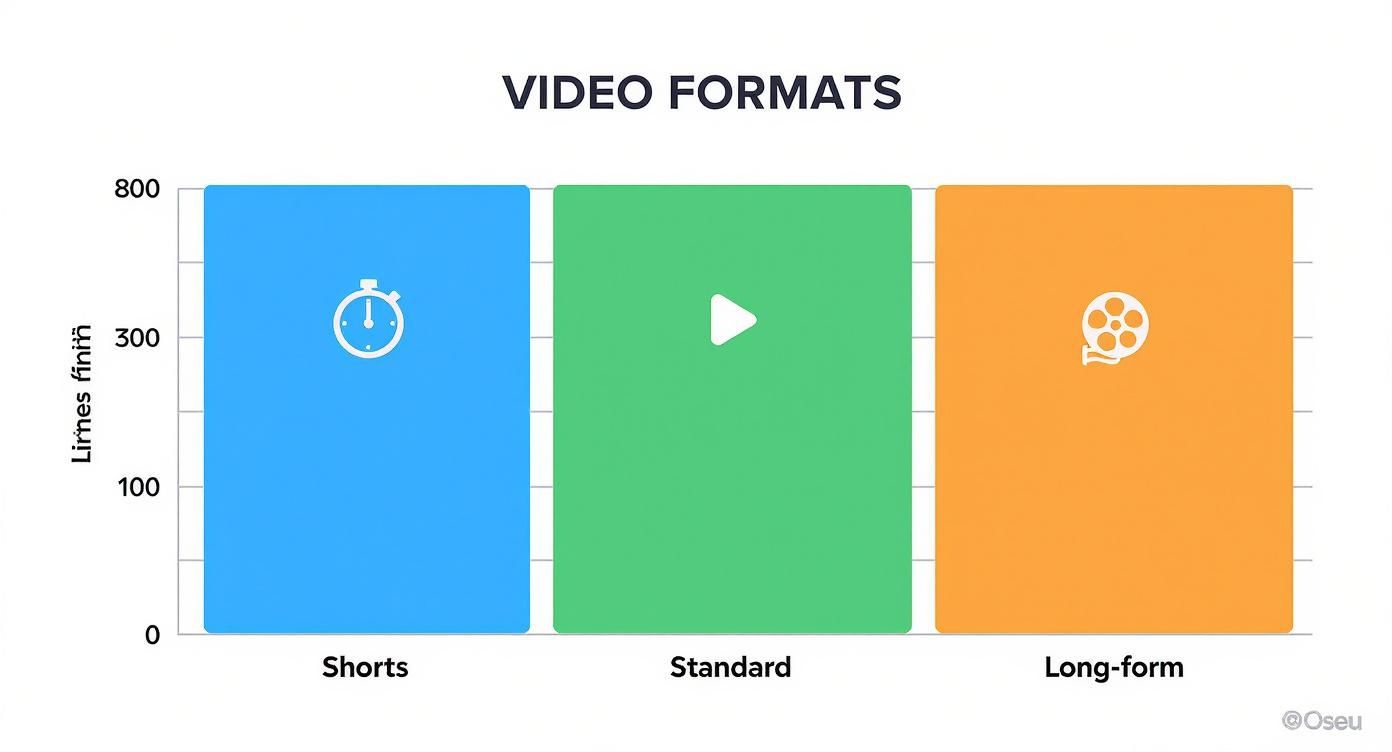
This chart reminds us that Shorts deliver quick engagement, 6–12 minute pieces hit a balance, and 20–30+ minute or livestream formats invite deeper dives. Testing shows which format resonates with your niche.
How Video Length Affects Viewer Retention
Below is a breakdown of average viewer retention and play rates across different video length categories to inform your content strategy.
| Video Length Range | Viewer Retention Rate | Play Rate |
|---|---|---|
| Under 1 Minute (Shorts) | 60% | 85% |
| 5–15 Minutes | 50% | 70% |
| 20–30 Minutes | 45% | 60% |
| Over 60 Minutes (Long-Form/Livestreams) | 40% | 58% |
Use this snapshot to guide your next uploads. Match your topic to the length that keeps viewers clicking “Next.”
In practice, many creators find 5–15 minute videos deliver the best blend of watch time and ad revenue. Still, a well-structured livestream or long-form edit can hold a dedicated audience for over 60 minutes when the value stays high.
To dive deeper into advanced metrics and automate your analysis, check out some of the top YouTube analytics tools for channel growth in 2025. With data in hand, you’ll confidently move from guessing at your ideal length to knowing exactly what your viewers want.
Simple Tricks to Boost Watch Time

You don’t need a massive production budget to get people to actually watch your videos. Often, the biggest gains in watch time come from small, clever tweaks that make a world of difference. These are the kinds of tricks that help you keep people engaged without having to completely reinvent your content strategy.
Those first 15 seconds are everything. That’s your window to either hook someone or lose them for good. You need to open with a bang—a bold claim, a fascinating question, or even a quick flash of the most exciting part of the video. Give them a reason to stick around right from the jump.
Think of your intro as the trailer for your video. It needs to sell the value proposition immediately: what will they get out of this? A slow, rambling start is the fastest way to kill your audience retention.
Master Your Pacing and Structure
Okay, so you’ve got their attention. Now you have to keep it. The secret here is pacing. Even in a 20-minute deep dive, the energy can't be allowed to dip. A few simple techniques can keep your viewer’s brain active and wondering what’s coming next.
Break up the monotony. Mix your standard talking-head shots with B-roll, on-screen text, or even basic animations. These "pattern interrupts" are like a little reset for the viewer's brain, preventing them from zoning out during a longer segment.
You also want to structure your video with clear signposts. Verbally guide your audience with phrases like, "Next up, we're diving into..." or "The third mistake most people make is..." This helps manage their expectations and makes your content feel organized and easy to digest. Knowing https://monetizedprofiles.com/blogs/monetization-on-social-media/what-are-watch-hours-on-youtube and how they add up is key to seeing why these little structural cues matter so much.
Your video's structure should act like a roadmap, guiding the viewer from point A to point B without any confusing detours. A clear path encourages them to complete the journey.
And while you're focused on the content, don't forget the technical side. Nothing kills a session faster than a buffering wheel. Making sure you have reliable internet for smooth streaming is a simple but crucial step to prevent viewers from clicking away out of pure frustration.
Optimize End Screens and Ad Placements
The last 20 seconds of your video are incredibly valuable real estate. Don't just let people drift off to another creator's video. Use your end screens to tell them exactly what to do next. A well-designed end screen can massively boost your session watch time by keeping viewers locked into your channel.
Here’s how to make your end screens pull their weight:
- Suggest a Relevant Video: Always point viewers to another video on your channel that’s closely related to what they just watched.
- Use a Playlist: Even better, send them to a playlist. This tees up a whole series of videos to autoplay, racking up that watch time automatically.
- Encourage Subscribing: A big, clickable subscribe button makes it simple for a happy viewer to join your community right then and there.
Finally, a quick word on ads. If your videos are over eight minutes long, take control of your mid-roll ads. Don't let YouTube just drop them in randomly. Go in and manually place them during natural pauses—like after you've made a key point or during a transition between topics. An ad that cuts you off mid-sentence is a guaranteed way to send viewers running.
Answering Your Biggest Questions About Video Length
Trying to figure out the "perfect" video length can feel like chasing a moving target. Let's clear up some of the confusion and tackle the questions I hear from creators all the time.
Quality or Length: Which One Really Matters?
This is a debate as old as YouTube itself, but the answer is surprisingly simple: quality always wins. Every single time.
Think about it from a viewer's perspective. Would you rather watch an amazing, tightly-edited three-minute video that leaves you wanting more? Or would you click away from a rambling, ten-minute video after just 60 seconds? The YouTube algorithm is smart enough to know the difference. It rewards engagement, not just minutes on the clock.
So many creators fall into the trap of stretching a five-minute idea into an eight-minute video just to get those mid-roll ads. This is a classic mistake. If your audience retention tanks because of obvious filler, you're signaling to YouTube that your video isn't satisfying. A short video with high retention is infinitely more powerful than a long one nobody bothers to finish.
So, When Does Making a Longer Video Make Sense?
Going long should be a conscious decision driven by your content, not by a timer. It's the right call only when the topic truly needs the extra breathing room. You wouldn't try to cram a feature-length film's plot into a 60-second short, right? The same logic applies here.
A video should be exactly as long as it needs to be to deliver on its promise to the viewer—and not a second longer. Let the substance of your content define its runtime, not the other way around.
Consider making a longer video when:
- The Topic is a Beast: Deep-dive tutorials, complex product reviews, or historical documentaries just can't be rushed. They need time to unfold properly.
- You're Weaving a Story: Great storytelling, in-depth interviews, and video podcasts need space to build an emotional connection and explore nuances.
- Your Audience is Asking for More: Pay attention to your analytics. If viewers are consistently watching your 12-minute videos all the way through, that's a green light to test out a 20-minute video on a similar topic.
How Much Does My Niche Dictate Video Length?
Massively. What works for a gaming channel is completely different from what works for a cooking channel. Viewer expectations are baked into the niche itself. An audience for a gaming walkthrough might happily settle in for a 45-minute session, but someone looking for a quick pancake recipe probably wants it in under five minutes.
For instance, commentary and educational channels often hit their stride with videos in the 10–20 minute range, giving them enough time to build an argument or explain a concept thoroughly. On the other hand, channels built on quick tips, comedy sketches, or breaking news updates usually do better with punchy videos under that eight-minute mark.
The best way to figure this out? Go study the top creators in your space. See what video lengths are standard and, more importantly, what's getting the most engagement.
Ready to skip the grind and start earning immediately? MonetizedProfiles offers fully approved YouTube accounts, so you can focus on creating great content without worrying about monetization requirements. Check out our ready-to-go channels at https://monetizedprofiles.com.


