


So, you want to get paid for your YouTube Shorts? Let's cut right to the chase.
To start earning money from your Shorts, you need to get into the YouTube Partner Program (YPP). The main way to do that is by hitting two key milestones: getting 1,000 subscribers and racking up 10 million valid Shorts views in the last 90 days.
If you also make long-form videos, you have another option: 1,000 subscribers and 4,000 watch hours on those longer videos in the past year. Hitting either of these combinations is your golden ticket to unlocking ad revenue from your Shorts.
Your Roadmap to Earning from YouTube Shorts
Figuring out how to make money with YouTube Shorts used to feel a bit like a guessing game. Remember the old Shorts Fund? It was unpredictable. Thankfully, things are much more straightforward now. YouTube has built Shorts monetization directly into its Partner Program, giving creators a much more reliable path to earning.
Think of this guide as your GPS. We'll start with the finish line—the specific numbers you need to hit—and then work backward to map out the best route to get there.
We're going to break down the whole process, not just what the requirements are, but how you can actually achieve them. It's about more than just numbers; it's about building a channel that can sustain itself. We'll even touch on the earlier, lower-tier requirements that can unlock fan-funding features to help you earn while you grow.
Understanding the Core Milestones
At its core, getting into the YPP comes down to proving you have a real, engaged audience. YouTube uses two main metrics to measure this. They’re the gatekeepers to earning ad revenue and accessing other powerful tools.
- Subscriber Count: You absolutely need at least 1,000 subscribers. This tells YouTube that you’ve built a solid community that cares about your content.
- Performance Threshold: This is where you have a choice. If you're all-in on Shorts, your goal is to hit 10 million valid public Shorts views in the last 90 days. If you're more of a hybrid creator, you can also qualify with 4,000 valid public watch hours on your long-form videos over the past 12 months.
This dual-path system is a huge deal. It gives short-form creators a direct path into the Partner Program without ever having to make a traditional, long-form video.
Hitting these numbers is the first big step. But you also have to play by the rules. That means following all of YouTube’s policies, like the Community Guidelines and advertiser-friendly content guidelines. For a complete picture, it’s worth understanding the general YouTube monetization requirements that apply to the entire platform.
To help you visualize the two main paths to full YPP eligibility, here's a quick breakdown:
YouTube Partner Program Eligibility at a Glance
| Requirement Path | Subscriber Threshold | Performance Metric | Timeframe |
|---|---|---|---|
| Shorts-Focused | 1,000 Subscribers | 10 Million public Shorts views | Last 90 Days |
| Long-Form Focused | 1,000 Subscribers | 4,000 public watch hours | Last 12 Months |
As you can see, YouTube gives you flexibility depending on where you focus your creative energy.
As you keep growing, you'll find more tips and in-depth strategies to help you on your journey right here on our blog. For more information, explore our other articles at https://monetizedprofiles.com/blog.
The Two Roads to YouTube Partner Program Eligibility
Getting into the YouTube Partner Program (YPP) is how you start making real money from your channel, and YouTube gives you two different ways to get there. It’s a bit like choosing to be a sprinter or a marathon runner. One isn't better than the other; they just reward different styles of content and audience engagement. Your content strategy will ultimately decide which path is right for you.
One path is all about the fast-paced, high-energy world of short-form video. The other is for creators who build deeper connections through more traditional, long-form content. Both roads lead to the same place—full monetization—but the journey is totally different. Figuring out these options is the first step to building a solid plan for your channel's growth.
The Shorts Sprinter Path
This first route is built for speed. If your channel is all about creating quick, punchy, and shareable vertical videos, this is your fast track into the YPP. The whole game here is to grab a massive amount of attention in a very short time.
To qualify using the Shorts path, you need to hit two main goals:
- A Solid Follower Base: You must have at least 1,000 subscribers.
- Explosive Viewership: Your channel needs to rack up 10 million valid public Shorts views within the last 90 days.
This is absolutely the sprinter’s lane. That 90-day window means you have to perform consistently and hope the algorithm blesses you with viral hits. It's a high-intensity race where a couple of huge videos can push you over the finish line almost overnight. This is perfect for channels focused on trends, comedy skits, quick tips, or anything that delivers a lot of value in under 60 seconds.
This handy flowchart breaks down how to think about which path makes sense for your channel.
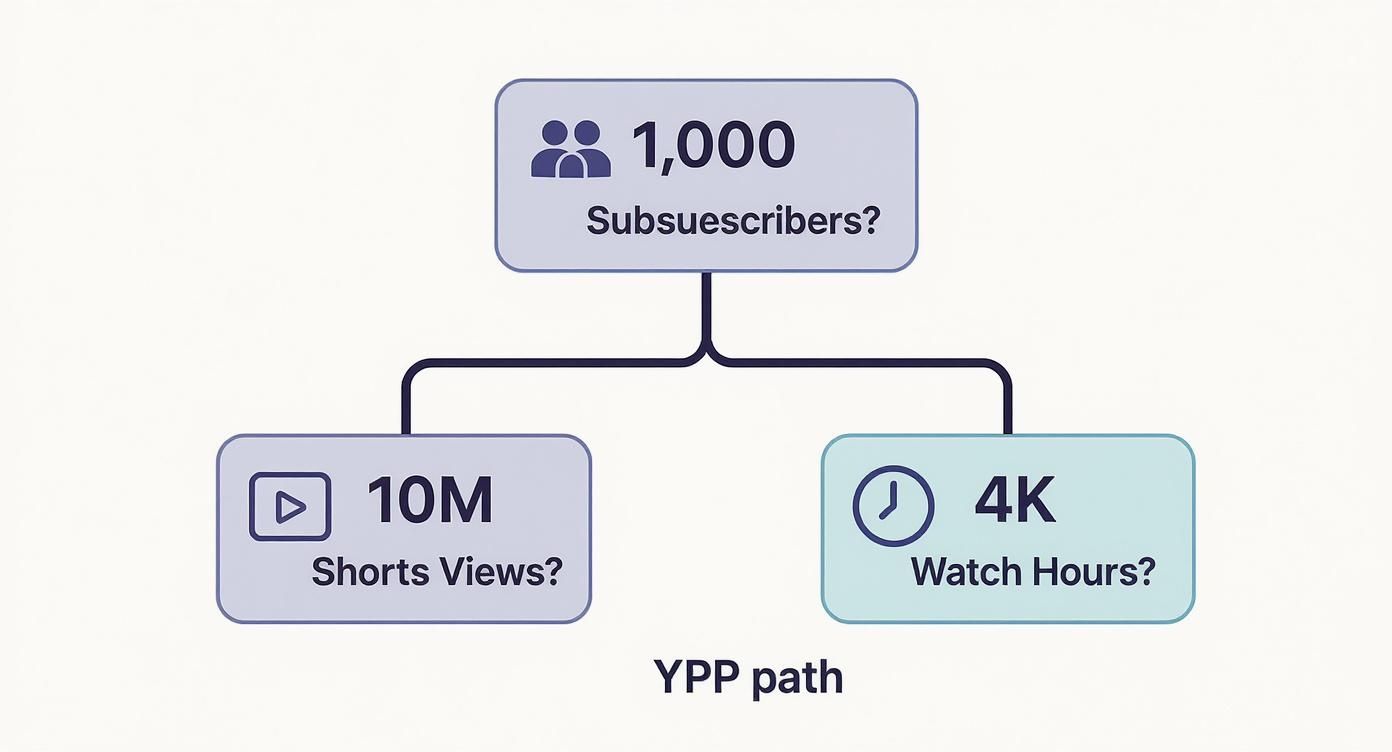
As you can see, once you hit that 1,000 subscriber mark, your next target is all about where your views are coming from.
The Long-Form Marathoner Path
Now, if your style is more about in-depth tutorials, detailed vlogs, or long-form storytelling, this second path is designed for you. This route values sustained attention and loyalty over quick, viral bursts. Think of it as an endurance run, not a sprint.
Here are the requirements for the long-form path:
- A Solid Follower Base: Just like with Shorts, you still need to reach 1,000 subscribers.
- Sustained Watch Time: The key difference is here: you need to accumulate 4,000 valid public watch hours on your long-form videos within the last 12 months.
See the difference? A whole year. That 12-month window gives you much more breathing room to build a library of content that steadily attracts viewers. This path rewards the slow, consistent burn of building a loyal community that actually sticks around to watch your videos all the way through. It's not about raw view counts; it’s about the total time people are spending with your content.
Choosing Your Lane
At the end of the day, both roads get you to the same destination. You just need to hit that 1,000 subscriber minimum and then meet either the 10 million Shorts views (in 90 days) or the 4,000 watch hours (in 12 months) requirement. This setup is great because it means creators who excel in either format have a fair shot at monetization. To get a deeper look at the latest rules, check out this detailed breakdown of the 2025 YouTube Shorts policies.
But it’s really important to understand what YouTube means by "valid" views and watch hours.
What Counts as a Valid View or Watch Hour?
For a view or watch hour to count toward your YPP goal, it has to come from a public video. Any views from private videos, unlisted videos, deleted videos, or paid ad campaigns (like Google Ads) don't count. For Shorts specifically, the views must come from the Shorts Feed to be considered valid.
This is a critical distinction. It means you can't just buy your way into the Partner Program by running ads. Your growth has to be organic, driven by people who are genuinely discovering and watching your stuff. So whether you’re sprinting with Shorts or running a marathon with longer videos, the core mission is the same: create compelling, public content that people want to watch.
Getting Past YouTube's Content and Originality Gatekeepers

Hitting those subscriber and view count numbers feels great, right? It’s like reaching base camp on Mount Everest. But that’s just the first part of the journey. The real climb is getting through YouTube’s strict content policies to actually get—and stay—monetized.
These rules aren't just suggestions; they're the bedrock of the entire YouTube Partner Program (YPP).
Think about it from an advertiser's perspective. They won't pay to have their ads show up next to copied, unsafe, or low-quality content. YouTube's obsession with these rules is about protecting everyone: viewers, advertisers, and legitimate creators. Ignoring them is the quickest way to get your application denied or, even worse, get demonetized later on.
The Golden Rule: Originality Is Non-Negotiable
If there's one thing to burn into your memory, it's this: YouTube pays for originality. The whole system is built to reward your unique ideas, your voice, and your creative spin. Just downloading someone else's video and re-uploading it is a fast track to failure.
This means channels built on unedited clips from movies, TV shows, or other creators' content are dead on arrival. The same goes for what YouTube considers "low-effort" stuff, like slideshows of stock photos with generic music or those robotic voices reading Reddit threads.
You have to add real value. Ask yourself, "Am I adding meaningful commentary, a creative edit, or a fresh perspective here?" If the answer is a hard no, you’re playing with fire.
A huge mistake I see all the time is creators treating Shorts as a dumping ground for their TikToks or Reels. If your channel is just a scrapbook of other people's viral videos without any significant input from you, it will almost certainly get rejected for "reused content."
The safest path is to make sure the vast majority of your content is yours and yours alone. If you use someone else's clips, they need to be part of a larger, transformative work like a review, parody, or commentary—not the main event.
What “Advertiser-Friendly” Actually Means
On top of being original, your videos need to be "advertiser-friendly." It's a bit of a vague term, but it really just means your content has to be a safe place for brands to run their ads. Big companies don't want their ads popping up next to anything controversial or explicit.
YouTube has some clear lines you can't cross. They restrict or completely deny monetization for content that includes:
- Inappropriate Language: Think excessive swearing, slurs, or hateful speech.
- Violence: This includes graphic imagery or focusing on tragedies.
- Adult Content: Anything sexually suggestive or featuring nudity.
- Harmful or Dangerous Acts: Content promoting activities that could lead to serious harm.
- Hateful and Derogatory Content: Videos that attack or demean people based on their identity.
Your channel doesn't need to be G-rated, but you have to steer clear of these major red flags. Just one video that crosses the line can jeopardize your entire channel's monetization. To learn more about what YouTube considers off-limits, it's worth reading up on their strict content reuse policies.
How Using Music in Shorts Affects Your Paycheck
Finally, let's talk about music. Using trending songs in your Shorts is a fantastic way to get views, but that music isn't free. When you add a song from YouTube's library, the platform handles the licensing fees automatically before you ever see a dime.
Here’s a simple breakdown of how it works: YouTube takes all the money made from ads on the Shorts feed and puts it into one big pot. Before a single creator gets paid, YouTube uses that money to pay the music licensing companies.
The money that’s left over is called the "Creator Pool." Your slice of the pie is calculated from that pool, and of that slice, you get 45%. It's a clean system that keeps you safe from copyright strikes, but it's important to know that the cost of music directly reduces the total amount of money available for creators.
How Shorts Ad Revenue Sharing Actually Works
So, you’ve met the YouTube Shorts monetization requirements and you're officially in the Partner Program. Great! But how does the money actually flow from those quick-hitter videos into your bank account? It's a bit different than the ads you see on longer videos.
Instead of ads playing directly on your content, Shorts revenue is based on a big, shared pool. Think of it like a giant pot of money that all Shorts creators contribute to and get paid from.
Every month, YouTube takes all the cash generated from ads running between videos in the Shorts feed and puts it into one central fund, which they call the Creator Pool. This is the only way to do it fairly, since an ad isn't tied to a single creator's video but to the overall scroll-fest.
First, The Music Gets Paid
Before a single dollar from that pool makes its way to a creator, YouTube has to pay for the music. If you use a track from YouTube's library in your Short (which most people do), a slice of the ad money is automatically used to cover the licensing costs for that song.
This happens right off the top. It’s a smart system that makes sure artists and labels get paid without you having to worry about copyright strikes. Once those music costs are handled, what's left over is the real Creator Pool, ready to be divided among all the monetized creators.
How Your Slice Is Calculated
Okay, so how much of that final Creator Pool do you get? It all comes down to your channel's performance. YouTube looks at the total number of monetized Shorts views across the entire platform for the month and figures out your share.
It’s pretty simple, really. If your Shorts got 1% of all eligible views from monetizing creators in a given month, you get 1% of the Creator Pool. The more valid views you bring in, the bigger your slice of the pie.
The Bottom Line: You don't earn based on an ad shown next to your specific Short. You earn a percentage of the entire ad revenue pool based on how many views your channel contributed.
The Final 45% Creator Share
Once your share of the Creator Pool is determined, the last step is the split. For Shorts, creators keep 45% of their allocated revenue, and YouTube takes the remaining 55%.
This is a bit different from the 55% cut creators get on long-form videos. The main reason for the difference is that YouTube uses its share to help cover the massive, ongoing costs of licensing music for the entire Shorts platform. It keeps the whole system running smoothly.
Setting Realistic Earning Expectations
Now for the reality check. It's super important to know what to expect. Because of this pooled model and how short-form ads work, the earnings per 1,000 views—often called RPM—is much lower for Shorts than for traditional videos.
On average, most creators see earnings somewhere between $0.01 and $0.06 per 1,000 Shorts views. To put that in perspective, a Short with 1 million views might only earn you between $50 and $70. Of course, this can swing up or down depending on the time of year or where your viewers are.
This is why you can't rely on just one viral hit. If you want to make real money from Shorts ads, you need a steady stream of content that consistently pulls in a lot of views. You can find more details about the earning potential of Shorts at usevisuals.com.
Moving Beyond Ads with Alternative Income Streams
Getting into the YouTube Partner Program and seeing those first dollars from the Shorts ad pool is a huge win. But stopping there is like a farmer planting only one crop in a giant field—you’re leaving a ton of potential on the table and taking a big risk. The most successful creators don't see Shorts as the end goal. They see them as the top of their business funnel.
Think of it this way: every Short that goes viral is a free commercial for your brand. It’s a quick handshake, a way to grab someone’s attention and introduce yourself. Your real job is to guide that attention somewhere more valuable, whether that's your longer, more detailed videos, affiliate links in your descriptions, or your own line of merchandise. This turns your Shorts from a simple revenue stream into a powerful engine for your entire creative business.
Unlocking Fan Funding Sooner
One of the best recent changes to the YouTube Partner Program was the creation of an earlier entry point. This lets you start making money directly from your audience much, much sooner. Instead of grinding it out for the full YPP requirements, you can unlock fan-funding features with more manageable goals.
To get your foot in the door, you just need to hit these milestones:
- 500 Subscribers
- 3 million valid public Shorts views in the last 90 days (OR 3,000 public watch hours on long-form videos in the past year)
Hitting these numbers won't turn on Shorts ad revenue, but it does open up direct support from the people who love your content the most. For instance, 500 subscribers and three million Shorts views unlock monetization tools like Memberships and Super Thanks. You still need to hit the higher thresholds for a cut of the ad and YouTube Premium revenue, but this is a fantastic first step. You can learn more about YouTube’s tiered monetization approach to see exactly what unlocks at each level.
To make this clearer, let's break down what you get at each of the two main monetization tiers.
Shorts Monetization Tiers and Features
| Feature | Unlocked at 500 Subs / 3M Views | Unlocked at 1,000 Subs / 10M Views |
|---|---|---|
| Channel Memberships | ✅ | ✅ |
| Super Thanks | ✅ | ✅ |
| Super Chat & Stickers | ✅ | ✅ |
| YouTube Shopping | ✅ | ✅ |
| Shorts Ad Revenue Sharing | ❌ | ✅ |
| Long-Form Ad Revenue | ❌ | ✅ |
| YouTube Premium Revenue | ❌ | ✅ |
As you can see, the first tier is all about building a direct relationship with your audience, while the second tier adds in the more traditional ad-based revenue.
Your Fan Funding Toolkit
Once you hit that 500-subscriber tier, you get a handful of powerful tools that let your community support you directly. These are all about creating a stronger bond with your most dedicated fans.
- Channel Memberships: This is a game-changer. Your viewers can pay a small monthly fee for exclusive perks like custom badges, unique emojis, or members-only videos. It creates a steady, predictable income stream you can count on.
- Super Thanks: Think of this as a digital tip jar. A viewer can buy a "Super Thanks" on one of your Shorts to show some extra love. A fun, colorful animation pops up on the screen, and you get a direct contribution. It's a fantastic way for fans to say "great job!" with more than just a comment.
- Super Chat & Super Stickers: These are for live streams. Viewers can pay to have their comments highlighted in the chat or to send eye-catching animated stickers. It's a great way to make your live sessions more interactive and profitable at the same time.
These fan-funding tools are so powerful because they shift your focus from chasing astronomical view counts to cultivating a loyal community. A few hundred dedicated members can easily bring in more stable income than millions of unpredictable, ad-supported views.
Building these extra income streams is crucial for long-term success. It gives you a much more resilient business that doesn't live or die by the whims of the algorithm or fluctuating ad rates. While growing your channel to meet the full YPP requirements is a worthy goal, some creators find that fast-tracking the process is the best move for their strategy. If you're looking to hit the ground running, exploring an option like a pre-approved monetized YouTube channel can give you immediate access to every monetization feature, letting you focus entirely on making great content from day one.
Proven Ways to Speed Up Your Channel’s Growth
Hitting those YouTube Shorts monetization numbers can feel like a long, slow climb. But with the right approach, you can turn that marathon into a sprint. The secret isn't just making more content; it's about making your content work smarter to hit those growth goals faster.
Your main job? Obsess over retention. The YouTube algorithm absolutely loves Shorts that people watch all the way through—or even better, on repeat. A high watch time is a massive green flag telling YouTube to push your video out to more people.
Keep It Short and Punchy
Just because you can make a 60-second Short doesn't mean you should. The real magic for retention often happens in the 15-30 second range. This shorter format forces you to get straight to the point and hooks viewers before they can even think about swiping away.
Every successful Short has a simple, powerful structure:
- The Hook: You have 1-3 seconds to grab someone's attention. Start with a burning question, a bold statement, or some eye-catching movement to stop them in their tracks.
- The Value: This is the meat of your video. It's the punchline, the quick tip, or the cool reveal you promised in the hook.
- The Payoff: End with a satisfying conclusion that makes the viewer feel smart for watching. A great ending is what gets people to hit replay and share.
Nailing this formula creates a super-engaging loop that keeps viewers watching and signals to the algorithm that you've got the goods.
Ride the Trend Wave
Hopping on trends is one of the quickest ways to introduce your channel to a ton of new people. You don't have to do every dance challenge, but you definitely need to keep your finger on the pulse of what's buzzing on the platform.
Listen for trending audio clips, sounds, and songs. When you use a popular sound, your Short gets grouped with other videos using it, giving you a shot at a huge, built-in audience. To cast an even wider net, consider strategies like crossposting YouTube content to platforms like TikTok.
Pro Tip: Don't just copy a trend—put your own spin on it. The creators who really win with trends adapt them to their own niche. This makes the content feel original while still cashing in on the trend's momentum.
Post Consistently and Let Data Be Your Guide
Consistency is non-negotiable. When you're trying to grow, you should aim to post at least one Short every single day. This keeps your channel fresh, gives the algorithm more to work with, and multiplies your chances of a video going viral.
But don't just post and pray. Dive into your YouTube Analytics and see what's actually working. Are your top-performing Shorts about a specific topic? Do they share a certain editing style or type of hook? Find the pattern and then double down on what your audience is telling you they love.
It’s worth the effort. Shorts are a subscriber-generating machine. For channels over 1 million subscribers, Shorts bring in about 29.2 new subscribers per 10,000 views. That's a huge leap from the 11 subscribers you'd get from a long-form video.
While these tips will fast-track your organic growth, some creators want to skip the starting line altogether. If you’d rather focus purely on making great videos from day one, buying an aged YouTube channel can be a shortcut, letting you hit the ground running without the long wait to meet the initial requirements.
Got Questions About Shorts Monetization? Let's Clear Things Up.
Diving into the rules for making money with YouTube Shorts can feel a bit confusing. You're not alone. Let's tackle some of the most common questions creators have so you can get on the right track.
Can I Really Make Money Without 1,000 Subscribers?
Yes, you can! This is a common misconception. YouTube actually created an earlier entry point into the YouTube Partner Program (YPP) specifically for creators who are still growing.
Once you hit 500 subscribers and rack up 3 million valid Shorts views in the last 90 days, you unlock access to fan-funding features. This is a huge first step and includes tools like:
- Super Thanks: Think of it as a virtual tip jar right on your Shorts.
- Channel Memberships: Let your most dedicated fans support you with a monthly subscription.
- Super Chat: During live streams, fans can pay to have their messages highlighted.
So, while you won't be tapping into the Shorts ad revenue pool just yet, this is a fantastic way to start earning directly from your community while you build toward the next milestone.
Do All My Shorts Views Count Towards the 10 Million Goal?
Not exactly. YouTube is pretty specific about what counts. For a view to help you meet that 10 million threshold, it has to be from a public and valid Short.
That means any views from videos you've set to private, unlisted, or deleted won't make the cut. The same goes for any views you paid for through an ad campaign.
And once you're monetized, there's another layer: your Shorts need to follow YouTube's advertiser-friendly guidelines to actually earn anything. If your Short is just an unedited clip from a movie or TV show, or breaks any community rules, it won't be eligible for ad revenue.
The bottom line is this: your growth needs to be real, and your content has to play by the rules. YouTube rewards creators who build an authentic audience with original, advertiser-safe videos.
What's a Realistic Payout for Shorts?
Let's manage expectations here, because this is important. The revenue per 1,000 views (often called RPM) for Shorts is way lower than for traditional, long-form videos. Most creators see somewhere between $0.01 and $0.06 per 1,000 views.
So, what does that look like in practice? A Short that hits 1 million views might earn you between $10 and $60. The exact amount wiggles around based on things like where your viewers are and even the time of year.
This tells you that building a real income from Shorts ads isn't about one viral hit. It’s about creating a steady stream of videos that consistently pull in millions of views.
Ready to skip the grind and start earning from day one? At MonetizedProfiles, we provide fully approved YouTube channels that meet all the monetization requirements, so you can focus on creating great content instead of chasing metrics. Check out our pre-monetized channels.


