


Ever wondered how long your YouTube videos should be? The answer isn't as simple as you might think. While videos between 10-15 minutes often seem to be the sweet spot for a lot of creators, the real "perfect" length is just long enough to tell your story well—without a single wasted second.
The Myth of the Perfect Video Length

So many creators get hung up on finding that one magic number for video length. But the truth is, a universal "ideal" length is a total myth.
Think of it like a conversation. A quick update is perfect for a text message, but a deep, meaningful chat needs a long phone call. Both are effective, but only in the right context. The same goes for YouTube. A 60-second Short can be brilliant for a quick laugh, while a 30-minute deep dive can establish you as an expert and build a dedicated community.
The key is matching the length to your goal and what your viewer is looking for.
Why Length Is a Strategic Choice
Instead of following a rigid rule, start thinking of video length as a strategic tool in your creator toolkit. Your main goal should always be to give your audience value and keep them hooked from the first second to the last. A video only needs to be as long as it takes to get the job done.
This viewer-first approach is what really matters. When you understand how the YouTube algorithm works, you see that it's all about watch time and audience retention. A 20-minute video that people click away from after two minutes is way less valuable to the algorithm than a tight, 7-minute video that people watch all the way through.
Of course, trends do matter. The average YouTube video now clocks in around 11.7 to 12.5 minutes. But that number doesn't tell the whole story. Gaming videos, for example, tend to be much longer (averaging 24.7 minutes), while music videos are much shorter (around 6.8 minutes). The length has to fit the niche.
The most important question isn't "How long should my video be?" but rather "How long can I hold my audience's attention while delivering maximum value?"
To give you a practical starting point, I’ve put together a quick guide on recommended lengths for some of the most common video formats on YouTube.
Quick Guide to Ideal YouTube Video Lengths by Format
This table breaks down the typical sweet spots for different types of content, helping you make smarter decisions right from the planning stage.
| Video Format | Ideal Length Range | Primary Goal |
|---|---|---|
| Tutorials & How-To's | 8-15 Minutes | In-depth instruction and problem-solving |
| Product Reviews | 10-20 Minutes | Detailed analysis and trust-building |
| Vlogs & Lifestyle | 12-18 Minutes | Storytelling and community connection |
| Commentary & Analysis | 15-25 Minutes | Deep-dive exploration of a topic |
| YouTube Shorts | Under 60 Seconds | Quick engagement and channel discovery |
Use this as a guideline, not a strict rule. Always test what works for your specific audience and adapt as you grow.
How Viewer Retention Actually Works

Everyone seems obsessed with video length, but the metric that really moves the needle with the YouTube algorithm is audience retention. Think of it as the ultimate measure of how captivating your content is. The longer you keep someone glued to their screen, the more YouTube sees your video as valuable and starts showing it to more people.
This completely flips the script. The question isn't "how long should my video be?" but rather, "how long can I keep my audience totally hooked?" YouTube's entire business model revolves around keeping people on its platform, and videos with fantastic retention are the engine that makes it all work.
A longer video that holds its audience sends a massive signal to the algorithm that you're creating quality stuff. That’s why a 12-minute deep dive that keeps 50% of viewers watching is infinitely more powerful than a 4-minute clip that loses almost everyone after 30 seconds. This is a fundamental concept, and you can get the full story on how YouTube counts these valuable views in our other guide.
The Critical First Minute Wall
Every creator, big or small, runs into the "one-minute wall." It’s that make-or-break moment where a huge chunk of your audience decides if your video is worth their time. Your intro—your hook—is the only tool you have to smash through it.
And trust me, the numbers don't lie. Research shows this is a universal problem. In fact, it's pretty common for less than 45% of viewers to make it past the first 60 seconds of any video, regardless of its total length. This just goes to show how vital a strong, compelling opening truly is.
A killer hook needs to do three things, fast:
- Promise Value: Tell them exactly what they're going to get out of watching.
- Spark Curiosity: Ask a provocative question or introduce an interesting problem.
- Set the Vibe: Establish the energy and tone for the rest of the video.
If you don't grab them right away, the rest of your amazing content might as well not exist. It'll never get seen.
The YouTube algorithm doesn't just care if people watch; it cares how long they watch. High retention is the clearest signal you can send that your content is genuinely valuable.
This is why chasing a specific video length is the wrong way to think about it. While some data points to a sweet spot, quality content will always beat a specific runtime. For example, some studies show that videos between 5 to 10 minutes often hit a retention peak of around 31.5%. This directly challenges the old "shorter is better" myth and proves that engaging content is what keeps people watching.
How to Analyze Your Retention Graph
To get better, you have to play detective. Your most important clue is the Audience Retention graph, which you can find in YouTube Studio for every video you upload. This graph shows you, second by second, what percentage of your audience is still watching.
Here are the key patterns to look for:
- A Steep Drop-off at the Start: This is a dead giveaway of a weak intro. Your hook didn't work.
- Sudden Dips: These pinpoint the exact moments viewers got bored. Did you ramble, or was a segment just too slow?
- Bumps or Spikes: These are pure gold! It means people re-watched a specific part, which tells you it was incredibly valuable or entertaining.
By digging into these graphs, you can see exactly what's working and what's driving people away. Use this data to tighten up your intros, mercilessly cut boring parts, and double down on the stuff that makes viewers hit the replay button. This is how you stop guessing and start finding the perfect video length for your channel and your audience.
What's the Right Video Length for Your Niche?
A 25-minute software tutorial can be just as successful as a 3-minute gadget review. Why? Because they both deliver on a specific promise to a specific audience. This gets to the heart of the matter: there is no single YouTube ideal video length. The "perfect" duration is all about what your viewers expect from your kind of content.
Think of it from the viewer's perspective. Someone clicking on "Quick iPhone Tip" wants a fast solution, probably under three minutes. But a person searching for a deep-dive documentary on ancient history is ready to settle in for a much longer journey. Your job is to match these unspoken expectations.
Get it wrong, and you'll see your audience drop off. If your video feels like it's dragging on for the topic, people get impatient and leave. If it's too short, they might feel like you didn't deliver the value you promised. Finding that sweet spot is the key to keeping people watching.
Your Niche Sets the Rules
Different types of content naturally lean toward different lengths. A comedy skit needs to get to the punchline quickly, while a detailed financial analysis requires time to build a solid argument. The goal is always to respect the viewer's time by giving them what they came for as efficiently as possible.
Let's look at how this plays out in some popular niches:
-
Educational & Tutorial Channels: Longer is often better here, usually in the 10-20 minute range. Viewers are looking for detailed, step-by-step guidance. A longer video lets you cover a topic thoroughly, building your authority without rushing the important details.
-
Entertainment & Comedy: Keep it short and sweet. A punchy 3-5 minute video is perfect for a sketch or a viral challenge. You want to deliver immediate entertainment, and stretching it out just kills the vibe.
-
Gaming: This is a unique one. Successful gaming videos can be anything from a 15-minute highlight reel to a 45+ minute "let's play" stream. The length completely depends on the format. A slick, edited montage should be tight, while a full playthrough needs the space to breathe.
-
Product Reviews & Tech: Most in-depth reviews land somewhere between 12-18 minutes. This gives you enough time to unbox the product, show off its features, walk through the pros and cons, and give a final verdict without it feeling rushed or superficial.
Real-World Examples of Niche-Specific Lengths
Look at what the top channels in your space are doing—they provide the blueprint. A channel that teaches a complex program like Adobe Premiere Pro will consistently post videos over 20 minutes long because its audience demands that level of detail.
On the other hand, a channel covering daily news might stick to the 8-12 minute mark. That's just enough time to give context on the day's events but short enough to fit into someone's morning coffee routine. They've found the perfect rhythm for their audience. For a more detailed breakdown, you can explore our complete guide on the best video length for YouTube to see how various formats stack up.
The ideal video length isn't about a magic number. It's about fulfilling the promise your title and thumbnail make in a way that feels complete and satisfying for your specific audience.
Stop guessing and start studying your niche. Your goal is to create videos that feel "just right"—long enough to be valuable, but short enough to keep your viewers hooked from start to finish. This is how you master the art of video length.
When you're trying to make a living on YouTube, video length stops being just a creative choice. It becomes a business decision, plain and simple. How long you make your videos has a direct line to how much money your channel can actually earn. Getting this right is fundamental to turning your channel from a hobby into a sustainable career.
Think of it this way: the time and effort you pour into your content needs to pay off. That return on investment is directly tied to ad revenue, and video length is a huge lever you can pull. With YouTube pulling in over $50 billion in ad revenue in the last five quarters (as of Q3 2024), there's a massive pie for creators to share. You can dig into more of those numbers in this breakdown of YouTube's financial landscape at Awisee.com. But to get your slice, you need to be strategic about how long your videos are from the get-go.
The Magic 8-Minute Mark for Monetization
If your channel is in the YouTube Partner Program, there’s one number you absolutely need to burn into your brain: eight minutes. This is the golden ticket. It's the minimum length a video needs to be to qualify for mid-roll ads.
Why is this such a game-changer? It all comes down to ad slots.
- Under 8 Minutes: Your videos are stuck with ads at the very beginning (pre-roll) and sometimes at the end (post-roll). That's it.
- Over 8 Minutes: Suddenly, you can place multiple ad breaks during the video. This means a 10 or 12-minute video can potentially earn double or even triple what a 7-minute video earns, even if they get the same number of views.
You're making a calculated trade-off here. A longer video might see your audience retention drop off a little bit towards the end, but the extra cash from those mid-roll ads often makes it well worth it. This is precisely why you see so many creators stretching their content to be just a hair over that eight-minute mark.
The ability to insert mid-roll ads is the single most powerful monetization tool related to video length. Crossing the 8-minute mark unlocks a new level of revenue potential for your content.
Monetizing Shorts: A Different Ball Game
Now, throw all that out the window when we talk about YouTube Shorts. They play by a completely different set of rules. Shorts don't have mid-roll ads; instead, they earn from a giant, shared pool of ad revenue that plays between the videos in the Shorts feed.
Your cut of that pool is based on your channel's share of the total Shorts views in your country. So, with Shorts, the strategy isn't about getting ad breaks in your video—it's about racking up as many views and as much engagement as possible across all your short-form clips.
While the payout for a single view is typically much lower than for a long-form video, don't sleep on Shorts. They are an incredible engine for discovery and brand awareness. Think of them as the top of your sales funnel—they introduce a flood of new people to who you are. A portion of those viewers will then click over to your main channel to watch your longer, more profitable videos. A truly smart strategy uses both formats in harmony to build a robust and diversified income.
Choosing Your Strategy: Shorts vs. Long-Form
As a creator on YouTube today, you’re standing at a fork in the road. One path is labeled "Shorts," the other "Long-Form." It feels like you have to pick one, right? Think of it less as a choice and more like deciding between a sprinter and a marathon runner. Both are phenomenal athletes, but they play completely different games.
Shorts are your secret weapon for getting discovered. These clips, all under 60 seconds, are designed for quick consumption and have an algorithm built to push them in front of tons of new eyeballs. If you want to tap into trends and reach a massive audience fast, Shorts are the way to go.
Long-form videos, on the other hand, are how you build a real, lasting community. This is where you get to dive deep, share your expertise, and build a genuine connection with your audience. From a business standpoint, this is also where the serious monetization happens.
The Hybrid Approach: A Winning Combination
Here’s the thing: you don’t have to pick a side. The smartest channels I've seen don't. They create a powerful hybrid strategy where each format feeds the other in a perfect loop. It's the classic one-two punch for channel growth.
Here’s a simple way to think about it:
- Shorts as Trailers: Think of your Shorts as movie trailers for your main content. A killer 30-second clip can spark curiosity and send a wave of new viewers over to your longer, more detailed videos.
- Long-Form for Community: This is where you turn those curious viewers into loyal subscribers. Your longer videos deliver the core value that makes them hit that subscribe button and come back for more.
This balanced strategy creates a self-sustaining ecosystem for your channel. Shorts act as the welcome mat, bringing in a steady flow of new people, while your long-form content is the comfortable living room that makes them want to stay. Of course, length is just one piece of the puzzle. Learning how to create compelling video content is the foundation for success, no matter the format.
This simple infographic breaks down how video length directly ties into your ability to make money on YouTube.
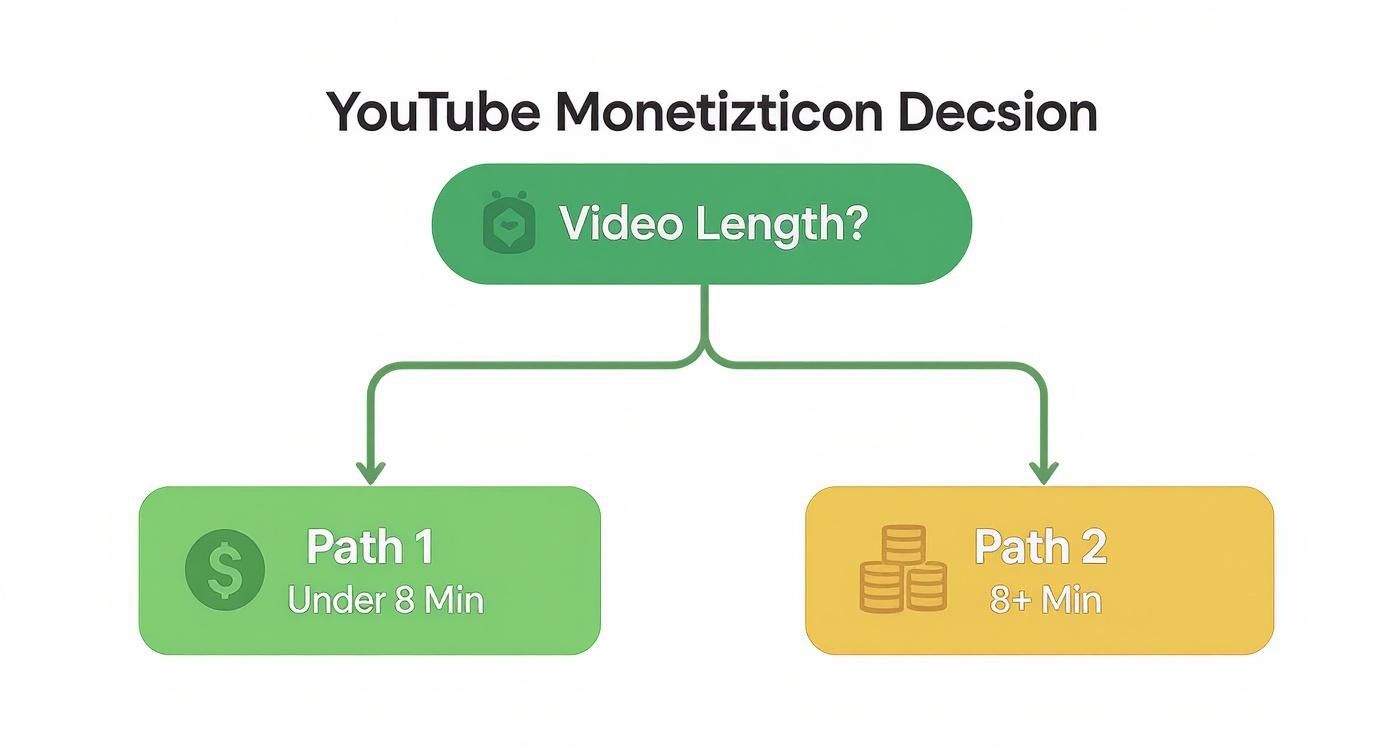
The biggest takeaway? Once your videos cross that magic eight-minute mark, you unlock mid-roll ads, which can dramatically increase your revenue.
A Strategic Comparison
To really help you map out your plan, let's put these two formats head-to-head. Understanding where each one shines is key to using them effectively.
Here’s a side-by-side comparison to help you decide where to focus your energy based on your specific goals.
YouTube Shorts vs Long-Form Videos: A Strategic Comparison
| Feature | YouTube Shorts (Under 60 seconds) | Long-Form Videos (Over 8 minutes) |
|---|---|---|
| Primary Goal | Reach & Discoverability | Community Building & Monetization |
| Audience Mindset | Passive, "lean back" scrolling | Active, "lean forward" engagement |
| Monetization | Shorts Fund, Ad revenue sharing (lower) | AdSense (pre-, mid-, post-roll), Sponsorships |
| Content Style | Fast-paced, trendy, high-impact | In-depth, educational, storytelling |
| Subscriber Growth | High volume, lower loyalty | Lower volume, higher loyalty |
| Algorithm Focus | Broad audience targeting, viral potential | Niche targeting, viewer retention |
Ultimately, choosing the right format—or combination of formats—comes down to what you want to achieve with your channel.
Your content strategy shouldn't be a choice between Shorts and long-form, but rather a plan on how to make them work together. Use Shorts to find your audience and long-form to build your community.
Getting clear on these differences is the first step. It empowers you to build a content plan that truly aligns with your goals, whether that’s explosive growth, a tight-knit community, or maximizing your income.
Common Questions About YouTube Video Length
Even when you think you've got a solid strategy, a few specific questions about the ideal YouTube video length always seem to pop up. Let's tackle some of the most common ones I hear from creators to give you clear, straightforward answers.
One of the biggest questions is about re-uploading. Should you take a video down just to make it longer or shorter? The answer is almost always a hard no. When you re-upload a video, you reset the clock. All your views, likes, and comments are gone, which tells the algorithm this new video is starting from scratch. It's much better to learn from that video's analytics and apply those lessons to your next upload.
Another thing that trips people up is that magical eight-minute mark. Creators worry that if their video is, say, 8:05, the algorithm will see it as "stretched" and penalize it.
Does an 8-Minute Video Have to Be Perfect?
Nope, the algorithm isn't going to punish you for being a few seconds over eight minutes. The only reason that number matters is for monetization—it's the minimum length required to place ads in the middle of your video (mid-rolls). As long as those extra seconds aren't just dead air, you're fine.
It all comes down to the viewer's experience. If you can use that extra time to offer a great final thought or a bonus tip, go for it! But if you're just rambling to hit a time goal, your audience retention graph will tell the real story when people start dropping off.
Your main goal should be to end the video on a strong, conclusive note. If that naturally takes you to 8:10, that’s far better than awkwardly cutting it short at 7:50 just to be concise.
And remember, to get the most out of every video no matter the length, think about other ways to boost its reach. For instance, converting YouTube video to text for SEO and repurposing can help it get discovered in new ways.
Should You Edit an Old Video to Change Its Length?
It can be really tempting to look back at an old, underperforming video and want to trim it down or even add to it. But here’s the thing: YouTube doesn't let you just swap out the video file. You can use the editor in YouTube Studio to trim sections, but it's often clunky and can make the video feel disjointed.
Instead of trying to perform surgery on old content, here are a few better ideas:
- Create a "Part 2": If you have more to say on the topic, just make a follow-up video. It's a great way to link content together.
- Produce a Short: Find a killer 60-second highlight from your longer video and turn it into a YouTube Short. This can actually drive traffic back to the original.
- Remake the Video: If the idea was solid but the execution was off, consider filming a fresh "2.0" version with better pacing and updated info.
This way, you're not messing with the data on your existing videos. You're simply learning and moving forward, which is what building a successful channel is all about.
Ready to skip the slow grind and start earning from your content immediately? MonetizedProfiles offers fully approved YouTube accounts that are ready for monetization from day one. Get your channel at https://monetizedprofiles.com and focus on what you do best—creating amazing content.


