


Before you even think about investing in a YouTube channel, running a YouTube fake subscriber check is the most critical step you can take. It’s your best defense against channels that look popular on the surface but are actually propped up by worthless bots. These fake accounts are a serious liability, tanking engagement rates and telling the YouTube algorithm your content isn't worth showing to anyone—ultimately killing any chance of real growth.
Why Fake Subscribers Are a Ticking Time Bomb
That big, shiny subscriber number might look impressive, but it’s often just a vanity metric hiding a complete mess. Fake subscribers aren't just dead weight; they actively sabotage a channel's health and future. You have to understand the real damage they cause before you pour your time and money into what might just be a digital ghost town.

The core of the problem is how they interact—or more accurately, how they don't. This lack of genuine activity sets off a chain reaction of negative consequences that are incredibly difficult, if not impossible, to fix.
The Algorithmic Penalty
Let's be clear: YouTube’s algorithm is incredibly sophisticated. It promotes content that people actually watch and engage with. So, when a channel with 100,000 subscribers posts a video and only gets 1,000 views, the algorithm immediately spots the huge gap. It reads this dismal view-to-subscriber ratio as a clear signal: the content isn't even interesting to its own followers.
As a result, the algorithm simply stops recommending the channel's videos to new, potential viewers. The channel's organic reach dries up, and trying to grow a real audience becomes a constant, losing battle. The channel is effectively trapped, punished by its own inflated numbers.
A channel's true health isn't about how many people hit 'subscribe,' but how many of those subscribers actually care. Fake subscribers represent an audience of zero, sending all the wrong signals to the platform.
Destroyed Engagement Metrics
It’s not just about views. Fake subscribers decimate all the other metrics that signal a healthy, active community. A channel propped up by bots will either have a completely dead comments section or one filled with generic, spammy nonsense like "Nice video!" These low-effort comments add zero value and are painfully obvious fakes.
This creates a host of issues:
- Low Engagement Rate: The ratio of likes and comments to subscribers will be abysmally low. This is a massive red flag to any potential brand partner or buyer.
- Poor Audience Retention: Bots don't watch videos. This leads to terrible audience retention graphs, another key metric YouTube's algorithm relies on to rank content.
- Wasted Investment: If you're buying a channel to sell products or earn ad revenue, you're paying for an audience that simply doesn't exist. Your marketing will go nowhere, guaranteeing zero return on your investment.
In the end, a channel bloated with fake subscribers is a broken asset. It's missing the genuine community required for monetization, brand deals, or any kind of sustainable growth. Performing a thorough YouTube fake subscriber check isn't just a suggestion—it's essential due diligence to protect yourself from buying a channel that’s fundamentally worthless. This guide will give you the know-how to spot the fakes and find channels with real, vibrant communities.
Don't just take a channel's subscriber count at face value. To really know if an audience is legitimate, you have to roll up your sleeves and look at the individual accounts that make up that number. A manual audit is one of the quickest and most effective ways to get a real gut feeling for a channel's health.
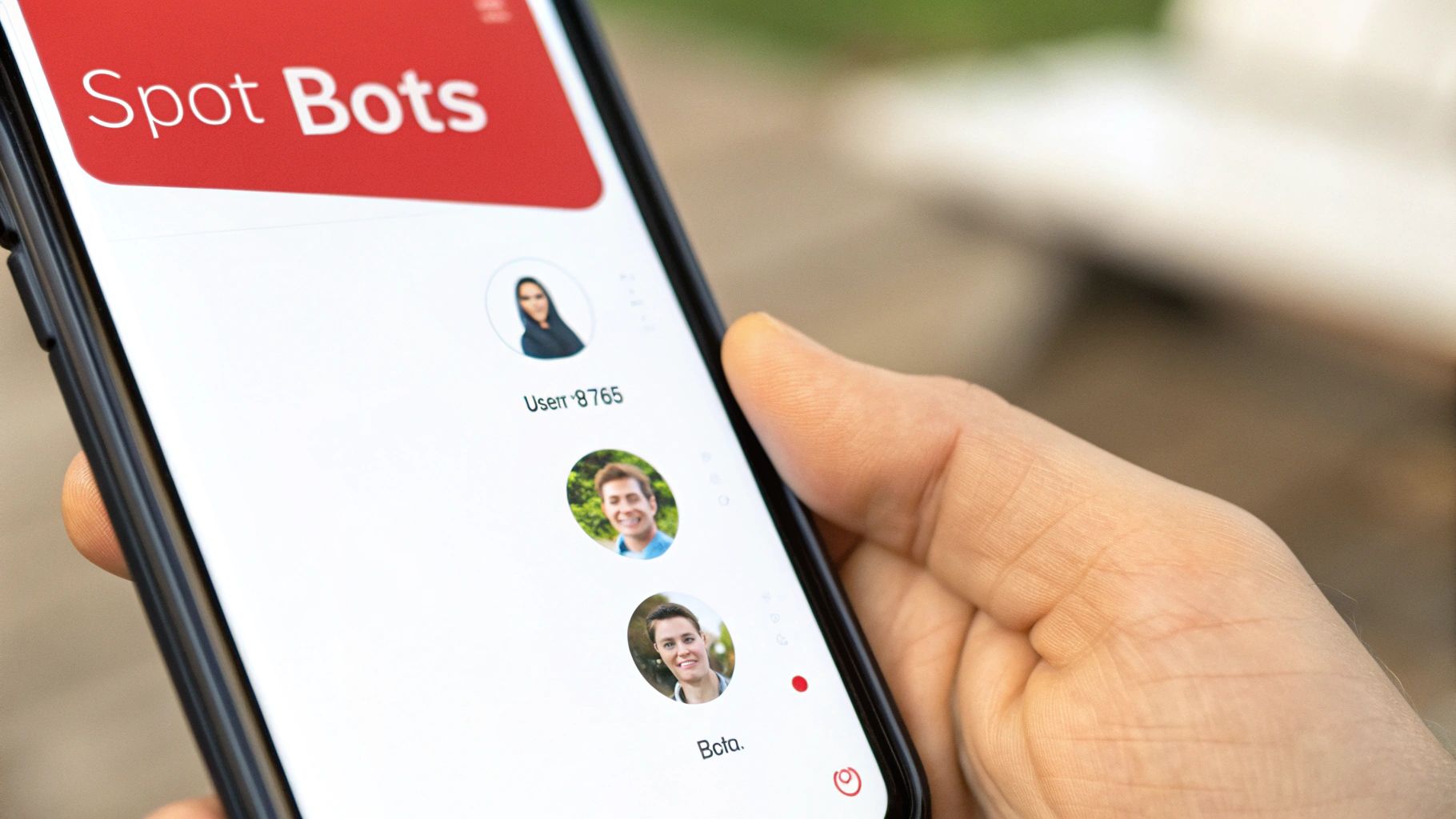
The idea is to spot-check a random sample of a channel’s subscribers. While you can't always see the full subscriber list due to privacy settings, the comment sections of recent videos are a goldmine for this kind of detective work. This is where you'll find the tell-tale signs of bot activity that raw analytics just can't show you. If you need a refresher on where to find this info, we have a great guide on how to see your subscribers on YouTube.
The Anatomy of a Fake Profile
Fake YouTube accounts almost always follow a lazy, predictable pattern. Once you learn what you’re looking for, they stick out like a sore thumb. They simply lack the digital history and personality of a real person who actually uses the platform.
Here are the most common red flags to watch for:
- Generic or Gibberish Usernames: Real people tend to pick something at least semi-personal. Bots, on the other hand, often have default names like "User" followed by a random number string (think User987654321) or complete keyboard nonsense like "ydfmsyufzx".
- Missing or Stock Profile Pictures: A sea of subscribers with no profile picture is a huge red flag. Some bots might use generic stock photos, but a large percentage of those default blank avatars suggests you’re looking at an army of fakes.
- Zero Channel Activity: Go to a real user's profile, and you'll probably see some playlists, liked videos, or maybe even their own uploads. Fake profiles are usually ghost towns—no public activity, no videos, and no playlists.
Deconstructing Subscriber Behavior
Beyond what the profile looks like, how these accounts behave (or don't) tells you everything. A real subscriber interacts. A fake one is just a number.
A classic bot tactic, for instance, is subscribing to thousands of completely random channels in a very short time. This is a clumsy attempt to look "active" to YouTube's algorithms, but it’s a behavior no human would ever follow.
A channel full of subscribers who follow thousands of other channels but have zero videos and a generic username is a classic sign of a bot farm. Real users curate their subscriptions; bots collect them indiscriminately.
Even the paid subscriber services can't create truly convincing fakes. In some recent tests, the "high-quality" providers delivered subscribers where 80% had profile pictures and 25% even had some content. But within 10 days, the channel's engagement had cratered, triggering a 'fake engagement' warning from YouTube. Cheaper services were even more obvious, with 50-85% of their fake accounts having zero other subscriptions—they screamed "brand new bot."
Your Manual Audit Checklist
When you sit down to do a manual check, be systematic. Don’t just look at one or two profiles. You need to sample at least 15-20 accounts from the comments on a few recent videos to get an accurate picture.
Here’s a simple checklist to guide you:
- Username Analysis: Does it look like a person came up with it, or a script?
- Profile Picture Quality: Is it a default icon, a stolen image, or does it seem authentic?
- Channel Content: Does the subscriber have any of their own videos or playlists? A complete lack of content across many profiles is a bad sign.
- Subscription List (If Public): Are they subscribed to a reasonable number of channels in a particular niche, or thousands of unrelated ones?
- Creation Date: This isn't always public, but thousands of accounts all created around the same time is highly suspicious. Older accounts are generally more trustworthy.
By spending just a few minutes on this kind of manual review, you can quickly tell if a channel’s audience is a genuine community or just a hollow collection of bots. It’s an essential first step before you dive any deeper into the analytics.
Using Engagement Metrics to Reveal the Truth
Subscriber count is just a number on a screen. If you really want to know if a YouTube channel is healthy, you have to look at its engagement—the likes, comments, and, most importantly, the views.
A channel with a real audience is a living, breathing community. One pumped up with fake subscribers? It's a digital ghost town. Digging into these engagement patterns is the single most reliable way to spot the fakes.
Engagement is the ultimate lie detector. Bots and fake accounts don't watch videos, leave thoughtful comments, or share content. Their presence just drags down the metrics that tell YouTube's algorithm the content is valuable, which means the channel gets hidden from potential real viewers.
The Critical View-to-Subscriber Ratio
The first place I always look is the view-to-subscriber ratio. This quick calculation gives you an instant snapshot of a channel's audience health. A creator's videos should consistently pull in a reasonable percentage of their subscriber base.
So, what's a good number? As a rule of thumb, you want to see views on recent videos hitting at least 5-10% of the total subscriber count.
- Healthy Example: A channel with 50,000 subscribers should be getting 2,500 to 5,000 views (or more) on its videos. This shows people who subscribed are actually tuning in.
- Red Flag Example: A channel with 50,000 subscribers that only averages 500 views per video is a huge red flag. It tells you the overwhelming majority of its audience is either completely inactive or fake.
This simple check cuts right through the noise. It’s a direct measure of whether the subscribed audience actually cares about the content. A consistently low ratio is one of the most glaring signs of a compromised account.
Decoding the Comments Section
Numbers are one thing, but the comments section tells a much richer story. This is where you can see the difference between a genuine community and a facade built by bots. Real viewers ask questions, share their opinions, and have actual conversations.
Bots, on the other hand, are terrible at faking human interaction. Keep an eye out for these tell-tale signs:
- Overly Generic Phrases: A wall of comments like "Great video!," "Nice one," or "Good job" with zero specific details about the video is highly suspicious.
- Excessive Emojis: Comments that are just a string of emojis are often a sign of automation.
- Irrelevant or Spam Links: A comment section filled with spammy links or people promoting their own channels signals poor moderation and a low-quality audience.
A healthy comments section has depth. You’ll see inside jokes, debates, questions, and personal stories related to the video. A fake one is a shallow sea of repetitive, one-word praise.
By 2025, YouTube had grown to over 2.7 billion monthly active users, yet many creators still try to cheat the system with bots or sub4sub schemes. Luckily, spotting them is still pretty straightforward if you know what to look for. If a channel’s video views are consistently less than 5% of its subscribers, it’s a dead giveaway—real fans actually watch the content. You can explore more about these detection strategies on PeerToPeerMarketing.co.
Here's a quick reference table to help you spot suspicious activity at a glance.
Red Flag Metrics for Fake Subscriber Detection
This table highlights key metric ratios and comment patterns that signal the presence of fake subscribers, helping you quickly assess a channel's health.
| Metric/Indicator | Healthy Channel (Green Flag) | Suspicious Channel (Red Flag) |
|---|---|---|
| View-to-Subscriber Ratio | 5-10% or higher on recent videos | Consistently below 5% |
| Like-to-View Ratio | A reasonable number of likes, feels natural | Extremely low likes despite high views |
| Comment Quality | Specific, relevant, and conversational | Generic ("Nice video!"), emojis, or spam |
| Audience Origin | Primarily from countries relevant to content | Heavy traffic from unrelated, low-cost regions |
Think of this table as your cheat sheet. When these red flags start piling up, you know you’re likely looking at a channel propped up by fake numbers.
Likes, Dislikes, and Shares
While not as revealing as views and comments, the like-to-view ratio can still offer some clues. A healthy video will naturally get a good number of likes relative to its views.
An extremely low number of likes on a video with thousands of views can be fishy. It might suggest the views themselves were artificially inflated. Having some background on how YouTube counts views can give you more context for this kind of analysis.
Shares are tougher to track publicly, but they're a huge signal to the algorithm. Channels with real, engaged fans get more shares, which fuels organic growth. Fake subscribers will never share content, leaving the channel stuck in the mud.
By layering these different pieces of the engagement puzzle, you can build a complete and accurate picture of a channel's authenticity. This multi-faceted approach takes your checkup beyond a simple number and helps you understand the true value of the community.
Analyzing Growth Patterns with Analytics Tools
While a quick look at a channel's engagement gives you a snapshot, the real story is in its history. Real channels grow with a certain rhythm—sometimes it's a slow burn, other times it's a big jump tied to a hit video. Fake growth, on the other hand, leaves behind a set of very distinct, unnatural footprints.
Digging into the analytics is where you move from making an educated guess to finding hard evidence. When you look at a channel’s growth over time, the tell-tale signs of bought subscribers—like sudden, vertical spikes that make no sense—are almost impossible to hide.
To really get the most out of this, you need a solid grasp of how YouTube Analytics explained for channel growth actually works. It's the foundation for making sense of the data you're about to uncover.
Interpreting the Subscriber Growth Graph
Your number one tool here is the subscriber growth graph. You can find this data on public third-party platforms, which let you see a channel’s subscriber count going back months or even years. What you’re looking for is a story that adds up.
Organic growth usually looks like a series of hills and plateaus. You’ll see a gradual climb as the channel posts content, with steeper slopes when a video really takes off. It’s a logical pattern that shows a real audience responding to what they see.
A channel propped up by purchased subscribers looks completely different. The graph will often have a jarring, out-of-place spike.
A sudden vertical jump of thousands of subscribers in a single day is the clearest sign of a bulk subscriber purchase, especially if it doesn't line up with a viral video. After that spike, you'll often see the growth flatline or even start to drop as YouTube purges the fake accounts.
The Tell-Tale Signs of Inauthentic Growth
Beyond that obvious vertical spike, other patterns can give the game away. In a healthy channel, subscriber and view counts should grow together. When they don't, that’s a huge red flag.
Here’s what to keep an eye out for in the historical data:
- Subscriber Spikes Without View Spikes: If a channel somehow gains 10,000 subscribers in a week but its video views don't budge, where did all those new "fans" go? Real subscribers watch videos.
- Consistent Daily Declines: It's normal for a channel to lose a few subscribers here and there. But if it’s consistently losing subscribers every single day, it's likely bleeding fake accounts from an old purchase as YouTube's system cleans house.
- Perfectly Uniform Growth: Did the channel gain exactly 100 subscribers every day for a month? That's incredibly suspicious. Organic growth is messy and unpredictable, never that perfect.
This image shows the stark difference between a healthy channel and one with some questionable numbers.
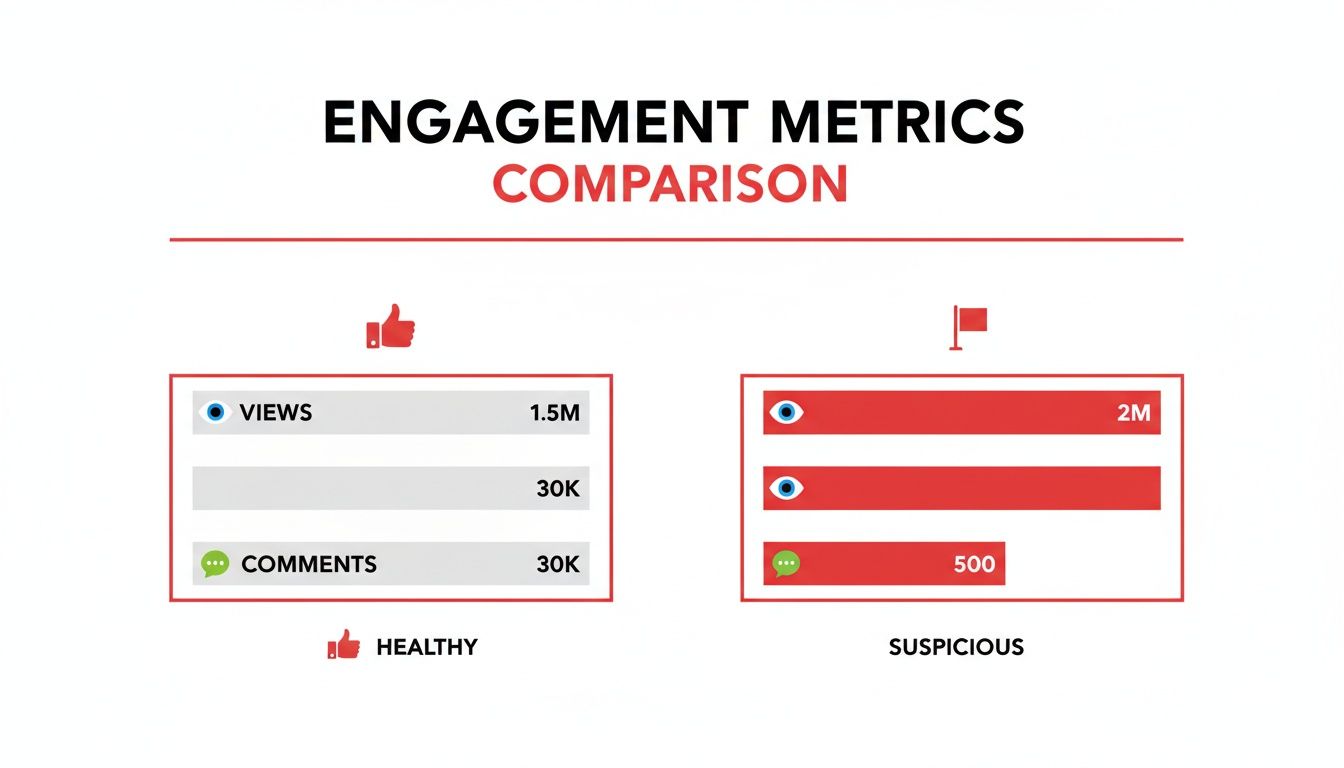
You can see how a real channel has a logical balance between its views and comments. The suspicious one has a massive disconnect, a classic sign of a fake audience.
A Practical Scenario Comparison
Let's say you're looking at two channels, and both have 50,000 subscribers.
Channel A's growth graph is a steady upward climb, gaining anywhere from 50 to 150 subscribers a day. You see a few sharp jumps, but they line up perfectly with videos that now have hundreds of thousands of views. This is exactly what you want to see.
Channel B's graph is basically flat for months. Then, on one random day, it shoots up by 20,000 subscribers. You check the videos from around that time, but none of them went viral—they all have the same low view counts as before. In the weeks after, the graph shows a slow, steady bleed of subscribers. This is an open-and-shut case. They bought them.
By using analytics to look back at the history, you’re not guessing anymore. You’re doing a proper audit, which lets you make a decision based on real evidence. It's a crucial skill for anyone serious about investing in a YouTube channel.
A Smarter Path to a Monetized Channel
Now that you know how to spot the red flags, it’s pretty clear that buying a random monetized channel is a massive gamble. You run a huge risk of inheriting a ghost town of bots or an account that’s just one step away from being shut down.
So, what's the alternative for a creator who wants to skip the initial grind but doesn't want to roll the dice?
The answer is not to buy fake subscribers yourself—that’s a surefire way to kill your channel before it even starts. The smart move is to acquire a pre-vetted, organically grown account that's already been approved for monetization. This approach cuts out all the guesswork and gives you a secure foundation to build on.
The Problem with Fake Growth Promises
You'll see countless shady online services promising "real subscribers" with a "natural increase" for laughably low prices. Don't fall for it. They prey on the desire for a quick win, but the damage they cause is almost always irreversible.
For example, one YouTuber put a service to the test and bought 1,000 subscribers for just $32.99. The seller promised delivery in 48 hours. Two weeks later, the channel had only gained 94 subscribers. Even worse, the two videos posted during that time got a single view for a grand total of 46 seconds of watch time—none of it from the purchased subs. To add insult to injury, the subscriber count actually dropped on one day, a dead giveaway that YouTube was actively purging the bots. You can read more about this disastrous experiment on UNILAD Tech.
This scenario proves there are no shortcuts to building a real audience. Those "subscribers" are just empty numbers that torpedo your channel's metrics and destroy its organic reach.
How a Vetted Account Changes the Game
A much more strategic approach is to invest in a channel that has already been professionally verified. Reputable providers perform their own exhaustive YouTube fake subscriber check on every channel before it’s ever listed for sale. This isn't just a quick glance; it's a deep-dive audit.
This verification process is intense and usually includes:
- Historical Growth Analysis: They look for sudden, unnatural subscriber spikes that don't match up with any viral content.
- Engagement Metric Audit: They ensure the view-to-subscriber and like-to-comment ratios are healthy and consistent over time.
- Audience Quality Check: This involves manually reviewing subscriber profiles and comment sections to spot and filter out bot activity.
- Monetization Status Verification: They confirm the channel is in good standing with the YouTube Partner Program and is completely free of strikes.
By acquiring a pre-vetted channel, you are essentially skipping the high-risk gamble. You're not just buying a subscriber count; you're investing in a clean, legitimate asset that has already passed YouTube's rigorous monetization review.
This method lets you hit the ground running. From day one, you can focus your energy where it actually matters: creating great content for a proven, organic audience. You won't have to waste time worrying about algorithmic penalties or a damaged reputation. If you're curious about the official requirements, our guide explains more about how to get monetized on YouTube the right way.
Ultimately, the goal is a thriving channel with a real community. Instead of taking shortcuts, focus on solid strategies to increase YouTube subscribers that actually stick for long-term success. Choosing a pre-vetted account isn't about cheating the system—it's about making a smart investment in a solid foundation for your creative career.
Common Questions Answered
After digging into the nitty-gritty of checking for fake YouTube subscribers, you probably have a few practical questions. Let's tackle some of the most common ones I hear, so you can move forward with confidence.
Can YouTube Actually Ban a Channel for Fake Subscribers?
Yes, they absolutely can and do. Pumping up your subscriber count with bots is a major violation of YouTube's policies, and they don't take it lightly. Their systems are getting smarter every day at sniffing out and axing fake accounts.
If a channel gets caught, the consequences can be brutal. At best, they might just purge all the fake subscribers, which is embarrassing. But it can get much worse, from getting demonetized to having the entire channel shut down for good. This is exactly why you need to do your homework before buying a channel—you don't want to invest in an asset that could disappear overnight.
How Can I Tell Viral Growth Apart From Fake Growth?
This is a fantastic question because, on a graph, they can look almost identical: a massive, sudden spike. But there’s one simple, tell-tale difference.
Genuine viral growth is always connected to high-performing content.
If you spot a huge subscriber jump, your very next move should be to look at the channel's video views during that exact same time.
It breaks down like this:
- Viral Growth: You'll see one or more videos suddenly explode with hundreds of thousands or even millions of views. The surge in subscribers, likes, and comments directly follows that success. It's a clear cause-and-effect.
- Fake Growth: A channel packs on thousands of subscribers in just a day or two, but none of its videos show any real uptick in views or engagement. The subscriber spike just sort of hangs there with no explanation. That's a huge red flag.
Is It Really Safe to Buy a Monetized YouTube Account?
It can be, but you have to be incredibly careful about where you get it from. The biggest risk is buying a channel that looks legit but was actually built on a foundation of bots and fake engagement. YouTube could find out and penalize it at any moment, leaving you with nothing.
This is where a reputable marketplace like MonetizedProfiles makes all the difference. A trustworthy provider does all the intense vetting for you. They confirm the channel hit its monetization goals organically, with real people watching and engaging. They've already done all the exhaustive checks we've talked about, so you're getting a clean, compliant channel that's ready to go.
Think of it this way: buying a properly vetted account isn't about finding a shortcut. It's about securing a safe, legitimate starting point so you can focus on what you do best—creating great content.
What's the Very First Thing I Should Check on a Channel?
If you only have a minute, go straight for the view-to-subscriber ratio. It's the fastest way to get a powerful gut check on a channel's health.
Here’s what you do: scan the last 10-15 videos (skip any huge viral hits) to find the average view count. If that number is consistently less than 5% of the total subscriber count, something’s fishy.
For instance, a channel with 50,000 subscribers should be pulling in at least 2,500 views per video on average. If you see most of their recent videos sitting at just a few hundred views, you can be pretty sure that subscriber number is inflated with inactive or fake accounts. Make this simple check your first move, every time.
Ready to skip the risk and start with a channel that's already verified and monetized? MonetizedProfiles offers a secure marketplace of organically grown YouTube accounts, each one thoroughly vetted to ensure its authenticity and compliance. Find your perfect channel and start creating today.


