


So, how much money does 1,000 views on YouTube actually make? The honest answer is: it's all over the place. You could earn as little as $0.04 for Shorts or pull in over $50 in high-value niches like personal finance. For the average creator, though, a realistic range is somewhere between $2 and $5 per 1,000 views once you're monetized.
What 1,000 Views Are Really Worth on YouTube
The dream of getting paid just for views is what gets most of us started on YouTube. But the reality is a lot more nuanced than a simple "views-to-dollars" conversion. Your earnings aren't tied directly to how many people watch, but rather to how valuable those viewers are to advertisers.
This is where the term RPM, or Revenue Per Mille, comes in. It’s the metric that matters, representing your total earnings for every 1,000 views on your channel. Getting a handle on your RPM is the first real step toward understanding what your channel can actually earn.
Several key things move your RPM up or down, which explains why some channels earn a fortune while others barely make pocket change. The big three are:
- Your Content Niche: Advertisers will pay a premium to get their products in front of people interested in stocks, real estate, or software. That same advertiser will pay far less to reach an audience watching funny cat videos.
- Your Audience's Location: A viewer from the United States is generally worth more to advertisers than a viewer from a country with a smaller economy, simply because there's more ad competition and higher consumer spending.
- The Type of Content You Make: Longer videos naturally have more opportunities for ad breaks (mid-rolls), which directly boosts how much you can earn from a single video.
Your Niche Sets Your Earning Ceiling
The difference your niche makes is staggering. To give you a real-world picture, let's look at some hard numbers. While that $2 to $5 average RPM holds true for many, picking the right topic can completely change your financial trajectory.
For example, a finance channel reviewing credit cards can easily see an RPM over $50. Why? Because the audience is actively looking to make financial decisions, and advertisers are willing to pay top dollar for that attention. On the flip side, a gaming channel might average just $1 to $2, and a YouTube Shorts creator could see as little as $0.04 per 1,000 views because the ad-sharing model is entirely different.
The table below breaks down a few popular niches to show you just how much earning potential can vary.
Estimated YouTube Earnings Per 1,000 Views By Niche
Here’s a quick look at potential RPM ranges for popular YouTube content categories, illustrating how niche selection impacts ad revenue.
| Content Niche | Average RPM Range (per 1,000 views) |
|---|---|
| Personal Finance & Investing | $15 - $50+ |
| Tech Reviews & Software | $8 - $25 |
| Business & Marketing | $10 - $30 |
| Health & Fitness | $5 - $15 |
| Lifestyle & Vlogging | $2 - $7 |
| Gaming | $1 - $4 |
| YouTube Shorts | $0.04 - $0.06 |
As you can see, the topic you choose to build your channel around is one of the biggest levers you can pull to increase your income.
This chart drives the point home even more clearly.
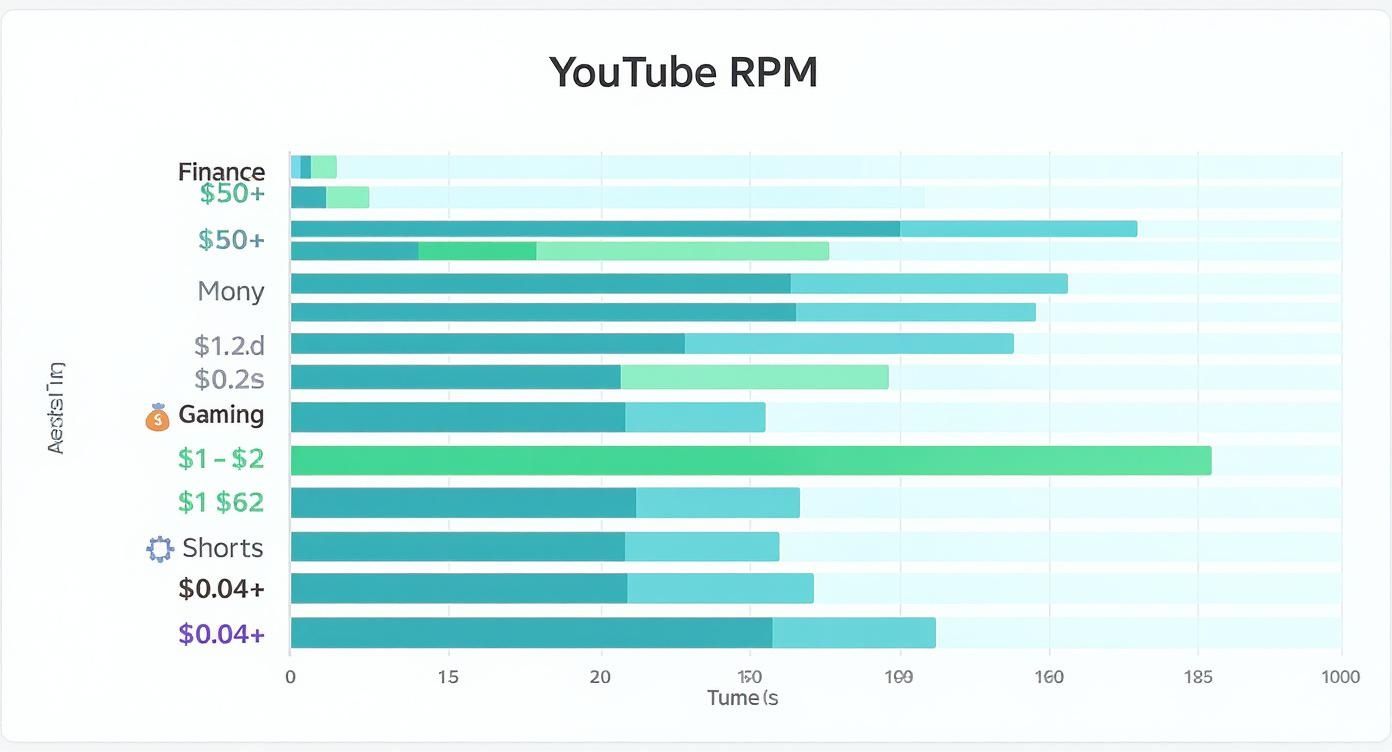
This visual shows exactly why your content strategy is so critical to your bottom line. Hitting 1,000 views is a great start, but understanding what makes those views valuable is the secret to building a truly profitable channel.
Want a more personalized estimate? Plug your own numbers into our YouTube money calculator to see what you could potentially earn based on your specific niche and view count.
Understanding Your Paycheck: CPM vs. RPM

To really get a handle on how much money 1,000 views on YouTube can make, you have to learn the language of monetization. The two biggest words you need to know are CPM and RPM. They might sound almost the same, but they tell two completely different stories about your channel's financial health.
Think of it this way: CPM is what advertisers pay to get their products in front of your audience. RPM is what you actually get to put in your pocket. Both are calculated per 1,000 views (that's what "mille" means in Latin), but they measure totally different things.
What Is CPM? The Advertiser's Price Tag
CPM, which stands for Cost Per Mille, is the price an advertiser pays for 1,000 ad impressions on YouTube videos. This number shows how much your audience is worth to companies. A high CPM is a great sign—it means advertisers are fighting to get a spot on your content.
For instance, an advertiser might bid a $10 CPM. That doesn't mean you make $10 every time your video gets 1,000 views. It means the advertiser pays YouTube $10 each time their specific ad is shown 1,000 times.
But here's the catch: you don't keep all that money. And not every single view on your video will even have an ad. That’s why CPM is an advertiser-focused metric; it's what they pay, not what you earn.
Why RPM Is Your True North
This is where RPM, or Revenue Per Mille, comes in. This is the number that should matter most to you as a creator. RPM tells you your total revenue—from ads, Super Chats, memberships, you name it—for every 1,000 views your videos get.
Unlike CPM, RPM gives you the real picture by factoring in a few crucial details:
- YouTube's Revenue Share: YouTube takes a 45% cut of ad revenue. This is the single biggest reason your RPM will always be lower than your CPM.
- Non-Monetized Views: Let's be real, not everyone sees an ad. People use ad-blockers, or sometimes YouTube just doesn't have an ad ready to serve. These "empty" views bring your average earnings down.
- Multiple Ad Formats: Your RPM lumps everything together. It includes earnings from pre-roll ads, mid-roll ads, and even other income streams like channel memberships, giving you a holistic view of your earning power.
Your RPM is your actual take-home pay per 1,000 views after YouTube takes its cut and after accounting for all the views that didn't generate ad revenue. Focusing on increasing your RPM is the single most effective way to grow your income.
A Practical Example: Seeing CPM vs. RPM in Action
Let's do some quick math. Imagine your channel has a Playback-based CPM of $12. This means advertisers are paying $12 for every 1,000 views where an ad actually plays.
Now, let's say your video gets 10,000 total views. But because of ad-blockers and other factors, ads only played on 6,000 of those views.
Here’s how it all shakes out:
- Gross Ad Revenue: (6,000 monetized views / 1,000) * $12 CPM = $72
- YouTube's Cut (45%): $72 * 0.45 = $32.40
- Your Earnings: $72 - $32.40 = $39.60
- Calculate Your RPM: ($39.60 in earnings / 10,000 total views) * 1,000 = $3.96 RPM
So, in this case, that impressive $12 CPM turned into a $3.96 RPM. See why obsessing over CPM can be misleading? If you want to dig even deeper into this crucial metric, check out our complete guide on what RPM is in YouTube.
This gap between CPM and RPM is fundamental. In 2025, for example, the average YouTube CPM is projected to be around 2.50 EUR, but it can swing wildly from 1.00 EUR to over 8.00 EUR depending on your niche and audience location. A creator's final RPM typically ends up being about 60-70% of their CPM. At the end of the day, your RPM is the number that actually hits your bank account.
Why Niche and Audience Location Are Game-Changers
Ever wonder why two YouTube channels with the exact same view count can have wildly different bank balances? The secret isn't some complex algorithm; it's actually pretty simple. Not all views are created equal.
The real value of your audience boils down to two huge factors: the niche you're in and the location of your viewers. Getting a handle on these is the difference between earning coffee money and building a real, sustainable income from your channel.
The Power of a Profitable Niche
The single biggest lever you can pull to influence your earning potential is your content niche. It determines which advertisers are bidding for a spot on your videos, and more competition means higher ad rates. That, in turn, boosts your RPM.
Think about it. A creator in the personal finance space might talk about stock trading, credit cards, or real estate. The companies advertising on these videos—banks, brokerage firms, financial apps—can make thousands from a single new customer. Naturally, they're willing to pay a much higher CPM to get in front of that highly motivated audience. This is why a finance channel can easily see an RPM of $20, $30, or even over $50.
On the other hand, a channel focused on entertainment, like comedy sketches or pranks, usually attracts advertisers with everyday products like mobile games or snacks. The value of one customer is much lower, so their ad budgets are smaller. This often leads to a lower RPM, typically in the $2 to $7 range.
Key Takeaway: The more money your audience is willing to spend within your niche, the more advertisers will pay to reach them. Your YouTube 1k views money is a direct reflection of your audience's commercial value.
How Audience Location Dictates Your Ad Value
Just as important as what your viewers watch is where they're watching from. Advertiser demand and spending power change dramatically from one country to the next, mostly because of economic strength and consumer habits.
An audience in the United States, the United Kingdom, or Australia is sitting in a hyper-competitive ad market. Brands there have massive marketing budgets and are constantly fighting for the attention of consumers with disposable income. This bidding war drives up ad prices, giving creators a much healthier RPM.
In contrast, a viewer in a developing economy might see ads from local businesses with much smaller budgets. With less competition and lower overall purchasing power, advertisers just aren't willing to pay as much for those eyeballs. The result is a drastically lower RPM, even for the very same video.
The table below really drives home how much geography matters.
Audience Location vs. Average RPM Potential
Here’s a quick comparison showing how average RPMs can shift dramatically depending on where your audience is located. The financial impact is impossible to ignore.
| Country/Region | Estimated Average RPM | Reason for Variation |
|---|---|---|
| United States | $7 - $20+ | High consumer spending and a very competitive ad market. |
| United Kingdom | $6 - $16 | Strong economy and high advertiser demand. |
| India | $0.50 - $3 | Large audience but lower advertiser budgets and purchasing power. |
| Philippines | $0.75 - $4 | Growing market but still lower ad spend compared to Tier 1 countries. |
Looking at these numbers, it becomes crystal clear. A creator with a million views from a US-based audience could potentially earn 10 to 20 times more than a creator with the same view count from an audience in India. This just goes to show how crucial it is to think about who you're trying to reach.
How to Earn More Than Just Ad Revenue

Chasing a higher RPM is a smart move, but relying only on AdSense is like building a house with just one pillar—it's incredibly risky. The creators who truly succeed treat their channel like a real business, which means setting up multiple, independent streams of income.
This approach does more than just make you more money. It insulates you from surprise algorithm changes and opens up earning possibilities that ads alone could never touch. The trick is to stop thinking just about views and start thinking about building a brand. Your audience's trust is an asset, and it's far more valuable than any single video view.
Here's how you can turn that trust into real, sustainable income that often blows ad revenue out of the water.
Jump Into Affiliate Marketing
For most creators, affiliate marketing is the most natural first step beyond ads. The idea is simple: you recommend a product or service you genuinely use and love. When someone buys it through your unique link, you get a cut of the sale.
This works so well because you're tapping into the trust you've already built. A recommendation from you doesn't feel like an advertisement; it feels like a genuine tip from a friend. To start branching out, many creators find success with YouTube affiliate programs.
Getting started is straightforward:
- Find Relevant Products: What gear, software, or products already show up in your videos? If you're a tech reviewer, that could be camera equipment. If you're a fitness creator, maybe it's supplements or workout gear.
- Join Affiliate Programs: Big players like Amazon Associates are a popular starting point, but don't sleep on smaller programs in your niche. They often pay much higher commissions.
- Promote Authentically: Weave your recommendations naturally into your content. Make it easy for your viewers by dropping the affiliate links in your video description, a pinned comment, and even on-screen graphics.
Make and Sell Your Own Products
Why promote someone else's stuff when you can sell your own? Creating your own digital or physical products gives you 100% control over the brand, the price, and—most importantly—the profits. This is how the top-tier creators really rake it in.
And you don't need a warehouse to start. Many creators kick things off with digital products because they have zero overhead and can be sold an infinite number of times.
Here are a few ideas to get you thinking:
- Digital Products: E-books, video courses, workout plans, software presets, or exclusive templates.
- Physical Merchandise: T-shirts, hats, and mugs let your biggest fans wear their support on their sleeves (literally).
- Consulting or Coaching: Offer one-on-one sessions to share your expertise directly with people who need it.
Selling your own products is the moment your channel evolves from a content hub into a real business. It cements your brand and forges a direct financial connection with your most dedicated fans.
Land Lucrative Brand Sponsorships
Sponsorships, or brand deals, are often seen as the holy grail of making money on YouTube. This is when a company pays you a flat fee to feature their product or service in a video. A single good brand deal can easily earn you more than an entire month of AdSense revenue.
Sometimes brands will reach out to you, but you should also be proactive. Put together a professional media kit showing off your channel stats, audience demographics, and what you charge. Then, start reaching out to brands that actually fit your content and values.
Remember, a smaller channel with a super-engaged, niche audience can be way more attractive to a brand than a huge channel with a generic viewership.
The global YouTube ad revenue hit a mind-boggling $36.1 billion in 2024. That growth means more brands are pouring money into creator partnerships. This rising tide creates sponsorship opportunities for channels of all sizes, not just the superstars.
Use YouTube's Built-In Monetization Tools
Beyond just ads, YouTube gives you several other ways to earn directly from your audience. These tools are fantastic because they let your most loyal fans support you financially, right on the platform.
Be sure to explore these key features:
- Channel Memberships: Let fans pay a recurring monthly fee for exclusive perks like custom emojis, special badges, and members-only videos.
- Super Chat & Super Thanks: During livestreams, viewers can pay to make their comments stand out. With Super Thanks, they can leave a tip on any of your regular video uploads.
These alternative methods are absolutely critical for building a resilient creator business. To get a closer look, check out our guide on the top YouTube monetization alternatives in 2025.
Actionable Strategies to Increase Your YouTube RPM

Understanding the numbers behind your youtube 1k views money is one thing, but making those numbers grow is where the real work begins. Boosting your RPM isn't about crossing your fingers and hoping for the best; it's about making deliberate, strategic moves with your content and channel settings.
The goal is pretty simple: make every single view you get work harder for you. By putting a few proven tactics into play, you can directly influence how much advertisers are willing to spend to get in front of your audience. These strategies range from the type of content you create to small, powerful tweaks that can give your earnings a serious lift over time.
Master the 8-Minute Mark for More Ads
One of the most direct ways to pump up your ad revenue is to create videos longer than eight minutes. This is a magic number on YouTube because it unlocks the ability to place mid-roll ads—commercials that can run right in the middle of your video, not just at the start or finish.
Think about it this way: a seven-minute video is like a small shop with a single billboard out front. An eleven-minute video, on the other hand, is a bigger store with billboards at the entrance, in the aisles, and by the checkout. You simply have more opportunities to earn money from the same viewer.
Now, this doesn't mean you should stretch every video just to hit the mark. A video that's long but boring will wreck your watch time, which can do more harm than good. But when it makes sense for your main content, aiming for that eight-minute-plus sweet spot gives you much more control over your ad placements.
Focus on Advertiser-Friendly Evergreen Content
Some videos are hot for a week and then fade away. Others stay relevant for years. This "evergreen" content is an absolute goldmine for building passive income. These are the kinds of videos people will be searching for months, or even years, from now—things like "how to set up a budget" or "beginner's guide to photography."
This type of content is a magnet for advertisers for a couple of key reasons:
- Consistent Traffic: Evergreen videos pull in a steady, reliable stream of views every single day, giving advertisers a predictable audience.
- Safe for Brands: The topics are usually educational or helpful, making them a safe bet for big brands that are cautious about being associated with controversial content.
When you build a library of evergreen videos, you're creating assets that keep earning for you on autopilot. A video you uploaded two years ago could still be one of your top earners today, quietly adding to your income long after the initial buzz has died down.
A strong catalog of evergreen content acts like a portfolio of income-generating assets. Each video is a small engine, consistently contributing to your overall YouTube 1k views money potential month after month.
Optimize Titles and Descriptions with High-Value Keywords
Advertisers aren't just bidding on channels; they're bidding on keywords. If your video's title, description, and tags are loaded with terms valuable to high-paying advertisers, you're going to attract premium ads. This is where a little SEO savvy becomes a powerful monetization tool.
For instance, a video titled "Fun Day Out" is incredibly vague. An advertiser has no idea who's watching. But a video titled "Comparing Luxury Travel Credit Card Rewards for 2025" is packed with high-value keywords like "luxury travel" and "credit card rewards."
Financial companies, airlines, and luxury brands will fight for that ad space, driving up your CPM and, in turn, your RPM. Use keyword research tools to find the terms in your niche that advertisers love and build your content around them.
Improve Accessibility and SEO with Captions
Making your content accessible isn't just the right thing to do for your audience; it's also great for your wallet. Adding accurate captions to your videos has a ripple effect that can seriously boost your RPM. Learning how to caption videos effectively is a crucial strategy for boosting your content's accessibility, SEO, and engagement.
Here’s exactly how it helps:
- Increased Watch Time: Captions let people watch your videos in noisy places (like on the bus) or help viewers with hearing impairments stay locked in, keeping them on your video longer.
- Broader Reach: Well-made captions can be automatically translated, opening up your content to a massive global audience.
- Better SEO: Search engines can actually read your caption files. This helps your video rank for even more keywords, leading to more organic traffic from high-value countries—a direct path to a higher RPM.
With these strategies, you're no longer just passively waiting for AdSense to pay you. You're actively shaping your channel to attract better ads and earn more from the views you're already getting.
Your Questions About YouTube Earnings Answered
Diving into YouTube monetization can feel like trying to learn a new language. You’re hit with terms like RPM, CPM, YPP... it’s easy to get lost. It's completely normal to have a ton of questions when you're starting out.
This section is all about giving you clear, direct answers to the things new creators wonder about most. We'll cut through the jargon and get straight to the point so you can set realistic goals for your channel.
How Many Views Do You Need to Make Your First Dollar?
This is the classic question, but there’s no magic number. Your first dollar depends entirely on your RPM (revenue per mille). A creator in a high-value niche like finance might earn their first dollar after a few hundred views, while someone in a gaming or vlogging niche might need a few thousand.
The real hurdle, though, isn't getting views—it's getting into the YouTube Partner Program (YPP) in the first place. Before you can earn a single cent from ads, you have to hit those minimum requirements.
What Are the YPP Requirements?
To start earning from ads, you need to get your channel accepted into the YouTube Partner Program. The criteria are pretty straightforward, but they take time and consistent effort.
- Subscribers: You need at least 1,000 subscribers.
- Watch Time: You have to rack up 4,000 valid public watch hours over the last 12 months.
- OR Shorts Views: Alternatively, you can qualify with 10 million valid public Shorts views in the last 90 days.
Once you hit those numbers, you can apply. YouTube then reviews your channel to make sure you're following all their rules and community guidelines.
Important Note: Just hitting the numbers doesn't guarantee you'll get in. YouTube is looking for channels that add real, unique value. Original content is absolutely essential.
Can You Make Money with Only YouTube Shorts?
Yes, you can, but it’s a totally different ballgame. Shorts monetization doesn't work like regular videos. Instead, YouTube pools all the ad revenue from Shorts into a "Creator Pool" each month and splits it among eligible creators.
Your cut is based on your share of the total Shorts views on the entire platform. This usually means a much, much lower RPM—we're talking just a few cents per 1,000 views, often around $0.04 to $0.06. To make real money from Shorts ads alone, you need an astronomical number of views, often in the hundreds of millions every month.
That’s why most smart Shorts creators don't rely on the ad revenue. They use Shorts to build a massive audience quickly and then drive that traffic to other income sources like affiliate links, their own products, or their long-form videos.
Do You Get Paid Just for Uploading Videos?
Nope. Simply uploading a video does nothing for your bank account. You only start earning money after your channel is in the YPP and ads actually run on your videos. The money comes from viewers watching or clicking on those ads, not from the act of hitting the "upload" button.
What Happens If You Don't Post for a While?
Consistency is key on YouTube, not just for the algorithm but for keeping your monetization active. If your channel is in the YPP and you go completely silent—no uploads or community posts—for six months or more, YouTube can actually turn off your monetization.
This rule is there to make sure the program benefits active creators who are contributing to the platform. To stay safe, it’s a good idea to maintain at least a minimal posting schedule.
Feeling a bit daunted by the long road to monetization? The grind to 1,000 subscribers and 4,000 watch hours can take months, sometimes even years. If you'd rather skip the waiting game and start earning now, MonetizedProfiles offers a shortcut. We provide fully monetized YouTube accounts that are ready to generate revenue from day one. Stop grinding and start creating. Check out our pre-monetized YouTube channels to get started today.


