


So, you've been creating content and building an audience on YouTube. What's the next step? For most creators, the goal is to join the YouTube Partner Program (YPP).
Think of the YPP as the official handshake between you and YouTube that turns your channel from a passion project into a potential business. It’s the program that lets you start earning money from the videos you work so hard to create.
Your Gateway to Earning on YouTube
At its heart, the YouTube Partner Program is simply a revenue-sharing agreement. Once you're in, YouTube can place ads on your videos, and you get a cut of the money advertisers pay. But it's grown to be so much more than just ads. It's the key that unlocks a whole suite of tools designed to help you earn from your content.
This partnership is what fuels the entire creator economy on the platform. You provide the great content that keeps viewers coming back, and YouTube gives you access to its massive global audience and the infrastructure to get paid.
The Core Concept of Partnership
Here's a simple way to look at it: Imagine you're a talented musician playing fantastic music on a street corner for free (your YouTube channel). The YPP is like a major venue owner coming along and offering you a primetime slot on their main stage (your monetized channel).
They handle the venue, sell the tickets, and bring in the crowds. In exchange for playing on their stage, you get a significant cut of the ticket sales. You get to focus on your music, and they help you turn it into a career. That's the YPP in a nutshell.
The YouTube Partner Program is the difference between uploading videos for fun and building a sustainable media business. It transforms your channel into an asset that can generate consistent revenue.
This program has completely changed the game for digital creators. On average, a YouTuber can expect to earn around $0.18 per view, which works out to about $18 per 1,000 views. As you can see from these YouTube stats, those numbers can add up to a real income once you start getting consistent views.
A Quick Glance at the Program
To get a clearer picture of what the YPP is all about, let's break it down into its most important parts. This table gives you a high-level look at what the program is, what you need to do to get in, and what you get once you're accepted.
YouTube Partner Program At A Glance
| Component | Description |
|---|---|
| Primary Goal | To allow creators to earn money from their content through various revenue streams provided by YouTube. |
| Key Requirement | Meeting specific thresholds for subscribers and watch time (or Shorts views) to prove audience engagement. |
| Main Benefit | Unlocks monetization features like ad revenue, channel memberships, Super Chat, and YouTube Shopping. |
| The Agreement | A formal partnership where you and YouTube share the revenue generated from your channel's content. |
Basically, the YPP is your ticket to the show. It’s the system that validates your channel's growth and gives you the tools to build a business around your creativity.
Meeting the Core YPP Eligibility Requirements
Before you can start earning money on YouTube, you need to prove your channel has a real, engaged audience. Think of these entry requirements as YouTube’s way of making sure your channel is the real deal—a place where people consistently show up to watch your content.
There are now two main ways to get your foot in the door.
The Classic Path: Subscribers and Watch Hours
The traditional route is built around long-form video. To qualify this way, your channel needs to hit two key milestones: at least 1,000 subscribers and a total of 4,000 valid public watch hours over the past 12 months.
This isn't just about getting views; it's about getting people to stick around and watch for a significant amount of time.
So, what exactly does "valid" mean? YouTube is pretty specific here. They only want to count genuine, organic watch time from your public videos.
Watch time that won't count includes:
- Time spent on private or unlisted videos.
- Hours from any videos you’ve deleted.
- Views you paid for through ad campaigns.
- Any views from the Shorts feed (that has its own separate metric).
Hitting this goal is a marathon, not a sprint. If you're struggling to get there, our guide on the fastest way to get 4000 watch hours on YouTube like a pro has some great strategies.
The Shorts Creator Path: Views, Views, Views
With Shorts absolutely blowing up, YouTube created a second path just for short-form creators. You still need to hit that magic number of 1,000 subscribers, but the second requirement is all about viral potential.
Instead of watch hours, you need to rack up 10 million valid public Shorts views within the last 90 days.
This is built for the fast-paced nature of Shorts, where one video can explode overnight. The same rules apply, though—the views have to be from public Shorts and they have to be legitimate.
You can always see how close you are by popping into the "Earn" tab in your YouTube Studio. It’s a great visual tracker that takes the guesswork out of it.
The Foundational Checklist
Getting the numbers is just one part of the equation. Before you can even apply, every single channel has to tick off a few non-negotiable boxes. These are all about security and playing by the rules.
Think of these foundational steps as building a solid base for your channel's business. They protect your account, ensure you can get paid, and confirm you're playing by the rules before YouTube enters into a partnership with you.
Here’s what you absolutely must have in place:
- Two-Step Verification: This is a must-have security layer for your Google Account. It keeps your channel and your future earnings safe from hackers, and YouTube won't let you in without it.
- An Active AdSense Account: This is how you get paid. You’ll need to link an approved Google AdSense account to your channel so YouTube knows where to send your money.
- No Active Community Guideline Strikes: Your channel needs a clean record. If you have an active strike for violating YouTube’s rules, you won’t be able to apply until it expires.
Getting these basics sorted out gives you a clear roadmap for your application. And as you work on growing your audience, remember that making your content more accessible with tools like YouTube transcript generators can also give your SEO a nice boost, helping you meet those watch time goals faster.
A Step-by-Step Guide to Your YPP Application
So, you’ve finally hit those magic numbers. Congratulations! Now it's time to actually apply to the YouTube Partner Program. This part can feel a little nerve-wracking, but it’s really just a straightforward process that you’ll handle right inside your YouTube Studio.
Everything you need is in the ‘Earn’ tab. If you've been grinding away, you've probably been staring at this page for months, watching your progress bars fill up. Once you're eligible, that page officially flips from a tracker into your application portal.
Kicking Off Your Application
Getting your application started involves three key steps. Think of them as the building blocks for your new partnership with YouTube. You'll need to complete each one before your channel can be sent off for review.
- Review and Accept the Terms: First up, you have to agree to the YPP terms. This is the legal agreement that covers everything from how you’ll share revenue with YouTube to the content policies you need to follow as a partner.
- Connect Your Google AdSense Account: This is how you get paid, so it's a big one. YouTube will prompt you to link an existing AdSense account. If you don't have one, don't worry—the process will guide you through setting a new one up.
- Submit for Review: Once the terms are accepted and your AdSense account is linked, your work is done. Your application is automatically submitted to YouTube's review team.
This simple infographic breaks down the major milestones you've already passed to get here and what comes next.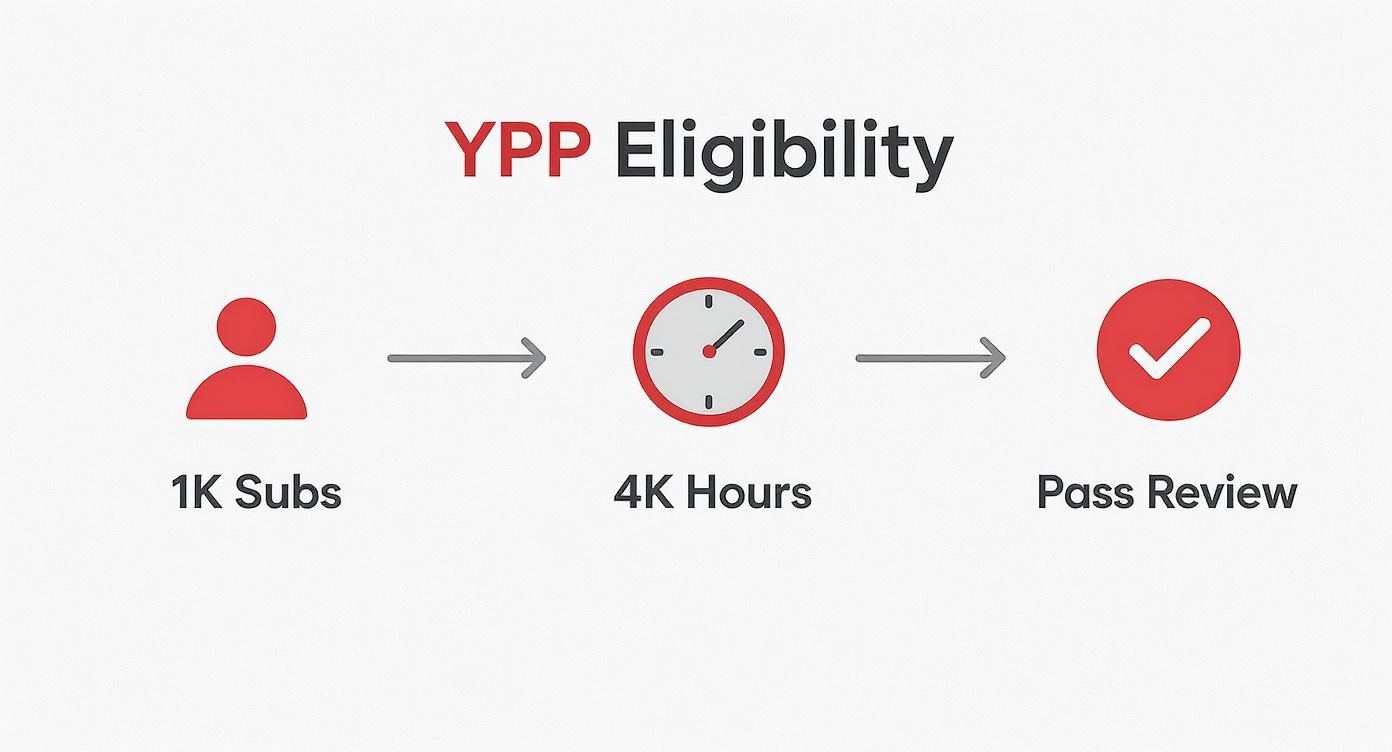
As you can see, hitting the subscriber and watch time goals is just the first half of the journey. Passing the human review is the final hurdle to monetization.
The AdSense Connection: A Critical Detail
Here’s a heads-up on the most common tripwire in the entire application process: AdSense. Google's policy is crystal clear on this: you are only allowed to have one AdSense account per person.
If you've ever created an AdSense account before—maybe for an old blog or another website—you must use that existing account. Trying to make a second one will get your application rejected and can cause some seriously frustrating delays. If you think you might have an old account, take the time to track it down before you apply.
What Happens During the Review
After you click that final button, your channel gets placed in a queue to be looked at by a real person. This isn't just an algorithm checking your stats. A human reviewer at YouTube will actually dive into your channel to make sure it aligns with all of their monetization policies.
This review is basically YouTube's quality control. They're making sure your channel is a good-faith effort that provides value and is a safe place for advertisers. They care about authenticity, not just big numbers.
Reviewers take a holistic look at your channel, focusing on a few key areas:
- Main Theme: What’s your channel all about? Is it consistent?
- Most Viewed Videos: These give the reviewer a quick snapshot of your most popular content.
- Newest Videos: This shows them where your channel is headed and the quality you're producing now.
- Watch Time Sources: They’ll look at which videos are generating the bulk of your watch hours.
- Video Metadata: Your titles, thumbnails, and descriptions all need to follow the rules.
In the end, they’re just trying to answer one question: does this channel offer original, valuable content that follows the Community Guidelines and Advertiser-Friendly Content Guidelines? Knowing this is what they're looking for will help you prepare your channel and apply with confidence.
How You Actually Make Money on YouTube
Getting into the YouTube Partner Program (YPP) is like being handed a master key to a vault with several different treasure chests inside. Most people fixate on the biggest one—ad revenue—but a smart creator knows that real, sustainable income comes from opening as many of those chests as possible.
Think of it this way: relying on just one income stream is like standing on a one-legged stool. It's wobbly and unpredictable. Your goal is to build a solid foundation with multiple legs.
The Foundation: Ad Revenue Sharing
Let's start with the classic. Ad revenue is the bedrock of YouTube monetization and what most people think of first. When advertisers pay to run commercials on your videos, YouTube gives you a piece of the pie. It's a straightforward partnership.
For your standard, long-form videos, you get a 55% cut of the ad revenue. With Shorts, the model works a little differently: creators get 45% of their portion of a collective "creator pool" funded by Shorts ads. This system makes sure even your bite-sized content helps your bottom line.
You also have some control over the types of ads that run:
- Skippable ads: The ones viewers can skip after five seconds.
- Non-skippable ads: Shorter ads that play all the way through.
- Bumper ads: Quick, six-second ads that can't be skipped.
- Overlay ads: Small banners that pop up at the bottom of the video.
Beyond Ads: Direct Fan Support
Ad revenue is great, but it can swing wildly from month to month. That’s where direct fan funding comes in, creating a much more stable and predictable income. These features let your most loyal fans support you directly, turning them from passive viewers into active patrons of your work.
"Diversifying my income streams has been incredibly helpful for my creator business...I’ve also incorporated passive income streams like ad revenue through the YouTube Partner Program, affiliates, and digital products to help level out my income." - Austen Tosone, YouTube Creator
These tools don't just bring in money; they build a stronger, more engaged community.
Key Fan Funding Features
- Channel Memberships: This is basically a mini-Patreon built right into your channel. Fans pay a monthly fee for exclusive perks you create, like custom emojis, members-only videos, or special badges next to their name in the comments.
- Super Chat & Super Stickers: During live streams, viewers can pay to have their message highlighted with a "Super Chat" or send an eye-catching animated "Super Sticker." It's a fun way for them to stand out and support you in real time.
- Super Thanks: Think of this as a tip jar for your regular videos. If someone really loved a specific video, they can send you a "Super Thanks" to show their appreciation with a one-time payment.
YPP Monetization Features Compared
With several options available, it helps to see how they stack up. This table breaks down the primary monetization features, how they function, and which type of creator they suit best.
| Monetization Feature | How It Works | Best For Creators Who... |
|---|---|---|
| Ad Revenue | You earn a percentage (55% for long-form, 45% of the creator pool for Shorts) of the money from ads shown on your videos. | Have consistent viewership and produce content that is advertiser-friendly. |
| Channel Memberships | Viewers pay a recurring monthly fee for exclusive perks like badges, emojis, and members-only content. | Have a loyal, dedicated community that wants to get more involved. |
| Super Chat/Stickers | During live streams, fans can pay to highlight their messages or send animated stickers. | Regularly host live streams and have an active, engaged live chat audience. |
| Super Thanks | Viewers can "tip" on your individual pre-recorded videos to show extra appreciation. | Create high-value evergreen content that viewers find particularly helpful or entertaining. |
| YouTube Shopping | You can link your own merchandise store or promote affiliate products directly below your videos. | Have a strong brand and an audience that would be interested in physical or digital products. |
| YouTube Premium | You get a portion of the subscription fee from YouTube Premium members who watch your content. | Have high watch time, as revenue is based on how long Premium members view your videos. |
As you can see, each feature serves a different purpose. The most successful creators don't just pick one; they combine several to create a resilient business model.
Monetizing Your Content with Products
The YPP also unlocks the ability to turn your channel into a digital storefront. This is a game-changer for connecting your content directly to tangible goods.
Through YouTube Shopping, you can integrate your own merchandise store (think t-shirts, mugs, or digital guides) or promote products from other brands right below your videos. Viewers can browse and buy without ever leaving YouTube, which makes the whole process incredibly smooth. For creators in any niche, this is a fantastic way to monetize YouTube videos far beyond ad views alone.
Tapping into YouTube Premium
Finally, there's a quiet but powerful income stream that comes from YouTube Premium. When a subscriber who pays a monthly fee for an ad-free experience watches your videos, you get a cut of their subscription fee.
Your earnings here are based on how much watch time Premium members spend on your channel. Don't underestimate this one. In late 2022, YouTube Premium was estimated to be pulling in between $879 million and $1.12 billion in monthly revenue, and a slice of that massive pie goes directly to creators like you.
Ultimately, the YPP isn't just one thing; it's a full toolkit designed to help you build a diverse and sustainable business. For a deeper dive, check out this comprehensive guide on how to make money on YouTube. By mixing and matching these methods, you build a financial foundation that's strong enough to support your creative vision for years to come.
What Sinks Most YPP Applications? (And How to Avoid It)
There's nothing more deflating than hitting your 1,000 subs and 4,000 watch hours, applying for the YouTube Partner Program, and getting rejected. After all that work, it feels personal. But usually, it’s not about you—it’s about a few common, and totally avoidable, mistakes.
Think of this as your pre-flight checklist. Before you ask YouTube to review your channel, you need to see it through their eyes. They aren't just looking at your numbers; they're checking if your channel genuinely adds value and follows the YouTube Channel Monetization Policies.
The "Reused Content" Trap
This is, without a doubt, one of the biggest reasons creators get rejected, and it's often misunderstood. "Reused Content" doesn't mean you can never use clips or images from other sources. It means your channel can't just be a collection of other people's stuff without a heavy dose of you.
Imagine a DJ. A bad one just hits play on a Spotify playlist. A great one mixes, scratches, and creates a whole new vibe. That's what you need to do.
Your application will likely get flagged if your channel is full of:
- Clips from movies or TV shows with no real commentary.
- Compilations of other people's TikToks or Twitch streams stitched together.
- Reading Reddit posts or news articles verbatim with no original analysis.
The fix? Make your contribution significant. Add funny commentary, in-depth analysis, or a critical review. Your unique perspective needs to be the main event, not an afterthought.
The "Repetitive Content" Hurdle
Right behind reused content is its close cousin, "Repetitive Content." This rule targets channels that feel like they're mass-produced on an assembly line. If your videos are so similar that it’s hard to tell one from the next, YouTube sees it as low-effort.
YouTube’s goal is to reward creators for adding unique value. If your content feels like a copy-and-paste job, it fails that core test. It doesn't give the audience something new, so it's not a good fit for the partnership.
Think about channels that use software to pump out hundreds of videos with robotic narration or simple slideshows where only the background image changes. That’s the kind of thing that gets flagged.
This often includes:
- Auto-generated videos: Content made by a program with a text-to-speech voice.
- Templated content: Videos where you just swap out a name or a picture but the format is identical every time.
- Simple slideshows: Just images or scrolling text with background music.
The solution is to make sure every video feels distinct. Even if your niche is narrow, bring a fresh angle, new information, or a creative twist to each upload.
Other Red Flags to Watch For
Besides those two big ones, a few other things can get your application tossed out immediately. Do a quick channel audit for these before you apply.
- Copyright Problems: Are there active copyright strikes against your channel? Do you have a ton of unresolved Content ID claims? A single claim won't kill your chances, but a pattern of using music or footage you don't have the rights to is a massive red flag.
- Misleading Thumbnails and Titles: Your metadata needs to be honest. If your titles and thumbnails promise something the video doesn't deliver (aka clickbait), that's a violation. The same goes for stuffing your description with irrelevant keywords.
- Community Guideline Strikes: This one’s a dealbreaker. Any history of promoting spam, dangerous content, or scams on your channel will lead to a swift rejection from the YouTube Partner Program.
Before clicking "apply," take an objective look at your channel. Is it a body of work you’re proud of? Is it original, valuable, and clean? A little self-policing now can save you from the frustration of a rejection later.
Exploring Monetization Beyond the Partner Program
https://www.youtube.com/embed/KJgiCIjKL34
For a lot of creators, getting into the YouTube Partner Program feels like the finish line. But here’s a little secret from the pros: the smartest creators start making money long before they ever see that YPP acceptance email.
Thinking about different income streams from the very beginning makes your channel so much more resilient. You're not putting all your eggs in one basket, which gives you more control and a lot less stress as you grow.
Building Your Own Revenue Streams
Honestly, the best way to earn is to create your own opportunities. These methods don't need YouTube's permission, and you can start them as soon as you have an audience that trusts you—even a small one.
Here are a few of the most popular and effective strategies:
- Affiliate Marketing: This is a classic for a reason. You talk about products you genuinely use and love, share a special link, and earn a commission when someone buys through it. It’s a natural fit for review channels, how-to videos, or really any content where you recommend gear or software.
- Selling Merchandise: Platforms out there make it incredibly easy to design and sell your own merch—think t-shirts, mugs, or hats with your logo or an inside joke from your channel. It’s a great way to make money and build a real community.
- Direct Brand Sponsorships: Don't assume you need a massive following for this. Smaller, niche channels can absolutely land paid deals with brands that want to reach their specific audience. You can pitch companies directly or use platforms designed to connect creators with brands.
By diversifying your income, you're essentially building a financial safety net. It's what allows you to go full-time without constantly worrying about a sudden drop in ad revenue.
These strategies aren't just placeholders until you get into the YPP. They are powerful, long-term business models. For a deeper dive, check out our guide on the top YouTube monetization alternatives in 2025.
Leveraging Your Expertise
Your knowledge is an asset. You can package it up and sell it directly to the people who are already watching you for your expertise. This shifts your role from just a content creator to a trusted authority in your field.
Think about creating digital products. This could be anything from an eBook or a detailed guide to a full-blown video course or a set of templates that save your audience time and effort.
And don't forget YouTube's incredible reach. The platform gives you a massive potential customer base, especially in countries like India, which has around 476 million users. It’s also worth noting that over 90% of YouTube’s traffic comes from mobile, so make sure whatever you’re selling is easy to access on a phone. You can dig into more stats on YouTube’s global user base on analyzify.com.
At the end of the day, whether you're working toward YPP or are already in the program, exploring these other income streams is what separates a monetized channel from a sustainable, long-term business.
YPP FAQs: Your Questions Answered
Even after breaking it all down, a few nagging questions always seem to come up when creators are on the brink of applying to the YouTube Partner Program. Let's clear the air and tackle the most common ones.
How Long Does The YPP Review Process Usually Take?
YouTube's official line is that it takes about a month, but think of that as a ballpark estimate, not a hard deadline. In reality, the timeline can be all over the place.
I’ve seen creators with squeaky-clean, straightforward channels get their approval in just a few days. On the other hand, if your content needs a closer look from a human reviewer to make sure it ticks all the policy boxes, you might be in for a longer wait. You can always check your application status in the “Earn” tab inside YouTube Studio.
Will I Lose Monetization If I Drop Below The Requirements?
This is a huge source of anxiety for creators, but here’s the good news: once you’re in the club, you’re in. If your subscriber count dips below 1,000 or your watch time slides under 4,000 hours, you will not be automatically kicked out. You’ve already proven you can hit the mark.
After you're approved, YouTube cares more about your activity than your stats. They want partners who are actively part of the ecosystem, not just channels that once hit a target.
The only real catch here is inactivity. If you go completely dark and stop uploading videos or posting in your Community tab for six months or more, YouTube might pull your monetization. The fix is simple: stay active.
Is The YouTube Partner Program Available Everywhere?
The YPP is available in a lot of places, but it's not a global free-for-all. This is a crucial detail to check before you put in all the hard work.
YouTube keeps an official, updated list of all the countries where the program is live. Do yourself a favor and check that official YouTube Help Center list to make sure your country is on it. The list does grow, so always rely on the source for the latest info.
Grinding your way to YPP eligibility can feel like a marathon. If you'd rather skip the long wait and start earning right away, MonetizedProfiles offers a fast track. We provide fully approved, monetization-ready YouTube accounts so you can jump straight to what you do best: creating great content.
See what's available and start your journey today at https://monetizedprofiles.com.


