


So, what is this "growth hacking" thing you keep hearing about?
At its heart, growth hacking is all about one thing: rapid experimentation. It’s less about following a rigid marketing playbook and more about applying a scientific, data-first approach to figure out the fastest ways to grow a business. Think of it as a relentless hunt for clever shortcuts to scale your audience, user base, or revenue.
Deconstructing Growth Hacking

Let’s cut through the buzzwords. Growth hacking isn't some secret magic trick; it's a specific mindset focused entirely on scalable growth.
Imagine a traditional marketer as a patient gardener. They carefully plant seeds one by one, nurturing them over a long season and following the established rules for watering and sunlight. It’s a proven, steady process.
A growth hacker, on the other hand, is like a botanist trying to engineer a self-scattering seed pod. The goal isn't just to grow one plant but to create something that multiplies and spreads on its own, carried by the wind. They’ll run hundreds of tiny tests on the soil, light, and seed design to find the perfect combination that explodes across the landscape.
This scrappy, high-speed approach is a perfect fit for content creators and faceless automation professionals who need to see rapid channel expansion without a massive budget.
Mindset Over Methods
The term was coined back around 2010 by Sean Ellis, who was looking for a way to describe a process that builds a self-perpetuating growth machine. Done right, businesses that truly adopt this mindset can see up to 10x faster user growth compared to conventional methods.
This distinction is what really matters. Traditional marketing often focuses on broader goals like brand awareness and long-term campaigns. Growth hacking is obsessed with immediate, measurable results that directly move the needle.
Growth hacking prioritizes clever, testable, and scalable tactics over large budgets. It’s about finding the highest-impact results with the lowest possible resource investment.
Growth Hacking vs Traditional Marketing At a Glance
To make this crystal clear, let’s put the two approaches side-by-side. The table below breaks down the fundamental differences in how they operate, which really highlights why growth hacking is so powerful for online creators.
| Aspect | Traditional Marketing | Growth Hacking |
|---|---|---|
| Primary Goal | Brand awareness, market share | Rapid user acquisition and growth |
| Budget | Often large and pre-approved | Minimal and highly flexible |
| Process | Long-term campaigns, structured | Short, rapid experiments (sprints) |
| Focus | Top of the funnel (awareness) | The entire user journey (AARRR) |
| Metrics | Impressions, reach, sentiment | User activation, retention, virality |
| Team | Siloed marketing department | Cross-functional (product, data, marketing) |
As you can see, the entire philosophy is different.
For a faceless YouTube or TikTok creator, this means you stop worrying about a single, big "launch" and start focusing on relentless testing. It's about trying ten different video hooks, five thumbnail styles, and three calls-to-action just to see which combination doubles your subscriber rate. To do this well, you need to understand the core principles of audience growth, like learning what makes a video go viral and how to do it.
Ultimately, this cycle of testing, measuring, and learning is the real engine of growth. We dive into a ton of these practical strategies over on our https://monetizedprofiles.com/blog.
Adopting the Growth Hacker Mindset
Understanding the definition of growth hacking is one thing, but truly internalizing the mindset is where the magic happens. This isn't just about learning a few new tricks; it’s about a fundamental shift in how you look at your content, your audience, and your entire operation. It's the difference between stumbling into success and engineering it.
At its heart, this way of thinking rests on three key pillars. First, an almost obsessive focus on data—and I don't mean just the surface-level stuff. Second, a relentless drive to experiment, treating every single piece of content as a test. And finally, a holistic view of the entire viewer journey, from the first click to becoming a die-hard fan.
For a content creator or a faceless channel manager, this means you stop obsessing over vanity metrics like subscriber counts. Those numbers tell you what happened. A growth hacker is laser-focused on why it happened and how to make it happen again, bigger and better.
The Power of Deep Data Analysis
Getting deep into your data isn't about drowning in spreadsheets. It's about asking smarter questions. For instance, instead of just celebrating that a video got 10,000 views, a growth hacker immediately jumps into YouTube Analytics and pulls up the audience retention graph.
They're on a mission to find the exact moment—down to the second—where a big chunk of viewers decided to leave. Was it a clunky transition? A boring intro? An explanation that just didn't land? That drop-off point isn't a failure; it’s a goldmine of information. By figuring out what’s pushing people away, you can fix it in the next video, methodically boosting your watch time and sending powerful engagement signals to the algorithm.
This simple shift turns you from someone who just makes content into someone who makes content that performs.
Relentless Experimentation and Testing
A traditional creator might polish a single video for weeks, hoping it’s a masterpiece. A growth hacker sees that same video as one data point in a much bigger experiment. They live by the mantra of rapid, constant testing to discover what truly connects with their audience.
This could look like:
- Thumbnail A/B Testing: Not just making two versions, but maybe ten wildly different thumbnails for one video and using tools to see which one gets the best click-through rate (CTR).
- Hook Variation: Writing the first five seconds of a video in three different ways and analyzing the retention data to see which intro grabs the most people.
- Call-to-Action (CTA) Changes: Testing if "smash the like button" actually works better than asking viewers to "join our Discord" for driving real community engagement.
This commitment to experimentation turns content creation from a pure art form into a data-informed science. It doesn't kill creativity; it channels it. Instead of relying on gut feelings, you’re making decisions based on cold, hard evidence.
"Growth hacking is a process of rapid experimentation across marketing channels and product development to identify the most effective, efficient ways to grow a business."
It’s all about finding leverage—the smallest tweak that delivers the biggest results. This isn't about being a "hacker" in the stereotypical sense. In fact, a 2023 report on the state of growth revealed that only 10.9% of professionals still see growth hacking as just finding cheap tricks. The field has matured, shifting its focus to rigorous data experimentation and building scalable systems for growth. You can dive into the full report on growth trends and professional perspectives to see just how much things have changed.
A Creator-Focused Mindset in Action
Let's make this real. Imagine you run a faceless YouTube channel that makes animated history summaries. You notice one video about ancient Rome absolutely crushed it.
- The Traditional Mindset: "Awesome, the Rome video went viral! I'll make another one about Rome."
- The Growth Hacker Mindset: "Okay, why did this specific video do so well? Was it the thumbnail art style? The faster storytelling pace? The specific historical figure we focused on? I need to isolate the variables. I'll make three new videos: one with the same thumbnail style but about a different topic, one on another Roman topic but with a totally different thumbnail, and one with a much faster editing style. Then I'll measure the CTR and audience retention on all three to find the real growth driver."
See the difference? By testing hypotheses, the growth hacker uncovers the repeatable formula behind their channel's success. They can then scale that growth on purpose, not by accident. That, right there, is the essence of thinking like a growth hacker.
Using the AARRR Funnel to Grow Your Channel
If the growth hacker mindset is the engine driving your channel, then the AARRR funnel is your GPS. It’s a beautifully simple framework—often called "Pirate Metrics"—that lays out a clear roadmap for real, scalable growth. Forget guessing what to do next. This model gives you five distinct, measurable stages of a viewer's journey.
For a content creator, this is like getting a cheat sheet for winning with the algorithm. It shows you exactly where your energy will have the biggest impact, helping you turn casual scrollers into a loyal, monetized community. The five stages are Acquisition, Activation, Retention, Referral, and Revenue.
Let's dive into what this looks like for a monetized social account.
Stage 1: Acquisition — Where Do New Viewers Come From?
Acquisition is the very top of your funnel. It answers one simple question: how do people find your channel for the very first time? This is all about grabbing attention and pulling fresh eyeballs into your world.
For faceless channels on TikTok or YouTube, this isn't about running expensive ads. It’s about being clever and using the platform’s own discovery tools to your advantage.
- Trending Audio: Using a trending sound isn’t just for fun; it's a raw acquisition tactic. The algorithm is already pushing that audio hard, giving your video a free visibility boost to a massive audience that wouldn't have seen it otherwise.
- Keyword-Rich Descriptions: When someone searches "easy side hustle ideas," you want your video to be the one they find. By optimizing your titles, descriptions, and tags with the right keywords, you make your content discoverable through search.
- High-Impact Thumbnails: On YouTube, your thumbnail is your billboard. A compelling, high-contrast thumbnail that clearly promises value can make a huge difference in your click-through rate, which is a core acquisition metric.
Stage 2: Activation — Turning Viewers Into Subscribers
Okay, so you got a click. Now what? That's where Activation comes in. This stage is about getting that new visitor to take a meaningful first step. It's the difference between someone watching one video and leaving forever versus deciding, "Wow, I need more of this."
An activated user is someone who truly experiences what your channel is all about. For a creator, this usually means they smash that subscribe button, join your email list, or follow your profile.
Those first three to five seconds of your video are everything for activation. You need an irresistible hook that instantly tells the viewer they're in the right place. A great hook might promise a solution, spark deep curiosity, or present a fascinating problem that your video is about to solve.
The entire growth process hinges on this scientific loop of looking at data, trying new things, and mapping out the viewer's journey.
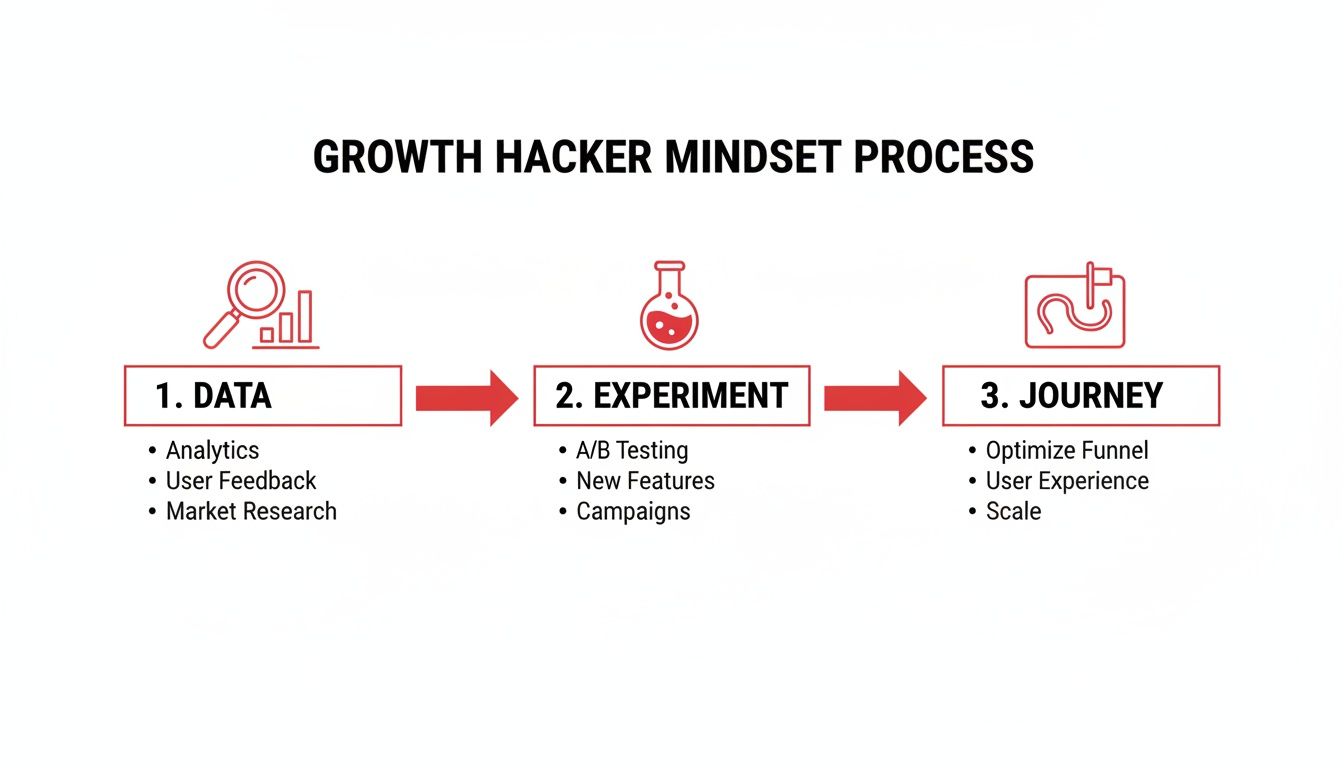
This process shows that real growth isn't about finding one magic trick. It's about a relentless cycle of testing and learning.
Stage 3: Retention — Creating Binge-Worthy Content
Retention might just be the most important metric for the long-term health of your channel. It asks a simple but crucial question: do they come back for more? Platforms like YouTube and TikTok love channels with high audience retention because it's a powerful signal that people are finding the content genuinely valuable.
A killer growth hack for retention is to create a content series.
Let's say you run a faceless channel about weird historical events. Don't just make a one-off video. Create a five-part series, and end each video on a cliffhanger that leaves people desperate to see the next one. You've just transformed your channel from a collection of random videos into a must-see destination.
Stage 4: Referral — Turning Fans Into Marketers
This is where your growth really starts to compound. Referral happens when your content is so good, so entertaining, or so shockingly useful that your audience does the marketing for you. Every share, every "you have to see this" tag in the comments—that's a referral.
To get this flywheel spinning, you need to bake "share triggers" into your content. These are moments designed to get an emotional reaction, making someone feel almost obligated to send it to a friend. This could be a mind-blowing statistic, a laugh-out-loud moment, or a brilliant insight that makes the viewer look smart just for sharing it.
Stage 5: Revenue — Connecting Growth to Your Bank Account
Finally, Revenue. This is where it all comes together. This stage isn’t just about flicking on monetization; it’s about understanding how every single step before it feeds your bottom line.
- Better Acquisition and Activation mean more subscribers, which lifts your baseline ad revenue.
- Higher Retention leads to more watch time from each user, a massive factor in how much platforms like YouTube will pay you.
- A strong Referral loop means you spend less time and money promoting yourself, which directly increases your profit margins.
By focusing on each step of the AARRR funnel, you stop chasing flimsy vanity metrics. Instead, you're systematically building a reliable, scalable, and profitable content machine.
Actionable Growth Hacks for Content Creators

This is where the rubber meets the road. All the frameworks and mindsets are great, but real growth happens when you actually do something. So, let’s get into some concrete, step-by-step tactics designed specifically for content creators, especially those running YouTube and TikTok automation channels.
These aren't complex theories. They are simple, repeatable systems you can put into action today to see real results. Each one is built on the core growth hacking principles: test fast, follow the data, and find clever shortcuts to scale.
The Content Splintering Technique
One of the most efficient hacks for any creator trying to be on multiple platforms is content splintering. The idea is dead simple: never let a piece of content live in just one form. You want to squeeze every last drop of value out of the effort you put in.
Let's say you just spent hours grinding out a 15-minute deep-dive video for your faceless YouTube channel. With this technique, that one video becomes the raw material for an entire wave of new content.
- Step 1: Identify Key Moments: Watch your video and pull out 5-10 of the best moments. These could be surprising facts, powerful quotes, quick tips, or even funny outtakes.
- Step 2: Create Micro-Content: Chop each of those moments into its own vertical video, perfectly formatted for TikTok, YouTube Shorts, or Instagram Reels. Slap on some captions and a trending sound.
- Step 3: Deploy and Measure: Just like that, you've turned one asset into ten potential viral clips. Post them over a few days and watch your analytics to see which themes or formats pop off. Then, just double down on what works.
This approach massively increases your chances of being discovered without forcing you to constantly brainstorm new ideas from scratch. It’s a classic example of what is growth hacking: getting more out of what you’ve already got.
The Trending Audio Hijack
Algorithms on platforms like TikTok and Instagram live and breathe trending audio. The Trending Audio Hijack is all about finding a sound that's blowing up and pairing it with content from your niche—even if it seems like a weird fit at first. This lets you ride the coattails of the algorithm's built-in promotional engine.
For creators going all-in on TikTok, this is non-negotiable. To truly master the platform, you have to understand the little tricks that lead to explosive growth. It’s worth diving into some proven TikTok growth hacks to see just how powerful this can be.
The real skill is finding a creative way to connect the audio's vibe to your video's message. For instance, you could use a trending emotional song over a faceless video showing a chart of your channel's growth, telling a silent story of struggle and success. This tactic injects your niche content directly into a massive, mainstream conversation.
The Community Growth Loop
Maybe the most powerful growth hack of all is building a system that feeds itself. The Community Growth Loop turns your viewers into an active part of your marketing team, creating a flywheel that promotes your content for you.
The core concept is to create a cycle where your content builds a community, and that community, in turn, amplifies your future content.
Here’s how you build it:
- The Call-to-Action (CTA): End your videos with a strong, specific CTA that pushes viewers to an exclusive spot, like a Discord server or private Facebook group. Give them a good reason to join, like behind-the-scenes content or direct access to you.
- Community Engagement: Once they’re in, make it a place they want to be. Nurture that community. This is your secret lab for testing new video ideas, getting instant feedback, and building real relationships with your biggest fans.
- The Amplification: Now, when you post a new video, you have a direct line to your most passionate supporters. Announce it in the community first. They'll provide that first wave of views, likes, and comments, which sends immediate positive signals to the algorithm and kickstarts its promotion to everyone else.
This creates a powerful, self-perpetuating loop. It’s the same logic that made Dropbox a household name—their simple referral program offered users free storage for inviting friends, leading to a 3900% increase in users (from 100,000 to 4 million) in just 15 months.
Whether you're a startup or a creator, getting your audience to bring in more audience members is the ultimate growth hack. It's also a fantastic way to give a new channel a strong start, especially if you hit the ground running with a monetized TikTok account.
Your Essential Growth Hacking Toolkit
Just like a chef needs their knives, a growth hacker needs the right set of tools. You can have the best ideas in the world, but without the right tech to test, measure, and scale them, you’re just guessing.
For content creators, especially those running faceless channels, this doesn't mean you need to spend a fortune. It's about being smart and choosing tools that give you the biggest bang for your buck—the ones that help you find those hidden pockets of growth.
Getting to Know Your Audience with Analytics
Data is your best friend. Seriously. Before you can "hack" anything, you need to know what you're working with. Who's watching? Where are they coming from? What makes them stick around? These tools give you the answers.
-
YouTube Studio: This is so much more than a place to upload videos. It’s your command center. Get obsessed with the Audience Retention graphs—they literally show you the exact second viewers get bored and click away. The Traffic Sources report is another goldmine, telling you if people are finding you through search, recommendations, or elsewhere.
-
TikTok Analytics: For TikTokers, this is non-negotiable. It shows you follower growth, sure, but the real magic is in the traffic sources. Look for the percentage of views coming from the "For You" feed. A high number here is your proof that you’re successfully feeding the algorithm what it wants.
A growth hacker sees beyond the vanity metrics like total views. They're digging through the dashboards, hunting for patterns in viewer behavior that scream "opportunity!" This deep dive into the data is what growth hacking is all about.
Putting Content Creation on Autopilot
Let's be real: scaling content is a grind. Automation isn't about being lazy; it's about being strategic so you can focus on the big picture instead of tedious, repetitive tasks. This is especially true if you're hitting the ground running with something like an aged YouTube channel, where you need to build on existing momentum right away.
-
Canva: Your secret weapon for creating killer thumbnails, social posts, and short-form video clips in minutes. Their templates are a lifesaver, letting you produce professional-looking graphics without needing a design degree.
-
Zapier: Think of this as the universal translator for all your apps. You can set up little automated workflows, or "Zaps," to handle simple tasks. For example, you can create a Zap that automatically shares your latest YouTube video to a Discord channel, saving you a few clicks every single time.
Finding What People Are Actually Looking For
One of the easiest shortcuts to growth is to simply create content about things your audience is already searching for. Don't reinvent the wheel. These tools help you tap into that existing demand so the platform's algorithm does the hard work for you.
-
TubeBuddy & VidIQ: If you're on YouTube, you need one of these browser extensions. Period. They integrate right into YouTube and give you keyword scores, competitor insights, and tag suggestions. Use them to uncover those "golden keywords"—the ones with decent search volume but not a ton of competition.
-
Google Trends: This free tool from Google is fantastic for sniffing out what's hot right now. You can see if a topic is on the rise or falling out of fashion, helping you ride the wave of a trend instead of getting caught in its wake.
To make it even simpler, here’s a quick-reference table of the kinds of tools a creator-focused growth hacker should have in their back pocket.
Essential Growth Hacking Tool Stack for Creators
| Tool Category | Example Tools | Primary Use Case |
|---|---|---|
| Analytics & Data | YouTube Studio, TikTok Analytics, Google Analytics | Understanding audience behavior, identifying top-performing content, and finding traffic sources. |
| Content Creation | Canva, CapCut, Adobe Express | Quickly creating high-quality thumbnails, social graphics, and short-form videos. |
| Automation | Zapier, IFTTT, Make.com | Connecting different apps to automate repetitive tasks like cross-platform posting. |
| Keyword Research | TubeBuddy, VidIQ, Google Trends | Finding low-competition, high-demand keywords and spotting emerging content trends. |
| Email & Community | ConvertKit, Mailchimp, Discord | Building a direct line of communication with your audience off-platform. |
This isn't an exhaustive list, of course, but it's a solid foundation. The key is to find a few tools that solve your biggest problems and then master them.
Got Questions About Growth Hacking?
Once you start wrapping your head around growth hacking, the practical questions start popping up. It's easy to talk about the AARRR funnel, but how does that actually help your faceless YouTube channel get more views? Let's tackle some of the most common questions head-on.
We'll cut through the noise with clear, direct answers. Think of this as the practical guide to applying these strategies without the fluff, helping you move from theory to real-world experiments.
Is This Just a Thing for Tech Startups?
Not at all. While the term got its start in Silicon Valley, the mindset is universal. At its heart, growth hacking is simply a process of rapid, data-driven experimentation to find the most efficient ways to grow. That applies to anyone trying to build an audience on a budget.
For a content creator, this approach is a superpower. You probably don't have a massive marketing budget or a team of analysts. Your advantage is your agility—you can test new video formats, thumbnail styles, or content hooks faster than bigger players. A solo creator running a network of automated TikTok channels can be more of a growth hacker than a stuffy corporate marketing department.
It's all about the same core idea:
- A startup tests ad copy to find what lowers their cost per customer.
- You test video titles to see which one gets the highest click-through rate.
The goal is identical: find the small tweak that delivers an outsized result. The playing field is different, but the game is the same.
Isn't This Just a Fancy Word for Spamming?
This is a really important distinction, so let's be clear: ethical growth hacking and spam are polar opposites. The difference comes down to one simple word: value.
Spam is about blasting irrelevant, unwanted messages at people, hoping something sticks. It’s a numbers game that completely disrespects the user. True growth hacking is the reverse. It’s about creatively finding ways to deliver more value to the right people.
A spammer shoves a flyer under 10,000 doors, hoping for a single call. A growth hacker creates a guide so useful that 1,000 people willingly share it with their friends.
The whole point is to create a win-win. Dropbox’s famous referral program wasn't spam. It was a brilliant growth hack because it gave real value to both the person sharing (more free storage) and the person signing up (more free storage). It fueled explosive growth because everyone benefited.
How Long Until I See Results?
This is the classic "how long is a piece of string?" question, but I can give you some realistic guideposts. The speed of your results depends entirely on the speed and quality of your experiments. Growth hacking is not an overnight magic trick.
Some tests give you answers almost immediately. You could A/B test a YouTube thumbnail and see a clear winner with a 2% higher click-through rate within a day. That's a quick, measurable win.
On the other hand, bigger strategies, like building a community on Discord to drive traffic to your videos, might take weeks or even months to gain real momentum. The key is to stop looking for one giant viral moment and start focusing on iterative progress. Your goal is a chain of small, consistent improvements that stack up over time.
What Are the Big Mistakes I Should Avoid?
It’s easy to stumble when you're just starting out. Keep an eye out for these common traps, and you'll save yourself a ton of headaches.
- Testing Everything at Once: If you change your video's thumbnail, title, and description all at the same time, you'll have no idea what actually worked (or didn't). You have to isolate your variables. Test one thing at a time to get clean data you can actually use.
- Ignoring the Human Feedback: Numbers are crucial, but don't forget to read the comments. Your audience will literally tell you what they want, what confused them, and what they loved. That feedback is a goldmine for your next experiment.
- Quitting Too Early: Your first ten ideas will probably "fail." That’s not just okay—it's part of the process. Every failed test teaches you what doesn't work, which gets you one step closer to what does. The biggest mistake is giving up before you find that winning formula.
Ultimately, growth hacking is about embracing this cycle of testing, learning, and adapting. It’s how you take the guesswork out of growing your monetized social accounts and replace it with a clear, methodical path forward.
At MonetizedProfiles, we believe in giving creators a head start. Our monetization-approved social media accounts let you skip the grind and start earning from day one, so you can focus all your energy on implementing these powerful growth strategies. Check out our ready-to-go accounts and begin your growth journey today.


