


Ever created something you're proud of—a killer photo, a great article, or a catchy tune—and wished you could make money from it more than once? That's exactly what content licensing lets you do.
Essentially, you're not selling your work; you're renting it out. You give another person or company a permission slip to use your creation under very specific conditions. This way, you earn money while still owning your original work.
What Is Content Licensing in Simple Terms

Let's stick with the property analogy. Owning a piece of content is like owning a house. You could sell it outright and hand over the keys for good. Or, you could rent it out, letting someone else use it for a while in exchange for regular payments. Content licensing is the rental agreement for your creative work, your intellectual property (IP).
Every licensing deal involves two main parties:
- The Licensor: That’s you—the creator, the copyright owner, the "landlord" of the content.
- The Licensee: This is the person or business paying for the right to use your work—the "tenant."
The license agreement is the official rulebook. It clearly spells out how, where, and for how long the licensee can use your content. This document is your best friend, ensuring you stay in control while opening up new ways to make money and get noticed.
A Powerful Tool for Creators
At its heart, content licensing is a smart business move. It transforms one creative asset into an ongoing source of income. Instead of selling a photo just once, you could license it to a magazine, a marketing firm, and a popular blog all at the same time. Suddenly, that single photo is generating three separate paychecks. This is precisely how industries like stock photography and music libraries thrive.
One of the biggest perks is the boost in visibility. When a big brand licenses your content, they're essentially showing off your work to their massive audience. This builds your reputation and gets your name out there—no advertising budget required on your part.
Table: Key Players and Concepts in Content Licensing
To get a handle on this, it helps to know the lingo. Here’s a quick overview of the essential terms you'll encounter in any content licensing agreement.
| Term | Simple Definition | Real-World Example |
|---|---|---|
| Licensor | The owner of the content (you, the creator). | A photographer who owns the copyright to a stunning landscape photo. |
| Licensee | The person or company paying to use the content. | A travel magazine that wants to feature the photographer's photo on its cover. |
| Royalty | The payment made to the licensor for the right to use the content. | The magazine pays the photographer 5% of the revenue from every issue sold. |
| Exclusive License | Grants the licensee the sole right to use the content. No one else can. | The photographer agrees that only this magazine can use the photo for one year. |
| Non-Exclusive License | The licensor can grant the same usage rights to multiple licensees. | The photographer also licenses the same photo to a blogger and a hotel chain. |
These terms form the foundation of any licensing deal, so getting comfortable with them is the first step toward making smarter decisions about your work.
Keeping Your Assets in Order
As you start licensing more content, keeping track of all those "permission slips" becomes absolutely critical. You can't afford to accidentally sell exclusive rights to two different clients or forget when a license is up for renewal. Good organization is the key to scaling your efforts without creating a mess.
To really get this right, it's worth exploring some digital asset management best practices. A solid system will help you protect and monetize your portfolio as it grows.
Ultimately, understanding content licensing shifts your perspective. Your creative work is no longer just a collection of pieces in a portfolio; it's a dynamic library of valuable assets. By mastering this process, you can get paid for your work again and again, build your brand, and keep your intellectual property safe. It's a fundamental skill for any creator serious about building a lasting career.
The Blueprint of a Licensing Agreement
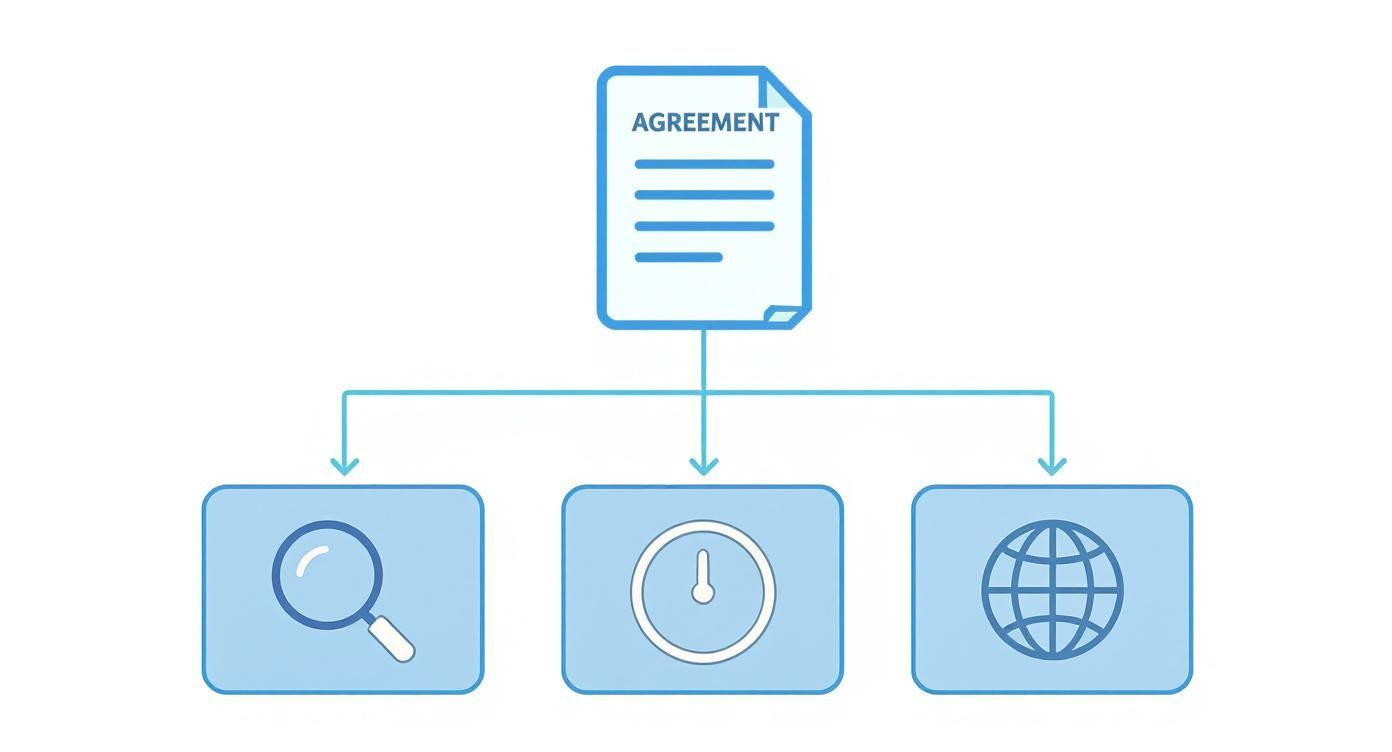
Every content licensing deal hinges on a few core components that lay out the ground rules. Think of the agreement as the official "terms of service" for using your creative work. It's the legal document that keeps everyone on the same page, protecting both you (the creator) and the person licensing your content.
This contract might look a little daunting at first, but it really just boils down to a handful of essential parts. Once you get a handle on these, you'll feel much more confident putting together or signing an agreement. To get a feel for how these pieces fit together in a real document, it can be helpful to look over a generic license agreement template.
Defining the Scope of Use
First up, and arguably the most important part, is the scope. This section answers one simple question: "What, exactly, can they do with my content?" It draws a clear line in the sand, preventing your work from popping up in ways or places you never agreed to.
Let's stick with our example of a musician licensing a song to a vlogger. The scope would clearly state that the song can only be used as background music for videos on their specific YouTube channel. It would also probably forbid the vlogger from doing things like:
- Selling the song separately: They can't just rip the audio and sell it as a music track.
- Using it in paid ads: The license might only cover organic, non-promotional content. Using it in a commercial would require a different, pricier license.
- Altering the original work: The vlogger likely can't create their own remix of your song without getting your express permission.
Getting super specific here is your best defense against future headaches. Ambiguity is not your friend.
By clearly defining the scope, you keep the reins on how your work is presented to the world. It ensures your content is always used in a way that feels right for your brand.
Setting the Duration and Territory
Next, every agreement needs a calendar and a map. The duration clause sets the timeline for the license. How long is it good for? Is it a one-year deal, a five-year term, or does it last forever (known as a "perpetual" license)? Shorter terms, like a common 24-month license for digital content, give you the freedom to renegotiate or find a new partner down the line.
The territory defines the geographical boundaries. Can the vlogger's video be seen only in North America, or is it a worldwide license? Naturally, global rights are worth more and come with a bigger price tag. This is especially important if your work has an international audience.
Understanding Exclusivity
Finally, you need to decide on exclusivity. This determines if you're giving rights to just one person or company, or if you can license the same content to others at the same time. It usually comes in two flavors:
- Exclusive License: This is like giving someone the only key. For the duration of the agreement, they are the only one who can use your content. If our musician grants an exclusive license, no other creator or company can touch that song. Because it takes your content off the market for others, this type of license costs a lot more.
- Non-Exclusive License: This is far more common. It lets you license the same piece of content to as many people as you want. The musician could give a non-exclusive license to the vlogger, a marketing agency, and an indie filmmaker all at once. This is the model that powers most stock photo and music sites.
This choice has a massive impact on how you can earn money from your work. And remember, licensing is about granting permission to use your content, not giving up ownership entirely. That's a completely different ballgame. To get a better sense of that distinction, our guide on how to transfer ownership of a YouTube channel touches on similar ideas of rights and control.
Exploring Different Content Licensing Models
Content licensing isn't a one-size-fits-all deal. Think of it like renting a vehicle: you wouldn't get a long-term commercial truck lease just to run errands for a weekend. The right license depends entirely on what you want to achieve, so understanding the common models is the first step to getting it right.
Let's break down the main types of licenses you’ll run into, whether you're a creator selling your work or a business looking for the perfect asset.
Royalty-Free: The Workhorse License
The most common model you'll see on stock photo sites is Royalty-Free (RF). The name can be a bit confusing—it doesn't mean the content is free. It simply means you pay a single, one-time fee to use the content multiple times without ever paying another royalty.
Imagine you're a startup building a new website. You can buy a Royalty-Free photo of a team meeting for a flat fee and then use that same image on your homepage, in social media posts, and in your sales deck. No extra charges. It's a simple, budget-friendly choice for everyday needs.
This model is all about volume and convenience, making it perfect for:
- Blog posts and website images
- Social media content
- Internal presentations
- Small-scale marketing flyers
Rights-Managed: The Precision Tool
At the other end of the spectrum is Rights-Managed (RM) licensing. This model is incredibly specific, with the license tailored to a single use case. The cost is calculated based on exactly how, where, and for how long you plan to use the content.
Think about a major brand launching a national billboard campaign. They would secure a Rights-Managed license for a specific photograph. The price would hinge on factors like the number of billboards, the geographic regions (e.g., U.S. only), and the campaign's duration (e.g., three months). It's more expensive, but it offers creators higher paydays and gives brands greater control—often including exclusivity.
A huge plus for Rights-Managed licenses is the ability to track an asset's usage history. This prevents a direct competitor from using the same high-impact image in their campaign, keeping your project looking unique.
Creative Commons: The Spirit of Sharing
Not all licensing is about making a direct sale. Creative Commons (CC) is a nonprofit that provides a range of free-to-use copyright licenses. These licenses empower creators to let the public share and use their work, but with certain conditions attached.
For instance, a photographer might release her photos under a CC license that allows anyone to use them for free, as long as they provide proper credit (attribution). There are several types of CC licenses—some allow commercial use, while others don't. This is a great model for creators looking to build their reputation and get their work seen by a wider audience, which can open doors to other paid opportunities down the road. It's a strategy similar to what influencers do on various platforms, which you can learn more about in our guide on the TikTok Creator Marketplace.
To help you visualize how these models differ, here's a quick comparison.
Comparing Popular Content Licensing Models
This side-by-side look breaks down the common licensing types to help you decide which is best for your creative or business needs.
| Model Type | Best For | Common Cost Structure | Key Limitation |
|---|---|---|---|
| Royalty-Free (RF) | General digital use like blogs, social media, and small business websites. | One-time flat fee for multiple uses. | Non-exclusive, meaning others can license and use the same content. |
| Rights-Managed (RM) | High-profile, exclusive projects like major ad campaigns or book covers. | Custom pricing based on usage scope, duration, and territory. | Limited to the specific use case outlined in the agreement; expensive. |
| Creative Commons (CC) | Creators who want to share their work widely and build a following. | Free to use, but with conditions like attribution or non-commercial use. | Limited control over where and how the content is ultimately used. |
| Subscription | Businesses and creators needing a constant supply of fresh content. | Recurring monthly or annual fee for a set number of downloads. | Downloads are often capped, and license terms end if the subscription is canceled. |
Each model serves a different purpose, so the "best" one really comes down to balancing your budget, your project's needs, and your long-term goals.
Subscription Models: The "All-You-Can-Eat" Approach
A huge trend in the licensing world is the rise of subscription services, which are really a spin on the Royalty-Free model. Platforms like Adobe Stock or Envato Elements offer users access to millions of assets for a flat monthly or annual fee. Subscribers can typically download a certain number of photos, videos, or templates each month.
This model is a win-win. It gives creators a more predictable income stream and provides businesses with an affordable way to access a ton of high-quality content. This shift is a major reason the global Content Licensing and Distribution Market, valued at around $400 billion recently, is on track to hit $800 billion by 2032. Subscriptions make content more accessible than ever.
How Creators Use Licensing to Grow Their Brand

For creators, content licensing isn't just about getting paid once for a piece of work. It's a genuine strategy for building a lasting brand. While the licensing fee is a great immediate perk, the real magic lies in the long-term benefits that can turn your passion into a full-fledged, sustainable business.
Think about it: that amazing photograph, well-crafted article, or catchy song doesn't have to be a one-and-done sale. By licensing it, you turn that single piece of work into an asset that can be monetized over and over again. Your back catalog suddenly becomes a source of passive income, working for you long after you've moved on to the next project.
This creates a much more stable financial situation. Instead of constantly chasing the next client, you can build a library of licensable content that brings in money in the background. That kind of diversification is a lifesaver for navigating the typical ups and downs of creative work.
Expanding Your Reach Without the Marketing Budget
One of the biggest wins with licensing is the massive, organic boost in exposure it gives you. When a bigger company or a well-known brand licenses your content, they're basically paying to put your work in front of their entire audience.
This is marketing gold, and you don't have to spend a dime on it. All of a sudden, your photography could be on a corporate website seen by millions, or your music could be in a popular podcast heard by thousands. This gets your name in front of new fans, potential clients, and collaborators who probably never would have found you otherwise.
It's an incredibly efficient way to grow. You get to focus on what you do best—creating—while your partners handle the promotion, spreading your work across new markets and platforms.
Building Credibility and Authority
Having your work picked up and used by reputable brands is powerful social proof. It sends a clear signal to everyone in your industry that your work is top-notch and professional, which gives your credibility an instant lift. That association can be a real game-changer.
When your name is attached to a successful campaign or a popular product, it validates your skill and talent. This borrowed authority can open doors to bigger and better opportunities that were previously out of reach.
Let's look at how this plays out in the real world:
- The Graphic Designer's Story: A talented designer creates a unique icon set and puts it up on a creative marketplace. A major software company licenses the icons for its new app.
- The Ripple Effect: The app takes off. Design blogs start writing about its slick, user-friendly interface, and they credit the designer. Before long, their inbox is flooded with messages from other tech companies and big-name clients wanting custom work.
- The Outcome: That first licensing deal wasn't just a one-time paycheck. It was the launchpad for the designer's entire career, positioning them as an expert in their field.
Turning Creative Assets into a Business
At the end of the day, licensing completely changes how you see your own work. Your portfolio is no longer just a collection of past projects; it's a dynamic inventory of valuable assets. Every single piece holds the potential to become a recurring revenue stream and a tool for building your brand.
This business-first mindset helps you think more strategically. You start creating not just for a single client, but with a broader market in mind, trying to anticipate trends and produce work that has long-term licensing appeal. It’s how you turn your creative passion into a brand that can scale and last.
Why Businesses Rely on Licensed Content
We've talked about how licensing helps creators make money from their work, but that's only half the story. For businesses, licensing content isn't just a handy shortcut—it’s a core part of staying competitive and managing costs. Let's face it: creating professional-grade content from the ground up is a huge drain on time, talent, and money.
By using licensed assets, companies can sidestep those production headaches entirely. They get immediate access to a massive pool of ready-to-use photos, videos, music, and articles. This means they can get marketing campaigns off the ground for a fraction of what it would cost to create everything themselves.
Gaining Speed and Agility
In today's market, you can't afford to be slow. A business that launches a campaign in a few days while its competitor takes weeks has a huge advantage. Content licensing is what makes that kind of speed possible.
Think about a marketing team on a tight deadline for a new social media ad. The client wants a killer video, and they want it yesterday. Instead of spending weeks planning, shooting, and editing, the team can license some high-quality video clips and a professional music track. Just like that, they can assemble a polished ad in a matter of hours.
Licensed content allows businesses to move at the speed of the market. It eliminates production bottlenecks, enabling rapid campaign launches and quick pivots in strategy when needed.
Ensuring Quality and Consistency at Scale
Another major headache for growing businesses is keeping their brand looking consistent. As you push out content across different channels, it’s tough to make sure everything feels professional and cohesive.
Licensing solves this. Stock content platforms give you access to millions of assets created by pros, so you know you’re getting a high standard of quality. It’s a great way for smaller businesses to punch above their weight and project an image that rivals much larger companies.
A few key benefits really stand out:
- Access to Top-Tier Talent: A small startup can use a photo from an award-winning photographer—something they could never afford to commission directly.
- Brand Consistency: Businesses can easily find a whole series of images or videos with a similar vibe, creating a unified look across their website, social media, and ads.
- Reduced Risk: Licensed content comes pre-vetted for quality and legal clearance, so you don't have to worry about the risks that come with using amateur or unverified assets.
A Smart Financial and Strategic Decision
At the end of the day, licensing is just a smart financial move that frees up resources. Instead of pouring money into a single photoshoot or video, a company can put that budget toward other important things, like developing new products or improving customer service.
The numbers don't lie. The global brand licensing industry was recently valued at an incredible USD 369.6 billion, with the entertainment and character segment alone pulling in around USD 149.8 billion. This isn't some niche strategy; it's a massive part of the global economy. You can discover more about these industry trends from Licensing International.
By truly understanding what is content licensing, businesses can see it's more than a way to save a few bucks. It’s a strategic tool for staying ahead of the curve, allowing them to publish better content, faster than ever before.
Understanding Your Rights with Copyright and IP
https://www.youtube.com/embed/XzzkSZ0Jrko
When it comes to content licensing, there’s one golden rule: you can only license what you legally own. This all comes down to two key ideas you’ll hear a lot about: copyright and intellectual property (IP).
Think of copyright as the automatic protection you get the second you create something original. The moment you snap a photo, write a blog post, or compose a song, copyright law gives you the exclusive rights to decide how that work gets used, copied, and shared. It’s your creative DNA, legally recognized.
This ownership is the very thing that makes licensing possible. Without it, you have nothing to offer someone who wants to use your work. Intellectual property is just a bigger umbrella term that covers copyrights, trademarks, and patents. But for most creators like us, copyright is the main game—it’s the legal foundation for every licensing deal you’ll ever make.
And this isn't just legal fluff; it's a massive opportunity. The global market for copyright licensing recently hit USD 175.78 billion and is only getting bigger. That number shows just how valuable legally protected creative work has become.
The Role of a Written Agreement
A handshake deal or a quick email might feel simple, but in licensing, it’s a shortcut to a headache. A formal, written agreement isn't just a good idea; it's absolutely essential. It’s the one document that protects both you (the licensor) and the person using your content (the licensee) from confusion and legal trouble down the road.
This contract is where you spell out the rules of the game. It clearly defines what the licensee can and can't do with your work, for how long, and in what parts of the world. Without that piece of paper, you're left in a messy "he-said, she-said" situation if something goes wrong, leaving your work unprotected.
A written agreement isn't just about preventing problems; it's about creating clarity. It ensures everyone understands their responsibilities and rights, fostering a professional relationship built on trust and mutual respect.
Key Legal Concepts You Should Know
You don’t need to be a lawyer to get the hang of licensing, but knowing a few core concepts will help you protect your work and your wallet. Getting comfortable with these terms will empower you to make smarter decisions.
- Copyright Infringement: This is just a legal way of saying someone used your work without permission. If a brand slaps your photo on an ad without a license, that's infringement. They're violating the exclusive rights you hold as the creator.
- Fair Use: This is a tricky one. In some very specific cases, people can use small parts of your work without asking. Think movie reviews that show a short clip or a teacher using a poem in a lesson. But be careful—fair use is a complicated legal defense, not a free-for-all pass to use whatever you want.
- Public Domain: Once a creative work is old enough, its copyright protection expires, and it enters the public domain. This means it belongs to everyone and can be used by anyone for free. Think of Shakespeare's plays or Beethoven's symphonies.
If you want to see how these ideas are put into practice, a great example is looking at a service’s Terms and Policies page, which breaks down usage rights for their creative assets.
Getting a handle on these basic legal ideas gives you the confidence to manage your creative work like a pro. It’s how you make sure your art is not just a source of income, but also something that’s respected and protected for the long haul.
Got Questions About Content Licensing? Let's Clear Things Up.
Diving into content licensing can feel a little confusing at first, so let's tackle some of the most common questions that pop up for creators and businesses. Getting these basics down will help you feel much more confident as you start out.
What’s the Real Difference Between Licensing and Selling My Content?
Think of it this way: selling your content is like selling your house. Once you sign the papers, it's a done deal. You transfer the ownership—known as an assignment of copyright—and you no longer have any rights to it. It's a one-time transaction.
Licensing, on the other hand, is more like renting out that house. You still own it, but you're giving someone else permission to use it under specific terms for a set amount of time. The best part? You can "rent out" that same piece of work to many different people, opening up multiple income streams from one creative asset.
How in the World Do I Price a Content License?
There’s no magic number here, unfortunately. Pricing a license is less of a strict formula and more of an art that balances several key factors.
Here’s what you need to consider:
- Scope of Use: How, and where, will your content be used? An image for a small personal blog is going to be priced very differently from one used in a national ad campaign.
- Exclusivity: If you grant an exclusive license, you're promising not to license that content to anyone else. That kind of exclusivity is valuable and should command a much higher price.
- Duration and Territory: A license that grants worldwide usage rights for five years is going to be worth a lot more than one limited to a single country for just six months.
A good starting point is to see what similar work goes for in your specific field, whether that's photography, music, or writing. Check out stock content sites in your niche—many even have pricing calculators that can give you a solid ballpark figure.
Do I Really Need a Lawyer for a Licensing Agreement?
For simple, low-stakes agreements—like a standard royalty-free image license from a stock site—you can usually get by with a standard template. But when the stakes get higher, a lawyer is your best friend.
For any deal involving a lot of money, complex terms, or exclusivity, you should absolutely consult an intellectual property lawyer. They’ll make sure the contract is watertight and protects your interests, which can save you from massive headaches and costly legal battles down the road.
Can I License Work I Already Did for a Client?
This is a big one, and the answer is: it depends entirely on your original contract with that client.
If you signed a "work for hire" agreement, the client usually owns all the rights, meaning you can't license it to anyone else. However, if you kept the copyright and just gave the client a license to use the work, then you're free to license it as you please. It all comes down to what's in that initial contract.
Ready to fast-track your content creation journey? MonetizedProfiles offers monetization-approved social media accounts, perfect for creators looking to earn from day one. Skip the grind and start building your brand today by visiting MonetizedProfiles.


