


So, what exactly are YouTube watch hours? In the simplest terms, it’s the total amount of time people have actually spent watching your videos. It’s the metric that truly measures how captivating your content is, and honestly, it’s way more important than just racking up views.
What Are YouTube Watch Hours, Really?

Think of it like this: a "view" is just someone walking into your shop. It's nice to have a lot of foot traffic, but it doesn't mean much if they all turn around and walk right back out.
"Watch hours" are the people who come in, browse for a while, and actually stick around. This tells YouTube that what you're offering is valuable and holds people's attention—and that's the kind of content the algorithm loves to push.
The Key to Getting Monetized
This intense focus on viewer engagement is precisely why watch hours are a huge part of qualifying for the YouTube Partner Program (YPP). To even get in the door, your channel needs to hit 4,000 valid public watch hours in the last 12 months, plus have 1,000 subscribers. This rule is in place to make sure you've built a real, dedicated audience before you can start making money.
If you're curious about the bigger picture, you can find more details on YouTube's massive user base and monetization rules on Global Media Insight.
In essence, watch hours are the currency of viewer satisfaction on YouTube. They signal to the algorithm that your content is not just being clicked on, but is being genuinely consumed and enjoyed.
But here’s the catch: not all watch time is created equal, especially when you’re chasing that YPP goal. It’s super important to know what counts and what doesn't.
What Counts Towards Your 4,000 Hours
When it comes to hitting that magic number for monetization, only the time people spend watching your public long-form videos and livestreams makes the cut. To make this crystal clear, here’s a quick summary of what gets you closer to your goal and what falls short.
YouTube Watch Hours At a Glance
| Type of View | Counts Towards 4,000 Hours? | Reason |
|---|---|---|
| Public Long-Form Videos | Yes | This is the core content YouTube prioritizes for this metric. |
| Public Livestreams | Yes | Active engagement during live events is highly valued. |
| YouTube Shorts Views | No | Shorts have their own separate monetization model and don't count here. |
| Private Videos | No | Only content that’s available to the general public is included. |
| Deleted Videos | No | If you remove a video, its watch hours go with it. |
| Ad Campaign Views | No | Paid views from ads aren't considered organic engagement. |
Basically, YouTube is looking for genuine, organic watch time from the audience you've built. That means focusing on creating great public videos that keep people hooked.
Why YouTube Cares More About Watch Hours Than Views
To really get what watch hours mean on YouTube, you have to put yourself in YouTube's shoes. For the longest time, the name of the game was racking up as many views as you could. But that created a big problem: a high view count didn't always mean people were actually watching or enjoying the video.
So, YouTube made a pretty big switch. They realized their whole business works better when people stick around on the platform for as long as possible. The longer someone watches, the more ads they can show, and the happier that user generally is. It just makes for a better experience all around. This is why watch hours became the new king.
Think about it. A video that keeps someone hooked from start to finish is way more valuable to YouTube than some clickbait clip that gets millions of views but everyone clicks away from after 15 seconds. The first video signals quality and viewer satisfaction. The second one just signals disappointment.
From Quick Clicks to Real Engagement
Let’s imagine two completely different YouTube channels.
Channel A is all about those shocking, 30-second viral clips. A video might pull in a million views, which sounds amazing. But the average person only watches for about ten seconds before they get bored and leave. The total watch time is big, but it’s incredibly shallow.
Now, let's look at Channel B. This creator makes detailed, 20-minute tutorials. One of their videos might only get 50,000 views, but the average viewer sticks around for a solid 15 minutes because the content is genuinely useful. This video racks up far more total watch hours and sends a much stronger signal to the YouTube algorithm.
The algorithm sees high audience retention as a giant flashing sign that says "This is a quality video that people love!" As a result, it’s far more likely to recommend that video to new people, which creates an awesome growth loop for the creator.
This is the whole idea behind YouTube's obsession with watch time. They want to reward videos that keep people glued to their screens, not just the ones that are good at getting that first click.
How This Affects Your Channel's Growth
This focus on genuine engagement has a direct impact on how your channel grows. When your videos consistently get people to watch for longer, the YouTube algorithm starts to see you as a creator who delivers. Here’s what happens next:
- More Recommendations: Your videos will start popping up more on the homepage, in the "Up Next" sidebar, and within search results.
- Higher Search Rankings: Videos with great watch time metrics tend to rank higher for their target keywords, bringing in more free, organic traffic.
- A Loyal Audience: Content that actually delivers value makes people want to subscribe and come back for more. This is how you build a real community, not just a list of subscribers.
At the end of the day, by focusing on watch hours, YouTube makes the platform better for its users. They get served content that's actually worth watching, which keeps them coming back. For you as a creator, understanding this is the secret to building a channel that lasts, instead of one that just chases fleeting trends.
How to Track Your Public Watch Hours Correctly
If you're aiming for monetization, you need to know exactly where you stand. But first, let’s get one thing straight: not all watch time is created equal in YouTube's eyes. To hit that magic 4,000-hour mark, you need what YouTube calls “valid public watch hours.”
Think of it as YouTube’s way of measuring real, authentic interest from your audience. For a watch hour to count, it has to come from your publicly available videos and livestreams.
So, what kind of watch time gets left behind?
- YouTube Shorts Views: Shorts are fantastic for getting discovered, but they play by their own rules and don't contribute to the 4,000-hour goal.
- Private or Unlisted Videos: If a video isn't public for anyone to see, the watch time from it won't count.
- Deleted Videos: Be careful with that delete button! If you remove a video, all the watch hours it ever earned vanish from your total.
- Ad Campaign Views: Views you paid for through things like Google Ads aren't considered organic, so they're not included.
Finding Your Progress in YouTube Studio
Thankfully, you don’t have to guess where you are on your journey. YouTube makes it simple to check your progress.
Here’s how to find your official count in just a few clicks:
- Log in to your account and head over to YouTube Studio.
- On the left-side menu, look for the “Earn” tab (it’s the one with the dollar sign).
- Right there, you'll see the “Become a Partner” section. It lays out your current subscriber count and, most importantly, your public watch hours from the last 365 days.
This is your go-to spot for the official numbers. YouTube keeps this page updated, so it’s the only source you need to trust for your monetization eligibility.
This dashboard gives you the big picture, but the real gold is hidden a bit deeper. To figure out which videos are actually pulling their weight, you’ll want to dive into your analytics.
For a more granular look, you can check out some of the top YouTube analytics tools for channel growth to really understand what’s working. Getting comfortable with these numbers is how you turn good content into a great strategy.
Proven Strategies to Increase Your Watch Hours
Getting more watch hours isn't something that just happens; it’s the result of a smart, deliberate content strategy. You need to create videos that don't just get people to click, but convince them to stay.
Let's dive into some practical tactics you can start using right away to see those watch time numbers climb.
The cornerstone of racking up watch hours is making genuinely interesting videos that have some meat on them. While there's no perfect length, videos that run longer than 10 minutes tend to give you a better shot at accumulating more watch time from each viewer.
This isn't an excuse to pad out a three-minute idea, though. It’s about choosing topics that actually need a deeper explanation, whether it's a comprehensive tutorial, a detailed story, or an in-depth review.
Hook Viewers from the Start
You’ve got about 15 seconds. That’s it. That’s the window you have to convince someone they’ve landed on the right video. Your intro, or "hook," is make-or-break for holding onto your audience.
Forget long, drawn-out intros or fancy logo animations. Get straight to the point and show them what they're in for.
- Ask a burning question you promise to answer in the video.
- Flash a quick clip of the final result before you show them the process.
- Drop a surprising fact or a bold statement that makes them think, "Wait, what?"
When you prove your video’s value upfront, you give viewers a compelling reason to stick around past that critical initial drop-off.
The infographic below breaks down exactly what YouTube counts as a "valid" public watch hour, which is crucial for understanding how to focus your efforts.
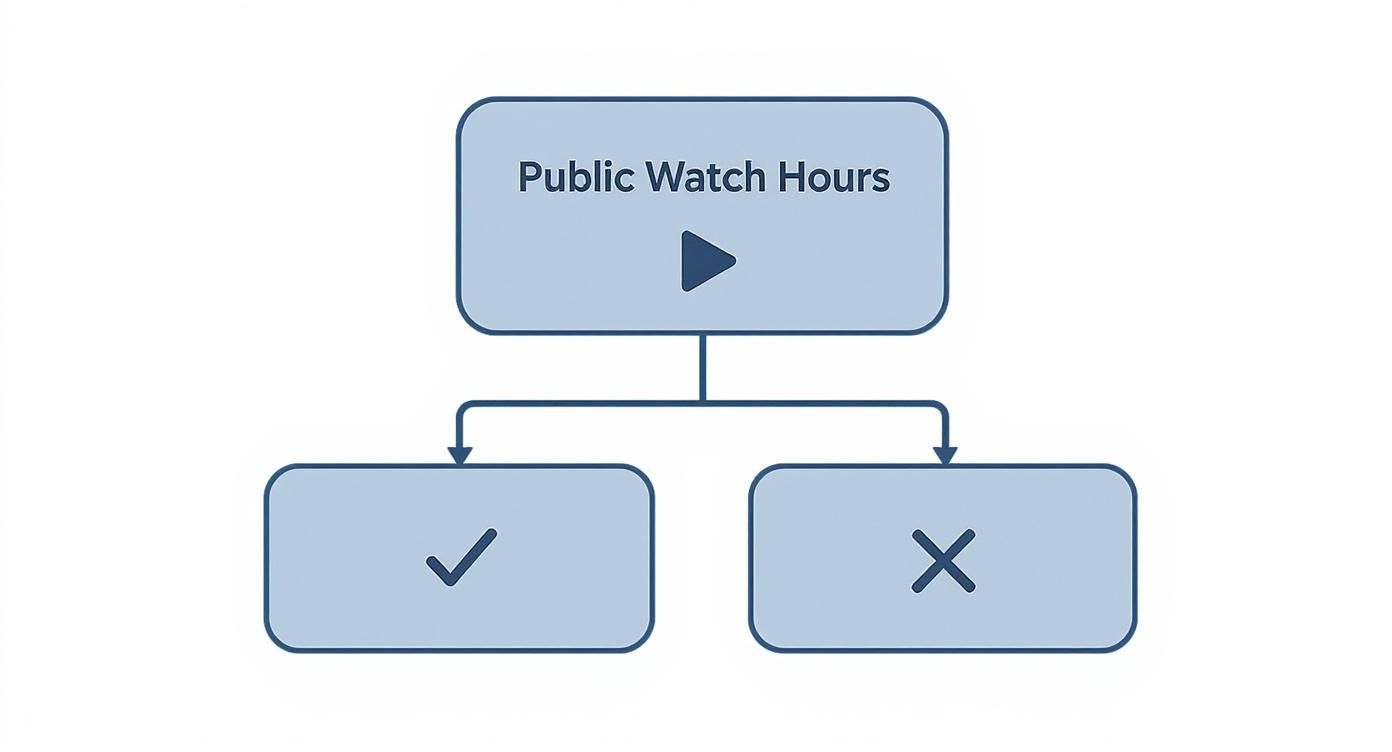
As you can see, your strategy has to be all about creating public, long-form content if you want to hit those YPP goals.
Engineer Your Content for Binge-Watching
One of the best ways to see your watch hours multiply is to get people to watch more than one of your videos in a single sitting. You have to actively encourage the binge-watch.
The goal is to make the decision to watch another one of your videos the easiest, most logical next step for your viewer. Don't leave it to chance; guide them intentionally through your content library.
Creating a video series or organizing your content into playlists around a core theme is a fantastic way to do this. When one video is just a piece of a larger story, viewers are naturally motivated to keep watching to get the full picture.
Use your end screens and cards to point them directly to the next video or a related playlist. It's a simple move that can turn a single view into a full-blown viewing session, sending your watch hours soaring. For a deeper dive, check out our guide on the fastest way to get 4000 watch hours on YouTube for more pro-level tips.
Not all strategies have the same effect. Choosing the right approach depends on whether your main goal is to keep viewers on a single video for longer or to get them to watch multiple videos.
Watch Hour Boosting Strategies and Their Impact
| Strategy | Primary Goal | Potential Impact on Watch Hours |
|---|---|---|
| Long-Form Content (>10 mins) | Increase Audience Retention on a single video | High. One video can generate significant watch time from a single engaged viewer. |
| Creating a Video Series | Encourage Session Duration across multiple videos | Very High. Turns a single view into a multi-video session, multiplying watch time. |
| Using Playlists | Organize content to facilitate Binge-Watching | High. Keeps viewers within your ecosystem, moving from one video to the next seamlessly. |
| Strong Hooks (<15 secs) | Reduce initial Viewer Drop-off | Moderate to High. Maximizes the potential watch time from every viewer who clicks. |
Ultimately, a mix of these strategies will give you the best results. Focus on creating longer, high-value videos and then make it incredibly easy for your audience to find and watch more of your content.
How YouTube Shorts Fit into Your Strategy
With short-form video taking over, a huge question creators have is how YouTube Shorts fit into the monetization puzzle. Let's get the most important detail out of the way first.
Views from Shorts do not count toward your 4,000-hour watch time requirement. This is a crucial distinction to understand.
Think of Shorts as the flashy movie trailer for your channel. Their main job isn't to rack up watch hours on their own. Instead, they’re a powerful discovery engine. The Shorts feed can get your content in front of a massive, fresh audience that might never have stumbled upon your longer videos.
This creates a brilliant funnel. Someone sees a quick, catchy Short, gets hooked, and clicks over to your channel to see what else you've got. That's when they find your deeper, long-form content—the videos that do pile up those precious watch hours.
Building a Hybrid Content Strategy
The smartest creators on YouTube right now are running a hybrid strategy. They're balancing the viral reach of Shorts with the community-building power of long-form videos. It's a one-two punch that works incredibly well.
Shorts are your top-of-funnel marketing. They grab attention and build awareness. Your longer videos are what turn those casual viewers into a loyal community that generates real watch time.
This strategy is a modern twist on a classic approach. Between 2014 and 2022, the amount of video uploaded every minute exploded by about 40%, which naturally led to a huge increase in traditional watch hours. Now, Shorts are a vital part of that ecosystem, changing how creators think about growth.
If you want to dive deeper into how you can actually make money from this format, you can learn more about if you can monetize YouTube Shorts in our detailed guide.
Using Shorts effectively is all about playing the long game for sustainable channel growth. For more advanced techniques on weaving Shorts into your content plan to boost your long-form videos, check out the shortgenius website for more insights.
Unlocking Your Channel's Global Potential

It’s so easy to get tunnel vision as a creator. You're constantly staring at your own analytics, obsessing over that next subscriber milestone. But to really get a handle on the opportunity here, you need to zoom out and see just how massive this playground truly is. YouTube isn't just another website; it's a global phenomenon.
Think about it: every single day, people all over the world watch billions of hours of content on the platform. That number is almost too big to comprehend, but it represents a gigantic, always-on pool of potential watch hours. Even grabbing a tiny sliver of that attention can be enough to turn a small channel into a full-blown community.
This huge viewership leads to some mind-boggling stats. On average, a YouTube user spends nearly 27 hours watching videos every month. And it's only growing. Projections show that YouTube will hit 2.85 billion monthly active users by 2025—that's more than a third of everyone on the internet.
Tapping into a Worldwide Audience
The amazing part is that your content can find an audience you never even knew existed. A simple tutorial you film in your bedroom could solve a problem for someone halfway across the globe. A vlog about your hometown could connect with people in a dozen different countries who find it fascinating.
The question isn't whether an audience for your niche exists—it's how you can create content compelling enough to capture its attention within this vast global network.
Figuring out how channels succeed financially is crucial, especially as you start to look at more creative approaches, like monetization strategies for AI influencers. Every single creator, big or small, is pulling from this same worldwide ecosystem.
Make Global Trends Work for You
Keeping this global scale in mind should actually shape how you create. For example, knowing that more people are watching on mobile phones and TV screens should push you to make sure your videos look great on any device. A video that’s easy to watch on a phone is far more likely to keep someone engaged while they’re on their commute.
When you really grasp the sheer volume of watch hours happening globally, that 4,000-hour goal starts to feel less like a mountain and more like a reachable milestone. Your next video could be the one that breaks out and finds viewers far beyond your own backyard, building momentum one view at a time.
Your Top Questions About YouTube Watch Hours, Answered
As you start chasing that monetization goal, you're bound to run into a few tricky questions. Everyone does. Let's clear up some of the most common ones so you can stop guessing and start growing.
Do My Own Views Count Toward the 4,000 Hours?
This is probably the first question every new creator asks. The short answer is no. While it's tempting to hit replay on your own videos, YouTube is smart enough to know the difference between genuine audience engagement and a creator bumping their own stats.
Your own views are filtered out. The system is built to measure how other people interact with your content, so focus your energy on attracting real viewers, not on artificially inflating your numbers.
What Happens If My Watch Hours Drop After I'm Monetized?
You did it! You’ve been accepted into the YouTube Partner Program. So, what happens if your watch time dips back below the 4,000-hour mark?
Take a deep breath—you’re safe. Once you’re in the YPP, you’re in. YouTube understands that channel performance fluctuates. A drop in watch hours won't get you kicked out.
The one thing to watch out for is inactivity. If you don't upload a video or post to your Community tab for 6 months or more, YouTube might review your channel's status. The key is simply to keep creating.
How Long Does It Realistically Take to Get 4,000 Watch Hours?
This is the classic "how long is a piece of string?" question. There's just no one-size-fits-all answer. Some channels get lucky with a viral hit and smash the goal in a few months. For most creators, it's a steady climb that takes a year or even longer.
To put it in perspective, 4,000 hours is 240,000 minutes.
Let's do some quick math. If you have a video that people watch for an average of 5 minutes, you'd need 48,000 views on that one video to hit your target. This really highlights why longer, super-engaging videos can be a game-changer for getting monetized faster.
Ready to skip the grind and start earning from your content immediately? MonetizedProfiles offers fully approved YouTube accounts that meet all the monetization requirements from day one. Get your monetized channel today and focus on what you do best—creating great content. Find out more at https://monetizedprofiles.com.


