


Let's be honest, calling YouTube just a "video-sharing site" is like calling Amazon just a "bookstore." It's so much more than that—it’s a critical piece of any modern social media marketing plan. Why? Because it’s also the world's second-largest search engine, a place where people go when they're actively looking for answers, how-to guides, and entertainment.
This guide is your complete playbook for taking a YouTube channel from a simple idea to a real, revenue-generating asset for your business.
Why YouTube Is a Social Media Powerhouse
It's easy to fall into the trap of seeing YouTube as just a hosting platform for your videos. But that mindset completely misses the bigger picture. At its heart, YouTube is a massive social network powered by content, community, and search.
Unlike platforms like Instagram or Twitter where content has the lifespan of a mayfly, your YouTube videos are long-term assets. A well-made video can keep pulling in new viewers for years, making it a cornerstone for any serious digital marketing effort. It’s where you can forge deep connections with an audience that’s already looking for the solutions you offer.
The Unmatched Scale of YouTube
The numbers behind YouTube are just staggering. It gives brands an incredible opportunity to reach a truly global audience, which is why it dominates the social media marketing YouTube conversation.
Think about this: by 2025, YouTube's potential ad reach is expected to hit 2.53 billion people. That's about 31% of the entire planet's population, putting it well ahead of Facebook and Instagram in terms of ad reach.
This isn't just a vanity metric. It translates directly into more brand awareness, more leads, and ultimately, more sales. For example, in a huge market like India, YouTube's ad reach was projected to be 491 million users in early 2025 alone. You can find more social media marketing statistics and see how they can shape your campaign strategy.
The real power of YouTube lies in its dual nature: It's both a massive social platform for community building and a powerful search engine for capturing high-intent audiences. Your strategy must address both sides to succeed.
More Than Just Views
A smart YouTube strategy delivers real business results that go way beyond simple view counts. Every single video you publish becomes a new touchpoint, guiding interested viewers down your sales funnel.
Here’s how a strong YouTube presence really moves the needle:
- Building Authority: When you consistently create high-quality, educational content, you become the go-to expert in your niche.
- Driving Targeted Traffic: You can strategically send engaged viewers from your videos directly to your website, specific landing pages, or product pages.
- Generating Revenue: Forget just ad revenue. You can promote your own products, push affiliate offers, or sell services directly to a warmed-up audience that already trusts you.
We'll walk you through the entire process—from setting up a professional-looking channel and nailing your content plan to mastering the growth tactics that actually work.
YouTube Marketing at a Glance
To get a clear picture of what we'll cover, this table breaks down the core components of a successful YouTube strategy. Think of it as our roadmap.
| Strategy Component | Key Objective | Primary Focus |
|---|---|---|
| Channel Setup & Branding | Establish a professional and recognizable brand presence. | Creating a compelling channel identity and optimizing for discovery. |
| Niche & Content Strategy | Attract a dedicated audience with valuable, targeted content. | Identifying your target audience and planning a sustainable content calendar. |
| Production & Repurposing | Create high-quality videos efficiently and maximize their reach. | Developing a streamlined workflow for shooting, editing, and distribution. |
| YouTube SEO | Increase organic visibility and attract viewers through search. | Optimizing titles, descriptions, tags, and thumbnails for discoverability. |
| Growth & Engagement | Build a loyal community and encourage viewer interaction. | Implementing tactics to boost subscribers, watch time, and comments. |
| Automation & Scaling | Grow your channel with less hands-on effort. | Using tools and systems to manage and scale content production. |
| Monetization & Integration | Turn your channel into a profitable business asset. | Exploring multiple income streams, from ads to affiliate marketing. |
Each of these pieces is crucial. By the end of this guide, you’ll understand how they all fit together to build a powerful marketing engine on YouTube.
Laying the Foundation for a Credible Channel
Think of your YouTube channel as your digital storefront. It’s way more than just a place to dump your videos. For anyone just stumbling upon your brand, your channel's appearance is a massive signal. Does it look professional and serious, or like a forgotten hobby? That first impression often determines whether they click "subscribe" or just click away.
Before a single video goes live, you need to pour some serious thought into the channel itself. This isn't about just filling in the blanks; it's about making deliberate choices with your name, branding, and messaging. Every piece should fit together to tell a clear story about who you are and what you offer.
Nailing Your Channel Name and Visuals
Your channel name is the first big branding decision you'll make. It has to be something people can remember, spell easily, and ideally, it should hint at what you do. If you call yourself "DIY Home Reno Hub," people instantly get it. That clarity helps both viewers and the YouTube algorithm understand your focus.
With a name picked out, your visuals are next. You have two crucial pieces of digital real estate to work with:
- Your Profile Picture: This little icon follows you everywhere—on your channel, beneath your videos, in every comment you leave. It needs to be crisp and instantly recognizable, even when it’s tiny.
- Your Channel Art: This is the big banner at the top of your page. It's your billboard. Use it to show off your brand's personality, spell out your value proposition, or even post your upload schedule.
These two elements are the first things anyone sees. They have to scream professionalism and make your channel feel like a place worth exploring.
Writing an "About" Page That Works for You
Your channel's "About" page is a goldmine for YouTube SEO, yet so many creators treat it as an afterthought. This is your chance to tell YouTube exactly what your channel is all about. It’s basically an extended pitch for both potential subscribers and the algorithm.
Craft a description that’s genuinely interesting and packed with the right keywords. Clearly explain who you're trying to reach and what problems you solve for them. Weave your keywords in naturally. Instead of just saying, "We post marketing videos," try something like, "This channel is all about helping small businesses master social media marketing on YouTube, with practical tutorials covering everything from video SEO to content strategy."
Pro Tip: Google and other search engines index your channel description. The first couple of sentences are critical because they often show up in search results. Make them count.
For those on a faster track, sometimes acquiring a channel that already has some history is the smart play. You can see how a monetized YouTube channel can give you an immediate head start on your content strategy.
Designing a Channel Layout That Converts
A smart channel layout is all about guiding people to your best stuff and keeping them on your page longer. YouTube actually gives you some great tools to customize what new visitors and returning subscribers see.
This screenshot from YouTube's own guide shows where you can set up a featured video for your subscribers and a completely different channel trailer for newcomers. This is a powerful feature—it lets you tailor the experience for both audiences.
Here's how to set up your layout for the best results:
- Create a Killer Channel Trailer: This is a short video (30-60 seconds) that auto-plays for anyone who isn't subscribed. It needs to be a quick, energetic introduction to you and your content, ending with a clear call to subscribe.
- Pick a Great Featured Video: For your subscribers who already know you, this spot is perfect for your latest upload, a fan favorite, or a video tied to a current promotion.
- Use Playlists Strategically: Group your videos into logical playlists like "Beginner Guides," "Advanced Tactics," or "Client Case Studies." Feature these playlists right on your homepage. This makes it incredibly easy for viewers to binge-watch, which drives up your watch time—a metric the YouTube algorithm absolutely loves.
Developing a Content Strategy That Connects
Okay, so you've got a great-looking channel. That's a solid start, but a pretty banner won't keep people coming back. Your content will. Without a clear plan, you'll find yourself scrambling for ideas, your uploads will be sporadic, and your audience won't know what to expect. A good content strategy is your roadmap, plain and simple. It makes sure every video has a purpose.
This isn't just about jotting down a few video ideas on a napkin. It’s about getting inside the head of your ideal viewer and creating a world of content that solves their problems, answers their questions, or just keeps them entertained. That's how you turn a casual viewer into a die-hard fan.
This flow breaks down the essential pillars for building a channel that actually attracts an audience, from that first spark of an idea to the content that makes them stick around.
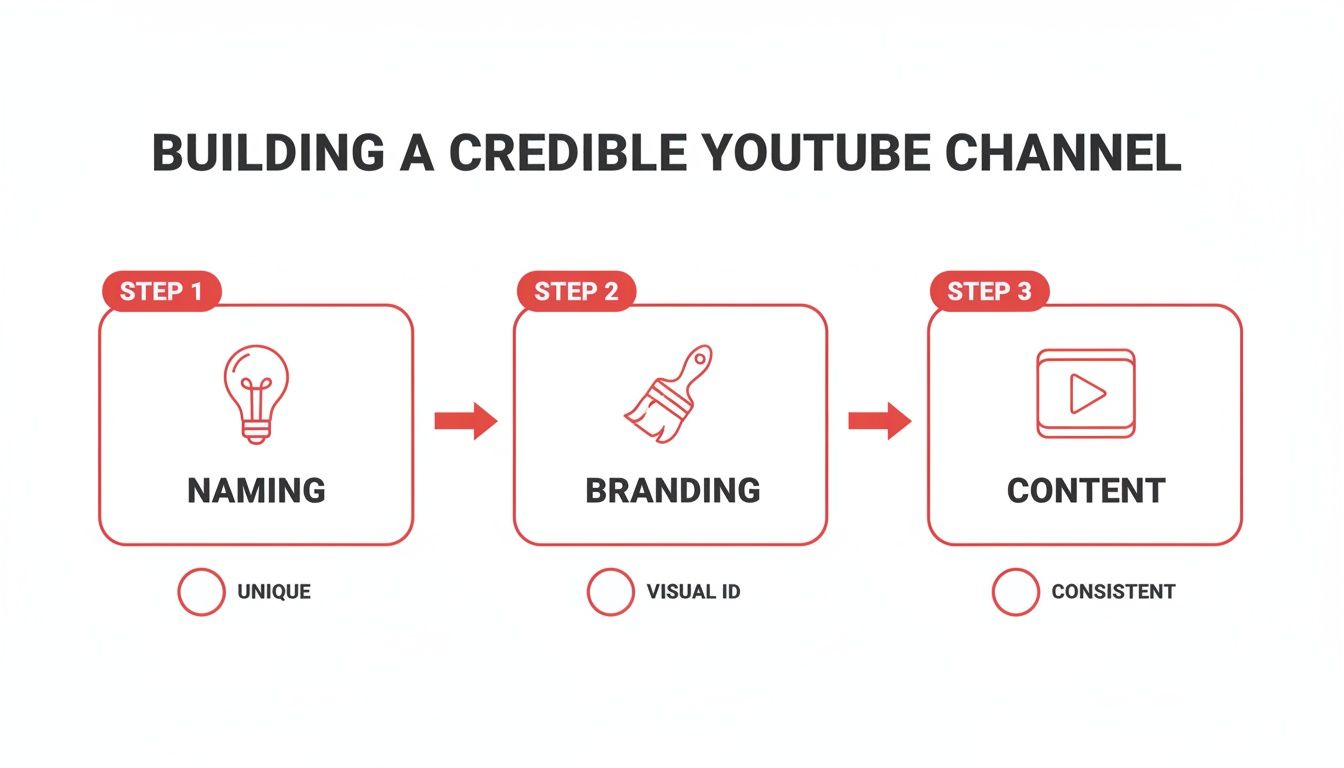
As you can see, content is the final piece of the puzzle. It’s what gives your channel its personality and ultimately decides whether you sink or swim.
Defining Your Niche and Audience
Before you even think about hitting that record button, you need to answer two huge questions: Who am I making this for? And what am I giving them? If you try to make videos for everyone, you'll end up connecting with no one. That's a fatal mistake on a platform as crowded as YouTube.
Your niche is your specialty. Don't just be a "fitness" channel; be the "bodyweight fitness for busy parents" channel. See the difference? That specificity makes you memorable. Once you’ve nailed your niche, sketch out a detailed profile of your ideal viewer.
- What are their biggest frustrations and day-to-day challenges?
- What questions are they typing into Google and YouTube's search bar?
- What kind of videos do they actually enjoy watching (tutorials, vlogs, deep dives)?
Answering these questions helps you create content that feels like it was made just for them.
Building Your Content Pillars
Think of content pillars as the main themes that hold up your channel. You don't need a dozen of them; usually, three to five are perfect. They give your channel variety without feeling random and act as a compass for all your video ideas.
Let’s say your channel is all about social media marketing for YouTube. Your pillars could look something like this:
- Educational Tutorials: Super practical, step-by-step guides on things like "How to Design a Thumbnail That Gets Clicks" or "A Beginner's Guide to YouTube Keyword Research."
- Strategy Breakdowns: In-depth case studies where you analyze successful channels or break down what made a specific video go viral.
- Tool Reviews: Honest, no-fluff reviews of the software, gear, and apps that can help creators grow faster.
This structure makes planning your content a breeze and tells your audience exactly what they're going to get when they subscribe. For more inspiration on this, our MonetizedProfiles blog has tons of articles on building a solid creator business.
Creating a Sustainable Content Calendar
Consistency is king on YouTube. It's one of the strongest signals you can send to the algorithm that your channel is serious. A content calendar is your secret weapon for staying consistent without burning out. And it doesn't need to be fancy—a Google Sheet or a Trello board works perfectly.
Try to map out your video ideas at least a month ahead. For each one, jot down a working title, a few bullet points for an outline, and your target upload date. This little bit of planning saves you from that "Oh no, I need to post something tomorrow!" panic.
A content calendar transforms your channel from a sporadic hobby into a reliable resource. Viewers are far more likely to subscribe when they know they can count on you for regular, valuable content.
With hundreds of hours of video uploaded every minute and billions of hours watched daily, just showing up isn't enough. Your content needs to be discoverable. Success rides on a combination of great metadata, a consistent schedule, and smart promotion to cut through all that noise.
Maximizing Reach with Content Repurposing
You just spent hours—maybe even days—creating an amazing long-form YouTube video. Don't just post it and move on. That's a massive waste of effort. Smart repurposing is how you squeeze every last drop of value out of your hard work.
Think of one 10-minute video as your core asset. From that single video, you can create a dozen other pieces of content. Here’s a quick workflow I use all the time:
- Create YouTube Shorts: Pull out the best 30-60 second clips. These are perfect for quick, high-impact moments.
- Generate Social Media Clips: Edit slightly longer 1-2 minute segments for your Instagram feed, Facebook page, or LinkedIn profile.
- Write a Blog Post: Turn your video script into a detailed article and embed the original YouTube video right in the post for extra SEO juice.
- Design Quote Graphics: Grab a few powerful one-liners from your video and turn them into shareable quote cards for social media.
This strategy gets your message in front of more people on different platforms, all while driving traffic back to your main YouTube channel. It's about working smarter, not harder.
Mastering YouTube SEO to Get Discovered
You can make the most amazing video in the world, but if no one can find it, does it even exist? That's where YouTube SEO comes into play. It’s all about making your content pop up when people search for answers on the platform.
Think of YouTube as the world's second-largest search engine, not just a video-sharing site. People show up with a problem they need to solve or a question they want answered. Your job is to make sure your video is the best possible solution waiting for them. By optimizing a few key things, you're essentially giving the YouTube algorithm a clear roadmap to your content, telling it exactly what your video is about and who needs to see it.
Uncovering What Your Audience Is Searching For
Great SEO starts way before you hit the record button. It begins with solid keyword research. You have to climb inside the mind of your ideal viewer and figure out the exact words and phrases they're typing into that search bar.
Don't just guess. Use the tools right in front of you. A fantastic starting point is YouTube’s own search bar. Type in a topic related to your niche and see what autocomplete suggests—that’s a direct line to what people are actually looking for.
To dig a little deeper, I always recommend:
- Spying on the Competition: Check out the top-ranking videos for your target topics. What keywords are they hitting in their titles and descriptions? Tools like TubeBuddy or VidIQ can give you a behind-the-scenes look at the exact tags your competitors are banking on.
- Riding the Wave with Google Trends: This free tool is perfect for spotting what’s hot and what’s not. You can compare search terms over time and jump on rising trends before everyone else does.
- Answering the Public: This is one of my favorites for finding content ideas. It visualizes all the questions people are asking around a keyword—think "how," "what," "why," and "when." It’s an absolute goldmine.
When you ground your content strategy in real data, you’re basically guaranteeing an audience is already waiting for your video.
Crafting Titles That Demand a Click
Your title is your video's first impression. Its only job is to get someone to stop scrolling and click. It needs to be irresistible to a human but also perfectly clear to the YouTube algorithm.
The sweet spot is a mix of a strong keyword and a heavy dose of curiosity. I always try to put my main target keyword as close to the beginning of the title as I can. For example, instead of a flat title like "My Review of Some Vlogging Cameras," something like "Best Vlogging Cameras 2024 | My Top 5 Picks for Beginners" is infinitely more powerful.
The title and thumbnail work as a one-two punch. A great title makes a promise, and a great thumbnail visually delivers on that promise, making the click almost irresistible.
Writing Descriptions the Algorithm Loves
So many creators sleep on the video description, but it's a huge piece of the SEO puzzle. This is your chance to give YouTube a ton of context about your video. A couple of lazy sentences just won't cut it.
You should be aiming for a detailed description of at least 200-300 words. The first few sentences are the most important since they appear before the "Show more" link, so make sure your primary keyword is right there. Use the rest of the space to break down what the video covers, sprinkling in related keywords and synonyms naturally. This is also the perfect place for relevant links, timestamps, and a call to action.
The Power of Thumbnails, Tags, and Timing
While titles and descriptions carry a lot of weight, a few other elements really tie your optimization strategy together.
1. Design Scroll-Stopping Thumbnails: Your thumbnail might be the single biggest reason someone clicks on your video over another. It has to stand out in a crowded feed. Use bright, contrasting colors, easy-to-read text, and expressive faces to grab attention instantly.
2. Use Tags Strategically: Tags are like little signposts that help YouTube categorize your content and suggest it alongside similar videos. Your very first tag should always be your main keyword. From there, add a healthy mix of broader and more specific tags that accurately describe your video.
3. Optimize Your Upload Schedule: Believe it or not, when you post matters. Dropping a video when your audience is most active can give it a crucial initial boost in views and engagement. That early traction signals to the algorithm that your content is a winner. To get this right, you need to understand the best time to upload YouTube videos for your specific audience.
YouTube SEO Optimization Checklist
To keep things simple, I use a checklist for every single video I upload. It ensures nothing gets missed and gives my content the best possible chance to rank. Here’s a breakdown of what I follow:
| Optimization Element | Best Practice | Impact |
|---|---|---|
| Main Keyword | Place it at the beginning of the title. | High |
| Video Title | Make it compelling and < 60 characters. | High |
| Video Description | Write 200+ words; include keywords in the first 2-3 sentences. | High |
| Thumbnail | Use a custom, high-contrast design with bold text or faces. | High |
| Video Tags | Use a mix of broad and specific tags, starting with your main keyword. | Medium |
| Timestamps | Break the video into chapters for easy navigation. | Medium |
| End Screens & Cards | Add CTAs to other videos or your channel to increase watch time. | Medium |
| Subtitles/CC | Upload a custom subtitle file for better accessibility and indexing. | Low |
| File Name | Name your raw video file with your target keyword (e.g., "best-vlogging-cameras.mp4"). | Low |
By consistently applying these SEO principles, you stop just hoping for views and start actively engineering them. It’s a game-changer.
Growing a Community, Not Just a Subscriber Count
It’s easy to get obsessed with the subscriber number. We all do it. But focusing only on that number is a classic rookie mistake in social media marketing for YouTube. The real goal isn't just to get a big audience; it's to build an active, engaged community that genuinely cares about what you're doing.
Think about it: a community is your secret weapon. They’re the ones who hit 'play' the minute a new video drops, leave real comments, and share your stuff with their friends. That kind of deep interaction is pure gold for the YouTube algorithm, signaling that your content is worth showing to more people.
How to Actually Get People Talking
Engagement isn't magic—you have to create it. Your channel should feel less like a one-way broadcast and more like a real conversation. Every comment is a chance to connect.
Seriously, responding to comments is one of the most underrated growth hacks out there. When you take the time to reply, you're showing a real person is behind the screen and that you actually appreciate their time. A simple "So glad you found this helpful!" can make a viewer's day.
To take it a step further, try these moves:
- Heart and Pin Great Comments: Use YouTube's own tools to put the best comments on a pedestal. Pinning a really insightful or funny comment to the top encourages others to step up their game.
- Ask Direct Questions: Don't just sign off. End your videos with a question that gets people thinking and gives them a reason to head straight to the comments.
- Give Viewer Shout-Outs: Highlight an awesome comment from a past video in your new one. It's a great way to reward engagement and make your audience feel like they're part of the show.
Use the Community Tab as Your Clubhouse
That Community Tab on your channel? It's your own private social feed, and it's a goldmine for keeping your audience hooked between video uploads. Please, don't let it gather dust.
I tell creators to think of the Community Tab as a direct line to their core fans. It’s where you can get real feedback, share quick updates, and build a relationship that feels much more personal than your polished videos.
Use the tab to run polls on what video to make next. Share a behind-the-scenes photo from a project you're working on. Or just post a simple question to get a conversation started. Every little interaction keeps your channel on their radar.
For those just starting out, building this initial momentum can be tough. It's why some creators look for a head start. Sometimes, an aged YouTube channel can provide a foundation of trust and history that's otherwise slow to build from zero.
Spreading the Word Beyond YouTube
Your job isn't done when you hit "publish." A true community-building strategy means meeting people where they hang out online. This is all about smart cross-promotion on other social platforms.
Don’t just dump a link to your new video on Instagram and call it a day. Create a teaser that’s made for that platform. For instance, chop up a compelling one-minute clip for Instagram Reels or a 30-second vertical snippet for TikTok that makes people need to see the full story on YouTube.
And don't forget your email list. These are your die-hard fans. Sending them a quick, personal note when a new video is live is the best way to get an instant spike in views and engagement, which tells YouTube your new upload is a winner.
In the end, building a community comes down to one thing: treating your viewers like people, not analytics. It’s a marathon, not a sprint, but the payoff in loyalty and long-term success is more than worth it.
Got Questions About Your YouTube Marketing? Let's Unpack Them.
As you get deeper into growing your YouTube channel, you're bound to run into some confusing situations. It's totally normal. Here, I'll tackle some of the most common questions I hear from creators, giving you straight answers to help you sharpen your YouTube strategy and break through those inevitable plateaus.
A big one that always comes up is how often to post. Honestly, there's no secret formula, but here’s the real key: consistency beats frequency every time. A channel that drops one polished, valuable video every single week will almost always crush a channel that spams five low-effort videos and then disappears for a month.
The YouTube algorithm loves a predictable schedule. Find a rhythm you can actually maintain—whether that's weekly, bi-weekly, or even monthly—and make it your thing. This does wonders for training your audience to anticipate and look forward to your next upload.
"Help! My Channel's Growth Has Completely Stalled."
First off, don't panic. This happens to literally everyone. You have a great run, everything's clicking, and then... crickets. Your subscriber count hits a wall. When this happens, it's not a disaster; it's a signal to step back and take a hard look at your content.
Dive into your YouTube Analytics. Which videos are bombing? Is there a pattern? Now, flip the script and look at your all-time winners. Your audience is telling you exactly what they love and what they don't. Listen to them.
A growth plateau isn't a failure—it's feedback. Use it as an excuse to shake things up. Try a new video style, team up with another creator for a collaboration, or just go all-in on the topics that you know your audience already loves.
Sometimes the problem isn't even the video itself, but the way you present it. Start A/B testing your thumbnails. Make two different versions for your next video and watch which one pulls a better click-through rate. You'd be shocked how a simple design tweak can reignite your views.
"Seriously, How Long Will This Take?"
This is where you need to be real with yourself. Growing on YouTube is a marathon, not a sprint. Sure, some channels catch lightning in a bottle with an early viral hit, but for most of us, it’s a slow, steady climb built one subscriber at a time.
As a rule of thumb, you should plan on sticking to your strategy for at least six to twelve months before you can really start to judge its success. In that initial period, obsess over the metrics that truly matter for long-term health:
- Audience Retention: How long are people actually watching? A high retention rate tells YouTube your content is engaging.
- Click-Through Rate (CTR): Are your titles and thumbnails irresistible? This is your first impression.
- Watch Time: This is the holy grail for the algorithm. More watch time means more visibility.
If you focus on improving these core numbers, the subscriber and view counts will naturally follow. It's all about building that solid foundation first.
Putting in the work to build a channel from zero is a grind that takes patience and a serious understanding of how YouTube works. For those looking to skip that initial slow burn and get straight to earning, MonetizedProfiles offers a shortcut. They provide fully approved YouTube accounts, giving you a massive head start. You can check out their ready-to-go channels and see if it's the right fit for your goals.


