


Short-form video has completely flipped the script for creators, and YouTube Shorts is at the heart of it all. If you want to monetize YouTube Shorts, you'll need to think beyond just ad revenue from the YouTube Partner Program. The real money is made by mixing official monetization with smart, independent strategies like brand deals and affiliate marketing.
This guide will walk you through exactly how to turn those views—even billions of them—into a real income stream, something you can absolutely do even as a faceless creator.
The Gold Rush in Short-Form Video

It’s not an exaggeration to call the rise of short-form video a modern-day gold rush. What felt like a fun trend just a couple of years ago has exploded into a serious opportunity to build a business. YouTube Shorts is the new frontier, and creators are the pioneers.
We're not talking about small numbers here. The platform's engagement is staggering, with daily views soaring past 70-90 billion. That kind of massive viewership is fertile ground for making money, turning a few seconds of someone's attention into actual, tangible revenue. You can dig into more of the data by checking out these YouTube Shorts statistics.
Why Shorts Monetization Is Different
Making money from Shorts isn't the same as with traditional, long-form YouTube videos. It's a completely different ballgame. The viewing experience is rapid-fire, attention is scarce, and the potential to go viral overnight is very real. This calls for a totally different strategy.
Getting into the YouTube Partner Program (YPP) is your first step for ad revenue, but honestly, that's just the baseline. The real earning potential is unlocked when you start looking beyond the ads. The smartest creators I know treat their Shorts as the top of their business funnel, not the end product. They use viral content to build an audience and then guide that audience toward much more lucrative opportunities.
Key Takeaway: If you're only focused on ad revenue, you're leaving a ton of money on the table. The top Shorts creators build multiple income streams that make way more money from their audience's attention than ads ever could.
The Huge Opportunity for Faceless Creators
One of the best things about this Shorts gold rush is how accessible it is. You don't need a professional camera setup or a big, on-screen personality to strike it rich. In fact, some of the biggest and most profitable Shorts channels are run by creators who never show their face.
This opens the door for anyone who prefers to work behind the scenes. You can build a massive following and a profitable business just by focusing on great visuals, solid storytelling, and sharp editing. That's the approach we'll be focusing on throughout this guide.
- So many niches work: Faceless content is perfect for things like data visualizations, satisfying ASMR clips, AI art stories, or quick educational videos.
- It's easier to scale: Without the need to be on camera, you can often produce content faster. This makes it easier to post consistently and test what works.
- The content is king: Your success is all about the quality and value you provide, not your personality.
Once you get a handle on these dynamics, you'll be perfectly positioned to grab a piece of the action. The next sections will give you the step-by-step playbook for joining the YPP, understanding how the money works, and building a real business around your content.
Qualifying for the YouTube Partner Program
Getting into the YouTube Partner Program (YPP) is the first real mountain you need to climb to start making money from your Shorts. Think of it as your official license to earn from ad revenue. This is YouTube's system for sharing the advertising pie with creators, and it's a huge step toward building a real income stream.
YouTube has put some clear benchmarks in place for a reason. They want to see that channels joining the program are active and have a genuine audience. It’s not just red tape; it's a quality check that keeps both creators and advertisers happy.
The Two Paths to Eligibility
The good news is that YouTube gives you two different ways to get into the YPP. This is great because it recognizes that a Shorts-focused channel looks very different from a traditional long-form one. You only have to hit one of the viewership goals, not both.
Here’s the breakdown of what you need:
- The Foundation: 1,000 subscribers. This is non-negotiable and the starting point for both paths.
-
The Viewership Goal (Pick One):
- 10 million valid public Shorts views in the last 90 days. This route is tailor-made for creators going all-in on Shorts.
- 4,000 valid public watch hours on your long-form videos in the last 12 months. This is the classic path, perfect if you mix Shorts with longer content.
That 90-day window for Shorts views is really important. It shows YouTube that you have current, sustained momentum. A single viral hit from six months ago won't do it; the algorithm wants to see that you're consistently pulling in an audience now.
Checking Your Progress in YouTube Studio
You don't have to fly blind and guess where you stand. YouTube makes it super easy to see how close you are.
Just log in to YouTube Studio and find the Earn tab on the left-hand menu. That page lays it all out for you: your current subscriber count and your real-time progress toward both the Shorts views and watch hour requirements.
Make that dashboard your best friend. Checking it regularly keeps you motivated and helps you see which videos are actually moving the needle.
Pro Tip: Don't get discouraged if the numbers feel like they're crawling. Shorts can be explosive. I've seen channels go from a few thousand views to millions in a single week because one video hit the algorithm just right. That one video can be all it takes to blow past the 10-million-view mark.
Navigating the YPP Application Process
Once you finally hit those magic numbers, a big blue "Apply" button will appear on that same Earn page. Clicking it kicks off a simple but important review process.
First, you’ll have to review and agree to the YPP terms. It’s the legal stuff, but it’s worth scanning so you know the deal you're making with YouTube.
Next, and this is crucial, you have to connect a Google AdSense account. This is the engine that actually processes your payments. If you don't have one, YouTube guides you through setting one up right there. No AdSense, no money. It's that simple.
Finally, your channel goes into the review queue. A real person at YouTube will take a look at your channel to make sure it follows all their rules—Community Guidelines, AdSense policies, you name it. They're looking for red flags like spam, repetitive content, or unoriginal work. This usually takes a few days, but sometimes it can drag on for a week or more.
For those who want to skip the grind and start earning right away, buying a channel that's already qualified is an option. If that sounds like you, you can learn more about how a monetized YouTube channel can give you a major head start.
Common Reasons for Rejection
Getting turned down for the YPP stinks, but it's almost always for a specific reason. Knowing what they are ahead of time can save you a lot of grief.
- Reused Content: This is the big one for Shorts creators. If you’re just re-uploading movie clips, sports highlights, or other people's TikToks without adding any significant original commentary or creative editing, you're asking for a rejection.
- Repetitive Content: Pumping out dozens of nearly identical videos is a no-go. YouTube wants to see unique value in every video you publish, not just slight variations of the same thing.
- Copyright Issues: A channel littered with copyright claims or strikes is dead on arrival. Stick to royalty-free music or the sounds in YouTube's own audio library unless you have a proper license.
If you do get rejected, don’t panic. YouTube will give you a general reason why. You can fix the issues on your channel and re-apply in 30 days.
How Shorts Ad Revenue Actually Works
So, you made it into the YouTube Partner Program (YPP). That's a huge step, but now comes the part that really matters: getting paid. The way you earn money from Shorts is a completely different beast compared to traditional long-form videos, and it’s crucial to understand how the system is set up.
Unlike your longer videos, ads don't play directly before or during your individual Short. Instead, they pop up in between videos as people are swiping through the Shorts Feed. This setup meant YouTube had to invent a whole new way to pay creators.
The Creator Pool Explained
Here's how they did it. Each month, YouTube takes all the money made from ads shown in the Shorts Feed and puts it into one giant pot. This is what they call the Creator Pool.
Your mission is to claim your slice of that pie. The size of your slice depends entirely on how your channel’s Shorts perform against every other monetized Short out there. It all comes down to your share of the total views that all monetized Shorts racked up that month.
So, if your Shorts get 1% of all monetized views in a given month, you get 1% of the money from the Creator Pool. Simple as that.
Crucial Insight: You aren't just up against others in your niche. You're competing with every single YPP creator publishing Shorts on the platform. This is exactly why consistency and creating high-performing content are non-negotiable if you want to maximize your earnings.
Calculating Your Final Payout
Getting your share of the Creator Pool is just the first step. Before that money hits your bank account, there's another key calculation that happens, and it's all about music.
YouTube makes it incredibly easy to use popular songs in your Shorts, but that convenience has a price tag. A portion of the Creator Pool revenue is first set aside to cover all the music licensing costs.
Here’s a practical breakdown of how it affects your share:
- One music track: If you use one song from YouTube’s library, the revenue tied to your views gets split. Half goes to cover music licensing, and the other half is yours.
- Two music tracks: Use two songs, and the split changes. Two-thirds of the revenue goes to licensing, leaving you with the final one-third.
- No licensed music: This is the best-case scenario. If you stick to your own original audio or use sounds from YouTube's royalty-free library, you keep the full share of revenue allocated to you.
After music costs are handled, YouTube takes its platform cut. From what's left, creators receive 45%. This is the final number you'll see pop up in your AdSense account.
Realistic Earning Potential and RPM
This whole process explains why Shorts earnings can look surprisingly low on a per-view basis. The metric you'll hear about constantly is RPM, which stands for Revenue Per Mille, or what you earn for every 1,000 views.
For Shorts, creators typically see an RPM somewhere between $0.01 and $0.06 per 1,000 views. Digging a bit deeper, longer Shorts (around 40-50 seconds) tend to hit a higher RPM of about $0.065, while shorter clips (10-20 seconds) often land closer to $0.055. You can find some great YouTube revenue specifics if you want to dive into the data.
This table shows how these RPMs translate into actual earnings at different view counts.
Estimated YouTube Shorts RPM and Earnings Potential
| Total Views | Estimated Earnings (10-20 sec Short @ $0.055 RPM) | Estimated Earnings (40-50 sec Short @ $0.065 RPM) |
|---|---|---|
| 100,000 | $5.50 | $6.50 |
| 500,000 | $27.50 | $32.50 |
| 1,000,000 | $55.00 | $65.00 |
| 5,000,000 | $275.00 | $325.00 |
| 10,000,000 | $550.00 | $650.00 |
As you can see, the numbers start to add up once you hit those higher view counts, but it takes a massive audience to generate significant ad revenue from Shorts alone.
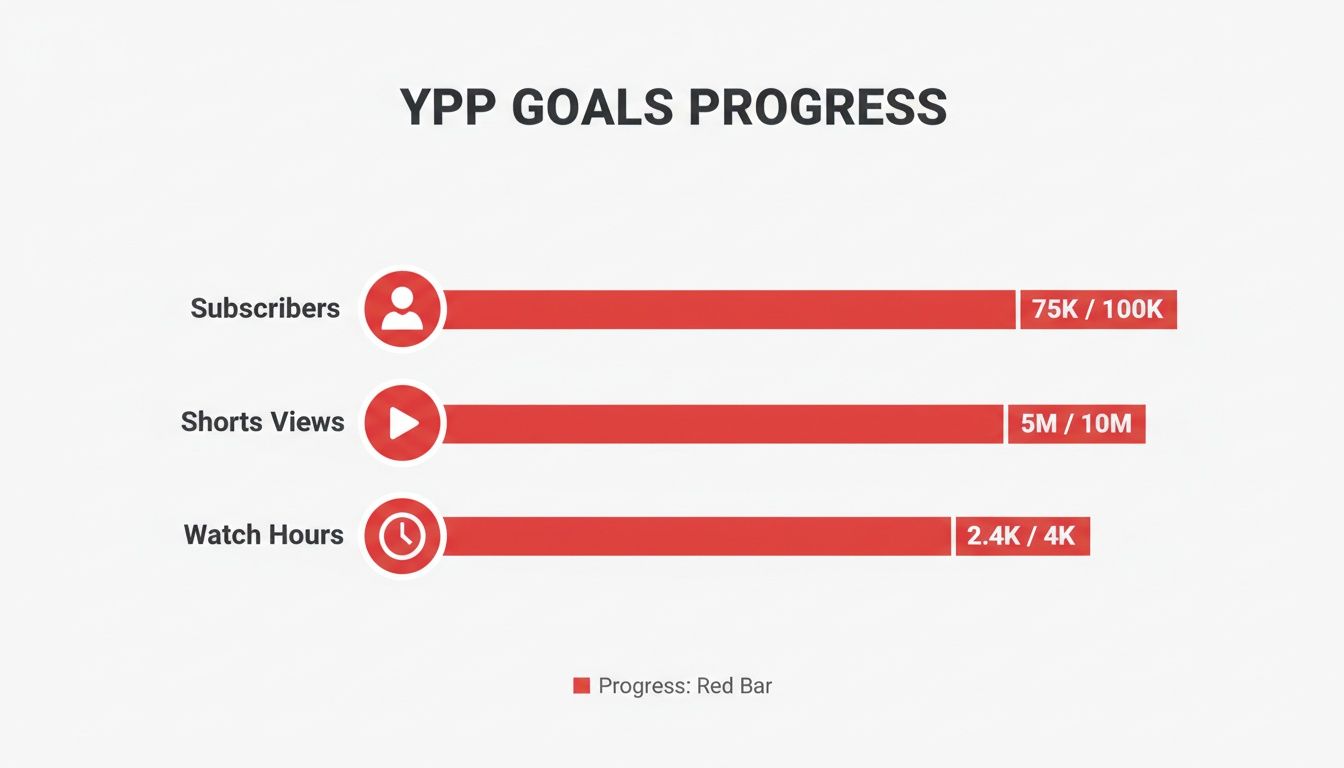
The YPP progress chart really drives home how important that 10 million Shorts views target is. It's a clear path to monetization built specifically for creators like you.
Let's ground this with a real-world example. Say one of your Shorts goes viral and hits 1 million views. Based on the typical RPM, you’re looking at an earning potential of between $10 and $60—and that’s before music costs and YouTube’s cut are taken out.
One of the biggest factors in that number is your audience's location. Viewers from countries with big advertising budgets, like the United States or the United Kingdom, will naturally generate a higher RPM than viewers from other regions. That's why a video can go viral in two different countries and earn wildly different amounts. Keeping this in mind will help you set realistic financial goals and manage your expectations as you grow.
Moving Beyond Ads to Real Profit

Let's be honest. Relying solely on YouTube Shorts ad revenue feels like trying to fill a swimming pool with a teaspoon. Sure, it's technically working, but it's a painfully slow way to make real money.
The secret the pros know is that the real value of your Shorts isn't the fractional cents you get from views. It’s about seeing your channel for what it truly is: the top of a powerful sales funnel. Your viral Shorts are the engine that grabs eyeballs and builds a community. Your job is to then guide that audience toward income streams that can turn a fun hobby into a legitimate business.
Turn Your Views into Affiliate Commissions
For many creators, especially those running faceless channels, affiliate marketing is the most natural next step. It’s simple: you recommend products you actually like, and when someone buys through your unique link, you get a cut. No hard selling required.
The key is making it feel seamless. People watch Shorts for a quick hit of entertainment, not a sales pitch. Think about a channel that posts satisfying cleaning clips—it’s a no-brainer for them to link to the exact sponge or cleaning solution they're using. A tech channel showing off a cool gadget can do the same.
Here's how to make it work:
- Use the Pinned Comment: Nobody sees the description on a Short unless they're really looking for it. Your pinned comment, on the other hand, is front and center. Use it for your affiliate link with a clear, simple call-to-action like, "Get the gadget from this video here: [link]."
- Make Your Bio a Hub: Don't just drop one link in your bio. Use a simple tool like Linktree or Beacons to create a landing page that houses all your important links. Then, just tell people in your videos to "check the link in my bio."
- Always Disclose: Trust is everything. A simple #ad or "(affiliate link)" in your comment keeps you transparent with your audience and compliant with FTC rules. It’s a small step that makes a big difference.
If you want to get serious about this, you'll need to find the right programs. Our guide to high-ticket affiliate marketing at https://monetizedprofiles.com/affiliate can show you how to find partners that offer much larger commissions.
Secure Lucrative Brand Sponsorships
This is where many creators start seeing life-changing income. A brand sponsorship is when a company pays you directly to feature their product or service in one of your Shorts. And you don't need a million subscribers to get on their radar.
Brands are increasingly looking to partner with "micro-influencers" who have smaller but highly engaged, niche audiences. A fitness channel with 50,000 die-hard subscribers is often far more valuable to a supplement company than a generic meme channel with 500,000 random viewers.
Your first move? Create a media kit. Think of it as your channel's resume.
Media Kit Essentials: Keep it to one page. Include your channel name, what your content is about, who your audience is, key stats (subscribers, average monthly views), and how to contact you. Professional and straight to the point wins every time.
Once your kit is ready, start reaching out to brands you think are a great fit for your content. A quick, personalized email explaining why your audience would love their product will get you much further than a generic, copy-pasted message.
Sell Your Own Products and Merchandise
This is the end game. When you sell your own stuff, you're in complete control and you keep 100% of the profits. Your Shorts channel essentially becomes a free, full-time marketing department for your own business.
The possibilities are endless, even for faceless channels:
- Digital Products: A channel sharing quick design tips could sell a pack of custom templates. An AI art channel could sell a detailed guide on writing the perfect prompts.
- Merchandise: If you’ve built a strong brand with a recognizable catchphrase or character, you can use print-on-demand services to sell t-shirts, mugs, or stickers with zero upfront cost.
- Services: Do your Shorts showcase a specific skill? Sell it! A creator making incredible video edits could offer their services to other YouTubers, using their own Shorts as a living portfolio.
Building a truly sustainable channel means thinking beyond that first ad payout. Diving into these strategies to remonetize and optimize earnings is crucial for long-term growth. Shifting your mindset from chasing views to building a funnel is what separates the hobbyists from the pros.
Making Shorts That People Actually Want to Watch
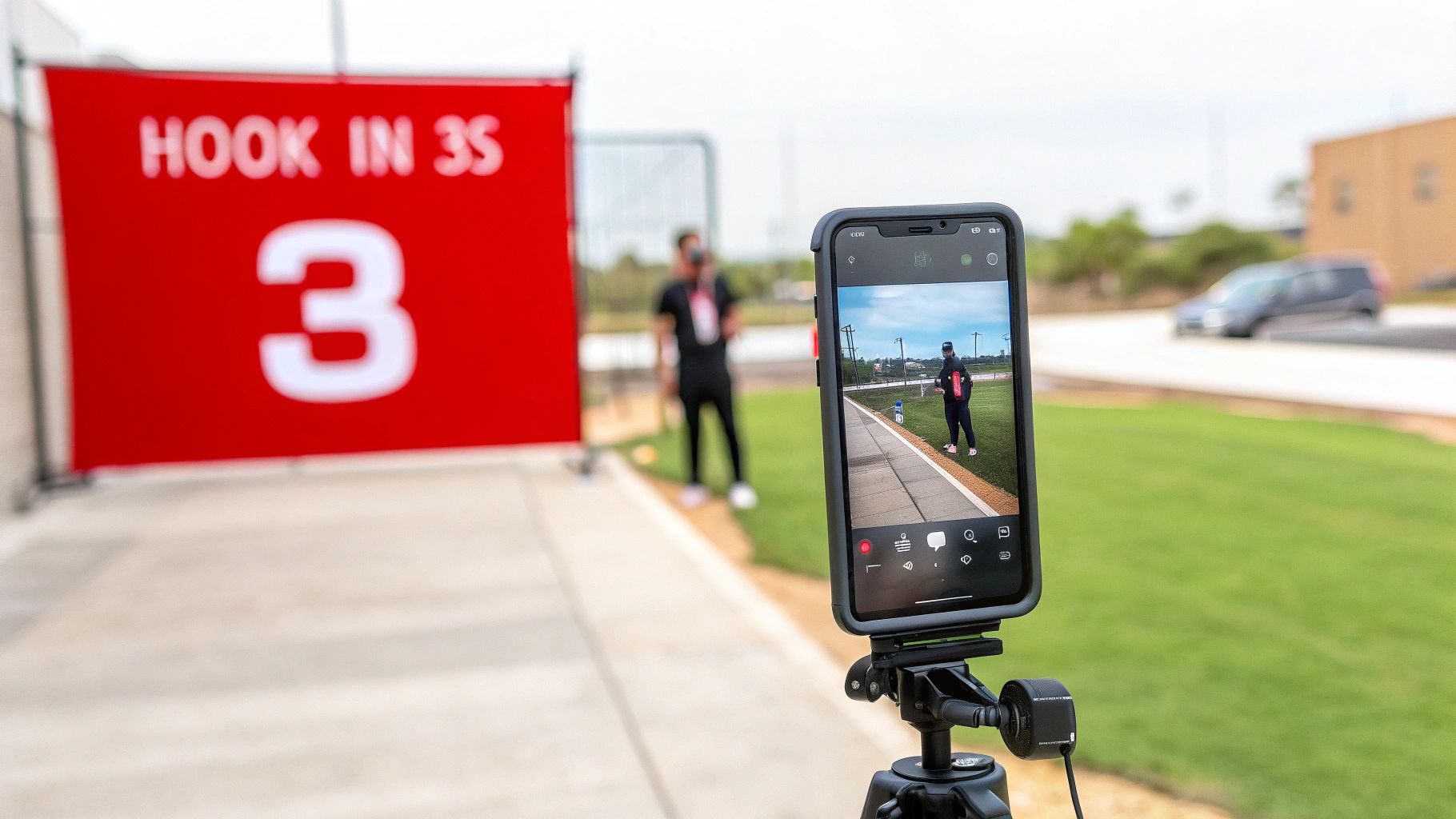
Let's be real. Whether your goal is ad revenue, affiliate sales, or brand deals, the math is simple: more eyeballs mean more money. To get those views and subscribers, your content needs to do more than just exist. It has to hook people in and keep them watching.
The YouTube algorithm is designed to keep people on the app. It does this by pushing videos with high audience retention and watch time. If someone watches your entire Short—or even better, lets it loop—you're sending a powerful signal to YouTube that your content is a winner. And YouTube will reward you for it with more impressions.
You Have Three Seconds. Make Them Count.
Seriously, that's all you get. Three seconds. If your opening is boring, they're gone. You have to grab their attention immediately. Ask a question, show a crazy "before" shot, or present a visual that makes them stop and think, "What is going on here?"
Imagine you run a faceless channel that shows data visualizations. Don't start with a clunky title card. Instead, open with a graph that's already in motion, showing some shocking statistic. That instant visual intrigue makes people want to see where it ends up.
Tell a Mini-Story, Not Just a Clip
Every successful Short has a clear beginning, middle, and end. It's a tiny story. This structure is what keeps viewers glued to the screen, maximizing that precious watch time.
Here's how to think about it:
- The Setup (Seconds 1-3): This is your hook. Show the problem, the question, or the messy "before." For a satisfying cleaning video, this is the shot of the grimiest part of the object.
- The Journey (Seconds 4-15): Show the process. This is the transformation, the "how-to," the meat of your video where you start delivering on the hook's promise.
- The Payoff (Final Seconds): The grand finale. Show the sparkling clean object, the final data point revealed, or the answer to the question. A satisfying payoff is what gets people to hit that share button.
Without this simple narrative arc, your video will feel random, and people will swipe away. That tells the algorithm your content isn't worth showing to others.
A huge mistake I see creators make is saving the best part for the end without building any anticipation. A great payoff is useless if no one sticks around to see it. Your hook and your payoff work as a team—one can't succeed without the other.
Jump on Trends and Trending Audio
That trending song you keep hearing isn't just background music; it's a cheat code for discovery. Using a popular sound gets your Short shown to people who've watched other videos with that same audio. It's one of the quickest ways to reach a brand-new audience.
But don't just slap a song on a random video and call it a day. The key is to integrate the audio cleverly. If you have a faceless history channel, for instance, you could use a dramatic trending sound to score a quick recap of a historical battle. It makes old content feel fresh and exciting. Also, ensuring your content is accessible can boost its reach; learning how to transcribe YouTube videos effectively is a great way to do just that.
Winning Without Showing Your Face
Faceless channels are absolutely crushing it on Shorts because the content itself is the star. The trick is to pick a niche that's visually interesting and doesn't need a person on screen to explain what's happening.
Here are a few faceless niches that consistently do well:
- Satisfying Content: Think power washing, paint mixing, or soap cutting. These videos have a natural story arc—from chaos to order—that is incredibly hypnotic.
- AI-Generated Stories: Use AI art tools to create stunning visuals and pair them with a compelling text-to-speech narrator. You can tell a whole story in 60 seconds.
- Data Visualizations: Animated maps and bar chart races are insanely popular. They're easy to understand and people love to watch them until the very end to see the results.
In each of these examples, the visuals do all the talking. By focusing on quality and a tight narrative, you can build a massive following and successfully monetize your Shorts without ever having to be on camera.
If you're looking for more ideas on growing your channel, we're always sharing new strategies over on the MonetizedProfiles blog.
Answering Your Top Questions About YouTube Shorts Monetization
Once you start digging into making money with Shorts, you're bound to have some questions. It's totally normal. Let's walk through some of the most common ones I hear from creators just starting out.
Can I Really Make a Full-Time Living from Shorts?
If you're only thinking about ad revenue, it's a very steep climb. Shorts RPMs are just lower than long-form videos, so you'd need an insane number of views to make it your sole income from ads.
But here’s the thing: thinking bigger makes a full-time income absolutely achievable. The smartest creators use Shorts as a lead magnet to build a massive audience. They layer their ad earnings with much more lucrative income streams like affiliate marketing, brand sponsorships, and selling their own merch or digital products. Think of the ad money as a nice base layer, with the real profits coming from those other avenues.
Do I Have to Show My Face to Go Viral?
Nope, not at all. One of the coolest things about Shorts is the explosion of "faceless" creators. Your content is the star, not your face.
We're seeing faceless channels absolutely crushing it in so many niches:
- Mesmerizing animations that you can't look away from.
- Quick-hit educational videos that simplify complex ideas.
- Clips showcasing luxury cars or travel, offering pure escapism.
- Incredible AI-generated art and short stories.
What matters is how compelling your content is. This is a huge win for introverts or anyone who just wants to let their work do the talking.
For a faceless channel, your content’s ability to grab and hold attention is everything. This means your editing, sound design, and storytelling have to be on point to keep people watching from the very first frame.
How Is This Different from the Old Shorts Fund?
Ah, the Shorts Fund. That was a temporary bonus pool that YouTube dished out to top creators until it ended in early 2023. It was nice when you got it, but it was unpredictable and you couldn't really build a business plan around it.
Today's system is a true ad revenue-sharing model baked right into the YouTube Partner Program (YPP). This is a massive improvement. Instead of a random bonus, you get a consistent cut of the ad revenue from the entire Shorts Feed. It's a much more stable and scalable way to earn, giving you predictable income you can actually build on.
What Happens if My Views Drop After I'm Monetized?
This is a fear I see all the time, but you can breathe easy. Once you're in the YPP, you don't need to keep hitting that 10 million views every 90 days threshold to stay in the program.
As long as you keep uploading and follow all of YouTube's rules, your channel will stay monetized. Your monthly payout will obviously go up and down with your view count—fewer views mean less ad money that month. That’s just part of the game and why sticking to a consistent posting schedule is key to growing your income over the long haul.
Ready to skip the long wait and start earning now? MonetizedProfiles provides YouTube channels that are already approved for monetization, letting you bypass the grind and focus on creating great content from day one. Check out our ready-to-go channels at https://monetizedprofiles.com.


