


Let's cut right to the chase: Yes, being a social sale rep is a completely legitimate career. This isn't some fly-by-night, get-rich-quick scheme. It's the natural evolution of professional sales for the modern era, where building genuine relationships on social media is the key to finding prospects and closing deals.
What a Modern Sales Pro Actually Does

When you hear "social sale rep," it's easy to wonder if it's a real job or just the latest online buzzword. The answer is simple: it’s a critical, strategic role in any forward-thinking company.
Think of these professionals less like the old-school cold-callers and more like digital relationship architects. Instead of interrupting someone's day, they use platforms like LinkedIn to carefully build connections based on trust and shared expertise. It’s a smart approach that lines up perfectly with how people buy things today—they do their homework online long before they're ready to talk to a salesperson.
Key Responsibilities of a Social Sale Rep
A real social selling job is defined by specific, professional tasks that produce real business results. It’s a disciplined role that takes skill, strategy, and a whole lot of consistency.
Here’s what a typical day might involve:
- Finding the Right People: Using tools like LinkedIn Sales Navigator to research and identify potential clients who perfectly match their company's ideal customer profile.
- Building Real Connections: Starting authentic conversations, sharing useful industry insights, and positioning themselves as a credible expert over time.
- Sharing Valuable Content: Curating and sharing articles, case studies, or company updates that actually help their audience solve problems.
- Nurturing Potential Leads: Gently guiding prospects through their buying journey by offering help and resources, not just a hard sales pitch.
And the data backs this up in a big way. According to LinkedIn, sales pros who are active social sellers create 45% more sales opportunities than their peers. Even more telling, 78% of social sellers outsell colleagues who aren't using social media. This isn't just a trend; it's a proven, effective sales strategy.
A big part of a social seller's performance is even measured through metrics like understanding your Social Selling Index (SSI) score.
A genuine social sale rep focuses on building a strong professional brand and providing real value. The goal isn't just to make a sale; it's to become such a trusted advisor that when a prospect is finally ready to buy, you're the first person they think of.
Telling a Real Job from a Scam
The real challenge is spotting a legitimate opportunity in a sea of potential scams. Scams are clever—they often use the same language as real job postings, but there are always red flags.
A genuine role will always be about selling a real product or service to actual customers. A scam, however, often shifts the focus to recruiting other people into the "opportunity" or asks you to pay upfront for training, starter kits, or access to their "system."
To make it easier, here’s a quick comparison of what to look for.
Legit Social Sale Rep vs. Potential Scam at a Glance
| Characteristic | Legitimate Social Sale Rep Role | Potential Scam |
|---|---|---|
| Primary Goal | Selling a real product/service to external customers. | Recruiting more people or selling internal "tools." |
| Compensation | Based on sales performance (salary + commission). | Focuses on recruitment bonuses or upfront fees. |
| Job Description | Clear duties, KPIs, and connection to a known company. | Vague promises of high income with little effort. |
| Upfront Costs | None. The company provides necessary tools and training. | Requires you to buy a "starter kit" or pay for training. |
| Company Reputation | Has a professional online presence and verifiable history. | Hard to find online, or has many negative reviews. |
| Communication | Professional, through official company channels. | Unprofessional, uses pressure tactics, or personal email. |
Ultimately, a real social selling job is just that—a job. It requires work, skill, and a focus on providing value to customers, not on paying to play.
What a Real Social Selling Pro Actually Does All Day

So, what does a social sale rep really do? It’s a great question, and the answer helps draw a clear line between a real career and a potential scam. This job isn't about aimlessly scrolling through social media feeds; it's a strategic and disciplined profession built around relationships that drive actual business.
A legitimate social selling professional works with a purpose. Their day isn't about reacting to notifications—it's structured around key tasks designed to find, connect with, and help potential clients. It's the polar opposite of sending spammy DMs; it’s about becoming a trusted resource in their industry.
Mornings are often dedicated to research. Using powerful platforms like LinkedIn Sales Navigator, they dig deep into their target audience. They’re not just looking for job titles; they’re trying to understand a company's pain points, spot key decision-makers, and catch "trigger events"—like a new funding round or a big executive hire—that signal a perfect time to connect.
Earning Credibility and Trust, One Post at a Time
Once they've identified who to talk to, the focus shifts to engagement. A huge part of their job is consistently sharing valuable content. This isn't just company ads; it’s helpful industry articles, interesting data, and practical tips that genuinely help their audience. This simple act positions them as a knowledgeable expert, not just another salesperson trying to make a quota.
This steady stream of value builds their professional brand and establishes credibility long before they ever send a message. So, when they finally do reach out, it’s not a cold, unwelcome interruption. It feels more like a warm, informed conversation starter based on a shared interest or a prospect's recent online activity.
A professional social seller knows that 91% of B2B buyers are active on social media. Their entire job is to meet these buyers where they are and offer value before ever asking for anything in return.
Turning Connections Into Real Conversations
The core of the role is having genuine conversations. This means paying attention to what prospects are talking about, leaving thoughtful comments on their posts, and participating in relevant group discussions.
Let's break down what this looks like in the real world:
- The Target: A sales rep identifies the Marketing Director at a fast-growing software company.
- The Homework: On LinkedIn, the rep notices the Director recently shared an article about the headaches of scaling content creation.
- The Engagement: Instead of a generic sales pitch, the rep leaves a genuinely helpful comment on the post, adding their own perspective.
- The Connection: After a few meaningful interactions like this, the rep sends a personalized connection request, referencing their shared interest in content strategy.
- The Conversation: Once connected, they still don't pitch. They might send over a relevant case study or invite the Director to a free webinar. The goal is to build a real relationship and prove they understand the Director's world.
This patient, value-first approach is what separates a true professional from a scam artist. It’s a long game that methodically turns online connections into qualified business opportunities and, eventually, happy customers. If you're looking to improve your own creator content strategy, you can find more tips on our MonetizedProfiles blog.
At the end of the day, a social sale rep’s schedule is a mix of smart research, valuable content sharing, and authentic networking. It’s a sophisticated process that requires skill, patience, and a solid grasp of how people make decisions today.
How to Spot the Red Flags of a Social Selling Scam
Jumping into the world of online jobs can feel like trying to cross a minefield. For every genuine social sale rep role, you'll find a dozen scams dressed up to look like the real thing, all waiting to catch you off guard. The best way to protect yourself is to learn how to spot the warning signs before you get roped in.
Scammers play on your emotions. They create a sense of urgency, pushing you to make a snap decision before your logical brain has a chance to catch up. They often use the right buzzwords, but if you look closely, you’ll notice that something just feels off. A real opportunity is transparent and professional; a scam almost always sounds too good to be true.
The Promise of Unrealistic Income
This is the oldest trick in the book, and it's also the most effective. Scammers dangle the promise of making a fortune with little to no work because they know how tempting that sounds. It's a powerful lure.
You'll run into flashy claims like:
- "Make six figures your first year, no experience required!"
- "Want financial freedom? Join us and get there in 90 days."
- "Our top reps are pulling in $20,000 a month just working part-time."
Let's be real. Legitimate sales jobs, including social selling, are hard work. You have to build skills, nurture relationships, and put in the time. The income potential can be fantastic, but you earn it. It’s not just handed to you. If a job ad sounds more like a lottery ticket than a career path, that’s a huge red flag.
Pay-to-Play Schemes
This one is a total deal-breaker. A real employer will never make you pay for a job. Ever. They invest in their employees with training and resources because when you succeed, they succeed. Scammers flip that script entirely—their whole business model is about getting your money.
A job is something you get paid for. If you're the one paying, you're not an employee; you're a customer. Remembering this simple truth is the easiest way to tell a real opportunity from a scam.
If you see any of these demands for cash, turn and run the other way:
- Mandatory Training Fees: They'll tell you that you need to buy their "exclusive" training or certification before you can start.
- Required "Starter Kits": You're pressured into purchasing a bundle of products, software, or marketing materials just to get in the door.
- Platform Access Charges: They demand a recurring monthly fee to access their "proprietary" sales platform or lead system.
Any legitimate company will cover these costs. It's just part of doing business. If you're being asked to open your wallet before you've made a single dime, it’s time to walk away.
Vague Job Descriptions and Misleading Communication
Scammers thrive on being vague. They avoid giving you concrete details because specifics can be checked, and they don't want you asking too many questions. A fraudulent job post is often full of exciting, high-energy words but provides zero substance about what you'll actually be doing day-to-day.
Be on the lookout for descriptions that talk endlessly about the lifestyle ("be your own boss," "work from the beach!") but are suspiciously quiet about the product you're supposed to sell or who the customers are.
The way they communicate is another dead giveaway. A real recruiter will have a professional company email address and a LinkedIn profile you can verify. A scammer will likely use a generic email (like a Gmail or Yahoo account) and push you hard to make a decision on the spot. They create that false sense of urgency to stop you from looking too closely.
Your Checklist for Verifying a Legitimate Sales Opportunity
Now that you know how to spot the most obvious red flags, it's time to get proactive. You need a solid game plan for vetting any opportunity that lands in your inbox. This isn't about being paranoid; it's about being smart and protecting your career.
Think of yourself as a detective. A legitimate company will not just welcome your questions—they'll have a clear, professional footprint that’s easy to trace. Scams, on the other hand, fall apart under a little bit of scrutiny.
The flowchart below gives you a quick mental model for sizing up an offer at a glance.
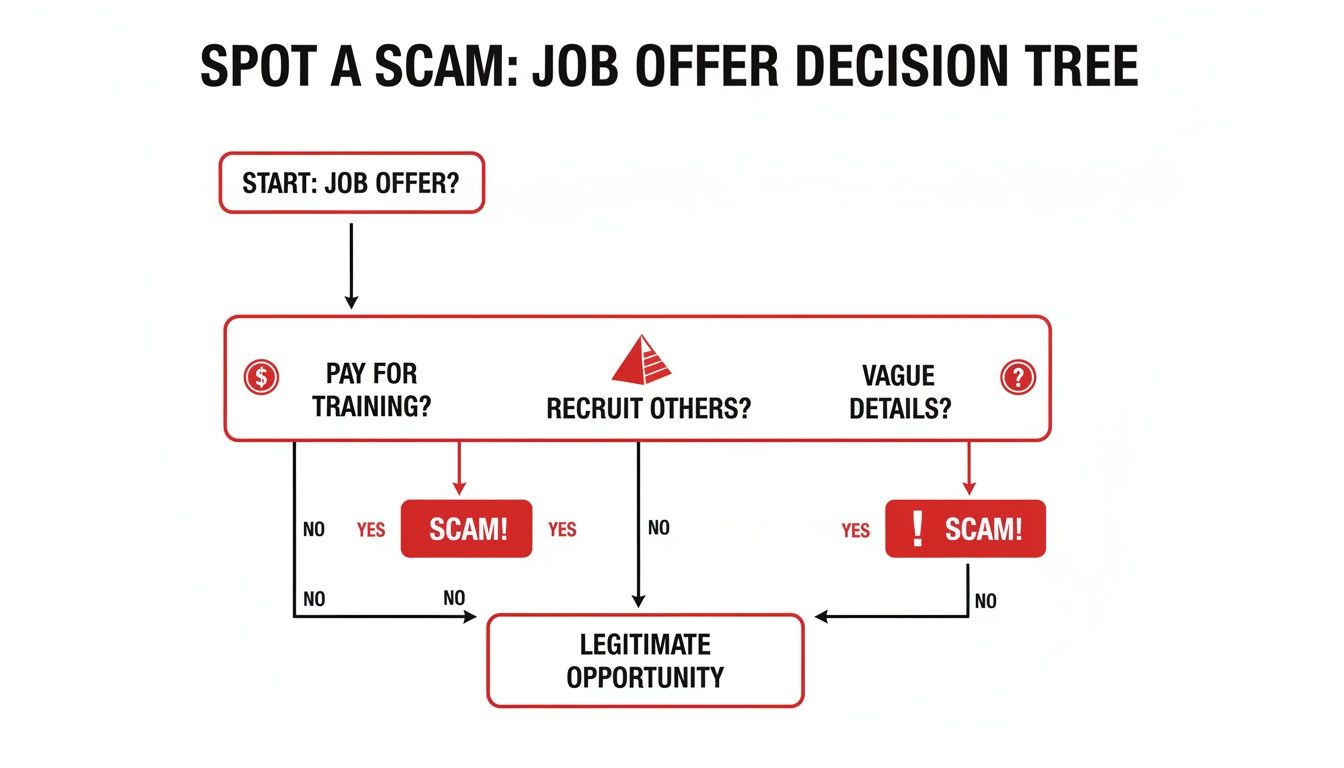
As you can see, if a job requires you to pay for your own training, focuses on recruiting others, or is frustratingly vague on the details, it's almost certainly a scam.
Verification Checklist for Social Sale Rep Jobs
Instead of just going with your gut, it helps to have a structured way to evaluate these roles. The table below is a step-by-step checklist you can use to methodically vet any social selling job you come across. It breaks down what to look for, what signals a good opportunity, and what should send you running for the hills.
| Verification Step | What to Look For | Green Flag (Legit) | Red Flag (Scam) |
|---|---|---|---|
| Company Research | A professional, detailed website, active social media, and third-party reviews. | The company has a polished website, an active LinkedIn page, and mostly positive reviews on Glassdoor. | A flimsy, one-page website, a dead LinkedIn page, and a flood of negative reviews (or no reviews at all). |
| Job Description | Clear responsibilities, required skills, and a transparent compensation structure. | The role, duties, and pay structure (e.g., base + commission) are all clearly defined. | Vague duties, unrealistic income promises, and a commission-only structure that wasn't mentioned upfront. |
| Recruiter Vetting | The recruiter's professional background and communication style. | They have a complete LinkedIn profile and communicate professionally from a company email address. | Their profile is sparse, they use a personal email (like Gmail), and they pressure you for a quick decision. |
| The Interview | The quality and depth of their answers to your questions. | They provide specific, detailed answers about training, tools, and performance metrics. | They dodge your questions, give generic answers, or can't explain the day-to-day role clearly. |
By working through this list, you create a clear picture of the opportunity. A legitimate company will tick all the green-flag boxes, while a scam will quickly reveal itself through a pattern of red flags.
Deep Dive into the Company's Online Presence
Let’s start with the company itself. Any real business leaves a digital trail, and your job is to follow it.
- Official Website: Does it look professional? A legitimate site will have an "About Us" page, a physical address, and clear contact info. A cheap, one-page website with no real substance is a huge warning sign.
- LinkedIn Company Page: A real company will almost always have an active LinkedIn presence. Look for consistent posts, real employees listed on their page, and genuine engagement. If the page is a ghost town or doesn't exist, be very skeptical.
- Third-Party Reviews: Head over to sites like Glassdoor and Indeed. What are people really saying? A couple of bad reviews are normal, but a consistent pattern of complaints about pay, culture, or deceptive practices is a deal-breaker.
Vet the Recruiter and the Job Description
Next, zoom in on the person who contacted you and the job description they sent. The devil is in the details here. A professional recruiter will have a complete LinkedIn profile that lines up with their company and title. A brand-new or sketchy-looking profile is a major red flag.
The job description should be a blueprint for the role, not a vague, hyped-up sales pitch. It needs to clearly outline:
- Specific Responsibilities: What will your day-to-day actually look like?
- Required Skills and Experience: Who is their ideal candidate?
- Transparent Pay Structure: How do you get paid? Is it a base salary plus commission, or is it commission-only? Commission-only gigs can be legit, but they must be upfront about it from the very beginning.
A professional job description respects you enough to give you the facts. Scams, however, thrive on ambiguity and big promises to get you hooked. It’s also a good idea to check out a company's legal documents; for instance, our MonetizedProfiles terms of service clearly lays out expectations for everyone involved.
Prepare Powerful Questions for the Interview
If the company and job description pass the initial smell test, the interview is your final—and most important—line of defense. This is your chance to flip the script and interview them. A real company will have no problem with tough questions. A scam will start to fall apart.
Walk in with a list of questions designed to get straight answers:
- "Can you walk me through your new hire training and onboarding process?" A legit company has a structured plan. Scammers will be vague.
- "What specific tools, like a CRM or sales software, will I be using?" Real sales teams use real tools.
- "How does the company generate leads for the sales reps?" This reveals whether they have a real marketing engine or if they expect you to hit up your friends and family.
- "What are the key performance indicators (KPIs) for this role in the first 90 days?" This shows they have a clear plan for success.
When done right, social selling is incredibly effective. In fact, 73% of sales reps who use social selling blow past their peers and are far more likely to hit their quotas. These reps see 45% more opportunities, and simply responding quickly to leads can increase annual revenue by 9.5%.
By asking sharp questions, you're making sure you land a real opportunity built for success—not a fraudulent scheme designed to waste your time.
The Essential Skills and Tools for Success in Social Selling

Being a successful social sale rep is about more than just having a bunch of followers. A real career in this field is built on a specific set of professional skills and a smart toolkit. This blend of the human touch and the right tech is what really separates a legitimate job from those low-effort scams promising easy money.
Think of a great social seller as part digital detective, part trusted advisor. You need the empathy to figure out what a potential client really needs and the analytical brain to make sense of all the engagement data. It's a balancing act between soft skills for building relationships and hard skills for getting real, measurable results.
The Human Element: Soft Skills
Before you can even think about tools, you have to master the art of genuine connection. These foundational skills are non-negotiable if you want to build the trust needed to turn a follower into a customer.
- Active Listening: This isn't just about hearing what people say. It's about paying attention to what they post, share, and comment on to understand their pain points before you even think about pitching a solution.
- Empathy: A top-tier social seller can truly put themselves in their prospect's shoes. They get the pressures and goals of their industry, which means every interaction feels helpful, not pushy.
- Relationship Building: This is the heart of the job. You have to be willing to play the long game—offering insights and building credibility over weeks or months, not just firing off a single sales message.
The best social sellers don't really see themselves as salespeople. They act more like expert consultants who offer solutions and build community. They earn trust one conversation at a time, and that approach is what makes the role so valuable—and what proves a social sale rep is legit.
The Technical Toolkit: Hard Skills and Essential Software
While soft skills lay the groundwork, the hard skills and the right tech provide the structure. A professional social seller doesn't just wing it; they use specialized tools to work smarter, not harder. This reliance on a pro-level toolkit is another dead giveaway of a legitimate career path.
For example, content creation is a huge part of the job. To grab attention on a platform like TikTok, knowing how to create engaging voiceovers for your content is a must-have skill. It also helps to have a solid account to practice on. Some creators even look into getting a pre-approved monetized TikTok account to start earning from their content right away.
Beyond creating content, a social sale rep has to be comfortable with a few key technologies:
- CRM Software (e.g., HubSpot, Salesforce): A Customer Relationship Management (CRM) system is your command center. It’s where you track every conversation, schedule follow-ups, and manage the entire sales pipeline from that first "hello" to a closed deal.
- Social Selling Platforms (e.g., LinkedIn Sales Navigator): This is your main tool for finding the right people. It lets you use advanced filters to pinpoint ideal clients, keep an eye on company updates, and identify the key decision-makers.
- Data Analysis: You've got to understand the numbers—engagement rates, click-throughs, and conversion data. This is how you figure out what's working and tweak your strategy for even better results.
Ultimately, it’s this combination of emotional intelligence and tech savvy that defines a modern social selling professional. It's a demanding role that requires you to always be learning and adapting, which is what makes it a serious and rewarding career.
Why Social Selling Is the Future of the Sales Industry
Social selling isn't just a buzzword or another sales tactic to add to the playbook. It represents a deep, fundamental shift in how business actually gets done. Grasping why this role is becoming so vital is key to understanding why a career as a social sale rep is legit and set up for real, long-term growth.
Simply put, it’s the answer to a massive change in how people decide what to buy.
The days when buyers would patiently wait for a salesperson to show up and educate them are long gone. Today's customers are incredibly informed and fiercely independent. They do most of their own homework online—reading reviews, comparing products, and asking their networks for advice—well before they even think about talking to someone in sales.
The New Buyer Reality
Let's be clear: the buyer is now in the driver's seat. This simple fact has turned the old sales model on its head, making traditional methods like cold calling less and less effective by the day.
A salesperson who just appears out of the blue to pitch a product is already late to the party. The buyer has already done the research, formed opinions, and probably narrowed down their options.
This is exactly where a skilled social seller comes in. By building real trust and providing genuine value on platforms like LinkedIn, they meet buyers where they’re already spending their time. They become a trusted advisor during that critical research phase, not just another salesperson.
Think about this: 91% of B2B buyers are active on social media today. And an incredible 74% of buyers end up working with the very first sales rep who actually adds value to their decision-making process.
This is precisely why the social selling role is the future. It’s not about interrupting people with a sales pitch; it’s about becoming a helpful part of their discovery process. A social sale rep’s job is to earn a seat at the table by being the most insightful and helpful person in the room.
Technology as a Growth Engine
And this role is only going to become more important. The right technology is turning social selling from a gut-feel art into a data-driven science, cementing its legitimacy and future potential.
Here are just a few ways tech is fueling this change:
- AI-Powered Insights: AI tools can spot buying signals and key trigger events as they happen. This allows reps to reach out with the right message at the perfect time.
- Advanced Analytics: Modern platforms give reps a clear picture of what content is actually working, so they can ditch the guesswork and focus on what resonates with their audience.
- Personalization at Scale: New tools make it possible to send personalized messages to hundreds of potential customers without sounding like a robot, keeping that all-important human touch.
At the end of the day, social selling is the most logical response to the modern buyer's journey. As customers become more empowered and digitally savvy, the companies that win will be the ones whose sales teams can build authentic relationships online. This isn't just a new way to sell; it’s quickly becoming the only way that will matter.
Answering Your Lingering Questions
Even with all this information, you might still have a few things on your mind. Let's tackle the most common questions that pop up when people are trying to figure out if a "Social Sale Rep" opportunity is the real deal.
Do I Have to Pay for My Own Training?
Nope. Not a chance. Any legitimate company is going to invest in you. They’ll provide the training you need to do the job right, and they’ll pay for it.
Think about it this way: if a company asks you to pay for mandatory training, buy a "starter kit," or purchase special access to their systems, you're not an employee—you're a customer. That’s a classic red flag. While you might decide to pursue your own professional development later on, the core training to get started should always be on the company's dime.
Isn't "Social Sale Rep" Just a Fancy Name for an MLM?
It’s a fair question, but no, they are two completely different things. The easiest way to tell them apart is to look at where the focus is.
- A Real Social Sale Rep Job: Your entire goal is to sell the company's product or service to actual customers. You get paid based on how well you do that, usually with a combination of a base salary and commission.
- Multi-Level Marketing (MLM): The real game here is often about recruiting other people to join under you (your "downline"). A big chunk of your earnings comes from the sales and recruitment efforts of the team you build, not just your own sales.
If the conversation is all about building a team and very little about the product itself, you should be very, very careful.
A real sales job is about creating value for a customer. A scheme is about creating value for the people at the top by recruiting more people at the bottom. The focus is completely different.
Can You Actually Make Good Money Doing This?
Absolutely. A career in social selling can be incredibly rewarding and financially lucrative. Most legitimate roles will offer a competitive pay structure, often blending a steady base salary with performance-based commissions. This setup rewards you directly for your skill and effort.
Top performers who really get the hang of building relationships and generating leads can earn a fantastic income. Just be skeptical of any job that promises "easy money" or huge paychecks for little to no work. Real success in sales always comes from dedication and smart strategy, not from empty hype.
Ready to bypass the grind and jumpstart your creator journey? MonetizedProfiles offers monetization-approved social media accounts, perfect for creators who want to earn from day one. Check out our selection of ready-to-go profiles at https://monetizedprofiles.com.


