


Let's get straight to it: a YouTube view happens when a real human being chooses to watch your video. It’s that simple, and that complicated.
For your regular, longer videos, the gold standard has long been the “30-second rule.” If someone watches for at least 30 seconds, you get a view. But for YouTube Shorts, the game is completely different—every single intentional play is counted as a view right away.
The Foundation of a YouTube View
Before we get into the nitty-gritty, let's establish what makes a view "real" in YouTube's eyes.
Think of it like this: YouTube is a bouncer at a club. It doesn't just count every person who walks past the door. It only counts the people who actually come inside, stay for a drink, and enjoy the music. The goal is to measure genuine interest, not just passing glances or bot traffic.
Over the years, YouTube has gotten incredibly sophisticated at telling the difference. This is huge for creators, especially if you're building a channel from the ground up with a pre-monetized account. The platform shifted from just counting clicks to prioritizing watch time and genuine engagement.
For a long time, that meant sticking to the 30-second rule for standard videos to filter out people who clicked by mistake. But with the rise of Shorts, YouTube had to adapt. Now, for those snappy vertical videos, every single intentional play—and even a replay—counts instantly. You can learn more about how creators adapt to these changes by reading additional insights on our blog.
Long-Form Videos vs YouTube Shorts
The biggest difference you need to grasp is how YouTube treats your standard videos versus your Shorts. This change really reflects how people watch different types of content.
-
Long-Form Videos (The 30-Second Rule): For your traditional uploads, that 30-second mark is still the key. It's the signal to YouTube that a viewer is actually invested, not just bouncing. This keeps the view count valuable for you and for advertisers.
-
YouTube Shorts (Instantaneous Count): Shorts are all about quick, fast-paced scrolling. YouTube gets this, so any deliberate play is counted as a view. That includes loops and replays, which is why Shorts can rack up views so incredibly fast.
How YouTube Views Are Counted at a Glance
This table breaks down how views are registered for different video formats, helping you understand what drives your numbers.
| Video Type | How a View Is Counted | What This Means for You |
|---|---|---|
| Long-Form Videos | A viewer must watch for at least 30 seconds. | Focus on a strong hook in the first 30 seconds to keep viewers watching. |
| YouTube Shorts | Any intentional play or loop counts instantly. | Your goal is to create instantly re-watchable content that grabs attention in the first second. |
| Live Streams | A view is counted when a user joins and watches the stream. | Engagement during the live event is key, as each viewer is counted upon joining. |
Ultimately, whether you're creating deep-dive tutorials or viral Shorts, understanding what counts as a view helps you focus on what really matters: making content that people genuinely want to watch.
How YouTube Filters and Validates Your Views
Think of YouTube's view-counting system like a bouncer at a popular club. Just because a huge crowd is lined up outside doesn't mean everyone gets in. YouTube has a similarly strict process to make sure every single view it counts is legit, which is a big deal for protecting both creators and advertisers from getting scammed. This whole process is about separating real, interested humans from what YouTube calls "invalid traffic."
This is exactly why you might see your public view count stall or even freeze for a bit after you publish. It’s not a bug, it’s a feature. YouTube is actively sifting through the initial flood of traffic and tossing out anything that looks fishy.
This flowchart breaks down how a view goes from a simple click to a fully validated number that contributes to your channel's growth.
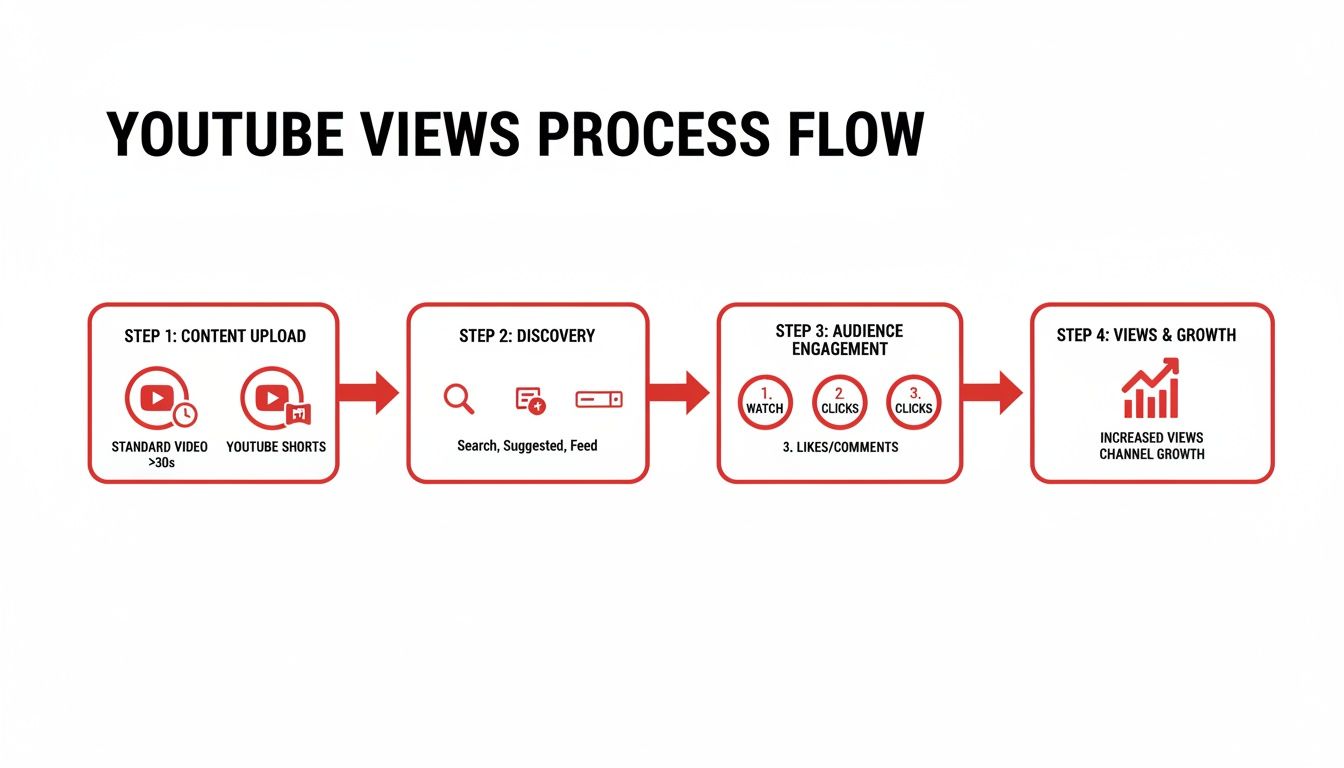
As you can see, every view has to pass a quality check. This ensures that the final number you see reflects genuine interest from a real audience.
The Infamous 301 View Freeze
Ever had a new video shoot up in views, only to get stuck at 301? This used to be a classic sign that your video was getting its first big audit. While the exact number isn't as common today, the principle remains the same. When a video hits an early burst of traffic, YouTube will often pause the public counter to run a deeper check on where those views came from.
This "freeze" is basically YouTube's algorithm taking a moment to analyze the traffic. It’s on the lookout for red flags and anything that doesn't scream "authentic viewer."
Key Takeaway: The view count freeze is a quality control checkpoint. YouTube hits pause to scrub out any fake views, ensuring the numbers that follow are real, reliable, and something you can actually build a channel on.
Once that first batch of views gets the all-clear, the counter unfreezes and starts ticking up again, this time with a solid foundation of validated engagement.
What Does YouTube Consider Invalid Traffic?
So, what kind of junk is YouTube actually filtering out? The main goal is to get rid of any view that wasn't started by a real person who genuinely wanted to watch your video. This covers a whole bunch of shady tactics people use to inflate their numbers.
YouTube’s system is built to spot and discard several types of low-quality views:
- Automated Plays: This is the obvious one. Any traffic from bots, scripts, or software designed to play videos on repeat without a human in sight gets tossed.
- Click Farms: If you pay a service where people are hired to just click on videos all day, YouTube will sniff that out and remove those views.
- Malware-Generated Views: Sometimes a virus will force someone's computer to play videos in the background. Those views are invalid and don't count.
- Excessive Self-Views: Mashing the refresh button on your own video won't get you very far. YouTube is smart enough to know it's you and will filter those plays out.
This filtering is absolutely crucial. It means that when you check your view count, you're looking at a number that reflects a real audience—and that's the only kind of audience that matters for growing a healthy, profitable channel.
Ever notice how the view count in your YouTube Studio dashboard doesn't quite match the number everyone else sees on your video's public page? It can be a little confusing, but it’s not a bug—it’s actually a crucial part of how YouTube ensures the numbers are legit.
Think of it like this: YouTube Analytics is your private, backstage pass. It gives you the raw, almost instantaneous data as it happens. The public view count, on the other hand, is the official, front-of-house number that's been double-checked and verified.
The Live Feed vs. The Final Report
When you upload a new video, your YouTube Analytics dashboard is the first place you'll see views start to tick up. It’s like a live feed, giving you immediate feedback on how your content is landing with your audience. This is fantastic for spotting trends right out of the gate.
The number displayed publicly on your video is more like a carefully audited final report. It often lags behind Analytics by 24 to 48 hours. Why the delay? Because during that time, YouTube's systems are busy scrubbing out any junk traffic before they put an official stamp on it.
This process is what creates the gap between what you see in real-time and what the public sees later. It all comes down to server caching—views are logged quickly at local data centers all over the world, then bundled together and verified in batches.
This screenshot of a YouTube Analytics "Realtime" view gives you a perfect example of that up-to-the-minute data in action.

The spikes and dips in this graph show you the raw, immediate viewer activity—the very data that's waiting to be finalized for the official public count.
Why Your Analytics Data is Your North Star
So, when it comes to making decisions, which number should you be looking at? Hands down, it's your YouTube Analytics. That's your most reliable source of truth for understanding how your channel is really performing.
Key Insight: The public view count is for your audience. Your Analytics data is for you. Treat it as your guide for crafting your content strategy.
For creators serious about growth, diving deep into performance metrics is non-negotiable. While YouTube's built-in tools are great, more advanced platforms can offer a wider lens. Exploring options like Postfast's analytics features can give you a more complete picture of your channel's health.
Whether you're just starting out or managing a channel with a long history, understanding this difference is key. And if you're looking to hit the ground running, you might find value in an https://monetizedprofiles.com/products/aged-youtube-channel, which already has an established presence. At the end of the day, your Analytics dashboard is the compass that points you toward what’s working, long before the public numbers catch up.
Replays, Autoplay, and Embedded Views: What Really Counts?
Not every view on your video happens neatly on your channel page. To get the full picture of your channel's performance, we need to look at the "edge cases" that often trip creators up: replays, autoplay, and views happening off of YouTube entirely.
These aren't just minor details; they represent how people actually engage with your content out in the wild. YouTube has specific rules for each, and knowing them can make a huge difference in how you interpret your analytics.
Do Repeat Views Count on YouTube?
The short answer is yes, but with a catch.
When a viewer loves your video so much they watch it again (and again), those extra plays can absolutely add to your view count. But there's a limit. YouTube's system is smart enough to tell the difference between a superfan and a bot. After about 4 or 5 views from the same person in a 24-hour period, it usually stops counting to prevent spam.
Interestingly, this works a bit differently for Shorts. Replays on Shorts count fully, which is a big shift from the rules for longer videos. If you want to dive deeper, there are some great insights on YouTube's view policies over at tubics.com.
The bottom line is that genuine re-watches are a great signal of engagement, but you can't game the system by leaving a video on a loop. It’s all about authentic interest.
How Autoplay and Embedded Views Are Counted
Your videos don't just live on your channel. They get shared on blogs, pop up in articles, and get served by YouTube's "Up Next" feature. The good news? Views from these sources count, as long as they meet the criteria.
-
Embedded Views: When you embed a video on your website or someone else does, it's a fantastic way to reach a new audience. As long as a real person intentionally clicks the play button, that view counts just like any other. The key word here is intentionally—videos that start playing automatically on a webpage usually don't get counted.
-
Autoplay Views: You know when one video ends and YouTube automatically starts the next one? That's the "Up Next" feature, and those views are 100% legitimate. If someone watches for the minimum required time (the classic 30 seconds for standard videos), it's a valid view.
Key Takeaway: Don't underestimate the power of embeds and autoplay. They are real, valuable views that expand your reach far beyond the YouTube platform, helping your content find an audience wherever they are.
Understanding this clears up a lot of confusion. It confirms that yes, embedding your videos on your own blog is a smart strategy. And it shows that when the algorithm recommends your content, it leads to real, measurable growth.
Common Myths About YouTube Views Debunked
The YouTube world is buzzing with tips and tricks, but let's be honest—a lot of it is just plain wrong. Bad advice about how views work can send you chasing phantom strategies that waste your time or, even worse, get your channel in trouble.
So, let's cut through the noise and bust some of the most common myths floating around.
First up, the classic: "I'll just refresh my video over and over to boost my views!" Nope. That doesn't work. YouTube’s system is way smarter than that and is built to spot this exact kind of artificial activity. It’s looking for real human interest, not just how fast you can hit the F5 key.
All Views Are Not Created Equal
It’s easy to think that a view is a view, but that’s not quite right, especially when it comes to making money. The truth is, the value of a single view can swing wildly depending on who’s watching.
For example, a view from a YouTube Premium subscriber is often worth more because you get a cut of their subscription fee. Location matters, too. A viewer in the United States, where advertisers spend more, will usually generate more ad revenue than a viewer from a region with a smaller ad market.
Key Takeaway: Stop chasing sheer numbers and start focusing on the quality of your audience. Engaged viewers in high-value locations are what truly drive a channel's revenue.
The Danger of Buying Fake Views
This is the most dangerous myth of all: that buying views is a legitimate shortcut to success. Let's be crystal clear: it's not. Buying views is a direct violation of YouTube's fake engagement policy, and it's a fast track to nowhere.
Those "views" you buy are just bots. YouTube is incredibly good at sniffing out and removing this fake traffic, so your numbers will eventually drop anyway. More importantly, it sends all the wrong signals to the algorithm. A video with thousands of views but no likes, comments, or shares looks like low-quality spam, which can kill your video's reach and tank your channel's reputation.
Real growth comes from building a real community, one genuine viewer at a time.
YouTube View Myths vs Reality
To make things even clearer, let's break down some of the biggest misconceptions in a simple table. Think of this as your quick-reference guide to what really counts.
| Common Myth | The Reality | Why It Matters |
|---|---|---|
| "Refreshing my own video adds views." | YouTube filters out repetitive, low-quality plays from the same IP address. | This tactic doesn't work and wastes your time. Focus on creating content that attracts real viewers instead. |
| "All views have the same value." | A view's value depends on the viewer's location, ad interaction, and whether they're a Premium subscriber. | Understanding this helps you tailor content to a more valuable audience, maximizing your revenue potential. |
| "Buying views is a good way to start." | This violates YouTube's policies, leads to fake engagement, and can get your channel penalized or terminated. | It damages your channel's credibility and long-term growth by signaling low-quality content to the algorithm. |
| "Views from embedded videos don't count." | They absolutely count, as long as the play was initiated by a real user and meets the duration requirement. | Embedding videos on your blog or website is a great, legitimate way to increase your reach and rack up more views. |
Ultimately, trying to "game" the system is a losing battle. The algorithm is designed to reward authentic engagement and quality content, so that's where your energy should be focused.
Strategies for Earning Authentic Monetizable Views
Knowing how YouTube counts views is one thing, but earning views that actually build your channel is another game entirely. It's easy to get caught up in chasing big numbers, but that's a recipe for burnout. Real, sustainable growth comes from focusing on what YouTube's algorithm truly values: authentic human engagement.
This means you need to create content that people don't just click on, but stick around to watch.
The path to a valuable view starts well before anyone hits the play button. It begins with your title and thumbnail. Think of them as your video's one-two punch that has to convince someone scrolling through a sea of options that your video is the one worth their time.
A great thumbnail grabs their eye, and a clear, intriguing title reels them in. This combination is your best shot at attracting the right audience, not just random clicks.
Hooking Viewers for Lasting Impact
Okay, so you got the click. Now the real work begins. The first 15 seconds of your video are absolutely make-or-break. You have to immediately deliver on the promise your title and thumbnail made.
A strong hook that grabs attention right away is critical for keeping people watching. This boosts your watch time, which is one of the most powerful signals you can send to the YouTube algorithm that your content is worth recommending.
From that point on, you need to keep encouraging interaction. Every like, comment, and share tells YouTube that real people are connecting with what you've made. This engagement is the fuel for the recommendation engine, helping push your content out to new, similar audiences.
For creators who want to jump past the initial slow growth phase, buying a pre-approved monetized YouTube channel can offer a serious head start.
Your goal isn't just to get a view; it's to start a conversation. When viewers feel involved, they become a community, and communities drive the authentic, monetizable views that lead to long-term success.
Understanding the real value of your audience also means knowing how to monetize YouTube Shorts and turn views into income, which can open up entirely new ways to earn. By focusing on quality content that builds a genuine connection with your viewers, you're not just getting views—you're building a healthy, profitable channel that can last for years.
Got Questions? We've Got Answers
Even when you think you have a handle on how YouTube counts views, some specific situations can still be a bit confusing. Let's tackle some of the most common questions creators run into.
Do Views From YouTube Premium Members Count Differently?
They sure do, and in the best way possible. Views from YouTube Premium subscribers are not only counted, but they're often more valuable for your bottom line.
When a Premium member watches your videos, you get a slice of their monthly subscription fee. YouTube divvies up that revenue based on how much watch time your channel gets from these viewers, opening up a nice income stream that has nothing to do with ads.
Why Did My View Count Suddenly Drop?
Seeing your view count take a nosedive can be alarming, but don't panic. This is almost always the result of a routine audit by YouTube.
The platform is constantly sniffing out and removing views it flags as illegitimate, like traffic from spam bots. Think of it as a quality-control check. While your public counter might fluctuate, your internal YouTube Analytics will always give you the most stable picture of your channel's performance.
Key Insight: A sudden view count drop isn't a penalty; it's YouTube's system doing its job. It's actually a good thing, ensuring that your view count reflects real human engagement, which protects your channel's integrity.
How Long Does It Take for Ad Campaign Views to Show Up?
If you're running a paid ad campaign, those views go through the same strict verification process as all your organic traffic.
You'll usually see them pop up in your real-time Analytics pretty quickly. However, it can take a full 24 to 48 hours for them to be fully vetted and added to the official public view count on your video. YouTube takes this time to make sure every single view, paid or not, is the real deal.
Ready to bypass the slow grind and start earning from day one? At MonetizedProfiles, we provide monetization-approved YouTube accounts that are ready for you to upload and earn. Find the perfect channel to kickstart your content creation journey at https://monetizedprofiles.com.


