


To truly stay anonymous online, you can't just rely on one magic tool. It's about building a fortress, layer by layer, using a combination of software like a VPN or the Tor browser and, just as importantly, disciplined habits. Think of it less as a checklist and more as a complete operational mindset—one built around keeping your digital lives totally separate and secure.
Why Bother With Anonymity Anyway?
In a world where every click and search is logged, online anonymity has gone from something only spies in movies cared about to a real-world necessity. For faceless creators, activists, or frankly, anyone who values their privacy, knowing how to stay invisible online is a crucial skill. It's about reclaiming control over your digital identity and shielding yourself from very real consequences.
The stakes are higher than you might think. A single mistake can lead to doxxing, harassment, or even professional ruin. On a bigger scale, the freedom to speak your mind without fearing who's listening is the bedrock of a healthy, open society.
The Walls Are Closing In
This isn't just paranoia. The space for free expression online is shrinking, and it's happening fast. A recent report revealed that for the 15th year in a row, global internet freedom has declined. People in at least 57 out of 72 countries surveyed have been arrested or even jailed for things they posted online. That chilling fact alone shows why robust anonymity isn't optional anymore. You can dig into the specifics of this trend in the Freedom on the Net report from Freedom House.
This guide isn't about generic tips you've already heard. We're going to build a secure digital foundation from scratch, creating a space where your online persona has zero connection to your real identity.
True online anonymity isn’t about hiding from the world. It’s about being in complete control of what you share, who you share it with, and when. It’s a deliberate strategy for safety in a world that defaults to watching your every move.
The Core Pillars of Online Anonymity
Before we dive into the nitty-gritty, it's helpful to understand the foundational concepts we'll be working with. Think of these as the pillars holding up your entire anonymous operation. Each one is critical; if one fails, the whole structure can come crashing down.
Here's a quick look at the essential components that create a strong anonymous presence online.
| Pillar | Objective | Key Tools |
|---|---|---|
| Secure Environment | Isolate your anonymous activity from your personal machine. | Virtual Machines (e.g., VirtualBox), Tails OS |
| Network Obfuscation | Hide your real IP address and location from websites and services. | VPNs (e.g., Mullvad, ProtonVPN), Tor Browser |
| Identity Compartmentalization | Create a persona with no links to your real life. | Privacy-focused email (Proton Mail), anonymous usernames |
| Content & Data Hygiene | Remove identifying information (metadata) from your files. | Metadata strippers, encrypted messaging (Signal) |
Getting these pillars right is non-negotiable. It's the difference between having a paper-thin disguise and a truly resilient, anonymous identity. Let's break down what each one really means for you.
Secure Environment Setup
This is all about creating a sterile, isolated digital workspace. The idea is to build a "sandbox" that keeps your anonymous activities completely separate from your personal computer, so nothing accidentally crosses over. We'll be looking at tools like Virtual Machines (VMs) to get this done.
Network Obfuscation
Here, the mission is simple: hide your true location and IP address. This is where VPNs and the Tor network come into play. They act as a cloak for your internet traffic, routing it through encrypted tunnels to make it incredibly difficult for anyone to trace it back to you.
Identity Compartmentalization
This is the art of creating a digital ghost. You'll build an online persona from the ground up that has absolutely no connection to your real name, email, or life. This involves using privacy-first email, unique usernames you've never used before, and even disposable phone numbers.
Content and Communication Hygiene
Every photo you take and every document you create contains hidden data (metadata) that can give you away. This final pillar is about discipline—stripping that data from your content before you post it and using encrypted channels to make sure your private conversations stay private.
Building Your Anonymous Digital Foundation
You can't just flip a switch and become anonymous online. Real anonymity requires building a secure, isolated digital environment from the ground up. Think of it as creating a completely separate digital life, one that has no connection to your real-world identity. This foundation is what prevents the small, simple mistakes that can unravel everything.
It all starts with knowing who you’re trying to hide from.
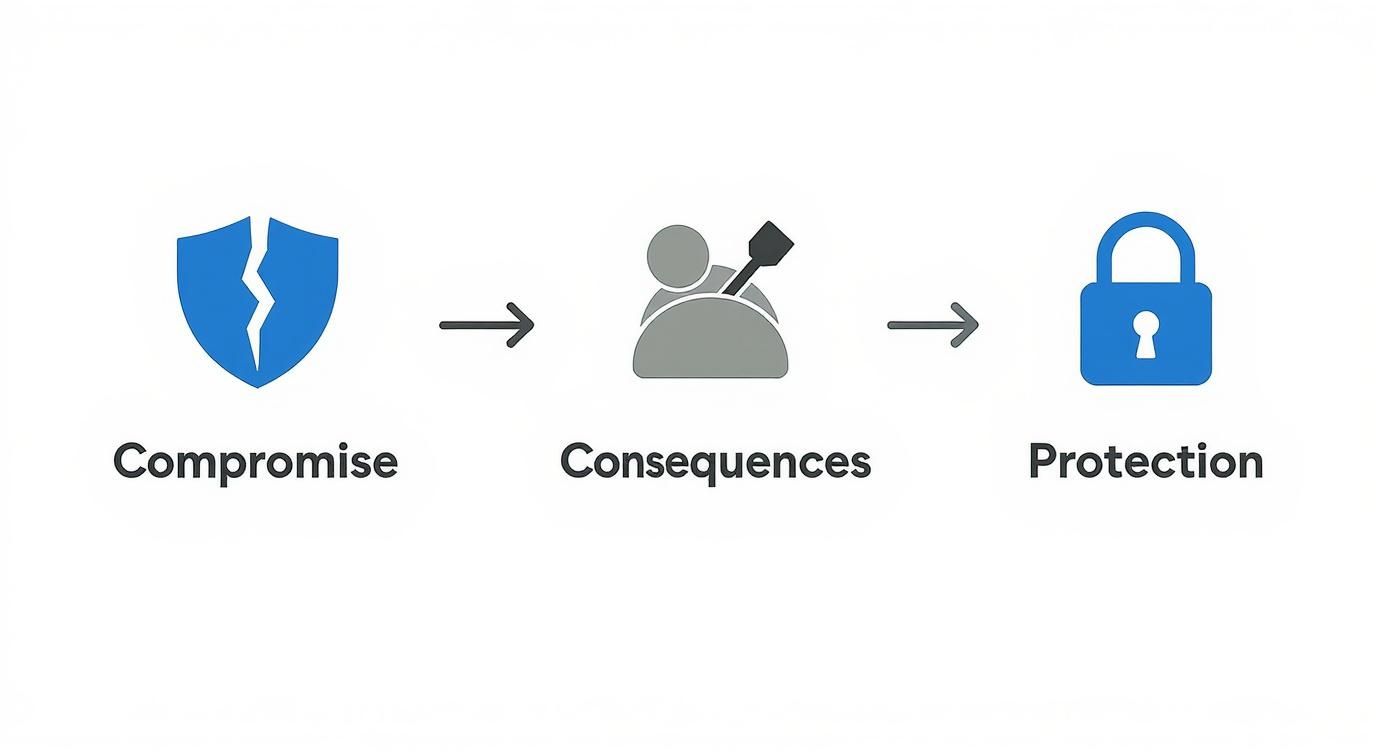
This diagram shows how a single slip-up can lead to serious consequences. That's why we have to build our defenses before we even start. And the very first step is defining exactly what you’re protecting yourself against.
Define Your Threat Model
Before you download a single piece of software, you need to answer a critical question: "Who am I trying to remain anonymous from?"
This is what we call a threat model, and your answer will guide every single decision you make from here on out. The strategy for hiding from a nosy coworker is completely different from one designed to evade a government agency.
Are you a faceless creator worried about obsessive fans or trolls digging up your personal information? Or maybe you're handling sensitive whistleblower data where a leak could put people in real danger? Be specific.
Your threat model isn't about being paranoid; it's about being smart and efficient. It helps you apply the right amount of protection—not so little that it's useless, and not so much that it makes creating content impossible.
Once you have a clear picture of the "who," you can start putting together your toolkit. For most creators, the goal is to prevent doxxing from the public, online platforms, and other casual adversaries. This calls for a layered defense, and the first layer is all about your network connection.
Layer One: Your VPN and Tor
Your computer’s IP address is its digital home address. It links your online activity directly to your physical location and internet service provider. Hiding it is job number one. Your main tools for this are a Virtual Private Network (VPN) and the Tor browser.
A VPN works by encrypting your internet traffic and routing it through a server owned by the VPN company. This effectively masks your real IP address from the websites you visit. The catch? You're placing your trust in the VPN provider not to log your activity.
- Choose Wisely: Always go for paid VPN services with a strict, independently audited no-logs policy. Free VPNs are notorious for selling user data, which completely defeats the purpose.
- Pay Anonymously: When you can, pay for your VPN using privacy-focused cryptocurrencies or other anonymous payment methods. This severs the link between your real identity and your anonymous toolkit.
For an even stronger layer of anonymity, there's Tor. The Tor browser routes your connection through a global, volunteer-run network of relays, making it incredibly difficult to trace back to you. While Tor is fantastic for privacy, it can be quite slow, which isn't always practical for uploading large video files. It's a powerful tool, but you have to know when to use it.
Layer Two: Isolate with a Virtual Machine
Even with a masked IP, your personal computer is a massive liability. Your operating system, browser history, and every app you have installed are potential sources of data leaks. The best way to manage this risk is to create a totally separate, walled-off environment using a Virtual Machine (VM).
A VM is basically a computer running inside your computer.
Software like the free and open-source VirtualBox or the more feature-rich VMware lets you install a completely separate operating system (like a fresh copy of Windows or a privacy-focused Linux distribution) that runs in a window on your desktop. This virtual environment is completely sandboxed from your main system—it has its own files, its own settings, and no access to your personal data.
This is where you'll build your anonymous persona. You install your VPN and Tor inside the VM. You create all your accounts from inside the VM. You do all your content creation inside the VM. If something ever gets compromised, it’s contained within that disposable environment, keeping your real life safe and sound. It's a digital clean room that prevents any accidental cross-contamination.
Creating and Managing a Sterile Online Identity
Once you’ve built your secure digital fortress, it’s time to create the persona who will live inside it. This is where you construct a completely sterile online identity—one that has zero connection to your real life. We're not just talking about picking a random username. This is a disciplined process of building a digital person from the ground up, making sure every email, account, and payment method is clean.
This requires a hard wall between your real world and your anonymous one. Even a tiny overlap, like using a password you’ve used before, can leave a breadcrumb. The goal is to build that wall so high that no one can ever peek over.
Secure Communication Channels First
Your very first move is setting up your core communication tools. Think of these as the foundation of your new identity. Everything starts with an email address, which you'll need to sign up for pretty much everything else.
Forget about using standard providers like Gmail. They’re built for data collection and often demand personal info. You need to go with a service that was designed from the ground up for privacy.
- Privacy-First Email: I always recommend services like Proton Mail. They’re based in Switzerland (great privacy laws) and offer end-to-end encryption. The best part? You can create an account without handing over any personally identifying information.
- Disposable Phone Numbers: So many platforms now force phone number verification. Never, ever use your real number. A Voice over IP (VoIP) service or a temporary number app will give you a number to receive verification codes. This puts a critical firewall between the platform and your real identity.
With these two tools, you have the building blocks to start operating online without ever tying your activity back to your real name or phone number.
The Discipline of Operational Security
Getting the tools is the easy part. Using them correctly, day in and day out, is where the real work begins. This is a concept we call Operational Security, or OpSec. It's less of a tool and more of a mindset—a set of habits you build to stop critical information from getting out.
For a faceless creator, OpSec is all about avoiding the simple, human mistakes that could connect your anonymous persona back to you. It's like digital hygiene.
The core principle of OpSec is to constantly look at what you’re doing from an attacker's perspective. Before you post, comment, or sign up for something, ask yourself: "What could someone learn from this? How could this be used to figure out who I am?"
Internalizing this way of thinking is probably the most important thing you can do. It makes abstract security rules feel practical. For example, when picking a username, don't just avoid your real name—avoid any handle you've ever used anywhere, no matter how old or obscure that gaming forum was.
Persona Management Best Practices
Maintaining this sterile identity isn’t a one-and-done setup; it's an ongoing practice. Here are the non-negotiable rules I live by:
- Never Reuse Anything. This is the golden rule. No shared usernames, passwords, profile pictures, or even distinct writing phrases between your real and anonymous lives. A good password manager is your best friend here—use it to generate and store unique, strong passwords for every single account.
- Invent a Backstory. Keep it simple and plausible, but make sure it’s entirely fictional. Where is your persona from? What are their interests (related to your niche)? Having this ready helps you stay consistent and keeps you from accidentally dropping real-life details into a conversation or video.
- Compartmentalize Devices. If you can swing it, use a dedicated device just for your anonymous work. It could be a cheap laptop or simply sticking to your virtual machine. If you ever get rid of a device, you have to be absolutely sure it's wiped clean. For example, before you sell or give away an old phone, you must learn how to totally wipe an iPhone to ensure no data is left behind.
- Manage Your Content Pipeline. As a creator, consistency is key, but managing a channel can be a security risk. To separate the creation process from platform management, some creators acquire pre-established channels. An aged YouTube channel that's already monetized can be a strategic way to hit the ground running without connecting a new channel to your personal details, adding another layer of operational security.
Keeping Your Content and Communications Private
You've built the fortress—the separate devices, the secure connection, the anonymous accounts. That’s the heavy lifting, but the real work starts now. Your daily habits in creating and sharing content are what will make or break your anonymity. One careless upload can undo everything.
This is where we get into the nitty-gritty of your day-to-day workflow. It's about making sure your content and conversations are as clean as your digital identity.
Think of every file you create—an image, a video, a document—as a potential digital breadcrumb. It’s packed with hidden data that can lead right back to you. This isn't just theory; it's a real-world problem you have to solve with every single post.
Scrub Your Files Clean of Hidden Data
Every photo you snap with your phone or camera embeds a chunk of information called EXIF data right into the file. This isn't just harmless fluff. It often includes the exact camera model, the timestamp of the shot, and most dangerously, the GPS coordinates of where you were standing. It's a goldmine for anyone digging for your identity.
It’s not just photos, either. Word documents and PDFs can contain the author’s name, their company, and a history of edits. Uploading a raw file is like accidentally dropping your driver's license at the scene.
The good news is that stripping this data is easy once you make it a non-negotiable step in your workflow.
-
For Images: Before you even think about uploading, use a metadata scrubber. On Windows, you can right-click the file, go to
Properties > Details, and then selectRemove Properties and Personal Information. For Mac users, an app like ImageOptim works wonders. - For Videos & Documents: A powerful, open-source tool like ExifTool can handle almost any file type, but it’s a command-line tool, which can be intimidating. A simpler method is to convert documents to a basic, "flattened" PDF, which often removes most of the sensitive data.
Your Golden Rule: Never, ever upload a file directly from its source. Always run it through a metadata scrubber first, ideally inside your virtual machine, before it ever touches a public platform. This one habit is your best defense against a catastrophic leak.
Your Writing Style Is a Fingerprint
Beyond the technical bits and bytes, your words themselves can give you away. There's a whole field called stylometry dedicated to identifying authors based on their unique writing patterns—the vocabulary they prefer, typical sentence length, and even their favorite punctuation quirks. It might sound like something out of a spy movie, but it's a very real technique.
As a faceless creator, this means you need to be conscious of how your anonymous persona sounds on the page. The idea isn't to write like a robot, but to deliberately avoid the distinct habits that connect to your real-life writing.
A few practical tips can make a huge difference:
- Adopt a different tone. If you’re normally a formal writer, make your persona casual and conversational. Or do the opposite.
- Switch up your vocabulary. Make a conscious effort to use synonyms and avoid pet words or phrases you lean on in your personal life.
- Use a grammar checker. Tools like Grammarly can help smooth out the unique quirks and patterns in your writing, making it less distinctively you.
Keep Your Conversations Secure and Private
Finally, let's talk about communication. Using your standard email or messaging apps for anything related to your anonymous brand is just asking for trouble. You need to use channels designed from the ground up for privacy. This is where end-to-end encrypted (E2EE) apps are non-negotiable.
Here’s a quick rundown of the most popular options:
| App | Key Feature | Anonymity Factor |
|---|---|---|
| Signal | Requires a phone number | Fantastic encryption, but the number is a potential link. Always use a disposable VoIP number. |
| Session | No phone number required | Creates a decentralized ID, offering much stronger anonymity right from the start. |
| Telegram | Optional E2EE | Standard chats are stored on their servers. Only "Secret Chats" offer true end-to-end privacy. |
For most creators who need to talk with partners or sources, Session is the top contender. It strikes an excellent balance between strong anonymity and ease of use. Because it's decentralized, there's no single company collecting your data.
To see how seriously we take this, you can check out how we handle data in the MonetizedProfiles privacy policy. A strong commitment to privacy is the bedrock of maintaining a truly anonymous online presence.
Navigating Payments and Platform Minefields
So you've built the perfect fortress. Your devices are locked down, your network is secured, and your sterile identity is in place. But now comes the real test: getting paid. This is often the final hurdle, and it’s where many anonymous creators stumble. The second you connect a bank account, all that hard work can unravel.
Let's be blunt: traditional finance is a dead end for anonymity. A bank transfer, a PayPal payment, a Stripe payout—these are all hardwired to your real name and address. There's no way around it. To keep your identity safe, you have to think outside the conventional financial box. That means exploring privacy-focused cryptocurrencies.
Receiving Anonymous Payments
Here's a common misconception I see all the time: people think Bitcoin is anonymous. It’s not. Bitcoin's public ledger, the blockchain, is like an open book where every single transaction is recorded forever. With enough digging, those transactions can be traced back to you. It's a risky bet unless you're an expert at using complex tools like coin mixers.
If you're serious about this, you need to go deeper into understanding crypto privacy and Bitcoin's anonymity. The details really, really matter.
For genuine privacy, you want to use a dedicated privacy coin. Monero (XMR) is the go-to choice for a reason.
- Anonymous by Design: Monero's transactions are untraceable and unlinkable right out of the box. It uses clever tech like ring signatures and stealth addresses to hide the sender, receiver, and amount.
- No Public Trail: Unlike Bitcoin, you can't just plug a Monero wallet address into a public website and see its entire history. This is what makes it the gold standard for getting paid without leaving a financial breadcrumb trail.
The moment you link a traditional payment method to your anonymous persona, the game is over. Using a privacy coin like Monero isn't just an option; it's a foundational requirement for maintaining long-term anonymity as a monetized creator.
The Dangers of Mainstream Platforms
Even if you nail your payment strategy, the platforms themselves—YouTube, TikTok, Twitch—are constantly trying to figure out who you are. Their entire business is built on collecting user data. Every login, IP address, and browser fingerprint is logged, stored, and analyzed.
This is why sticking to your secure setup (VPN, virtual machine, etc.) for every single interaction is non-negotiable. These platforms are masters at connecting the dots. Log into your personal YouTube account and your anonymous channel from the same home IP address just once, and you’ve given them all they need to link you. Always read the fine print; for example, reviewing the data clauses in the MonetizedProfiles terms of service shows you what to look for in a more privacy-conscious service.
The Rise of Mandatory ID Verification
The single biggest threat to online anonymity right now is the global push for mandatory ID verification. This isn't some niche concern anymore; it's becoming the new reality, and it poses a direct challenge to anyone trying to stay faceless online.
By late 2025, roughly half of the U.S. and the U.K. will require users to upload an ID or use facial scans to access adult content. Australia is following suit, introducing strict age gates for social media access for anyone under 16. These laws create a chilling effect where anonymous access to information is becoming a thing of the past.
There's no easy way around this. As a faceless creator, your best bet is to choose platforms that haven't yet implemented these intrusive policies. You also have to be ready to walk away from a platform the moment they do.
Common Questions About Staying Anonymous Online
Even when you think you have a solid plan, trying to stay truly anonymous online brings up a ton of questions. It's really easy to get lost in the weeds or fall for common myths. Let's clear up some of the most frequent hurdles people run into.
These aren't textbook answers. They're practical, based on what actually works and what gets people into trouble.
Is Using a VPN Enough to Be Completely Anonymous?
No. And this is probably the single most dangerous misconception out there. A VPN is an essential tool, but it is not a magic invisibility cloak. All a good VPN does is mask your IP address and encrypt your internet traffic. That’s a crucial first step, but it's just one piece of a much bigger puzzle.
You have to remember that websites have dozens of other ways to track you:
- Browser Fingerprinting: Your browser's unique mix of settings, fonts, and extensions creates a "fingerprint" that can identify you, no IP address needed.
- Cookies: These little trackers follow you from site to site, building a detailed profile of everything you do.
- Account Logins: If you slip up and log into a personal account like Google or Facebook while your VPN is on, you’ve just announced exactly who you are.
Think of a VPN as the first layer of defense, not the entire fortress. Real anonymity demands a layered strategy that includes a VPN, Tor, virtual machines, and disciplined habits.
A VPN makes you harder to find, but it doesn't make you a ghost. It only solves the "where" problem (your IP address), not the "who" problem (your behavior and digital footprint).
How Can I Receive Money Anonymously as a Content Creator?
This is the big one, the ultimate challenge for most faceless creators. You want to get paid, but the entire financial system is built on identity verification. Bank transfers, PayPal, and credit card processors are tied directly to your legal name, making them a non-starter for true anonymity.
Your best bet here is to use privacy-focused cryptocurrencies. While most people immediately think of Bitcoin, its public ledger makes it surprisingly traceable. For genuine privacy, Monero (XMR) is the gold standard. Its transactions are designed from the ground up to be untraceable and unlinkable, protecting the sender, receiver, and the amount.
Accepting payments this way completely severs the financial link between your anonymous work and your real identity. For long-term security, this is a critical move.
What Is the Single Biggest Mistake People Make?
The most common and catastrophic mistake is cross-contamination. It’s the simple act of accidentally linking your anonymous identity with your real one. It sounds obvious, but it happens in such subtle ways that it’s incredibly easy to overlook.
Here are a few real-world examples I've seen:
- Logging into a personal social media account from your "anonymous" browser for just a second.
- Reusing a username from an old gaming forum for your new, anonymous persona.
- Uploading a photo taken on your personal phone without scrubbing the GPS metadata first.
- Using the same password for an anonymous account that you've used for a personal one.
The only reliable way to prevent this is through strict compartmentalization. That means using separate devices, dedicated virtual machines, and different browsers for your anonymous activities. You have to treat them as two completely separate worlds that must never, ever touch.
Are Free VPNs Safe for Anonymity?
In almost every single case, the answer is a hard no. If you are serious about protecting your identity, you have to stay away from free VPN services. The old saying is absolutely true here: if you aren't paying for the product, you are the product.
Free VPNs need to make money somehow, and they usually do it by:
- Logging your browsing history and selling that data to advertisers.
- Using weak security protocols that can leak your real IP address.
- Sometimes even bundling malware or trackers into their software.
Investing in a reputable, paid VPN provider with a strict, independently audited no-logs policy is a tiny price to pay for real security. Consider it one of the foundational costs of operating anonymously.
At MonetizedProfiles, we know that building a secure and anonymous presence is a huge deal for faceless creators. That's why we offer monetization-approved social media accounts, giving you a safe starting point without tying your personal details to your new project. Check out our inventory of monetized YouTube and TikTok accounts to launch your channel securely from day one.


