


Let's be honest, growing a YouTube channel isn't about getting lucky. The channels you see blowing up overnight aren't just winging it; they're following a specific, repeatable system. It all boils down to three key pillars: picking the right niche, creating content that keeps people glued to their screens, and promoting it intelligently. That's the real "secret."
Your Fast-Track Framework for YouTube Growth

You can forget the old advice to just "post consistently." Sure, consistency is part of the equation, but it's completely wasted without a smart strategy behind it. Rapid growth today is about building an efficient system that predictably attracts and holds onto viewers.
It's not about chasing a one-off viral video. It's about engineering consistent success, video after video.
This framework is built on three core pillars that feed into each other, creating a powerful momentum loop. When you get all three working in sync, you can seriously shorten the growth timeline from years down to just a few months.
The Three Pillars of Rapid YouTube Growth
This whole guide is designed to help you master these three areas. They're all connected, and if you let one slide, the entire strategy falls apart. Think of it like a three-legged stool—you need all three legs for it to stand.
Here’s a quick breakdown of what makes this framework so effective.
| Pillar | Key Objective | Primary Action Items |
|---|---|---|
| Strategic Niche Selection | Establish authority and attract a dedicated audience. | Define a specific target viewer, analyze competitor gaps, and validate topic demand. |
| High-Retention Content | Maximize watch time and signal value to the algorithm. | Craft compelling hooks, structure scripts for engagement, and optimize for viewer satisfaction. |
| Intelligent Promotion | Accelerate discovery and drive traffic to new videos. | Optimize titles/thumbnails for clicks, master YouTube SEO, and cross-promote on other platforms. |
Mastering these pillars is what turns a hobby into a high-growth channel.
The goal isn't just to get views; it's to build a system that generates the right views from an audience that will subscribe and return for more. This is the difference between a viral moment and a sustainable channel.
This systematic approach is a game-changer, especially for creators in focused areas like faceless channels or automation professionals, where building authority with a targeted audience is everything.
If you're just starting out, there are ways to get a head start. For example, some creators use pre-monetized accounts to skip the initial grind of hitting YouTube's partner program requirements. This lets you put 100% of your energy into making incredible content from day one, which is truly what matters for long-term growth. By taking the pressure off hitting those early milestones, you can focus on what really moves the needle: refining your content and building a real community.
Nail Your Niche and Become the Go-To Expert

If you want to grow a YouTube channel fast, you have to start with a clear, focused direction. I see too many creators fall for the classic trap of "follow your passion," which often leads them to make videos that nobody is actually searching for.
A much smarter way to start is by finding a niche that has proven demand, but isn't overly crowded. This gives you a clear path to becoming a recognized expert in that space.
Think about it. Instead of a generic cooking channel, what if you focused on "30-minute vegan meals for busy professionals"? That level of specificity immediately grabs the attention of a dedicated audience. It's far easier to dominate a small pond first.
Hunt for High-Demand, Low-Competition Topics
It's time to put on your detective hat. The best part is, you can use free tools to figure out what people are actively searching for. YouTube's own search bar is a goldmine—just start typing a broad topic and watch what auto-suggestions appear. Those aren't random guesses; they're what real people are looking for.
Another incredible free tool is Google Trends. You can use it to compare search interest between different topics, spot seasonal trends, and find "breakout" keywords that are just starting to take off. You're looking for topics with a steady, upward-trending interest, not just a one-off viral spike. This data-driven approach takes all the guesswork out of your content strategy.
Let's say you're interested in "productivity." That's way too broad. But if you dig a little deeper, you might find rising interest in specific sub-topics, like:
- "Silent vlogs for studying" – taps into the huge trend of ambient content.
- "Notion template tutorials" – targets users of a very specific, popular app.
- "AI tools for marketers" – combines two hot topics into one powerful niche.
These "niches within a niche" are where the real opportunity is. You won't be competing with massive channels; you'll be serving a specific audience with perfectly tailored content. If you want a deeper dive, check out our guide on how to find a profitable niche for more advanced strategies.
Make Sure Your Niche Idea Is a Winner
Once you have a few potential niches shortlisted, you need to validate them. An idea is worthless if there isn't an engaged community or a way to make money beyond a few cents from ads.
Run your ideas through this quick checklist:
- Search Volume: Is there real interest? Use a keyword tool to see if enough people are actually searching for your topic.
- Competition: Who are the big players? Look for channels that have high engagement but maybe upload inconsistently or have lower production quality. Those are gaps you can fill.
- Community Vibe: Are there active Reddit communities, Facebook groups, or forums on this topic? A built-in community is a huge green flag.
- Money-Making Potential: Can you see multiple ways to earn an income? Think past AdSense. Could you do affiliate marketing, sell digital products, or land sponsorships?
A great niche isn't just something you know about. It's the strategic sweet spot where your expertise, audience demand, and a clear path to profitability all meet. Getting this right from the start is the most important thing you can do for rapid growth.
Analyze Successful Channels to Decode Your Audience
Don't just watch your potential competitors—study them. Click on one of their most successful videos and break it down.
What did they do in the first five seconds to hook you? How did they structure their information to keep you watching? Most importantly, read the comments. What questions are people asking? What problems are they trying to solve? The comment section is a direct line into the brain of your target viewer, giving you a nearly endless list of video ideas you know they want.
When you combine smart data analysis with a real understanding of what makes your audience tick, you're no longer just another creator. You become a trusted authority. That foundation is the key to the fast, sustainable growth you're looking for.
Create Content That Hooks and Holds Attention

Your niche gives you a destination, but your content is the actual engine that gets you there. Even the best channel idea in the world will go nowhere if the videos themselves can't grab viewers and keep them watching. Today, the battle for attention on YouTube is won or lost in the first few seconds.
This is where you earn a viewer's time. The algorithm is obsessed with one thing above all else: retention. And high-retention videos always start with a powerful, can't-look-away hook.
Master the First Five Seconds
Think about how you scroll. You give a video a few seconds—tops—to prove it's worth your time. Your viewers are no different. You have a tiny window, maybe 3-5 seconds, to answer their unspoken question: "What's in it for me?"
A great hook isn't just a flashy intro; it’s a promise of value. It tells the viewer exactly what they’re going to get out of your video.
Here are a few hook formulas I've seen work time and time again:
- The Pain Point Hook: Start with a problem you know your audience has. "Are you sick of your videos getting stuck at 10 views?"
- The Contrarian Hook: Challenge a common belief. "Everyone tells you to buy expensive gear to start on YouTube. They're wrong."
- The "End Result First" Hook: This one is a classic. Show off an incredible final product right at the beginning, then promise to reveal how you did it.
Get into the habit of scripting your hooks. The goal is to make the viewer feel like they have to see what happens next. A strong opening is the single most important factor in boosting your audience retention.
Use Shorts for Rapid-Fire Discovery
YouTube Shorts are no longer a side project; they're a primary discovery tool for new channels. Think of them as your channel's billboards, introducing you to a massive audience that isn't even looking for you.
Shorts get pushed to viewers who don't follow you, creating a direct funnel for new subscribers. The trick is to treat them as entry points, not just chopped-up versions of your longer videos. A good Shorts strategy is all about simple, looping, high-impact content that delivers one satisfying idea fast.
Build a Binge-Worthy Content Ecosystem
While Shorts bring in new faces, your long-form videos are what turn those casual viewers into a real community. This is where you build trust, deliver serious value, and rack up the watch time that YouTube's algorithm loves. Your ultimate aim is to create a web of content where one video naturally leads to the next.
Let's be real: growing to 1,000 subscribers and 4,000 watch hours can feel like a marathon. With over 113 million active channels competing for the attention of 2.53 billion users, standing out is tough. This is why channels that effectively mix Shorts and long-form videos have been shown to grow up to 3x faster. It creates a powerful flywheel effect.
You can encourage this binge-watching behavior strategically:
- Create Obvious Series: Group related videos into playlists. If you make a video on "Beginner Camera Settings," your next one should be "5 Easy Lighting Setups for Beginners."
- Master End Screens & Cards: Don't just end your video; actively point viewers to another relevant video on your channel. Don't let them click away to a competitor.
- Reference Your Own Library: Casually mention your other content in your script. "I actually break that down in more detail in my video on keyword research, which I'll link in the description."
This relationship between short-form and long-form is the key to explosive growth. Shorts are your discovery engine, pulling in a wide audience. Your long-form videos then capture that audience, prove your value, and turn them into loyal subscribers. When both are working in harmony, your channel's growth becomes a self-sustaining loop.
Get Found on YouTube with Smart SEO
Making an amazing video is only half the job. If nobody can find it, all that hard work goes to waste. This is where getting good at YouTube SEO becomes your secret weapon, turning your channel from an undiscovered secret into a go-to destination. It’s all about getting your videos in front of the exact people searching for them.
This thinking starts way before you even think about uploading. It kicks off with understanding how your audience talks—the specific keywords and phrases they’re plugging into that search bar. This isn't a guessing game; it's smart research.
Put yourself in a viewer's shoes. If you wanted to learn to make sourdough bread from scratch, what would you type? Maybe "easy sourdough recipe" or "beginner sourdough starter"? Those are your clues. Free tools like Google Trends or even just YouTube's own search bar suggestions are gold mines for figuring out what people are looking for.
Titles and Thumbnails That Make People Click
Think of your title and thumbnail as your video’s personal billboard on a very crowded highway. They have a single, crucial mission: get someone to stop scrolling and click on your video over all the others. A high click-through rate (CTR) is a massive signal to the YouTube algorithm, so you have to nail this.
A killer title needs to be both search-friendly and magnetic. It should feature your main keyword but also spark some curiosity or promise a real solution.
- Weak Title: "My Video About Sourdough Bread"
- Strong Title: "The ONLY Sourdough Recipe Beginners Will Ever Need (No Fail)"
See the difference? The second one hits a clear keyword ("sourdough recipe beginners") and makes a bold promise that’s hard to ignore.
Your thumbnail has to visually back up that promise. Use bright, high-contrast colors, easy-to-read text, and if it fits your channel, a person's face showing some emotion. You want a thumbnail that pops and tells a story, even when it’s tiny on a phone screen.
Feeding the Algorithm with Great Descriptions and Tags
Your video description is so much more than a place to drop a few links. It's valuable real estate for telling the YouTube algorithm precisely what your video is about. Pay close attention to the first couple of sentences—that's what people see in search results.
Try to get your main keyword in there naturally within the first 25 words. From there, write a friendly, detailed paragraph or two explaining what the video covers, weaving in related keywords as you go. This gives the algorithm all the context it needs. If you want to get deeper into the platform's brain, you can check out our guide on how the YouTube algorithm works.
Tags are another helpful clue for the algorithm. Their influence isn't what it used to be, but they still help YouTube sort and categorize your content, which is especially useful for new channels trying to find their footing.
Pro Tip: Make your very first tag the exact keyword you're targeting. After that, add some variations and broader, related topics. A tool like TubeBuddy is great for peeking at the tags your successful competitors are using.
This whole process—solid keyword research, eye-catching packaging with your title and thumbnail, and detailed metadata—is the bedrock of good YouTube SEO. It's not a one-and-done trick; it’s a system you follow for every video. When you consistently tell the algorithm who your content is for, the right viewers will find you. That’s how fast growth becomes not just a hope, but a predictable outcome.
Build a Consistent Upload and Promotion System
Making a great video is only half the battle. If you don't have a solid system for getting it in front of people, even the best content will just gather dust. The YouTube algorithm thrives on consistency—it’s how you signal that your channel is active, reliable, and worth showing to new viewers.
This isn't about burning yourself out trying to post daily. It's about finding a rhythm you can actually stick to for the long haul. A predictable schedule builds anticipation with your subscribers and keeps your channel on the algorithm's good side.
Define Your Upload Cadence
So, what's the magic number of uploads? Honestly, it's less about a specific number and more about what's sustainable for you. You need to find a pace that keeps the momentum going without leading to burnout.
For most creators, a hybrid approach blending long-form videos with Shorts is a fantastic starting point. This creates a powerful little content ecosystem that feeds itself.
- Long-Form Videos (1 per week): Think of this as your channel's main course. It's where you build a real connection with your audience, deliver massive value, and rack up the watch time you need to get monetized. Just pick one day of the week and make it your official upload day.
- YouTube Shorts (3-5 per week): These are your secret weapons for discovery. Shorts are perfect for grabbing the attention of a much wider audience, testing out new content ideas on the fly, and even acting as mini-trailers for your longer videos. They’re quick to make and have huge potential for reach.
This schedule keeps your channel buzzing with activity without requiring a production schedule that’s impossible to maintain. The key is planning ahead. To get your workflow dialed in, check out our guide on how to create a content calendar.
Create a Promotion Snowball Effect
Don't make the mistake of thinking your job is done once you hit "publish." That's when the real work of promotion begins. Your goal is to create a snowball effect, where every single piece of content you share online funnels people back to your YouTube channel.
The most efficient way to pull this off is by slicing and dicing your main video into smaller, bite-sized assets for other social platforms. You're essentially creating a web of content that all points back to your main hub.
A single long-form video can easily be repurposed into:
- Three to five high-impact Shorts or Reels: Just clip out the juiciest hooks, most surprising moments, or key takeaways.
- A compelling carousel post for Instagram: Use screenshots and key bullet points to give a quick summary of the video's value.
- A text-based thread for X (formerly Twitter): Break down the main points or steps from your video into a simple, easy-to-read thread.
This strategy squeezes every drop of value out of each video you create, making sure it gets seen by the largest possible audience. This simple workflow shows you how it all fits together.
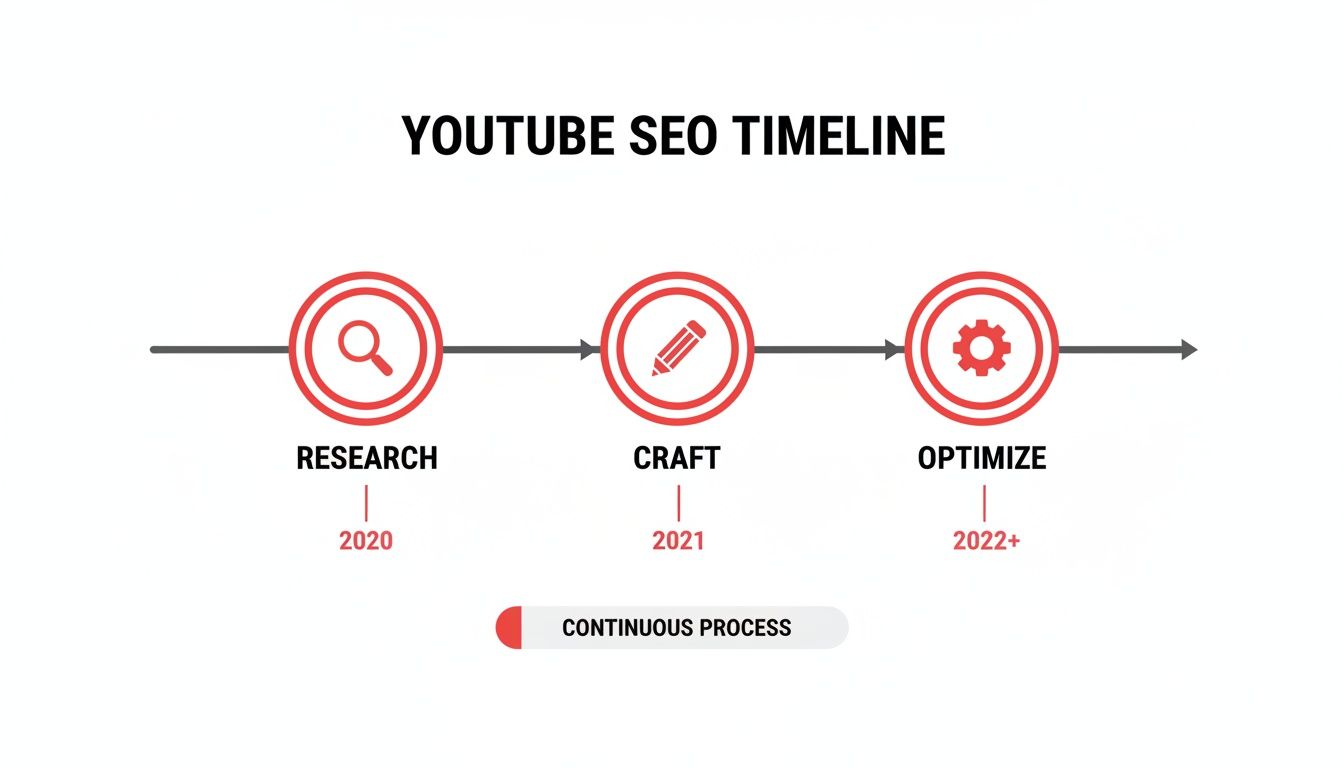
As you can see, it's a clear, repeatable process: figure out what people are searching for, create content that delivers, and then optimize it so it can be discovered.
Hack Your Growth with Smart Consistency
On YouTube, consistency crushes the competition. The top channels are relentless content machines, proving that for rapid growth, frequency often matters more than perfection. With 122 million daily active users watching over a billion hours of video every single day, channels that upload often just get more at-bats.
But for faceless creators and entrepreneurs, that grind to monetization can be brutal. A smart hack is to start with pre-monetized accounts, which are grown organically to meet the 1K subscriber and 4K watch hour requirements. This lets you skip the line and focus on high-volume content right from day one. You can learn more about what top channels are doing right at epidemicsound.com.
Building a system isn't about working harder; it's about working smarter. A consistent upload schedule combined with a multi-platform promotion strategy creates a growth engine that works for you 24/7, turning casual viewers into a loyal community.
Your YouTube Growth Questions, Answered
Even with the best roadmap, you're going to hit some bumps and have questions. I get it. Let's tackle some of the most common ones I hear from creators so you can keep moving forward without getting stuck.
How Fast Can My Channel Actually Grow?
Everyone wants to know the magic number, but the truth is, it's different for everyone. I've seen channels in a hot niche with a killer content strategy hit their first 1,000 subscribers in a couple of months. I've also seen others take a year.
Instead of obsessing over a timeline, pour that energy into two numbers that really matter: your click-through rate (CTR) and audience retention. If you can get people to click and then get them to stay, YouTube's algorithm will notice and start pushing your content. That's the real secret to growing faster.
Your growth speed is a direct measure of how quickly you learn and adapt. The faster you dig into your analytics and give people more of what they're proven to love, the faster you'll see that subscriber count climb.
Should I Make Shorts or Long-Form Videos?
Why not both? They're a perfect tag team. They have totally different jobs but work together to build a powerful channel.
- YouTube Shorts: These are your billboards. They're designed to blast your channel in front of tons of new people who have no idea who you are. Shorts are amazing for getting a quick hit of new subscribers.
- Long-Form Videos: This is where you build your community. Your longer videos are for delivering real value, earning trust, and racking up the watch hours you need to get monetized.
The ideal flow is using Shorts to grab someone's attention and then converting them into a loyal fan with your in-depth, long-form content.
What’s the Magic Number for Videos Per Week?
Forget a magic number. Consistency is so much more important than frequency. Posting one fantastic, polished video every single week is infinitely better than dropping five half-baked videos whenever you feel like it. The algorithm loves a predictable schedule.
For most people just starting out, this is a great rhythm to aim for:
- 1 long-form video each week.
- 3-5 Shorts sprinkled throughout the week.
This is a sustainable pace that keeps your channel active without burning you out. Once you get your workflow dialed in, you can think about ramping it up.
Can a Faceless Channel Grow Quickly?
Absolutely. In fact, they're some of the fastest-growing channels out there right now. This model proves that you don't need to be on camera to provide massive value. Think about niches like guided meditations, software tutorials, data visualization, or even just relaxing rain sounds.
For a faceless channel to take off, you have to be obsessed with quality where it counts:
- Audio: Your voiceover or sound design needs to be exceptionally crisp and clear. No exceptions.
- Visuals: Whether it's stock footage, screen recordings, or animations, it has to look clean and professional.
- Value: Your content has to solve a real problem or create an unforgettable experience.
When you're not on screen, your content is the star. You have to make sure it shines.
Do I Really Need to Buy Expensive Gear?
Nope. The phone you have right now is probably a fantastic camera. New creators almost always make the same mistake: they blow their budget on a fancy camera and completely forget about audio and lighting.
Think about it—you'll probably sit through a video that's a little grainy, but you'll click off in a second if the audio is scratchy and you can't understand what's being said.
If you have a small budget, here's where to put your money:
- A good microphone: A simple USB mic or even a lavalier mic for your phone will instantly make you sound more professional.
- Basic lighting: A ring light or a couple of cheap softbox lights can make a world of difference.
- Your smartphone: Seriously, use it as your camera until your channel starts making money.
Focus on making great stuff first. You can always upgrade your gear when the channel starts paying for itself.
Ready to skip the slow grind and start earning from your content immediately? MonetizedProfiles offers fully approved YouTube accounts that meet all monetization requirements from day one. It's the ultimate shortcut for serious creators who want to focus on making great videos, not waiting for permissions. Check out our ready-to-go accounts.


