


So, you want to get your YouTube channel monetized? It really comes down to one thing: joining the YouTube Partner Program (YPP). This is the key that unlocks ad revenue and other cool earning features.
To get in, you need to hit some specific numbers. The classic route is getting 1,000 subscribers and racking up 4,000 hours of public watch time on your long-form videos over the past 12 months.
But what if you're a Shorts creator? YouTube has an alternative path for you. You can also qualify with 1,000 subscribers and 10 million valid public Shorts views in the last 90 days. Of course, all of this has to happen while you're playing by the rules—following all the community guidelines and policies.
Your Roadmap to a Monetized YouTube Channel
Turning your creative passion into a real paycheck on YouTube is a huge milestone. It’s not just about uploading videos and hoping for the best; it’s a deliberate process of building an audience, creating content they love, and ticking off YouTube's official boxes.
Think of the YPP requirements less as a grind and more as proof that you've built something real. A subscriber isn't just a number; it's a person who wants to see more from you. Those 4,000 watch hours mean you've created content compelling enough to hold people's attention. That’s the real win.
The whole journey is pretty straightforward when you break it down.
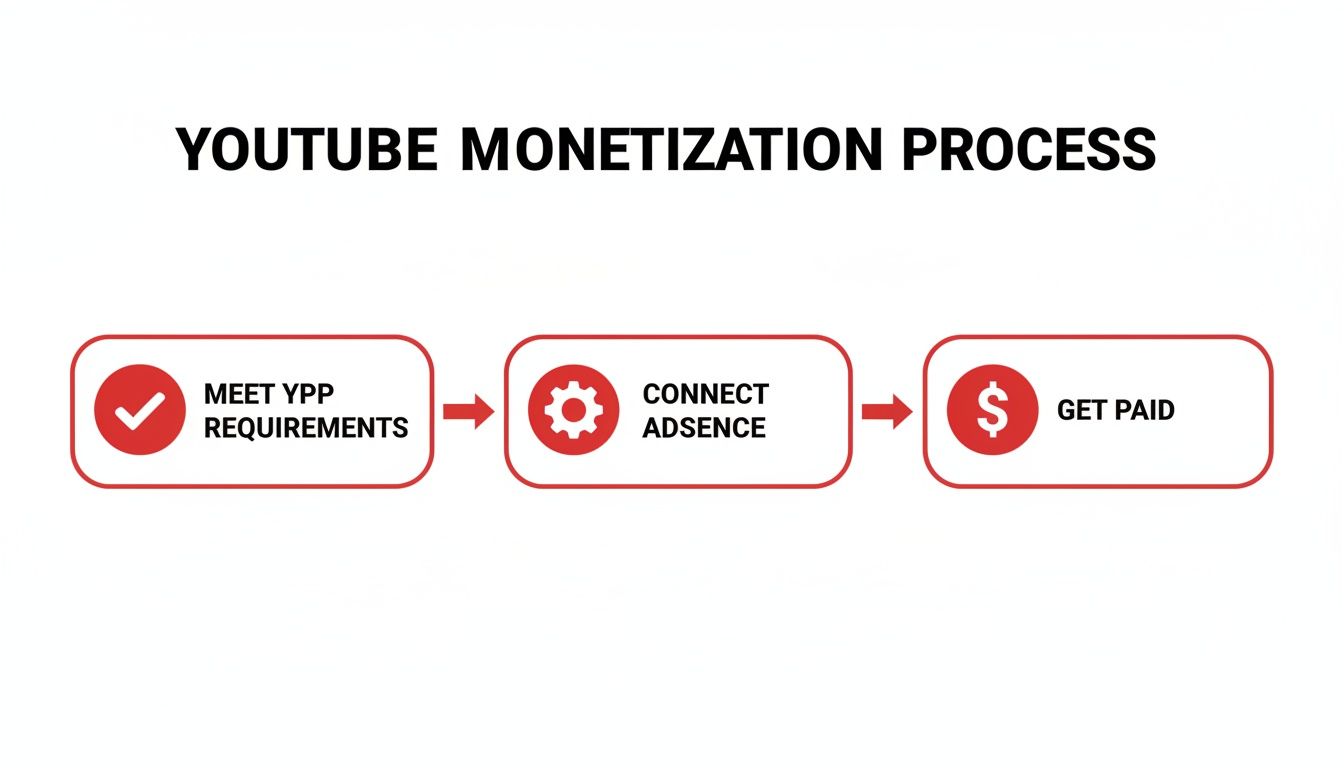
As you can see, you first meet the YPP rules, then handle the technical step of linking a Google AdSense account, and finally, you start getting paid. It's a massive ecosystem—over 5 million channels are already in the YPP, with YouTube paying out billions to creators every year.
The real goal isn't just to get monetized—it's to build a sustainable channel that continues to grow and earn long after you've hit the initial milestones. Consistency and value are your best tools.
For many, hitting those first targets takes time, often around 12-18 months of consistent effort. But the potential is absolutely there if you stay focused.
YouTube Partner Program Eligibility at a Glance
To make it even clearer, here’s a quick summary of what you need to aim for to unlock full monetization features. These thresholds are YouTube's way of making sure channels have a real, engaged audience before they start earning from ads.
| Requirement | Threshold for Full Monetization | Alternative Path (Shorts) | Key Policies to Follow |
|---|---|---|---|
| Subscribers | 1,000 | 1,000 | Must be organic subscribers (no "sub4sub"). |
| Watch Time | 4,000 public watch hours in the last 12 months | Not required if Shorts view threshold is met. | Only public, long-form videos count. |
| Shorts Views | Not required if watch hour threshold is met. | 10 million public views in the last 90 days | Views must be from the Shorts feed. |
| Channel Status | No active Community Guideline strikes. | No active Community Guideline strikes. | Adherence to Monetization Policies is mandatory. |
Meeting these requirements is your ticket into the program. Once you're in, you can start earning from ads, but remember that staying in means continuing to follow all of YouTube’s rules.
Getting Into the YouTube Partner Program
So, you want to get your YouTube channel monetized. The first hurdle everyone has to clear is getting into the YouTube Partner Program, or YPP. Think of it less like a finish line and more like a checkpoint. YouTube needs to see that you've built a real audience that actually sticks around before they start splitting ad revenue with you.
Let's get into what that looks like in practice.

YouTube gives you two main ways to qualify, which is great because it lets different types of creators play to their strengths.
You can go the traditional route with long-form videos:
- Get 1,000 subscribers.
- Rack up 4,000 hours of public watch time in the last 12 months.
Or, if you're all about short-form content, you can aim for the Shorts-specific path:
- Get 1,000 subscribers.
- Hit 10 million valid public Shorts views in the last 90 days.
You only need to meet one of these thresholds, not both. Most creators I know tend to focus on one path and let the other happen organically.
The Long Game: Cracking the 4,000-Hour Watch Time Code
For many, that 4,000-hour number feels like a mountain. It’s 240,000 minutes of people watching your videos. That’s a lot. The biggest mental shift you need to make is moving from "How do I get more views?" to "How do I keep people watching longer?"
A common mistake I see is creators pumping out lots of short, 3-minute videos, hoping one goes viral. The smarter play is to create content that naturally holds attention. For instance, a single 20-minute deep-dive tutorial on a piece of software will build watch time way faster than five separate 4-minute videos touching on different features.
Here are a few tactics that actually move the needle:
- Create binge-worthy playlists. Group related videos together. If someone likes one, YouTube's algorithm is much more likely to serve them the next one in the series, effectively doubling or tripling your watch time from a single viewer.
- Go longer, but with purpose. Aim for videos in the 8-12 minute range. But don't just add fluff to hit a number. The content has to justify the length. A longer video gives you more runway to build a connection and keep people engaged.
- Become a student of your analytics. Pop open your YouTube Studio and look at your audience retention graphs. Do people bail in the first 30 seconds? Your intros are the problem. Is there a big drop-off halfway through? Go back and see what you were talking about—it probably wasn’t as engaging as you thought.
You can track your progress right in YouTube Studio under the "Earn" tab. It lays out your subs and watch hours clearly, so there’s no guessing.
The Fast Lane: The 10 Million Shorts Views Path
The Shorts route—10 million views in 90 days—is a completely different beast. It’s a game of volume, trends, and pure virality.
Success here is all about creating content that's snappy, re-watchable, and easy to share. You have to jump on trending audio and popular formats almost immediately. A single Short that catches the algorithm's favor can explode and get you millions of views in a weekend. The trick is consistency. You can't just post one and pray; you need to be uploading frequently to increase your odds of striking gold.
My Takeaway: Don't fight your natural style. If you love telling detailed stories, focus on the 4,000-hour path. If you excel at quick, punchy content, go all-in on Shorts. Either way, the underlying goal is the same: prove to YouTube you can build and hold an audience.
Staying on the Right Side of the Rules
Hitting the subscriber and view-count milestones is just step one. I’ve seen so many creators get rejected because they overlooked the fine print. You absolutely have to follow YouTube’s policies to the letter.
This isn't just about avoiding obvious no-nos. It’s about understanding the nuances of what YouTube considers "advertiser-friendly."
Here’s a quick rundown of the big ones:
- YouTube Community Guidelines: This is the basic rulebook for being a good citizen on the platform. No hate speech, no spam, no dangerous pranks.
- AdSense Program Policies: These rules are all about what advertisers are comfortable being associated with. Controversial topics, even if they don't violate community guidelines, can make your channel ineligible for ads.
- Copyright: This is a huge one. You must own the rights to every piece of video and audio in your content. Using a popular song without the right license is one of the fastest ways to get a rejection letter.
The sneakiest policy that trips people up is "Reused Content." This doesn’t just mean you can't steal other people's videos. It can also flag low-effort content like text-on-screen compilations, generic slideshows, or reaction videos where you don't add significant original commentary. Your work has to be transformative.
For creators who want to bypass this initial grind and focus purely on making great videos, some look into acquiring an aged YouTube channel that's already cleared these hurdles. It's a shortcut, but one that lets you hit the ground running.
Building a Content Strategy for Monetization
Hitting those YouTube Partner Program numbers is one thing, but building a channel that actually lasts is a completely different game. This is where you stop chasing metrics and start creating content that genuinely pulls people in, keeps them watching, and builds a real community. This is how you get monetized for the long haul.
Think of your content strategy as the blueprint for your channel. It’s what guides every video you make—what it’s about, who it’s for, and how people will find it. Without a plan, you're basically just throwing videos into the digital void and hoping something sticks.

Finding Your Niche Sweet Spot
First things first: you need a niche. This is the specific topic your channel is going to own. A huge mistake I see creators make is going way too broad. A channel simply about "technology" is going up against massive media giants. But a channel focused on "budget-friendly smart home setups for renters"? Now that's specific. It serves a clear audience and has a real shot at standing out.
Your perfect niche is usually where these three things overlap:
- Your Passion: What could you talk about for 100 videos straight without getting bored?
- Audience Demand: Are people actually looking for videos on this topic?
- Monetization Potential: Can you eventually link products, attract sponsors, or use affiliate marketing in this area?
The game has changed a lot recently. The algorithm now heavily favors momentum, so if you can get people to binge-watch your stuff, your channel can take off. I've seen countless new creators get monetized in under six months, many of them riding the wave of YouTube Shorts. Entertainment content still dominates with 32% of all views, followed by gaming at 21% and tutorials at 18%. But some niches like AI (18x growth, $15-22 CPM) or health (19x growth, $14-18 CPM) are absolutely exploding.
Uncovering What Your Audience Wants
Once you've settled on a niche, you have to figure out exactly what your audience wants to watch. This isn't guesswork; it's detective work. You need to get inside their heads and find out what problems they're facing or what questions they're dying to have answered.
A great way to do this is by using a YouTube comments analyzer. Tools like this let you scan the comments on your own videos—and your competitors'—to spot recurring themes and questions. It's a goldmine for video ideas.
Here are a few other simple tactics that work wonders:
- YouTube Search Bar: Start typing a keyword from your niche into YouTube's search bar. The autocomplete suggestions are literally what real people are searching for.
- Spy on Your Competition: Look at the most popular videos from other channels in your space. What topics are getting them the most traction? Don't just copy them—find a unique angle or a way to do it better.
- Hang Out Where They Hang Out: Go to places like Reddit or Quora and find communities dedicated to your niche. The questions and complaints you see over and over are your next video ideas.
The best video ideas solve a specific problem or answer a specific question for your target viewer. Your goal is to become the go-to resource in your small corner of YouTube.
Crafting Clickable Titles and Thumbnails
Your title and thumbnail are your video's billboard. It doesn't matter if you've created a masterpiece if nobody clicks on it. Your click-through rate (CTR) is one of the most powerful signals you can send to the YouTube algorithm, and a killer title-thumbnail combo is how you boost it.
Your thumbnail should act like a movie poster. It needs to be visually interesting, easy to understand even when it's tiny, and spark a little curiosity. Bright colors, clear faces, and minimal text almost always win.
Your title has a dual job: it needs to attract a human and satisfy the search algorithm. It should be compelling but also packed with the keywords people are typing into the search bar. So instead of a title like "My Garden Tour," try something like "How I Built a Raised Bed Vegetable Garden for Under $100." The second one is specific, tells the viewer exactly what they're getting, and promises real value. To see more examples, feel free to check out our thoughts on crafting content that performs well on our blog.
Navigating the AdSense Application Process
So you've hit your subscriber and watch hour goals—congratulations! The last big technical hurdle is setting up and linking a Google AdSense account. This is the nuts and bolts of how YouTube actually gets money into your bank account. The process is pretty straightforward, but I’ve seen small, silly mistakes here cause major headaches and delays for creators.
Think of AdSense as the central bank for all your Google earnings. If you make money from a blog with Google ads, it goes there. If you make money from YouTube, it goes there too. It’s the hub that collects everything before sending you a payout.
Here's a crucial detail that trips up so many people: you can only have one AdSense account per person. Ever. Remember that old blog you started years ago? If you made an AdSense account for it, you have to use that one.
Creating and Linking Your AdSense Account
Once you’re eligible for the YouTube Partner Program (YPP), you'll kick off the application right from your YouTube Studio. Just head to the "Earn" tab. YouTube will guide you, prompting you to either connect an AdSense account you already have or create a brand new one.
This is what you'll see when you start the setup process.
You’ll then be asked to fill out your info—your legal name and your mailing address. Be a stickler for details here. Make sure everything is 100% accurate, because it's essential for the verification steps that come next. A simple typo in your address might seem minor, but it can completely derail the physical PIN verification you’ll need to complete later on.
Verification and Getting Paid
After your AdSense account is linked and YouTube gives your channel the green light for monetization, there are a few more hoops to jump through before you see any cash.
- Identity Check: First, you’ll have to upload a photo of a government-issued ID, like a driver's license or passport. The name on this ID must be an exact match for the name you put in your AdSense profile. No nicknames!
- The Famous PIN: Once your channel earns its first $10 (or your local equivalent), Google will physically mail a postcard to the address you provided. This little piece of snail mail has a 6-digit PIN you need to enter into AdSense to prove you live where you say you live.
- Bank Details: After the PIN is verified, you can finally add your bank account information. Keep in mind that AdSense won't send your first payment until your earnings hit the $100 threshold.
That PIN mailer is a classic stumbling block. It can take a few weeks to arrive, and sometimes it just gets lost in the mail. If that happens, don't sweat it. You can request a new one up to three times.
Pro Tip: If you've requested the PIN multiple times and it still hasn't shown up, AdSense usually offers a backup plan. You can often verify your address digitally by submitting a bank statement or utility bill that clearly shows your name and address. Just be patient and follow the prompts.
What to Do If Your Monetization Is Rejected
Getting that rejection email is a gut punch, but it's not the end of the world. YouTube is usually pretty clear about which policies you've violated, which gives you a roadmap for what to fix.
The most common culprits for rejection are:
- Reused Content: This means you're using other people's videos, music, or clips without adding something new and substantial. You need to add significant original commentary, educational value, or a transformative element.
- Repetitious Content: This is when you upload a ton of videos that are all basically the same. If your content looks auto-generated, spammy, or low-effort, you'll get flagged.
- Duplicate AdSense Account: This is a big one. If you accidentally created a second AdSense account and forgot about it, your application will get bounced. You have to find and close the duplicate account before you can move forward.
If you get rejected, you have 21 days to appeal the decision. If your appeal doesn't work, you'll need to fix the problems on your channel and then reapply after 30 days. Be warned: a second rejection means you have to wait 90 days before trying again. Use that time wisely to do a deep clean of your channel, delete any videos that are even slightly questionable, and make sure you're following every rule to the letter.
Thinking Beyond Ad Revenue
Getting that YPP approval email is a huge milestone, no doubt about it. But think of it as the starting line, not the finish. Relying solely on ad revenue is a rookie mistake—it's unpredictable and can swing wildly from month to month. The smartest creators treat their channel like a real business, building multiple income streams to create stability.
This is where you graduate from simply making videos to becoming an entrepreneur. YouTube actually gives you a whole suite of tools to make this happen, turning your dedicated fans into direct supporters of your work.
YouTube Monetization Features Compared
Before we dive into the specifics, let's get a bird's-eye view of how these different monetization features stack up. Each one caters to a different kind of creator and audience, so understanding the landscape helps you pick the right tools for your channel.
| Monetization Feature | Typical Revenue Potential | Best For | Key to Success |
|---|---|---|---|
| Channel Memberships | Moderate to High | Channels with a loyal, core community. | Offering exclusive perks that feel genuinely valuable. |
| Super Chat & Thanks | Low to Moderate | Live streamers and creators with high engagement. | Creating interactive, can't-miss moments. |
| YouTube Shopping | High | Creators who can create or curate relevant products. | Authentic integration and having products your audience wants. |
| Brand Deals | Very High | Niche experts with a strong, engaged following. | Professionalism and proving your value to brands. |
As you can see, the real magic happens when you start combining these methods. A loyal member might also buy your merch and tip you during a live stream. It's all connected.
Build a Predictable Income with Memberships
Channel Memberships are your secret weapon for creating stable, recurring revenue. It’s a simple concept: your most passionate fans pay a small monthly fee for access to exclusive perks. Think special badges, custom emojis, members-only live streams, or early access to your new videos.
This basically creates a VIP club for your biggest supporters. You're not just getting paid for views; you're building a community that wants to invest in your success. Even a handful of members can smooth out the financial bumps and give you a predictable income floor each month.
Let Your Fans Show Their Support
Beyond monthly memberships, YouTube gives you a few ways for viewers to give one-time tips. These are all about fostering a strong, interactive community.
- Super Chat & Super Stickers: These are for your live streams. Viewers can pay to have their message or a fun animated sticker highlighted in the chat. It's a great way to make streams more engaging and profitable at the same time.
- Super Thanks: Think of this as a tip jar for your regular videos and Shorts. A viewer can buy a "Super Thanks" to leave a colorful, highlighted comment. It’s a simple way for them to say "great job" and stand out from the crowd.
When you use these tools effectively, you turn passive watching into an active, supportive experience.
Turn Your Channel into a Storefront
YouTube Shopping is a game-changer. It lets you sell products directly from your channel, right below your videos. You can connect your own store from a platform like Shopify or Spring to sell branded T-shirts, hats, coffee mugs—you name it.
But it doesn't stop at your own merch. You can also tag products from other brands in your videos. When someone clicks and buys, you earn an affiliate commission. Understanding the difference between affiliate marketing vs influencer marketing is key to building a smart strategy. If you're looking to get started, you can learn more about how we can help with your affiliate journey right here.
The earnings potential truly explodes once you diversify. Channel memberships can range from $0.99 to $49.99 and contribute $1.3 billion annually to creators. At the same time, YouTube Shopping brings in $2.7 billion in sales. Discover more insights about these powerful YouTube trends.
The Holy Grail: Brand Deals and Sponsorships
For many creators, landing that first big brand deal is the ultimate goal. This is when a company pays you to feature their product or service in a video. And you don't need a million subscribers to get started. Brands are increasingly eager to work with smaller channels that have a super-engaged, niche audience.
The money follows the views. A channel pulling in 10K-25K views per video can often charge $300-$1,000 for a single integration. Once your videos are consistently hitting 100K-500K views, those numbers can skyrocket to $5K-$15K or even more. The trick is to be professional: create a media kit showing off your stats and start reaching out to brands that are a perfect fit for your audience.
Common Questions About YouTube Monetization
As you get closer to your monetization goals, you're bound to have questions. The path isn’t always straightforward, and it's easy to get tangled up in myths or confusing policies. I've pulled together some of the most common questions I hear from creators to give you clear, direct answers for this final stretch.
How Long Does It Really Take to Get 4,000 Watch Hours?
There’s no magic number here. In my experience, most creators who are uploading consistently hit the 4,000-hour mark in about 12 to 18 months. But that's just an average—your mileage will definitely vary.
Your niche, the quality of your content, and how often you post are the biggest game-changers. For example, a channel producing high-quality, long-form tutorials in a popular niche could genuinely get there in under six months. The secret isn't just about racking up views; it's about making videos that keep people watching and then get them to click on another one.
Sure, a single viral video can sometimes catapult a channel over the finish line overnight. But that's like winning the lottery—it’s the exception, not the rule. Real, sustainable growth comes from building a community of loyal subscribers who show up for every upload, steadily adding to that watch time bank.
What Are the Top Reasons for Monetization Rejection?
Getting that rejection email after pouring your heart and soul into your channel is a gut punch. The good news is that it's often due to a few common, and totally fixable, issues. Knowing what these pitfalls are ahead of time is your best defense.
The number one reason channels get denied, hands down, is for violating YouTube's "Reused Content" policy. This is a big, broad rule that catches channels using someone else's content without adding significant original commentary, educational value, or some kind of transformative twist. Think lazy compilations, simple reaction videos with no real input, or content scraped from other social media sites.
Here are a few other frequent offenders:
- Repetitious Content: This policy is aimed at channels where the videos feel almost identical, like they were mass-produced or spat out by a machine. If your content lacks meaningful variety from one video to the next, you're at risk.
- Misleading Metadata: Using thumbnails, titles, or descriptions that don't actually match what's in the video is a huge red flag. Clickbait that straight-up tricks viewers breaks trust and violates community guidelines.
- Copyright and Community Guideline Strikes: If you have any active strikes on your channel when you apply, it’s an almost guaranteed rejection. Your channel needs to be in good standing, period.
I can't stress this enough: do a deep dive into all of YouTube's monetization policies before you even think about hitting that apply button. An ounce of prevention here is worth a pound of cure.
Can I Get Monetized with AI or Faceless Content?
Yes, you absolutely can. YouTube's policies aren't against AI-generated visuals or faceless channels in principle. What they really care about is the value and originality you bring to the table.
The key is human input and transformation. A faceless channel with a human voiceover sharing unique insights over stock footage or custom animations? That’s perfectly fine. It's offering real, tangible value to the viewer.
The deciding factor is always the level of human creativity and originality you bring to the table. If your process is just feeding a text-to-speech bot a scraped article with generic visuals, you will likely be rejected for low-effort or auto-generated content.
On the other hand, a channel that uses AI tools to create stunning visuals for a well-researched documentary script is adding massive value. As long as you are the creative director steering the ship and making sure the final product is unique and engaging, you’re on safe ground.
Is It Safe to Buy a Monetized YouTube Channel?
Buying a pre-monetized channel can feel like a strategic shortcut, a way to bypass the initial grind. For businesses or creators running automation channels, this approach lets them jump straight into content production instead of audience building.
The main advantage is obvious: you skip the often grueling process of getting 1,000 subscribers and 4,000 watch hours. But let me be clear: this path is filled with landmines if you’re not careful.
The only safe way to do this is to go through a highly reputable and transparent provider. A trustworthy source will guarantee the channels were grown organically, are in full compliance with all of YouTube's policies, and have zero history of strikes or violations.
Buying from some random seller on a forum is incredibly risky. You could easily get stuck with a channel that was grown with bots or other shady tactics. YouTube's systems are smart and will eventually catch on, leading to swift demonetization and even channel termination. You'll be left with nothing.
Ready to skip the grind and start earning from day one? At MonetizedProfiles, we provide fully approved YouTube accounts that have been organically grown to meet all monetization requirements. Focus on what you do best—creating amazing content—and let us handle the rest. Explore our selection of ready-to-go channels at https://monetizedprofiles.com.


