


Getting that blue check on TikTok isn't just about being popular on the platform. It’s about proving you're a legitimate, noteworthy public figure, brand, or entity in the real world. You need an active, complete, and secure profile, sure, but the real key is showing you've got significant recognition outside of TikTok, like features in well-known news outlets. Forget about a magic follower number; it's your real-world credibility that truly counts.
Why the TikTok Blue Checkmark Actually Matters
Before we get into the nitty-gritty of the application, let's talk about why you should even want that blue badge. It's so much more than a digital status symbol. Think of it as a powerful business asset, a universal sign of trust and authority that everyone on the platform instantly recognizes.
In an endless sea of content, the verification badge immediately sets your account apart from fan pages, impersonators, and look-alikes. It’s a clear signal to users, potential brand partners, and even the TikTok algorithm that you are the one and only official source. This isn't just about bragging rights—it has a direct, positive impact on your growth and how you make money.
The Immediate Impact on Trust and Engagement
Put yourself in a user's shoes. When you stumble upon a verified account, you automatically trust what you're seeing a little more. That trust leads directly to better engagement. Imagine scrolling your "For You" page and seeing that blue check; you know you're watching the real deal. In fact, a whopping 74% of TikTok users say they trust verified accounts more than unverified ones. This credibility bump translates to an average of 32% higher engagement rates—more likes, more comments, and more shares that feed the algorithm.
This boost in trust creates a positive ripple effect:
- You're Seen as an Authority: Your tutorials, opinions, and content carry more weight.
- Protection from Fakes: It’s the best defense against impersonators trying to confuse your audience or tarnish your name.
- Better Visibility: While TikTok doesn't officially confirm this, countless creators will tell you that verified accounts seem to pop up more prominently in search results and comment sections.
Unlocking Better Monetization Opportunities
If you're serious about turning your TikTok into a business, verification is the key to unlocking bigger and better deals. Brands are far more likely to invest their marketing dollars in creators they know are legitimate. It completely removes the risk of them partnering with a fake account. This means you get access to more lucrative campaigns and can often negotiate better terms.
It also gives you a serious leg up on features like the TikTok Creator Marketplace, where brands go to find talent. That little blue check acts as a pre-vetted stamp of approval, making your profile instantly more attractive.
The blue checkmark is less about proving you're popular on TikTok and more about proving you're important outside of TikTok. It's a signal to the platform that your influence is so significant, it needs to be officially recognized and protected.
Ultimately, going after verification is about building a rock-solid foundation of trust. It's a move that accelerates every other goal you have, from audience growth to revenue, and it's the most powerful credibility signal you can have in such a crowded space.
So, What Does TikTok Actually Want for Verification?
Getting that coveted blue checkmark on TikTok isn't some secret handshake. TikTok is pretty open about what they look for, but let's be honest, their official guidelines can feel a bit like reading a legal document. I'm going to break down their corporate jargon into a simple, no-fluff checklist so you know exactly where you stand and what to work on.
Think of it this way: you need to build a solid foundation with four key pillars. If even one of these is wobbly, your application is dead in the water. Don't even bother applying until all four are locked in.
This flowchart gives you a great visual of the entire journey. It shows how having an active, notable, and secure account is the only real path to getting that verification request approved.
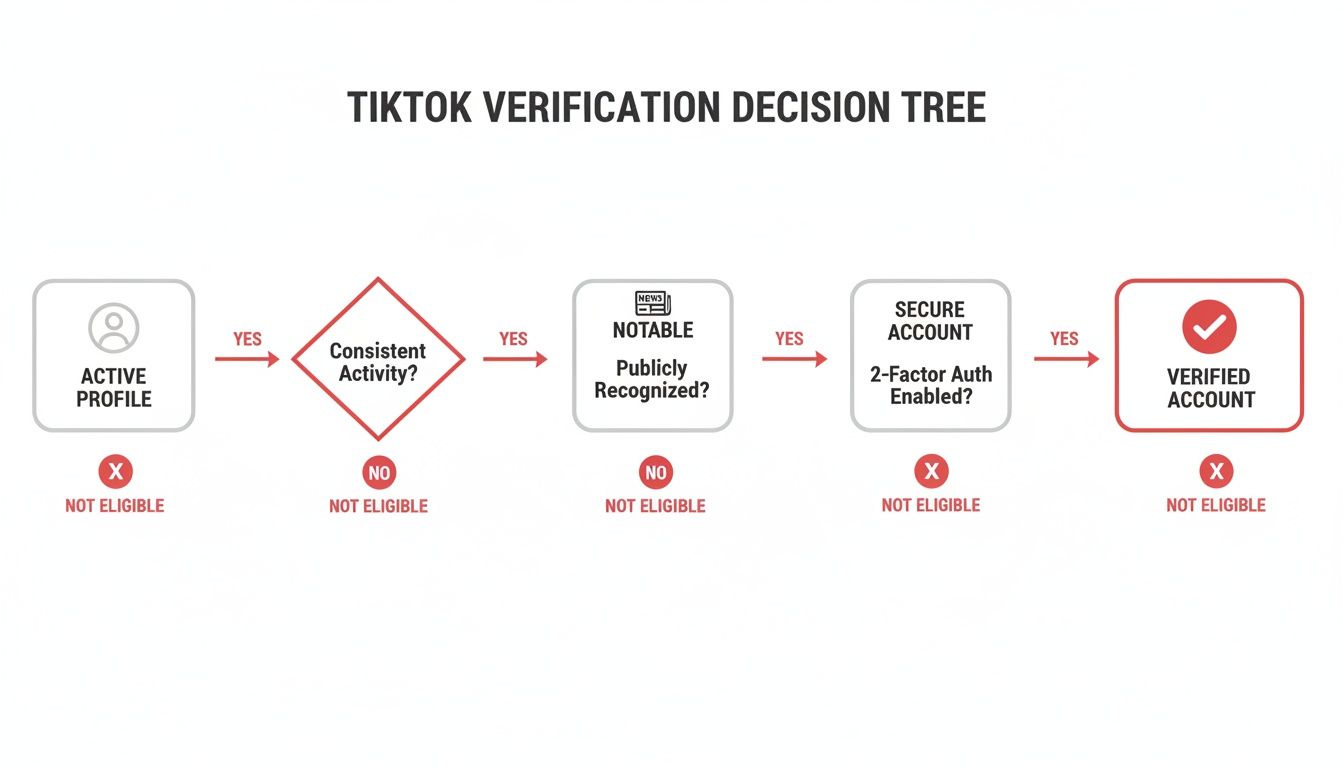
As you can see, it's not just about one viral video. It’s about building a credible presence that TikTok feels is worth authenticating for the public.
First Things First: Your Profile Must Be Active and Complete
Let's start with the basics. TikTok needs to see that you're actually using your account. It sounds obvious, but they explicitly require you to have logged in within the last six months. If your account looks abandoned, you're signaling that you aren't an active member of the community, which makes verification a non-starter.
Next up, your profile has to be 100% complete. You'd be surprised how many creators skip these simple but critical details. Here’s the checklist:
- Your account must be public. Private accounts can't be verified, period.
- You need a clear profile photo that people can recognize as you or your brand.
- Your bio must be filled out. Tell people who you are and what you do.
- You need at least one video posted.
These simple things show that your account is legitimate and ready for the kind of attention that verification brings. An incomplete profile just looks amateur.
The Non-Negotiables: Security and Authenticity
This part isn't a suggestion—it's a hard rule. Your account absolutely must have two-factor authentication (2FA) turned on, linked to a verified email address. This is TikTok's way of confirming you're a real person who takes your account security seriously.
Authenticity is the entire point of the blue checkmark. Your account has to represent a real person, a legitimate business, or a genuine organization. No fan accounts, no parodies, no impersonations. You’ll have to prove your identity with official documents during the application, so be ready for that. Oh, and it should go without saying, but you need a squeaky-clean record of following TikTok's Community Guidelines. Any major violations are an automatic disqualification.
Key Takeaway: Verification isn’t a reward for going viral. It’s a tool to protect public figures from being impersonated. TikTok’s main goal is to verify accounts that are at a high risk of being copied.
The Make-or-Break Factor: Notability
And here we are. This is the big one. The single biggest hurdle where most people fail is notability. TikTok needs to see that you've been featured in multiple, legitimate news sources. Your reputation off of TikTok is just as important, if not more so, than your presence on it.
So, what does TikTok consider a "reputable news source"?
- Major News Publications: Getting mentioned in places like Forbes, The New York Times, or the BBC is the gold standard.
- Top-Tier Industry Magazines: An article in a respected trade publication for your niche (think Variety for actors or TechCrunch for startup founders) carries a lot of weight.
- Prominent Digital Outlets: Features in well-known online sites like Mashable, HuffPost, or BuzzFeed are also great proof.
What will get you completely ignored? Press releases, sponsored articles, paid placements, or shoutouts on someone's personal blog. The verification team is trained to spot these. They're looking for organic, earned media that proves you're a person of public interest. This isn't unique to TikTok; learning how to get verified on YouTube shows a similar focus on real-world prominence.
In the end, all these requirements feed into each other. A complete, active profile helps you create better content. Great content can earn you press coverage, which builds your notability. And if you’re already focused on meeting the https://monetizedprofiles.com/blog/tiktok-monetization-requirements-how-to-qualify-fast, you'll find that the activity and profile completeness metrics line up perfectly with what you need for verification.
The Right Way to Apply for TikTok Verification
Alright, you’ve put in the work. Your profile is polished, your content is hitting its stride, and you've started to build that all-important buzz. Now it's time to actually apply for that blue checkmark.
The application itself is tucked away inside the TikTok app, but finding it is easy once you know where to look. Think of this as your chance to make a direct, compelling case to the review team. My biggest piece of advice? Have all your documents and links ready to go before you even start. There’s nothing worse than scrambling for files mid-application.
This whole process lives inside the app, so make sure your digital documents are easily accessible on your phone.
Finding the Verification Request Form
First things first, open up TikTok and head to your profile page. Don’t expect to see a giant "Apply for Verification" button—it’s buried a few taps deep in the settings.
Here’s the path:
- From your profile, tap the Menu icon (the three horizontal lines) in the top-right corner.
- Go to Settings and privacy.
- Tap on Account.
- From there, you should see the Verification option.
Now, if you don't see "Verification" listed, don't panic. It could mean the feature hasn't rolled out to your account yet, or that your account hasn't passed some of TikTok's behind-the-scenes preliminary checks. For most established creators, though, this is your doorway to the application form.
Choosing Your Verification Type
Once you’re in, you’ll hit your first major fork in the road: applying as an individual or as a business/institution. This is a critical choice because it completely changes the kind of proof you’ll need to provide.
- Personal/Creator Verification: This is the path for most public figures, influencers, artists, and notable individuals. Here, you are the brand.
- Business/Institutional Verification: This option is for companies, non-profits, organizations, and registered brands. The entity itself is what’s being verified.
Choosing correctly is essential. If you're a faceless creator but your brand name is the notable entity, you should probably go the business route. If your face is the one people recognize from your content, stick with personal.
Gathering Your Essential Documents
This is where your prep work really pays off. TikTok needs cold, hard proof of who you are before they'll hand over a blue check.
For a Personal Account, you’ll need:
- A crystal-clear photo of a government-issued ID. A passport or driver's license works perfectly.
- Be ready to take a live selfie inside the app. They use this to match your face to the ID you just uploaded.
For a Business or Institutional Account, the requirements shift:
- Official Business Documents: This means things like your business license, articles of incorporation, or tax registration forms.
- A Branded Email Address: Make sure the email registered to your TikTok account is on your official domain (e.g., contact@yourbrand.com), not a generic Gmail or Outlook address. It adds a layer of legitimacy.
Pro Tip: Don't just snap a quick photo of your ID on your messy desk. Scan your documents or take high-quality, well-lit pictures beforehand and save them to your phone. A blurry or unreadable submission is one of the fastest and most avoidable ways to get an instant rejection.
Submitting Your Proof of Notability
The final piece of the puzzle is showing them why you deserve to be verified. This is where you’ll provide the URLs to all that media coverage you've been collecting. TikTok gives you a few slots to drop in your links, so you need to be strategic.
Don't just paste in the first few articles you find on Google.
- Lead with Your Best: Start with your strongest press features from the most recognizable publications. A mention in a major national outlet is worth more than ten small blog posts.
- Show Some Range: If you can, include a mix of media types. For example, a link to a major online news site, a feature in a well-respected industry magazine, and a clip from a TV appearance shows broad notability.
- Cut the Fluff: Never, ever include press releases, sponsored content, or links back to your own website. The review team can spot these from a mile away, and it weakens your entire case.
Once you’ve filled everything out, read it over one last time. Then read it again. When you're sure it's perfect, hit submit. Now comes the hard part: waiting. The review process can take up to 30 days, so try to be patient.
Building Your Notability Beyond TikTok
If there’s one secret that separates the creators who get verified from those who don’t, it’s this: TikTok verification is less about what you do on the platform and much more about who you are off of it. The "notability" requirement is where most people get stuck, and it's the one area you can truly take control of.
Think of it like you're building a case file for the TikTok review team. Your job is to hand them so much compelling evidence of your real-world relevance that they have no choice but to see you as a public figure who needs that blue checkmark for protection. This isn’t about some overnight hack; it’s a long-game strategy to build a genuinely powerful public profile.
This requires a big mental shift. You have to stop thinking only like a content creator and start thinking like your own publicist.
Secure Earned Media in Reputable Outlets
The absolute gold standard for proving you're notable is earned media coverage. TikTok’s team is sharp—they're trained to spot and ignore paid placements, sponsored articles, and press releases. What they want to see is that real journalists and established publications found you interesting enough to write about on their own accord.
So, your mission is to get featured in places that carry some weight. Here’s how to start making that happen:
- Become a Niche Expert: Carve out a space where you are the go-to source. If you’re a finance creator, start pitching unique story ideas about budgeting trends to personal finance reporters or well-known blogs.
- Leverage Your Viral Moments: Did one of your videos just take off? That's not just a win for your follower count; it’s a news hook. Immediately reach out to digital media outlets that cover internet culture and pitch them a story about the trend you started.
- Offer Unique Data or Insights: If you run a small business, maybe you can survey your community and share the findings. Journalists are always hungry for fresh data to build stories around.
This blue checkmark isn't just for show. It’s a massive credibility booster on a platform with a potential ad reach of 1.94 billion users in 2025 and projected revenue expected to hit $20-26 billion in 2024. For anyone building a brand, that kind of trust is priceless.
The Power of Cross-Platform Verification
Another huge signal to TikTok is being verified on other major social platforms. If Instagram, YouTube, or Facebook has already given you their stamp of approval, it sends a clear message: another major company has already done the heavy lifting of vetting your notability.
If you aren't verified anywhere else, make it a parallel goal. The criteria differ slightly from platform to platform, but they all boil down to proving you're a public figure. Getting that first checkmark often creates a domino effect, making it much easier to get the next one.
Pro Tip: When you list your media features in your TikTok application, lead with your heavy hitters. A single feature in a well-known national publication is infinitely more powerful than a dozen mentions on small, obscure blogs.
Establish a Professional Online Hub
Beyond media hits and social proof, you need a central, professional online presence that you own completely. A polished personal or business website acts as the ultimate proof of legitimacy. It’s your digital headquarters, tying all your social profiles and media mentions together in one credible place.
For some, a Wikipedia page can be the ultimate trump card for notability. But let's be real—getting a Wikipedia page is notoriously difficult. It requires significant, independent media coverage just to be considered. Don't even think about creating one for yourself. If you're truly notable enough, an independent editor will likely create one for you organically.
Ultimately, building your authority is a marathon, not a sprint. To get verified, you have to think beyond the platform itself. Understanding how to become an influencer by growing your brand and audience is crucial, because that broader notability is what they're looking for. Every podcast interview, every article mention, and every verified badge on another platform adds another piece of evidence to your case, making your profile impossible for TikTok to ignore.
What to Do If Your TikTok Verification Request is Denied
Getting that rejection notice from TikTok stings. I've been there. But it’s not a dead end. Think of it less as a "no" and more of a "not yet."
A denial isn't personal; it's a gap in your application. Most of the time, the rejection comes down to two things: you didn't prove you were "notable" enough, or your profile didn't meet their activity and security standards. That feedback, even if it's vague, is your new roadmap.
Figure Out Why You Were Rejected
Before you can fix the problem, you have to find it. TikTok’s rejection email is usually pretty generic, so you'll need to do some honest self-assessment. Where did your application fall short?
Let's break down the usual suspects:
- Weak Media Coverage: This is the most common reason, by far. You might have a couple of blog posts about you, but if they weren't from major news outlets or they looked like paid placements, TikTok won't count them. They're looking for real, organic press.
- Shaky ID Verification: Was the photo of your driver's license a bit blurry? Did the name on the ID not perfectly match the name on your account? Any little mismatch can trigger an automatic denial.
- An Incomplete or Dusty Profile: A sparse bio, no recent posts, or missing two-factor authentication sends a clear signal that you aren't managing your account professionally.
Use the 30-Day Waiting Period as a Power-Up
After a denial, TikTok puts you in a 30-day timeout before you can try again. Don’t waste it. This month is your chance to go on the offensive and fix what was broken.
If notability was the issue, your mission is simple: get more press. What’s a newsworthy story you can tell about your brand or your journey? Start pitching that story to journalists and established online magazines. Remember, one solid feature in a well-known publication is worth more than ten mentions on small blogs.
Seriously, Read This: Never, ever pay someone who slides into your DMs promising to get you a blue check. They are 100% scams. Not only will you lose your money, but you also risk getting your account banned for violating TikTok's rules. The only way to get verified is through the official app.
A Quick Word on Shady "Verification Services"
It’s easy to get discouraged and look for a shortcut after being rejected. You'll see ads everywhere from people claiming to have a "contact" inside TikTok who can verify you for a few hundred bucks. It's always a lie.
Earning that blue checkmark is tough, but it's worth it. It tells your audience that you're the real deal, which is critical as features like TikTok Shop become more common. The badge isn't for sale; it's earned by building real-world credibility. If you want to learn more about how verification builds trust, Sproutsocial.com has some great insights.
While you can't buy the badge itself, some creators choose to accelerate their growth by acquiring an already established account. For those who want to skip the early grind, it's possible to buy a TikTok account that already has followers and engagement. This can give you a solid starting point to then build the public profile needed for a legitimate verification attempt down the road.
Got Questions About TikTok Verification?
Even with a clear plan, getting that little blue check on TikTok can feel like a black box. It's totally normal to have questions, especially with all the myths and bad advice floating around. Let's cut through the noise and tackle some of the biggest uncertainties I see creators struggle with.
Think of this as your go-to FAQ. I’ll give you the straight, no-fluff answers to the questions that pop up time and time again, so you can move forward feeling confident.
How Many Followers Do You Actually Need to Get Verified?
This is, without a doubt, the biggest misconception out there. The honest answer? There is no magic number. A huge follower count definitely helps, but it’s not the golden ticket TikTok’s review team is looking for.
What they really care about is your notability off of TikTok. Are you a recognized figure in your field? Have you been featured in news articles, appeared on podcasts, or won industry awards? That kind of real-world credibility carries way more weight than just a follower number.
I've seen verified accounts with only a few thousand followers simply because they were well-known public figures. On the flip side, countless creators with millions of followers are still unverified. Your time is far better spent building a legitimate media presence than just chasing an arbitrary follower goal.
The Bottom Line: TikTok’s main goal with verification is to prevent impersonation of public figures. If you don't have enough public recognition outside the app to be at risk of impersonation, your follower count doesn't mean much to them.
Can You Just Buy a Verified TikTok Account?
Let me be perfectly clear: no. You cannot buy verification directly from TikTok, period. Anyone sliding into your DMs or running an ad promising a blue check for a fee is a scammer. Trying to buy one is a fast track to getting your account permanently banned for violating TikTok's terms of service.
Now, there is a legitimate shortcut that many serious entrepreneurs and creators take. Reputable services can provide pre-monetized accounts that already have a solid foundation of followers and activity metrics.
- Crucially, these accounts do not come verified.
- What they offer is a major head start.
Starting with an account that’s already in good standing lets you skip the initial grind. You can pour all your energy into the real challenge: building the press coverage and external proof you need to submit a successful application the official way.
What About Faceless Creators? Is Verification Possible?
Running a faceless or brand-centric account throws a wrench in the works, but getting verified is still absolutely on the table. The strategy just pivots. Instead of proving a person is a public figure, you have to prove your brand is.
This means your entire PR strategy has to be about getting your brand name and TikTok handle featured everywhere—articles, interviews, industry roundups. You need to show the review team that your brand itself is newsworthy and has real authority.
When you go to apply, you’ll select the "Business/Institutional" category, not "Personal." You'll submit official paperwork like your business registration instead of a driver's license. For faceless accounts, your off-platform presence is everything, as it's the primary way you'll prove your brand's influence.
Ready to skip the slow, initial growth phase and start with an account that's already primed for success? At MonetizedProfiles, we provide monetization-approved social media accounts that give you the perfect foundation to build your brand and pursue verification the right way. Explore our ready-to-go TikTok accounts today!


