


Earning money from YouTube ads all starts with a single goal: joining the YouTube Partner Program (YPP). Once you're in, you'll link a Google AdSense account and can start placing ads on your videos. From there, your income becomes a share of what advertisers pay to show their ads on your content, effectively turning your creative passion into a real, scalable business.
Your Path to YouTube Ad Revenue Explained

Before a single dollar lands in your bank account, it's crucial to understand the fundamental mechanics of YouTube's advertising ecosystem. This isn't a lottery; it’s a business model where you, the creator, provide the platform that captures audience attention, and advertisers pay to access it. Your earnings are a direct result of how effectively you can build and hold that attention.
At the heart of this process is the YouTube Partner Program. Gaining entry is your first major milestone, requiring you to meet specific thresholds for subscribers and watch hours. For many creators, reaching these goals can take months or even years of consistent effort. However, some creators choose to fast-track this process by acquiring an already approved monetized YouTube channel to begin earning immediately.
The Core Monetization Engine
Once you are accepted into the YPP, you connect your channel to a Google AdSense account. Think of AdSense as the financial intermediary that processes payments from advertisers and distributes your share to you. You'll be able to turn on various ad formats for your videos, which directly impacts how you earn money from YouTube ads.
Your revenue isn't just about view counts. It’s measured by more specific metrics you'll need to become familiar with:
- CPM (Cost Per Mille): This is the amount an advertiser pays for one thousand ad impressions. A high CPM in a valuable niche like finance or technology means advertisers are willing to pay more to reach your audience.
- RPM (Revenue Per Mille): This is your actual revenue per one thousand video views after YouTube takes its cut. RPM is the most important metric for tracking your channel's financial health because it reflects what you actually earn.
Key Takeaway: Focusing on RPM, not just views, gives you a truer picture of your earning potential. A video with fewer views but a higher RPM can often be more profitable than a viral video with a low RPM.
A Realistic Financial Outlook
Building a significant income from YouTube ads is a marathon, not a sprint. Your initial earnings will likely be small, perhaps just a few dollars a day. Growth comes from a strategic approach to content creation that prioritizes viewer retention and targets a profitable audience.
Success hinges on consistently producing content that keeps people watching, which in turn creates more opportunities for ads to be shown. Understanding these foundational concepts is the first step toward building a sustainable and profitable channel.
Getting into the YouTube Partner Program
Before a single dollar from YouTube ads can hit your bank account, you have to get into the club: the YouTube Partner Program (YPP). Think of it as the official gateway to making money on the platform. It’s YouTube's way of ensuring that only channels with real engagement and quality content get to run ads.
Getting in isn't a given. You have to hit some very specific milestones first. These numbers tell YouTube that you've built a real audience that actually sticks around to watch what you create.
The Magic Numbers: Subscribers and Watch Time
First up, you need 1,000 subscribers. This milestone shows you’ve built a core community—a group of people who like your stuff enough to want to see more. It’s a clear signal that your channel has an identity and offers consistent value.
The second target is usually the tougher one: 4,000 hours of valid public watch time in the last 12 months. This isn't about how many people click on your video; it’s about how long they stay. Holding someone's attention for a long time is a much stronger sign of great content.
There's also a faster track for Shorts creators. If you can rack up 10 million valid public Shorts views in the last 90 days, you're in. This is a fantastic alternative for creators who are great at making those quick, viral hits.
A quick tip from experience: Stop chasing viral videos. Instead, build a library of solid, evergreen content. A single video that pulls in just 50 views a day, every day, will do more for your watch time over a year than a one-hit-wonder that dies out after a week.
How to Actually Hit Those YPP Goals
Getting to those numbers isn't about luck; it's a game of strategy. It’s all about creating content that pulls people in and makes them want to stay.
- Nail Down Your Niche: You have to answer one question: why should anyone subscribe to you? Your channel needs a clear focus. A specific niche like "3D printing for tabletop gaming" is way easier to grow than a generic "tech" channel.
- Make Your Content "Bingeable": The secret to racking up watch hours is getting viewers to watch more than one video. Use playlists, end screens, and even just say, "check out my next video on..." to guide them. And always, always have a strong hook in the first 30 seconds to stop them from clicking away.
- Talk to Your First Fans: Respond to every single comment you get. Ask questions in your videos. When your first 100 fans feel like they're part of a community, they become your biggest advocates and help you grow.
Let’s be honest, the grind to 1,000 subs and 4,000 hours can feel like a long, slow crawl. It's a major hurdle, and it’s why some creators choose to bypass it by acquiring an aged YouTube channel that’s already met the requirements. This lets them jump straight to what they do best: making great content.
It's Not Just About the Numbers: Playing by the Rules
Hitting the metrics is only step one. The next part is crucial and where a lot of people mess up: you have to follow YouTube's rules to the letter.
Your channel needs to have a clean record—that means no active Community Guidelines strikes. These are penalties for uploading content that violates YouTube’s policies on things like hate speech, spam, or nudity.
More importantly, your videos have to be advertiser-friendly. This means following the YouTube Partner Program policies and AdSense Program policies. Think about it from a brand’s perspective: they don't want their ads running on videos with excessive swearing, graphic violence, or hot-button controversial topics. Before you even think about applying, do a full audit of your channel and unlist or edit any videos that might cause a problem. Breaking these rules is the fastest way to get your application rejected.
Getting into the YPP is a test of your commitment. It’s designed to reward creators who bring real value to the platform. Once you're in, the ad revenue becomes real. Depending on your niche, you could see rates anywhere from $1 to $10 per thousand views, though this can vary. For more detailed stats, you can check out platforms like Analyzify.
How YouTube Ad Revenue Actually Works
Let's clear up a common myth right away: you don't get paid just because people watch your videos. A million views on a video doesn't automatically mean a fat paycheck. The real money comes from advertisers paying to get in front of your audience, and YouTube gives you a slice of that pie.
You only earn revenue when a viewer watches or clicks on an ad shown on your content. It's a small distinction, but it's the entire foundation of how you'll make money from ads.
CPM vs. RPM: The Two Metrics That Actually Matter
To really get a grip on your channel's finances, you need to understand two key metrics: CPM and RPM. They sound similar, but they tell you completely different things about how much you're earning.
- CPM (Cost Per Mille): This is the "Cost Per 1,000 Impressions." Think of it as what advertisers are willing to pay to show their ads 1,000 times on YouTube. A high CPM means advertisers find your audience valuable.
- RPM (Revenue Per Mille): This is your Revenue Per 1,000 Video Views. This is the metric you should obsess over. It's what you actually earn after YouTube takes its 45% cut from the ad revenue.
A high CPM is great news, but it's your RPM that pays the bills. RPM gives you a realistic picture of your channel's earning power because it already accounts for YouTube's share and shows how many of your views were actually monetized.
Why Your Niche Can Make or Break Your Paycheck
When it comes to ad money, not all niches are created equal. The topic you choose has a massive impact on your CPM and, by extension, your total earnings. Why? Because advertisers will pay a premium to reach audiences with serious buying power or very specific interests.
For example, a channel that teaches personal finance or reviews business software could easily see a CPM of $25 or more. The viewers are in a buying mindset for high-ticket items like investment platforms or enterprise software.
On the other hand, a gaming or a general comedy channel might have a much lower CPM, maybe around $5. They can pull in huge viewership, but the audience is broader, and the advertisers targeting them usually have smaller budgets. It's about quality of audience, not just quantity.
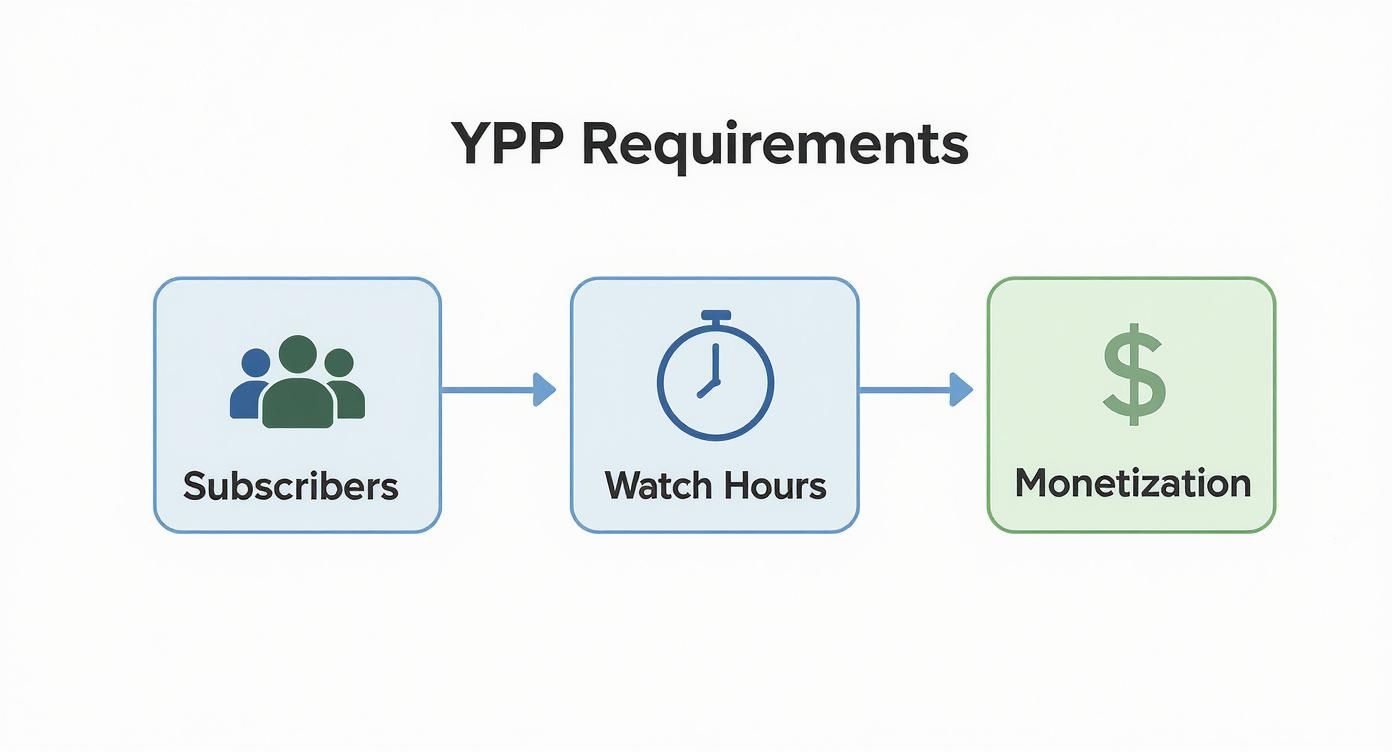
As this flowchart shows, getting to monetization is a journey that starts with hitting those key subscriber and watch time milestones.
How Your Audience's Location Affects Your Earnings
Your niche isn't the only big factor; where your audience is watching from plays a huge role in your income. Advertisers in developed countries like the United States, Australia, or the United Kingdom simply have more money to spend on ads and will pay higher rates to reach consumers there.
The global ad market has some wild variations. By 2025, YouTube's potential ad reach is projected to hit 2.53 billion users. While India leads in raw numbers with 491 million users, the United States at 253 million and Brazil at 144 million represent very different CPMs due to local economic conditions. You can find more global user statistics to see how this impacts revenue potential.
So, even if your content is amazing, if most of your viewers are in a country with a lower average CPM, your RPM will take a hit.
YouTube Ad Types and Revenue Potential
YouTube gives you a good amount of control over which ad formats run on your videos. The mix you choose can seriously impact your revenue. For any video longer than eight minutes, you unlock the ability to place mid-roll ads, which is a fantastic way to boost your earnings.
Understanding the different ad types helps you build a smarter monetization strategy.
| Ad Type | How It Works | Typical Revenue Impact | Best For |
|---|---|---|---|
| Skippable In-Stream Ads | Plays before or during a video. You get paid if a viewer watches for 30 seconds or clicks the ad. | High | Most videos, especially longer content where viewers are engaged. |
| Non-Skippable Ads | Shorter ads (15-20 seconds) that viewers must watch completely. | Moderate | Shorter content where you want guaranteed revenue, though they can annoy viewers. |
| Bumper Ads | Quick, 6-second non-skippable ads that play before a video. | Low | Channels that want to monetize without being too intrusive. Good for brand awareness. |
| Display (Overlay) Ads | Semi-transparent banners that appear on the lower portion of a video (desktop only). | Low | Supplementing other ad formats; relies on a viewer actively clicking. |
Ultimately, a smart combination of these ad types is your best bet. By understanding the dance between your content, your audience's demographics, and the ad formats you enable, you can turn your channel into a much more reliable and profitable business.
Strategies to Maximize Your Ad Earnings
https://www.youtube.com/embed/r2y_nqjHOLE
So, you're in the YouTube Partner Program. Congratulations! That’s a huge milestone, but it's really just the starting line. The real work begins now: turning that trickle of ad revenue into a reliable income stream.
This is where you need to shift your mindset. It's no longer just about getting views; it’s about making every single view as valuable as possible. It's a common misconception that more views automatically means more money, but that's not the whole picture.
Think about it: a channel with 50,000 highly engaged viewers in a lucrative niche can easily out-earn a channel with 500,000 casual views in a less valuable one. It all comes down to optimizing your content to appeal to both your audience and the advertisers who want to reach them.
Master the Art of Watch Time
If there's one metric you should obsess over, it's watch time. The longer people stay glued to your videos, the more ads they see. More importantly, it sends a powerful signal to the YouTube algorithm that your content is engaging and worth promoting to a wider audience.
Boosting your watch time isn't about padding your videos with fluff. It's about making every second count. Here's how to do it:
- Nail the Hook: You've got about 15-30 seconds to grab someone's attention. Your intro needs to make a promise, ask a burning question, or tease the most exciting part of the video. Ditch the long, generic intros and get straight to the good stuff.
- Use Pattern Interrupts: To keep eyes from glazing over, you have to keep things fresh. This could be a quick camera angle change, a sound effect, some B-roll footage, or a simple text graphic. These small shifts reset your viewer's attention clock.
- Tell a Story: Even a tutorial can have a narrative arc. Start with a problem (the "before"), guide them through the solution (the "journey"), and show off the transformation (the "after"). This is way more compelling than just listing facts.
A great target to aim for is an average view duration of at least 50% of your video's total length. Hitting this number consistently tells YouTube your content is top-tier, which leads to more promotion, more views, and ultimately, more ad revenue.
Get Strategic with Mid-Roll Ads
Once your videos are longer than eight minutes, you unlock a game-changer for your income: mid-roll ads. These are the ad breaks you can place during your video. If you just let YouTube do this automatically, it can drop them in the most awkward places, sending viewers running.
Don't let that happen. Take manual control. Watch your own videos and find the natural pauses and transition points. Good spots include:
- Right after delivering a major takeaway.
- Between different segments or topics in your video.
- Just before the big reveal or final conclusion.
Placing an ad at a natural break feels far less jarring. A good rule of thumb is to place one every 3-4 minutes, but always put the viewer's experience first. Two well-placed ads will always beat five annoying ones that cause people to click away.
Pick a Niche with High Earning Potential
Your channel's topic has a massive, direct impact on your earnings. Why? Because it dictates which advertisers are bidding for a spot on your videos. Advertisers will pay a premium to reach audiences with specific commercial interests or high purchasing power.
Some of the highest-paying (High-CPM) niches tend to be:
- Personal Finance & Investing: The audience is actively looking for financial products, and banks, brokerages, and fintech companies pay big bucks to reach them.
- Technology & Software Reviews: Tech companies have huge marketing budgets and are desperate to get in front of consumers ready to make a purchase.
- Real Estate: Viewers are often making the biggest purchases of their lives, making them incredibly valuable to advertisers.
- Digital Marketing: The audience is made up of businesses looking to spend money on tools and services.
While a gaming channel can pull in monster views, the CPM is often much lower because the audience is broader and the advertisers have smaller budgets. Choosing a profitable niche from day one is one of the smartest moves you can make for long-term growth.
Target Audiences in High-Value Countries
Just like your niche, the location of your audience matters. A lot. Advertisers in countries like the United States, United Kingdom, Canada, and Australia simply have bigger budgets and pay significantly more per ad view.
While you can't totally control who watches your videos, you can influence it. Create content on topics popular in those countries, use keywords they search for, and produce videos in English. You can see where your current audience is by heading to the "Audience" tab in your YouTube Analytics.
Always Keep It Advertiser-Friendly
Finally, consistency is everything. To keep the ad revenue flowing, you have to consistently play by YouTube's advertiser-friendly content guidelines. It only takes one video that gets demonetized to throw a wrench in your earnings and momentum.
Steer clear of excessive profanity, hot-button controversial issues, and graphic content. The more you produce brand-safe videos, the more trust you build with both YouTube and its advertisers.
To mix up your content and tap into new audiences, it's also worth looking into YouTube Shorts best practices. While the revenue per view is lower on Shorts, they are a fantastic tool for channel growth and can still add to your bottom line through sheer volume.
Ultimately, maximizing your ad revenue is a balancing act. It’s about creating amazing, high-retention content in a profitable niche, placing your ads smartly, and staying on the right side of the guidelines. Master these, and you're not just a YouTuber—you're building a sustainable business.
Using Analytics to Grow Your Ad Revenue
Making great content is only half the job. If you really want to scale your YouTube ad income, you have to stop guessing what works and start letting the data guide you. Your YouTube Studio analytics dashboard is the command center for this mission. It shows you not just what your audience watches, but how they watch it.
Think of it like this: every view, click, and drop-off leaves a trail of breadcrumbs. Follow that trail, and you'll find powerful insights that can directly boost your revenue. It's time to shift your focus from vanity metrics like raw view counts to the numbers that actually move the needle on your bank account.
This isn't about getting lost in spreadsheets. It's about looking at a few key metrics to diagnose your channel's health and spot opportunities, turning raw data into an actionable strategy for your very next video.
Pinpoint Your Most Valuable Content
First things first, you need to figure out which videos are your financial heavy hitters. Head into YouTube Studio, click on the Analytics tab, and then pop over to the Revenue section. You’ll see a list of your top-earning videos right there.
But don't just glance at the total revenue. The real magic is in the RPM (Revenue Per Mille) for each video. A video with a sky-high RPM is a goldmine. It’s telling you that the specific blend of its topic, audience, and watch time is a magnet for advertisers.
Once you spot these winners, ask yourself a few questions:
- What was the exact topic of this video?
- How long is it, and what's its average view duration?
- Which keywords did I use in the title, description, and tags?
Your goal here is to connect the dots. If your top three earning videos are all product reviews over 10 minutes long, that’s the market screaming at you to make more of them.
Decode Your Audience Retention Graphs
One of the most powerful—and brutally honest—tools in your analytics is the Audience Retention graph. This chart shows you, second by second, the exact moment viewers get bored and click away.
Every major dip in that graph is a lesson. Did a long, flashy intro cause a massive drop in the first 30 seconds? Did one particular segment drag on too long? This is like getting free, unbiased feedback from thousands of people on what's working and what isn't.
Actionable Tip: Find a popular video with a big viewer drop-off. Note the exact moment it happens. In your next video, consciously change your approach for that type of segment. Maybe you need to add more B-roll, pick up the pace, or just cut it out completely.
Improving retention directly impacts your ad revenue. Why? Longer watch times mean more chances for mid-roll ads to play. It also sends a powerful signal to the YouTube algorithm to promote your content to a wider audience.
Analyze Your Traffic and Geographic Data
Not all views are created equal, and where they come from matters a lot. In your analytics, go to the Reach tab and look at your Traffic source types. This report breaks down where your audience is finding you—be it YouTube search, Browse features, or external websites.
If you find that most of your high-RPM traffic is coming from YouTube search, you know your SEO is hitting the mark. It's a clear sign to double down on keyword research for future videos. If an external site is sending you quality traffic, think about creating content specifically for that audience. For more ideas on refining your content plan, you can explore the helpful articles on the MonetizedProfiles blog.
Finally, take a peek at the Audience tab to see your geographic data. You might notice that your highest CPMs come from viewers in countries like the United States or the United Kingdom. Knowing this allows you to create content on topics more relevant to those regions, which can lead to a nice bump in your earnings. This data-driven mindset is how you systematically improve your channel and maximize your ad revenue.
Common Questions About YouTube Ad Revenue
Jumping into YouTube monetization brings up a ton of questions. It's totally normal to wonder about how long it'll take, what kind of money you can really make, and what all the rules are. Getting straight answers helps you set realistic goals and build a smarter strategy for your channel from day one.
Let's break down some of the most common questions creators have when they're just starting to figure out YouTube ads. Think of this as your field guide to clearing up the confusion.
How Long Does It Take to Start Earning Real Money?
Honestly, there's no single answer to this. Anyone who gives you a specific timeline is probably guessing. The first big step is just getting into the YouTube Partner Program (YPP), and that journey is different for everyone. For some, it's a few dedicated months; for others, it might take over a year. It really comes down to your niche, how good your videos are, and how often you're putting them out there.
Once you’re in, don't expect the floodgates to open immediately. Your first few paychecks will likely be pretty small. Building a real, life-changing income from ads is a marathon, not a sprint. We're often talking several years of consistent work, growing your audience, and learning what works before you see a truly significant return.
Can I Make Money from Ads on YouTube Shorts?
You sure can. YouTube now shares ad revenue with creators who make Shorts, which is a huge deal. The model is a little different from your standard long-form videos, though. Revenue from all the ads that run in the Shorts feed gets collected into one big pot.
From there, you get a slice of that pot based on how many views your Shorts got compared to the total Shorts views in your country. While the RPM for Shorts is typically much lower than for longer videos, the potential for massive view counts can make it a really nice, supplementary income stream.
The real magic happens when you use Shorts and long-form content together. Think of Shorts as your hook to grab new subscribers and pull people in. Then, your long-form videos—with their much higher RPMs—are where you can really capitalize on that engaged audience.
Does Using Copyrighted Music Affect Ad Money?
This is a big one, and it trips up so many new creators. Using music you don't have the rights to is one of the fastest ways to lose your ad revenue. When you use copyrighted music, the owner can slap a Content ID claim on your video.
Once that happens, they call the shots. Most often, they'll just take all the ad revenue your video makes. Poof, it's gone. In worse-case scenarios, they can block your video entirely. To sidestep this mess, just stick to royalty-free music. The YouTube Audio Library is a fantastic free resource, and there are plenty of paid services that give you legal access to massive catalogs.
Why Did My YouTube Ad Revenue Suddenly Drop?
First, don't panic. Ups and downs in revenue are completely normal. A sudden dip can feel scary, but there's almost always a good reason for it. Seasonality is the biggest culprit; advertisers spend a ton of money in the fourth quarter (Q4) for the holidays, and then pull way back in the first quarter (Q1).
A few other things could be at play:
- You might have shifted your content to topics that are less appealing to advertisers.
- Your audience's primary location could have changed to a region with a lower CPM.
- Your channel's overall watch time or viewer retention might have taken a hit.
The best way to figure it out is to dive into your YouTube Analytics. Look at your CPM by country and check your audience retention graphs to see if you can spot the trend.
At MonetizedProfiles, we know the road to monetization can be a serious grind. For creators who want to skip that initial hurdle and start earning right away, we have a solution. Take a look at our selection of fully approved, monetization-ready channels at our official website.


