


Thinking about buying a YouTube channel? It’s a strategy that can shave years off the typical creator grind. Instead of starting from scratch, you’re basically inheriting a ready-made audience and, often, a channel that's already making money. It's a massive shortcut for anyone who wants to jump straight into creating content without the painful wait for that initial traction.
Is Buying a YouTube Channel the Right Move for You?

Let's be real: starting a YouTube channel from zero is a brutal climb. The platform is packed, and that long road to your first 1,000 subscribers and 4,000 watch hours can be discouraging, to say the least. So, the real question isn't just how to buy a channel, but why you'd want to in the first place.
For most people, it comes down to one thing: speed. Buying an established channel gives you an incredible head start. You’re not just getting a subscriber count; you’re tapping into an existing community that’s already interested in a specific topic. You get to skip the agonizingly slow build-up and start with a foundation already in place.
The Allure of Instant Momentum
The biggest advantage here is momentum. You aren't just buying subscribers; you're buying a history that the YouTube algorithm already understands. An established channel has a track record and data, which means your new videos have a much better shot at finding an audience right out of the gate. Think of it as a huge boost for anyone who has a killer content strategy but just needs eyeballs to get it off the ground.
Of course, this shortcut has its own pitfalls. The number one risk? A disconnect between you and the channel's audience. If your content or personality is a dramatic shift from what they’re used to, you could see a wave of unsubs and negative comments. It's a delicate balance.
Key Takeaway: Buying a channel isn't just about the numbers. It's about inheriting a community. Success hinges on your ability to respect that existing audience while slowly introducing your own vision.
To put the challenge of organic growth in perspective, let's look at a simple comparison.
Organic Growth vs Channel Acquisition at a Glance
| Factor | Starting a New Channel | Buying an Existing Channel |
|---|---|---|
| Time to Monetize | 1-3 years (or more) | Immediate (if monetized) |
| Initial Cost | Low (mostly time & gear) | High (upfront investment) |
| Audience Building | Slow, unpredictable grind | Instant, built-in audience |
| Algorithm | Starts from a cold start | Benefits from existing history |
| Risk | High risk of failure, burnout | Financial risk, audience rejection |
As the table shows, buying a channel swaps a long-term time investment for an immediate financial one.
A Look at the Competitive Landscape
The hard truth is that growing a channel from the ground up is tougher than ever. YouTube has over 2.7 billion monthly users and more than 114 million active channels. It's incredibly crowded.
Despite those massive numbers, very few creators ever break through. In fact, an estimated 97% of all channels never even hit 10,000 subscribers. If you want to dive deeper, you can explore more YouTube user statistics to see just how steep the climb is.
Ultimately, the decision comes down to a simple trade-off: Are you willing to invest cash upfront to save potentially years of work? If your main goal is to monetize quickly and scale your content, buying a channel could be the smartest move you make.
Alright, you've decided to buy a YouTube channel. So, where do you actually find one? The hunt begins in a few key places.
Your first and most obvious stop is usually a dedicated online marketplace. These sites are essentially brokerages for digital real estate, connecting people selling social media accounts with buyers like you.
Well-known platforms like Fameswap and Trustiu are popular for a reason. They list a ton of channels and give you a quick snapshot of the important stuff: subscriber numbers, claimed monthly income, and the channel's niche. It’s a lot like browsing Zillow for houses—you get a feel for what's out there and what the going rates are.
Marketplaces vs. a Direct Approach
While marketplaces are convenient, they’re not the only game in town. You can always try reaching out to creators directly.
Think about it: maybe you follow a channel in your niche that's been gathering dust, or the creator seems to have lost their passion. A well-crafted, professional message could be all it takes to start a conversation about a private sale. Going direct can often get you a better deal since you avoid the marketplace's commission fees, but it definitely puts more of the work—and the risk—on your shoulders.
My Two Cents: If you go the direct route, don't just slide into their DMs with "Hey, wanna sell your channel?" That almost never works. Start by building a little rapport. Compliment a specific video you enjoyed, ask about their plans for the channel, and ease into the idea. It's a much smoother approach that gets a far better response.
How to Spot a Dud From a Mile Away
Finding a promising listing is easy. The hard part is figuring out if it's actually any good. Don't get fooled by flashy numbers; a huge subscriber count means nothing on its own. A channel with 500,000 subscribers that only pulls 1,000 views per video is a classic red flag.
This initial check is all about sniffing out the bad deals before you waste too much time.
-
Check the Engagement Rate: This is your first reality check. Divide the average views on recent videos by the total subscriber count. A healthy, active channel should see view counts that are at least 10-15% of its subscriber base. If it's way below that, the audience is either asleep at the wheel or wasn't real to begin with.
-
Read the Comments: Seriously, just scroll through the comments on the last few videos. Are people having actual conversations, or is it a wall of "Nice video!" and "Great content!"? A flood of generic, one-word comments is a tell-tale sign of bots.
-
Look at Subscriber Growth: Ask the seller for a screenshot from their YouTube Studio analytics showing subscriber growth over the last 90 days. You want to see a nice, steady upward climb. Big, sudden spikes out of nowhere are suspicious and often point to a batch of purchased, fake subscribers.
This quick-and-dirty vetting process is your best friend. It helps you filter out the junk so you can focus your energy on channels with real potential. If you want a deeper dive into what a top-tier channel looks like, our guide on finding a monetized YouTube channel for sale breaks down all the key indicators.
Performing Your Deep-Dive Due Diligence
Once you've done a quick once-over on a potential channel, it's time to roll up your sleeves and get serious. This is where you go from just kicking the tires to a full-blown inspection, and honestly, it’s the most critical part of the entire process.
I’ve seen too many buyers get burned because they skipped a step here. They end up with a channel full of bot subscribers, hidden copyright strikes, or revenue claims that were completely made up.
Think of it like buying a used car. A fresh coat of paint looks great, but it doesn't tell you a thing about the engine. You need to get under the hood, and for a YouTube channel, that means getting temporary, view-only access to its YouTube Studio. If a seller refuses? That’s a massive red flag. Walk away.
This whole process is really a funnel. You start with a bunch of options, weed out the obvious duds, and then put your top candidates under the microscope.
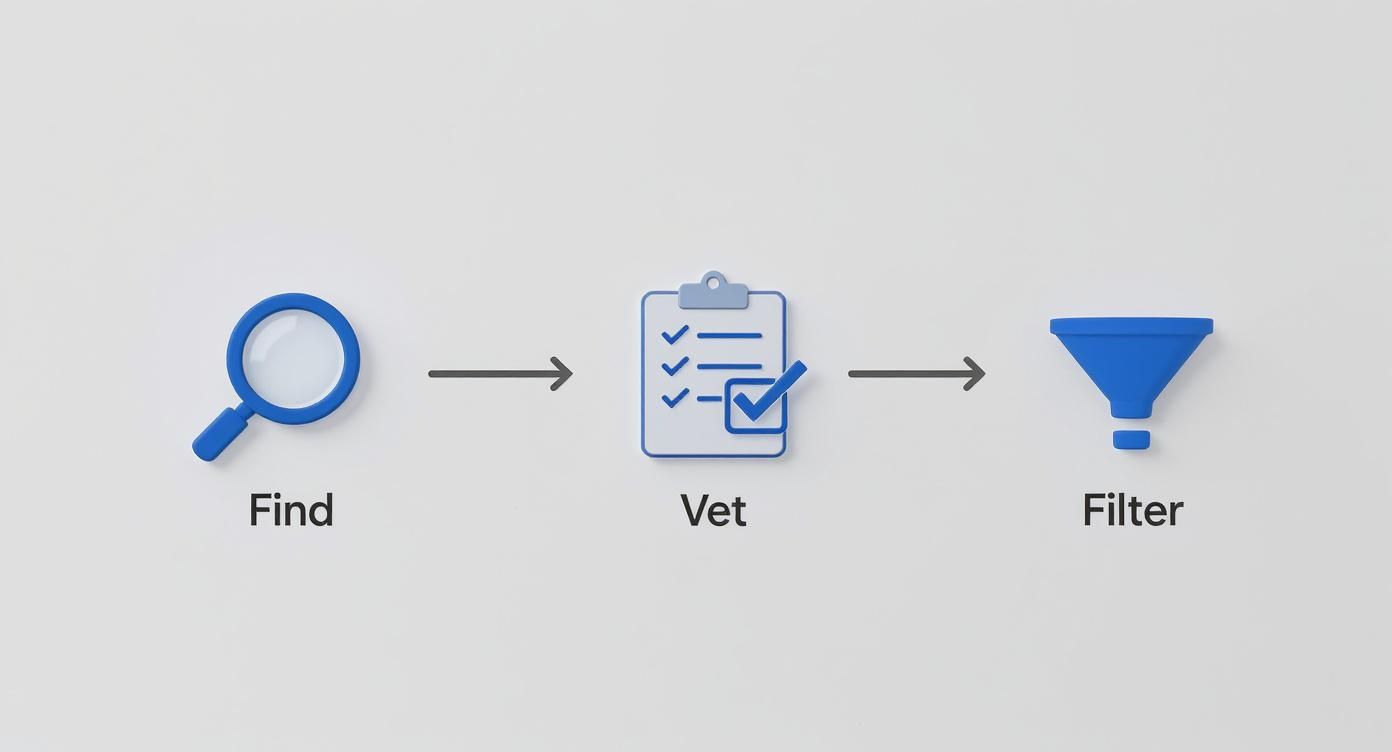
Analyzing the Core Analytics
The moment you get access to YouTube Studio, head straight for the "Analytics" tab. Forget the vanity metrics like subscriber counts for a moment; we're hunting for real data that shows a healthy, organically grown channel.
Here are the exact things I look for:
- Traffic Sources: The first thing I check is where the views are coming from. A solid channel has a healthy mix of sources, usually dominated by "Browse features," "YouTube search," and "Suggested videos." If you see a huge spike from "External" sources, especially from sketchy-looking websites, it's a warning sign of paid traffic that will vanish the second you take over.
- Audience Demographics: Next, click over to the "Audience" tab. Do the viewer age, gender, and location match the channel’s niche and your future content plans? If you’re buying a gaming channel for a US audience but find out 70% of the viewers are in a non-English speaking country, you're going to have a tough time growing it.
- Audience Retention: This one is huge. Look at the retention graphs for the channel’s most popular videos. It’s normal to see a drop-off in the first 15-30 seconds, but a good video will hold onto a decent percentage of viewers. If you see consistently poor retention, it tells you the content isn't connecting or the subscribers just aren't engaged.
Verifying Channel Health and Monetization
Okay, so the analytics look good. Now you need to make sure the channel is in good standing with YouTube itself. It's always a good idea to understand the channel's broader digital footprint and learn how to audit your online presence, but for now, stay focused inside YouTube Studio.
Head over to the "Earn" tab (what used to be called "Monetization"). This is where you'll find the make-or-break details.
Crucial Checkpoint: You absolutely have to see the "Copyright" and "Community Guidelines" sections. Ask the seller for screenshots or, even better, a live screen share. Any active strikes are a complete deal-breaker. A history of resolved strikes isn't always a no-go, but you need to have a serious talk about what happened.
Finally, it’s time to talk money. Verify the revenue by asking for read-only access to their AdSense account or detailed, screen-shared reports covering at least the last 6-12 months. The numbers in AdSense should match up pretty closely with the estimated revenue you see in YouTube Studio.
Keep in mind that YouTube's ad market is always shifting. Its global ad reach recently shot up by nearly 40 million users in a single quarter, which shows just how much advertiser demand can affect a channel's earnings.
Making sure the channel is properly monetized is everything. For a full checklist, take a look at our guide on YouTube channel monetization requirements to ensure all the boxes are ticked.
How to Figure Out What a Channel Is Worth and Get a Fair Price
Talking about money can feel like the trickiest part of buying a YouTube channel, but it’s less about guesswork and more about understanding the fundamentals. When you know how channels are valued, you can walk into a negotiation with the confidence to make a solid offer. This is how you avoid overpaying for a channel that looks good on the surface or, just as bad, lowballing a seller who has built something genuinely valuable.
The most common starting point is a pretty straightforward formula based on the channel's monthly profit. It helps to think of it like buying any other small business. You’re buying an income stream, and the price tag is all about what that future cash flow is worth.
The Standard Valuation Formula
Most deals you see on the market land within a predictable range. The industry benchmark is typically 24x to 36x the average monthly net profit, usually calculated over the last six to twelve months.
So, if a channel consistently brings in $1,000 per month after YouTube takes its share, you can expect its starting valuation to be somewhere between $24,000 and $36,000.
But that's just the baseline. A handful of other factors can dramatically swing the final price in either direction. This is where a good deal can become a great one—or a potential money pit.
A Quick Reality Check: Don't get hung up on just the multiplier. I've seen channels with explosive growth, a die-hard community, and several income sources sell for a 40x multiple. On the flip side, a channel with tanking views and a ghost town in the comments section might only be worth a 20x multiple, or even less.
What Really Moves the Needle on Price?
Two channels can earn the exact same amount but have wildly different price tags. During your talks, both you and the seller will be looking at the details that add or subtract value. Here’s what truly matters.
Below is a breakdown of the key factors that can really influence a channel's final selling price. Understanding these elements will give you a massive advantage when it's time to negotiate.
| Valuation Factor | Description | Impact on Price |
|---|---|---|
| Niche & CPM | The channel's topic. Niches like finance, tech, and real estate have higher CPMs (ad rates) than entertainment or gaming. | High Impact: High-CPM niches are more profitable and command a higher multiplier. |
| Audience Engagement | How much the audience interacts through likes, comments, and shares. A loyal community is a massive asset. | High Impact: Strong engagement proves the audience is real and invested, making the channel more valuable. |
| Growth Trajectory | Whether the channel's views and subscriber count are increasing, flat, or declining. | High Impact: A channel on an upward trend is worth significantly more than one that has peaked or is fading. |
| Revenue Diversity | Whether the channel relies solely on AdSense or has multiple income streams (affiliates, sponsors, merch, courses). | Medium-High Impact: Multiple revenue sources reduce risk and signal a more mature business, justifying a higher price. |
| Content Quality & Evergreen Potential | The production value and timelessness of the video library. Evergreen content generates views for years. | Medium Impact: A strong back catalog of evergreen videos acts like a long-term asset, adding to the valuation. |
| Automation & Systems | How much of the channel's operation is systematized or can run without the original owner's direct involvement. | Medium Impact: "Faceless" channels or those with established workflows are easier to take over and thus more attractive. |
Once you've done your homework and have a price range in mind, it’s time to make an offer. I always recommend starting at the lower end of your valuation—it gives you room to move. Be ready to back up your number with facts you uncovered during due diligence, like a recent dip in viewership or low audience retention on key videos.
When the seller counters, don't sweat it. That's just how negotiation works. Listen to their points, look at the numbers again, and see if there’s a middle ground that makes sense. The real goal is to land on a price that feels fair to both of you. A good deal is one where everyone walks away feeling like they won.
Making the Ownership Transfer Bulletproof
Alright, you've done the hard work of finding the channel, digging into the data, and striking a deal. Now comes the moment of truth: the actual handover. This is where your investment becomes real, and it’s absolutely the most critical stage. One wrong move here, and all that effort could go down the drain.
The smartest way to protect yourself and the seller is by using a trusted escrow service. It’s pretty simple: you give your payment to a neutral third party, and they hold onto it. Only when you’ve confirmed you have full control of the channel and all its assets do they release the funds to the seller. This takes all the "what ifs" out of the equation and keeps everyone honest.
The Nuts and Bolts of the Handover
So, how does the transfer actually happen? It all revolves around the channel’s Brand Account. Unlike a personal account, a Brand Account is designed to have multiple managers and owners, which is exactly what you need for a clean sale.
The process starts with the seller sending an invitation from their end, asking your Google Account to become an "Owner."
Once you accept, a clock starts ticking. There's a mandatory seven-day waiting period before your role can be upgraded to "Primary Owner." This is a security measure built-in by Google, and there’s no way around it. After those seven days are up, the seller can promote you to the primary owner. At that point, you can remove them, and the channel is officially yours.
For a more granular look at this process, we've put together a full guide on how to transfer ownership of a YouTube channel without any hiccups.
Don't Forget the AdSense Account
Here’s where many buyers stumble: the AdSense account. You can't just take over the seller's account. It's tied to their personal or business information and can't be sold. The seller has to unlink their AdSense account from the channel first. Only then can you connect your own approved AdSense account to start receiving revenue.
Pro Tip: Timing is everything with the AdSense switch. Make sure this happens after you become the primary owner but before the escrow payment is released. This ensures there's no interruption in monetization and the revenue stream is successfully redirected to you.
Finally, the YouTube channel itself is often just one piece of the puzzle. Make a quick checklist to ensure you get all the other digital assets that come with it.
- Social Media Accounts: Get the login details for any associated Twitter, Instagram, or TikTok profiles.
- Source Files: You'll want the raw video files, custom thumbnails, logos, and any other branding materials.
- Website/Domain: If there's a blog or website tied to the channel, make sure the ownership is transferred.
- Email List: Get access to the email marketing platform and the subscriber list.
These extra assets are often what give a channel its real power and community connection, so make sure they’re part of the final package.
Your First 90 Days As The New Channel Owner

The ownership transfer is wrapped up—and it feels great. Yet, the first 90 days are where the real test begins. In this window, you’ll earn trust, carve out your style, and set a growth trajectory.
Change can be unsettling. You want to honor the community the previous creator nurtured while gently weaving in your vision. Push too fast, and loyal subscribers may jump ship.
Create A Smooth Handover Video
Kick things off with a candid announcement. Be open about the handoff and why it matters.
Start by praising what came before—highlight a milestone or two you truly admire. Then, share who you are, your background, and where you plan to take the channel next. This builds reassurance.
Collaborating on this video with the former owner delivers a clear signal: you’re united, and the audience’s favorite content is in safe hands.
Your Post-Acquisition Checklist
Before diving into fresh uploads, tie up loose ends behind the scenes. These updates reinforce your brand and boost discoverability.
- Update Channel Branding: Swap banners, thumbnails, profile images, and watermarks so viewers instantly recognize your identity.
- Audit And Refresh Links: Scan descriptions, the “About” page, and pinned comments. Replace any URLs pointing to the old owner’s social profiles or products.
- Optimize Legacy Videos: Add new end screens and cards on top-performing clips. Guide viewers toward your new series or social channels, folding the old content into your roadmap.
After acquiring your YouTube channel, implementing effective strategies for growing an online business will be paramount to its success. This initial cleanup ensures every part of the channel works to support your new goals.
Your Top Questions About Buying a YouTube Channel, Answered
Alright, so you’ve got the roadmap for buying a channel. But even with a clear path, a few common questions always seem to surface right before making a move. Let's tackle them head-on, so you can move forward with confidence.
Is It Actually Legal to Buy and Sell YouTube Channels?
Short answer: Yes, it is.
While you might hear debates about YouTube's terms of service, the reality is that a channel—especially one properly configured as a Brand Account—is a digital asset. The transaction is no different than buying a website or any other online business. The key is doing it by the book.
When you use a formal sales agreement and a secure payment system, you're just making a standard business deal.
My Two Cents: Treat it like any other serious investment. As long as you follow the correct ownership transfer process through Google's Brand Account system, you're operating on solid ground.
How Much Should I Expect to Pay for a Monetized Channel?
There's no magic number, but a solid rule of thumb is to expect a valuation between 24 to 36 times the channel's average monthly net profit.
So, if a channel is consistently clearing $1,000 a month after YouTube takes its share, you could see an asking price anywhere from $24,000 to $36,000.
Of course, this is just a baseline. A channel in a red-hot niche like finance or tech, one with explosive growth, or a channel with a die-hard, engaged community will definitely fetch a premium.
What’s the Safest Way to Pay the Seller?
Don't even think about a direct bank transfer or PayPal. The gold standard here, without question, is a trusted third-party escrow service.
Here’s why it’s the only way to go:
- You send the purchase funds to the escrow company, not the seller. The money is held securely in a neutral account.
- The seller then proceeds with transferring ownership of the channel and any other assets included in the deal.
- Only after you've confirmed that you have full, primary ownership do you give the green light for the escrow service to release the payment.
This simple process takes all the "what ifs" out of the equation. It's the ultimate protection against payment fraud and ensures everyone holds up their end of the bargain.
Ready to skip the long grind and start earning from day one? At MonetizedProfiles, we provide monetization-approved YouTube channels that are organically grown and ready for your content. Find your perfect monetized channel today.


