


So, what is a YouTube view? It's more than just a simple click. A view is counted only when someone intentionally watches your video for at least 30 seconds.
Think of it this way: someone scrolling past your video is like a person glancing at a billboard on the highway. But when they stop, click, and watch for a meaningful amount of time, that's like someone pulling over to actually read what it says. That's the moment YouTube cares about.
What Actually Counts As a YouTube View
The magic number is 30 seconds. This is YouTube's core rule for separating a casual, accidental click from a viewer who is genuinely interested in your content. If someone watches for 29 seconds and bounces, it's a no-go. But the second they cross that 30-second threshold, ding!—you've earned a view.
This isn't just a random number. It's the first and most important filter in a sophisticated system designed to ensure the view count reflects real human engagement, not just inflated traffic from bots or people who clicked by mistake.
The Anatomy of a Valid View
For a view to make it past YouTube's digital bouncers and onto your public view counter, it has to check a few boxes. These rules are all about protecting creators from spam and making sure the analytics you see are trustworthy.
A view must be:
- Started by a Human: The viewer has to physically click the play button. Views from embedded videos that autoplay or other non-click-initiated plays are looked at much more closely and often don't make the cut.
- From a Real Person (Not a Bot): YouTube has some serious tech in place to sniff out and filter out views coming from scripts or bots. If it doesn't look like a real person with a real viewing pattern, it gets tossed.
- Watched for at Least 30 Seconds: This is the big one. It doesn't have to be the first 30 seconds, but the total time watched within a single session needs to add up to 30 seconds or more.
Let's break this down into a simple table to see how these pieces fit together.
The Anatomy of a Valid YouTube View
This table gives you a quick snapshot of what YouTube's system looks for before giving your video a +1 on its view count.
| Criterion | What It Means for Your Video | Why It Matters for Creators |
|---|---|---|
| User Intent | Someone must consciously press play to watch. | This filters out accidental or low-quality plays (e.g., autoplaying embeds), ensuring your views reflect genuine interest. |
| Human Viewer | The view must originate from a real person, not a program. | This protects your channel analytics from spam and fake traffic, giving you a true measure of your audience. |
| 30-Second Rule | The viewer must watch for at least 30 seconds straight. | This is the key signal to the algorithm that your content was engaging enough to hold someone's attention. |
Essentially, YouTube’s system is designed to reward content that truly connects with people, and these criteria are the first step in measuring that connection.
A view is YouTube’s first signal of audience interest. It’s not just a number—it’s a confirmation that your thumbnail, title, and topic were compelling enough to make someone stop and watch for a meaningful amount of time.
Why This Matters for Creators
Why get so bogged down in the details? Because understanding this is key to growing your channel the right way.
If you use clickbait titles and flashy thumbnails but your content doesn't deliver, people will leave before hitting that 30-second mark. Those initial clicks won't turn into views, and even worse, it tells the algorithm your video is a letdown. That's a recipe for getting buried.
The goal isn't just to get clicks; it's to earn views. When you focus on creating content that hooks viewers and keeps them watching past that 30-second mark, you're playing the game by YouTube's rules. This not only boosts your view count but also builds the foundation for what really matters: higher watch time and more recommendations, which are the true engines of channel growth.
How YouTube Counts and Verifies Every View
Ever uploaded a video, watched the view count soar, and then seen it suddenly freeze or even drop a few hours later? It’s a common experience, and it’s not a bug. It’s actually YouTube’s verification system in action, working to make sure every view is the real deal.
Think of it like a bouncer at a popular club. At first, they let people in quickly to get the party started. But after a while, they start checking IDs more carefully to make sure everyone belongs there. YouTube's view-counting process works in a very similar way.
The Initial Fast Count
The moment your video goes live, YouTube's system goes into high gear, tallying up views as they come in. This is the "get the party started" phase. The goal is to give you quick feedback on your video's initial performance, especially from that first wave of subscribers and followers.
This first count is just a preliminary number. It’s a rough estimate that includes just about every play, without scrutinizing where it came from. That's why you often see a big jump in views right after publishing.
This simple flowchart breaks down how a click becomes a counted view.
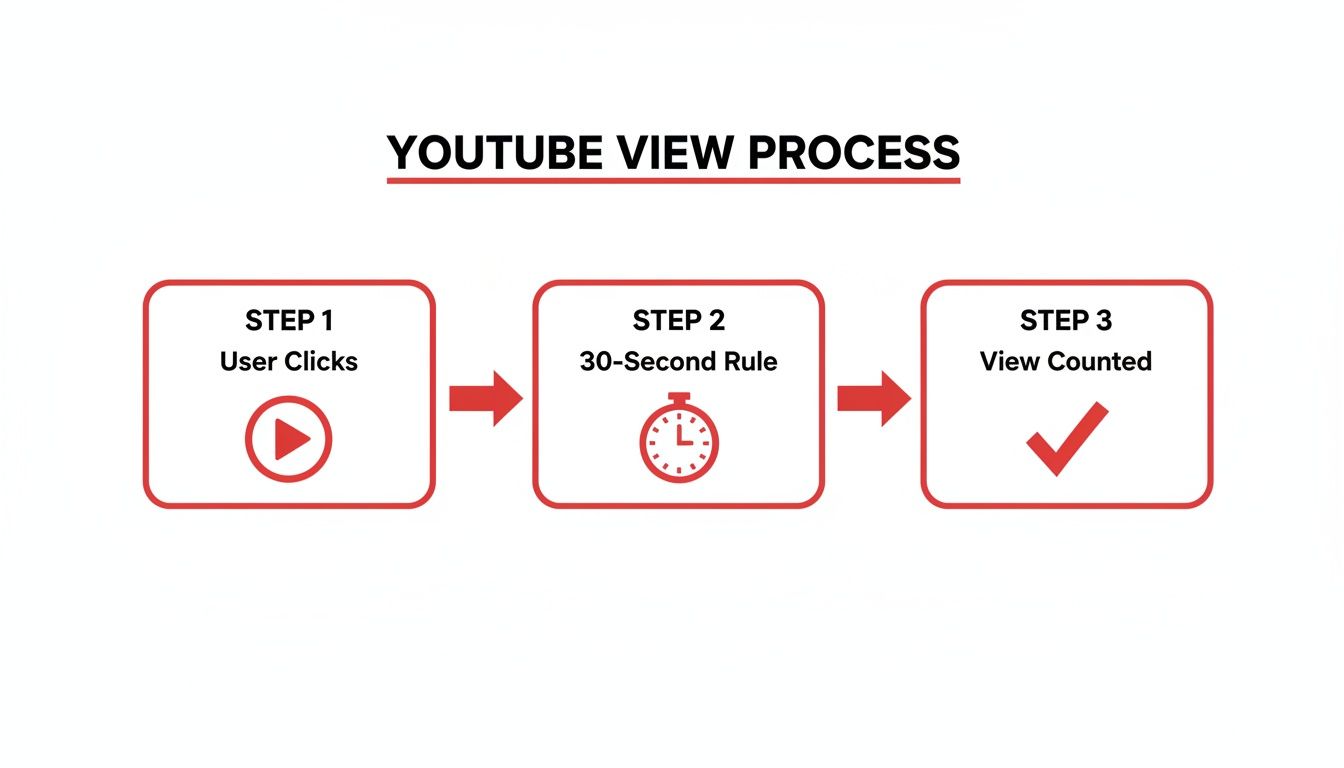
As you can see, not every click makes the cut. The system is designed to filter plays, making sure only those that last at least 30 seconds are counted as legitimate views.
The Auditing and Verification Phase
Now, the "bouncer" starts checking IDs. After the initial flood of traffic, YouTube's algorithms get to work auditing every single one of those early views. This is where the system gets serious about filtering out anything that doesn't look like a genuine person watching your video.
During this deep-dive verification, the system is on the lookout for red flags like:
- Bot Traffic: It sniffs out and discards views from automated scripts trying to game the system.
- Repetitive Plays: Someone hitting refresh over and over again? Those extra plays won't count.
- Malware and Spam: Any views coming from suspicious or malicious sources are immediately filtered out.
This is the reason your view counter might suddenly freeze—famously around the 300-view mark, but it can happen at any point. The counter is just paused while the system does its work. Once the audit is done, the number updates to a verified, more accurate total. If some invalid traffic was found, you might see the number dip slightly.
YouTube’s verification isn't there to punish creators. It’s about protecting everyone—creators, viewers, and advertisers—by ensuring the numbers are trustworthy and reflect genuine human engagement.
This two-step process is all about maintaining a fair and reliable platform. It means you can trust that your analytics reflect real audience growth, and advertisers know they're paying for actual eyeballs. By understanding this, you can stop worrying about fluctuating numbers and focus on what really matters: creating great content that real people genuinely want to watch.
Why Watch Time Is More Important Than Views

Getting a view is the first step, sure, but it’s not the metric that really moves the needle with the YouTube algorithm. The real currency on the platform is watch time—the total amount of time people spend actually watching your videos. This is where YouTube separates a passing glance from real engagement.
Think of it like a restaurant. Views are just the number of people who walk in the door. Watch time is how long they stay for a full meal. A restaurant with a line out the door is great, but if everyone leaves after one bite, it’s sending a terrible signal. The place that keeps people seated, happy, and ordering dessert is the one that's truly winning.
What Watch Time Tells YouTube
Every second a viewer sticks with your video, they’re casting a vote. When someone watches for a good chunk of time, they're sending a strong, clear signal to YouTube: "This content is good. It delivered on its promise, and I'm finding it valuable."
On the flip side, a video with a ton of views but awful audience retention tells a different story. It suggests the title or thumbnail was clickbait, or the content itself just didn't hold up. YouTube's main goal is to keep people on the platform as long as possible, so it's naturally going to promote videos that are proven to do exactly that.
This is the key to understanding how views really work. A video with 10,000 views and an average watch time of five minutes (50,000 total minutes) is infinitely more valuable to the algorithm than a video with 50,000 views and an average watch time of 30 seconds (25,000 total minutes).
High watch time is the ultimate vote of confidence from your audience. It tells the YouTube algorithm that your video isn't just getting clicked—it's being consumed and enjoyed, making it a safe bet to recommend to more people.
How Watch Time Fuels Your Channel's Growth
Focusing on watch time isn't just about feeding the algorithm; it’s about building a channel that lasts. This one metric dominoes into nearly every part of your channel’s growth, unlocking more visibility and a more loyal audience.
Watch time directly impacts three crucial areas:
- Search Rankings: YouTube’s search engine wants to show people videos that will satisfy them. High watch time is one of the strongest indicators of viewer satisfaction, which often pushes you higher in the search results for your keywords.
- Recommendations: The "Up Next" sidebar and the homepage recommendations are the holy grail for organic growth. Videos with great watch time are far more likely to get picked up and suggested to new audiences, creating a snowball of new viewers.
- Session Time: YouTube also tracks a metric called "session watch time." This is the total time a viewer spends on YouTube after they start with one of your videos. If your content keeps them on the platform watching more videos (yours or someone else's), YouTube sees your channel as a great starting point and rewards you with even more exposure.
From Chasing Views to Creating Value
So, how do you make the shift from obsessing over views to building up watch time? It all starts with a change in mindset. You have to move away from short-term gimmicks and focus on creating long-term value for your viewers.
Instead of asking, "Will this title get clicks?" start asking, "Will this video keep people watching?" That one simple question can completely reshape your content strategy.
Here are a few practical ways to do it:
- Nail Your Intro: The first 15-30 seconds are everything. You have to hook the viewer immediately, prove they're in the right place, and give them a compelling reason to stick around for the rest of the video.
- Give Your Content Structure: Don't just hit record and ramble. Plan out a clear, logical flow. Use things like chapter markers, on-screen text, and storytelling to guide the viewer and keep them engaged from start to finish.
- Become a Student of Your Retention Graphs: Get into your YouTube Analytics and study your audience retention charts. Pay close attention to the spots where viewers are dropping off. Those dips are gold—they're telling you exactly which parts of your content aren't working so you can fix them in the next video.
When you prioritize watch time, you're aligning your goals directly with YouTube's. You stop chasing a vanity metric and start building a library of genuinely good content that people love. That's what builds loyalty and gets the algorithm working for you, not against you.
How Your Views Translate Into Real Revenue
Okay, we've established that watch time is the secret sauce for getting the algorithm on your side. But let's get down to brass tacks: how do all those views actually put money in your bank account?
It all starts with the YouTube Partner Program (YPP). Once you're in, you can run ads on your videos, and YouTube shares the revenue with you.
Think of your channel as a prime-time TV spot. Advertisers pay YouTube to show their commercials to your audience, and every time they do, you get a cut of the cash. It's a simple idea, but the numbers behind it can be a bit tricky to unpack.
Decoding Your Earnings with CPM and RPM
To really get a grip on your channel's financial health, you need to know the difference between two critical metrics in your YouTube Analytics: CPM and RPM. They sound alike, but they tell you two very different things about your income.
- CPM (Cost Per Mille): This means "Cost Per 1,000 Impressions." It’s a measure of how much advertisers are willing to pay to show their ads 1,000 times on videos in your niche. A high CPM is a good sign—it means advertisers see your audience as valuable.
- RPM (Revenue Per Mille): This is "Revenue Per 1,000 Views." This is the number that really matters to you. RPM shows you how much money you actually pocket for every 1,000 views your video gets, after YouTube takes its share and all the math is done.
Here’s a simple way to think about it: CPM is like the sticker price on a car, but RPM is the actual cash you drive off the lot with after all the fees and taxes are paid. Your RPM will always be lower than your CPM, but it’s a true reflection of your earnings.
RPM is your channel's financial pulse. It rolls up all your income—ads, Super Chats, memberships—and divides it by your total views. It gives you the clearest picture of what one thousand views are actually worth to you.
Why Not All Views Are Created Equal
This leads to a really important point: when it comes to making money, a view is not just a view.
A view from someone in the United States watching a video about investing is worth a heck of a lot more to an advertiser than a view from another region watching funny cat clips. Why? Because some audiences have more spending power and are in markets that brands are desperate to reach.
Several things can make your views more valuable:
- Audience Demographics: Viewers from countries with strong economies (like the US, UK, Canada, and Australia) almost always bring in more ad revenue.
- Video Niche: Some topics are just goldmines. Finance, technology, and real estate have sky-high CPMs because the products being advertised are expensive.
- Time of Year: Advertisers go on a spending spree around the holidays, especially in the fourth quarter (Q4). Your views can earn you significantly more from October to December.
Understanding this is a game-changer. If you want to maximize your income, you need to think strategically about the content you create and the audience you're trying to attract. Building that kind of channel from the ground up takes a ton of time and effort, of course. For those looking to get a head start, an option like purchasing an existing monetized YouTube channel can be a major shortcut.
The Real Math Behind Your Payout
So, what does this all boil down to in your bank account?
While views keep your channel alive, it's the ad views that pay the bills. On average, YouTube pays creators somewhere between $3 to $5 per 1,000 views, but this number can swing wildly. If your video hits 1 million views, that could mean anything from $2,500 to $10,000.
Remember, you keep 55% of the ad revenue, and YouTube takes the other 45%. But if you're in a hot niche like finance and your audience is primarily in a top-tier country, you could see payouts as high as $50 per 1,000 views.
This all points to a fundamental truth for every creator: the road to a real income on YouTube isn't just about chasing views. It's about attracting the right views from an engaged audience that advertisers are lining up to meet. Once you understand what drives your RPM, you can stop just making videos and start building a real, sustainable business on the platform.
Common Reasons Your Views Aren't Showing Up
It’s a classic creator headache: you see the views rolling in on the real-time counter, but when you check your official YouTube Analytics, the numbers just don't match up. If you've ever felt like YouTube is shortchanging you on views, you're definitely not alone. But this isn't usually a bug. It’s actually YouTube’s view validation system doing its job.
The system is designed to filter out any activity that doesn't look like a real person genuinely choosing to watch your video. Let's break down the most common reasons why some plays get flagged and dropped, so you can stop wondering and start building a strategy that gets every legitimate view counted.
Invalid Traffic and Bot Activity
The number one culprit behind missing views is what YouTube calls invalid traffic. This is a catch-all term for any view that doesn't come from a real human who is genuinely interested in your content. Think of it as YouTube's bouncer, kicking out anyone who doesn't belong.
The most obvious offenders are automated bots and scripts built to rack up views. If the algorithm spots a weird pattern—like hundreds of views coming from the same place in an inhumanly short amount of time—it flags that activity and throws those views out.
Another big red flag is traffic from "view exchange" websites. You know the ones—they promise to send you views if you watch a bunch of other random videos. While it sounds tempting, YouTube’s systems are smart enough to spot this kind of artificial activity, and those views will never make it to your official count.
Your view count isn't just a number; it's a measure of your credibility. Using shady services for fake views is a fast track to violating YouTube's rules, and it completely erodes the trust you have with your real audience and the algorithm.
The Viewer Bailed Too Quickly
We talked about the 30-second rule earlier, and it's a make-or-break factor here. For a play to officially count as a "view," someone has to watch your video for at least 30 seconds. If a person clicks, watches for 25 seconds, and then clicks away, that interaction vanishes into the ether. It won't be counted.
This is all about engagement. A ton of these quick drop-offs tells the algorithm that your video didn't live up to the promise of its title and thumbnail. The takeaway? Your intro is everything. You absolutely have to hook your audience in those first few seconds and give them a reason to stick around past that 30-second milestone.
Autoplaying Embedded Videos
Embedding your videos on your blog or website is a fantastic way to get more eyeballs on your content. But there’s a catch: if you set those embedded videos to autoplay, the views they get often won't be counted.
YouTube’s philosophy is simple: a view has to be user-initiated. Someone needs to make the conscious choice to hit the play button. A video that starts playing on its own doesn't show any viewer intent, so the system is very likely to ignore it. To make sure those external plays count, always set your embedded videos to require a manual click.
Troubleshooting Common View Count Issues
Feeling a little lost in the data? This quick-reference table can help you diagnose what might be going on with your view count and figure out how to fix it.
| Potential Issue | How to Identify It | Solution or Best Practice |
|---|---|---|
| Short Watch Times | Check your Audience Retention graph in Analytics. Is there a steep nosedive in the first 30 seconds? | Craft a much stronger hook. Your intro needs to immediately grab your viewer's attention and deliver on your promise. |
| Invalid Traffic | Look for sudden, bizarre spikes in views, especially from "Unknown" or suspicious traffic sources. | Never, ever use view-boosting services. Focus on organic promotion strategies to attract a real audience that cares. |
| Autoplay Embeds | Your external traffic sources show high impressions, but those numbers aren't translating into counted views. | Go into your website settings and disable the autoplay feature on all embedded YouTube videos. Make people click to play. |
| Watching Your Own Videos | Your "Realtime" view count consistently seems higher than the final, verified number that shows up later. | It's simple: stop re-watching your own published videos from your main account or the same IP address. |
Think of this table as your first-aid kit for view count mysteries. By understanding these common pitfalls, you can spend less time worrying about your numbers and more time creating content that people genuinely want to watch.
How to Optimize Your Videos for More Views

Knowing how YouTube counts views is one thing. Actually getting more of them is a whole different ball game. The real goal isn't just to pump up the view count; it's about building a loyal audience that sticks around and drives up your watch time.
This means you need a solid strategy that covers everything from discoverability to retention. You have to get your videos in front of the right people, and then—once they click—give them a reason to keep watching. Let's break down how to make that happen.
Craft Compelling Thumbnails and Titles
Think of your thumbnail and title as the cover of a book on a crowded shelf. It's your first, and often only, chance to grab someone's attention and make them click. A killer thumbnail is bright, clear, and makes you feel something, while a great title is descriptive, searchable, and sparks just enough curiosity.
It’s a classic one-two punch:
- Thumbnails: Go for high-contrast colors and expressive faces. Keep text to a minimum—let the image do the talking.
- Titles: Your title needs to work with the thumbnail to clearly state the video's promise. Ask a question or offer a solution to a problem.
Master YouTube SEO and Promotion
Getting found on YouTube is all about playing nice with the search and recommendation algorithms. This means you have to optimize your video's metadata—the title, description, and tags—with keywords that tell the algorithm exactly what your content is about.
Don't stop there. Give your video an initial push by sharing it everywhere you can: social media, email newsletters, or relevant online forums. A little-known trick is to schedule your uploads strategically. Finding the best time to upload YouTube videos for your audience can make a huge difference in that initial engagement.
YouTube’s entire ecosystem, which serves over 2.5 billion monthly users, runs on views. The platform's algorithm is designed to reward videos with high watch time because that creates more ad slots and, in turn, more revenue for creators. Hitting 1 million monthly views can genuinely replace a full-time income for creators in the right niches.
Analyze Data and Double Down on What Works
Your YouTube Analytics dashboard is a goldmine of information. It's your roadmap. Start by looking at your click-through rate (CTR) to see how well your thumbnails and titles are actually performing. Then, dive into the audience retention graphs to pinpoint the exact moments viewers get bored and click away.
This data tells you what to do next. If one topic or format consistently keeps people watching longer, make more content like it. Building a channel is a marathon, not a sprint, and it's all about learning and adapting.
For creators wanting a head start, an aged YouTube channel can provide a pre-built foundation. But no matter how you start, long-term success comes down to a simple formula: great content, smart optimization, and data-driven decisions.
Got Questions About YouTube Views? We've Got Answers
Even when you think you have YouTube's system figured out, some view-related questions always seem to pop up. Let's clear up a few of the most common ones creators run into.
Do Replays Count As Views On YouTube?
Yes, they can! But there's a catch. If someone hits replay over and over again in a short period, YouTube's system is smart enough to see that's not natural behavior and will stop counting those plays.
On the other hand, if a fan comes back to watch your video again a few hours later, or even the next day, that's a great sign to the algorithm. YouTube sees this as genuine interest and will almost always count it as a new, legitimate view.
How Long Does It Take For YouTube Views To Update?
Right after you publish, you'll see the view counter tick up in real-time. It's exciting! But as more people start watching, you might notice the counter seems to slow down or even get "stuck." Don't panic—this is totally normal.
This pause is a good thing. It means YouTube's verification system has kicked in to scrub out any bot traffic or low-quality plays. Your final, accurate view count usually catches up and stabilizes within 24 to 48 hours.
Do Views On YouTube Shorts Work The Same Way?
Nope, they're a different beast entirely. A view on a Short is counted almost instantly when someone watches it in their feed. There’s no 30-second minimum like there is for your regular, long-form videos.
When it comes to getting paid, though, the rules are different. While the view counts immediately, what really matters for the YouTube Partner Program is hitting 10 million valid public Shorts views in the last 90 days. For more deep dives into YouTube strategy, feel free to explore our creator-focused blog. This separate requirement ensures that creators who find massive success with short-form content are rewarded for it.
At MonetizedProfiles, we specialize in providing creators with fully monetized social media accounts, allowing you to bypass the initial hurdles and start earning from your content immediately. Explore our ready-to-use accounts and accelerate your creator journey today.


