


So, you want to get paid on YouTube? The first big hurdle everyone has to clear is getting into the YouTube Partner Program (YPP). This is your official ticket to earning money from your videos.
There are a couple of ways to get in. The classic route is to hit 1,000 subscribers and rack up 4,000 hours of public watch time within the last 12 months. But if you're all about short-form content, there's another path: get 1,000 subscribers and hit 10 million valid Shorts views in the last 90 days.
Your Path to YouTube Monetization
Think of the YouTube Partner Program as the official club for creators who are serious about their channels. Once you're in, you unlock the ability to earn from ads, channel memberships, Super Chats, and a whole lot more. It's the milestone every creator works toward.
Let's be real—this part is a grind. It’s not just about uploading videos. You have to make stuff people actually want to watch and come back for. YouTube sets these requirements to make sure channels have a real, engaged audience before they start throwing ads on their content.
Meeting the Key Thresholds
Why those specific numbers? Well, subscribers show you've built a community of people who care about what you're making. Watch hours prove your content is sticky and holds people's attention, which is exactly what advertisers want.
The 10 million Shorts views option is a game-changer for creators in that space. A single viral Short can get you to the finish line way faster than a long-form video might. If you want to get into all the nitty-gritty details, check out our full guide on https://monetizedprofiles.com/blogs/monetization-on-social-media/youtube-channel-monetization-requirements.
This handy infographic lays out the whole process, from qualifying to getting paid.
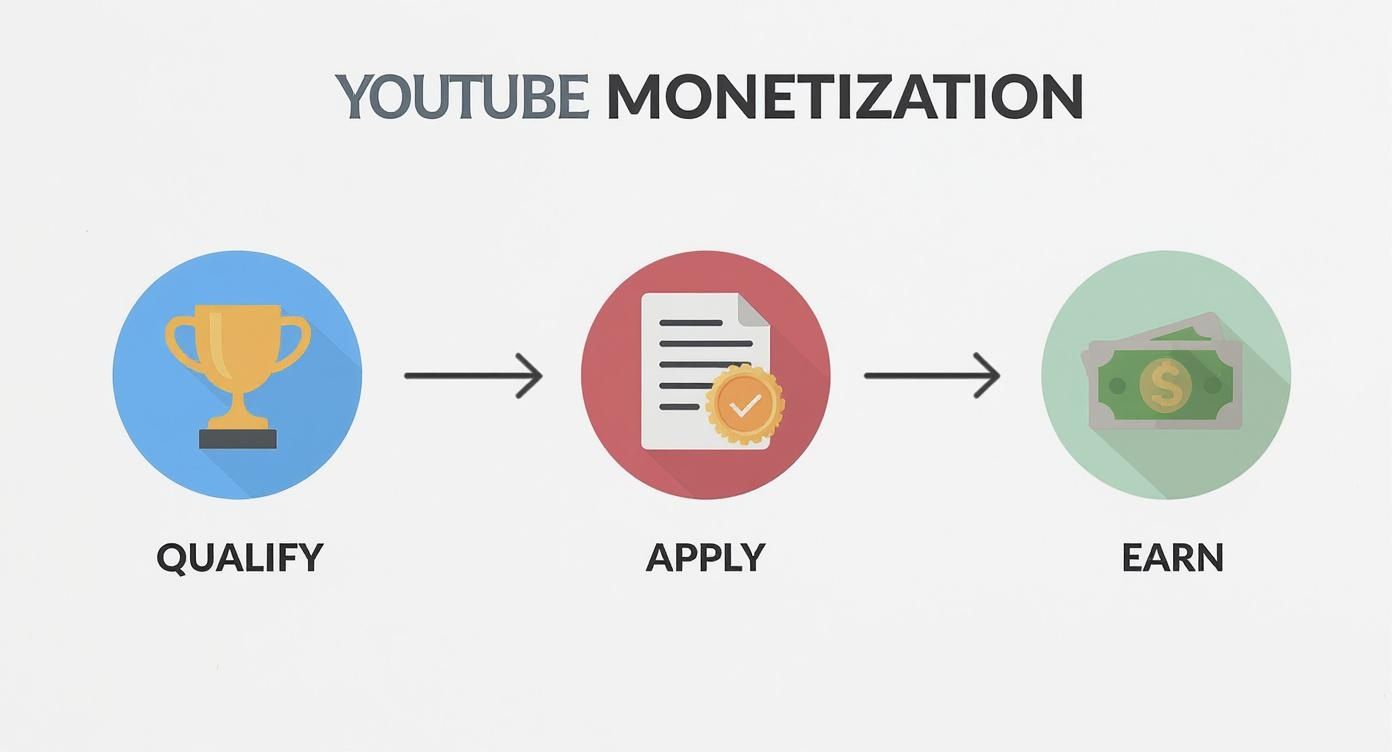
As you can see, hitting the numbers is just step one. You still have to apply, get reviewed, and then you can start seeing the money roll in.
To help you keep track, here’s a quick breakdown of what you need to aim for.
YouTube Monetization Requirements at a Glance
| Requirement | Threshold | Key Action |
|---|---|---|
| Subscribers | 1,000 | Create content that encourages viewers to subscribe. |
| Watch Hours | 4,000 hours (in last 12 months) | Make engaging, long-form videos that hold attention. |
| Shorts Views | 10 million views (in last 90 days) | Produce viral-worthy Shorts to hit this alternative goal. |
| AdSense Account | One active account | Set up and link your Google AdSense for payment processing. |
Meeting these goals is your primary focus as you build your channel toward monetization.
Setting Up Your Google AdSense Account
Once you've hit the YPP milestones, YouTube will prompt you to connect your channel to a Google AdSense account. This is a crucial step—AdSense is the tool that actually processes your earnings and pays you. No AdSense, no money. It's that simple.
Your AdSense account is a separate entity from your YouTube channel. Double-check that all your personal and tax info is perfect during setup. Any mistakes here can cause major payment headaches later. Also, remember you can only have one AdSense account in your name.
As your channel grows, don't forget about other revenue streams. It's worth exploring specific strategies for YouTube Shorts monetization, as YouTube is constantly adding new ways for short-form creators to earn. By nailing these basic requirements and getting your administrative house in order, you'll be building a solid foundation for a successful career as a creator.
How Ad Revenue Actually Works

So, you’ve made it into the YouTube Partner Program. Congratulations! This is where the idea of getting paid for your videos becomes real, and it all runs through your Google AdSense account. Think of AdSense as your financial command center for every dollar you earn on the platform.
AdSense is essentially the middleman. A brand pays Google to run an ad, Google places that ad on your video, and you get a cut of the money. Getting your AdSense account set up perfectly from the start is absolutely critical. You'll need to verify your identity, confirm your address, and submit the right tax info. Any little mistake here can lead to frustrating payment delays down the road.
Decoding Your Earnings with CPM and RPM
Diving into your YouTube Analytics for the first time can feel a bit overwhelming. You'll be hit with a bunch of acronyms, but the two most important ones to get a handle on are CPM and RPM. They sound similar, but they tell you very different things about your money.
CPM, or Cost Per Mille, is what advertisers pay for 1,000 ad impressions on YouTube videos. It’s an advertiser-centric number that shows you how much your niche is worth to businesses. A high CPM means advertisers are competing to get in front of your audience.
But that’s not what lands in your bank account. For that, you need to focus on RPM, or Revenue Per Mille. This is your metric. It shows your total earnings (from ads and other sources like Super Chats) for every 1,000 views your videos get. RPM has already factored in YouTube's cut, so it gives you a much clearer picture of what your content is actually generating. If you want to dig deeper, we have a whole guide on what RPM means for your YouTube channel.
Why Some Niches Earn More Than Others
Ever wondered how a finance channel with 100,000 views can make ten times more than a gaming channel with the same number? It all comes down to CPM. Advertisers will pay way more to reach an audience they know has money to spend.
Several key factors really move the needle on your earnings:
- Your Niche: A video on stock trading or real estate will attract high-paying advertisers like banks and investment firms. A prank channel? Not so much.
- Your Audience's Location: An advertiser will pay top dollar to reach a viewer in the United States, but significantly less for a viewer in a country with lower consumer spending power.
- Time of Year: Ad budgets go through the roof in Q4 (October-December) thanks to the holiday shopping frenzy. Expect to see your RPM climb during these months.
Key Takeaway: Stop obsessing over just the view count. A smaller, dedicated audience in a high-value niche can easily earn more than a massive channel in a less profitable one. It's about the quality of your viewers, not just the quantity.
Getting that first AdSense payout is a moment you'll never forget. YouTube pays out monthly (usually between the 21st and 26th), provided you’ve hit the $100 minimum payment threshold. While it varies wildly, it's not uncommon for creators to earn between $2,000 and $5,000 for 1 million views, depending on all the factors we just covered. The system is designed to reward you for attracting the right kind of audience—the one that advertisers want to reach.
Don't Just Rely on Ad Revenue—Build a Real Business
Relying only on ad revenue is a rookie mistake. It's like building your dream house on a foundation of sand—one algorithm change or a bad month for ad rates, and your income can plummet. To build a sustainable career on YouTube, you have to think like a business owner and diversify.
The smartest creators I know treat their channel as the core of a much larger business. The good news? YouTube gives you some powerful tools right out of the box to help you start building these extra income streams, often by letting your most loyal fans support you directly.
Let Your Community Support You Directly
Your biggest fans don't just want to watch your videos; they genuinely want to be part of your success. Features like Channel Memberships and Super Chats are built to bridge that gap, turning passive viewers into active patrons of your work.
Channel Memberships are a game-changer. You're essentially creating a paid subscription for your channel, where fans pay a monthly fee for exclusive perks.
- Exclusive Content: Think behind-the-scenes vlogs, early video access, or members-only livestreams where you can have a more intimate chat.
- Custom Emojis and Badges: These are small but mighty. Members love having a special badge next to their name in the comments, making them feel like true insiders.
- Community Access: A private Discord server is a popular choice, creating a hub for your most dedicated followers to connect with you and each other.
Then you have Super Chats and Super Stickers, which are perfect for livestreams and premieres. Viewers can pay to have their comment highlighted in the chat or send a fun, animated sticker. It gives them a way to stand out, grab your attention, and toss a few dollars your way all at once. It’s a direct financial high-five from your audience.
Landing Those Sweet Brand Deals
Moving beyond YouTube's built-in tools, you get to the really lucrative stuff: brand sponsorships. This is where many creators see their income take a serious leap. A brand deal is simple—a company pays you to feature their product or service in one of your videos.
Getting brands to notice you starts with having a professional media kit. This is your channel’s resume. It needs to show off your value with key stats like your monthly views, audience demographics (age, gender, top countries), and engagement rates.
When a brand finally reaches out, don't just jump at the first number they throw at you. Be ready to negotiate. Your value isn't just your view count; it's the trust and connection you've spent years building with your audience. A thoughtful, authentic product integration is worth far more to a brand than a generic 30-second ad read.
Your audience trusts you. Promoting a product you don't believe in can damage that trust and hurt your channel in the long run. Always prioritize authenticity and partner with brands that align with your content and values.
Expand Beyond the Platform
The real end game for many creators is building a business that stands on its own, with YouTube as just one part of it. This is where true financial freedom lies. Two of the best ways to do this are with affiliate marketing and selling your own products.
Affiliate Marketing is one of the easiest income streams to set up. You promote products you already use and love, and you get a commission for any sales that come through your unique link. For a tech reviewer, this means dropping Amazon affiliate links for all the gear in their videos. It's a natural way to earn money from recommendations you'd be making anyway.
Finally, the ultimate step is creating and selling your own merch or digital products. This gives you 100% control over everything from the product itself to the profits. You can launch a line of branded t-shirts, sell digital downloads like e-books or Lightroom presets, or even create your own online courses.
When you start weaving these different methods together, you’re no longer just a YouTuber—you're the owner of a robust business. For more inspiration, check out our guide on how to build multiple income streams. This is how you turn a fun channel into a profitable and long-lasting career.
Setting Realistic Earning Expectations
It's easy to see the headlines about YouTubers making millions and think you'll be swimming in cash overnight. But if you want to get paid on YouTube consistently, you need to ground your expectations in reality.
The truth is, your earning potential isn't just about racking up subscribers. It's about the value of the audience you build. I've seen channels with 100,000 subscribers that easily out-earn channels with 500,000, and it almost always comes down to one thing: their niche.
Your channel's topic directly dictates your ad rates because it determines who wants to advertise to your viewers. A creator talking about personal finance, real estate, or expensive tech is attracting an audience with buying power. That’s a goldmine for advertisers.
Naturally, brands will pay a premium to get their ads on those videos. This boosts the channel's CPM (Cost Per Mille) and, in turn, your RPM (Revenue Per Mille), putting more money in your pocket for every thousand views. On the flip side, broad entertainment or comedy channels often have lower ad rates because their audience is less targeted for high-value products.
How Your Earnings Grow as Your Channel Does
Let's talk numbers. Say you have a channel with 100,000 subscribers, and your videos consistently hit around 100,000 views. From AdSense alone, you might see anywhere from $500 to $1,500 per video. But here's where it gets interesting: that same video could land you a brand deal worth an extra $3,000 to $7,000.
Now, imagine that channel grows to a million subscribers. The scale is massive. At that level, a creator can pull in between $14,600 and $54,600 per month just from ads. That huge range really drives home how much your niche, audience location, and engagement matter. To get a deeper dive into how top creators build their income streams, Descript has a great breakdown on how YouTubers make money.
Here’s the bottom line: Subscriber counts are just vanity metrics without context. A smaller, highly engaged audience in a profitable niche is infinitely more valuable than a massive, passive one in a low-CPM category.
Think Beyond Just YouTube Ads
It also helps to look at how other platforms pay creators. For instance, TikTok's model is completely different from YouTube’s revenue-sharing system. Understanding the nuances of TikTok Creator Fund eligibility can give you some valuable perspective on building a multi-platform strategy.
This comparison shows that a smart creator doesn't just chase views. It’s about understanding your audience’s real value and building a sustainable business around it—whether that's solely on YouTube or, even better, across several platforms. Your journey to a real, sustainable income begins with that strategic mindset.
Lessons from YouTube’s Top Earners
It’s easy to look at the massive paychecks of top YouTubers and just be amazed. But if you want to build a real career on the platform, you need to look closer and start reverse-engineering their business strategies. What’s the secret sauce that separates the creators building media empires from those just cashing AdSense checks?
It all comes down to treating your channel as a business engine, not just a creative project.
Take MrBeast, for example. The guy is a master of viral content, no doubt. But his real genius is how he treats his revenue. He famously reinvests almost every single dollar he makes back into creating even bigger, more insane videos. This creates a powerful flywheel effect: a successful video funds a more ambitious project, which captures even more attention and generates more revenue, which he then funnels right back into the next big thing.
The Diversification Blueprint
If there's one thing the pros know, it's that relying solely on AdSense is a recipe for a fragile career. They see their YouTube channel as the top of a funnel—the entry point that leads their audience to a whole portfolio of different income streams. This is the model you need to adopt if you want to make a living on YouTube for the long haul.
Their income isn't from one source; it's a carefully built mix:
- Brand Deals: They don't just take any sponsorship. They secure deals with brands that actually resonate with their audience, often commanding six-figure fees for a single video.
- Merchandise: It's way past just slapping a logo on a t-shirt. Think high-quality apparel and products that fans are genuinely excited to buy, like Markiplier’s successful clothing brand, Cloak.
- External Ventures: The really big players launch entire businesses separate from their channel. Rhett and Link's "Good Mythical Morning" has spawned books, podcasts, and even food products under their Mythical Entertainment company.
Beyond the Screen
The highest-earning creators show us just how high the ceiling can be. For instance, MrBeast (Jimmy Donaldson) has led the pack with an estimated annual income of around $82 million. Others like Rhett and Link pull in an estimated $35 million, and Markiplier is right there with around $30 million.
These aren't just ad revenue numbers. They're the result of combining AdSense with sponsorships, merch sales, and other powerful income streams. You can dig deeper into how these top earners built their empires over at Target Internet.
The key takeaway here is to stop thinking like a YouTuber and start thinking like a CEO. Your channel is your best marketing tool, but your business is the entire ecosystem you build around it.
This mental shift is what turns a popular channel into a resilient, scalable company. It’s not just about chasing more views; it’s about creating more value from the attention you've already earned. When you start thinking this way, you build a business that can survive algorithm shifts and continue to grow for years to come.
Common YouTube Monetization Questions
Once you start down the path to getting paid on YouTube, questions are bound to pop up. The process isn't always cut and dry, and it’s easy to get bogged down in the details. Let's tackle some of the most common hangups so you can keep your momentum going.
One of the first big milestones that creators obsess over is hitting that watch time requirement. It’s a number that can feel a little daunting at first.
How Long Does It Take to Get 4,000 Watch Hours?
Honestly, there's no single answer here. The timeline is completely tied to your content, your upload frequency, and a little bit of luck. For a very small number of creators, a single viral video can get them there in just a few weeks.
But for the rest of us? It’s usually a steady grind over several months—often closer to a full year.
The real key is consistency. Your goal should be creating binge-worthy content that keeps people watching and, more importantly, clicking on the next video. Think in terms of series and playlists; they are absolute gold for racking up watch hours.
Another question I hear all the time is about being on camera and whether it's a deal-breaker.
It’s a huge myth that you have to be the "face" of your channel to make it big. I've seen countless six- and even seven-figure channels where the creator never once shows their face.
Just look at the variety of massive channels that prove this point:
- Animation Channels: Their success is built on great storytelling and visuals.
- Gaming Channels: It's all about the gameplay and entertaining commentary.
- Tutorial Channels: People are there for the screen recordings and clear instructions, not the person.
- Documentary-Style Channels: They thrive on stock footage and a compelling narrator.
As long as your content is original and plays by YouTube's rules, you can absolutely build a profitable channel without ever stepping in front of the camera.
Can I Use Copyrighted Music in My Videos?
This one is critical, so pay close attention. Using popular, copyrighted music without a license is the fastest way to get your video demonetized—or even hit with a copyright strike.
YouTube's Content ID system is incredibly sophisticated and will flag unlicensed music almost instantly.
When that happens, every cent of ad revenue from that video goes directly to the music's copyright owner, not you. To keep your earnings safe, you have to use royalty-free music. Your best bets are the free YouTube Audio Library or a paid subscription service that gives you the proper licenses for commercial use. It's a small price to pay to protect your income stream.
Ready to skip the initial grind and start earning right away? MonetizedProfiles offers fully approved YouTube accounts that are ready to generate revenue from day one. They're a perfect fit for faceless creators and automation experts who want an immediate head start. You can check out their selection at https://monetizedprofiles.com and kickstart your monetization journey today.


