


So, can you use copyrighted music on YouTube? The short answer is yes... but it's almost never free and always comes with strings attached. Using a popular track from your favorite artist without getting the right permissions is a huge gamble. You could lose your video's ad revenue, have your content completely blocked, or even put your entire channel in jeopardy.
Why Understanding Music Copyright Is Critical for Your Channel

If you're trying to build a monetized channel, a single music mistake can wipe out months of hard work. That perfect background song might feel like a harmless addition, but without the right license, it's a ticking time bomb.
Think of it like this: using a song is like renting professional film equipment. You can't just grab it and start shooting. You have to sign the rental agreement—the license—or you'll face some serious penalties.
Ignoring these rules doesn't just put one video at risk; it threatens your channel's good standing and your ability to make money. This isn't just about dodging annoying notifications. It's about protecting your business and making sure your creative work actually pays you.
What Happens When You Get Caught?
When you upload a video with unlicensed copyrighted music, YouTube's automated systems will almost definitely catch it. When that happens, you can expect one of a few outcomes, ranging from a minor headache to a channel-ending disaster.
Here’s a quick breakdown of what you can expect, from the most common scenario to the most severe.
Outcomes of Using Copyrighted Music Without a License
| Outcome | What It Means for Your Video | Impact on Your Monetization |
|---|---|---|
| Content ID Claim | Your video stays online, but the copyright owner now controls it. | The owner places ads on your video and collects 100% of the ad revenue. You earn nothing. |
| Video Block | The owner blocks your video from being viewed, either worldwide or in certain countries. | All your hard work goes to waste. The video gets zero views and makes no money. |
| Copyright Strike | This is a formal takedown notice that acts as a penalty against your channel. | Accumulating just three strikes can get your entire channel permanently deleted. |
As you can see, the consequences get serious fast. A Content ID claim is an annoyance, but a copyright strike is a direct threat to your channel's existence.
The reality for creators is that every piece of music has rules attached. Learning those rules isn't just a good idea—it's a fundamental skill for building a sustainable and profitable channel.
Getting a handle on music licensing is one of the best things you can do for your long-term success. It keeps you in the driver's seat, with full control over your content, your income, and your channel's future. In this guide, we'll walk through exactly how to do that—from finding safe music to keeping your channel growing without worrying about claims or strikes.
Understanding Content ID vs. Copyright Strikes
Trying to figure out YouTube's copyright rules can feel like you're learning a new language. But really, it all boils down to two key ideas. If you want to use music in your videos without putting your channel in hot water, you absolutely have to know the difference between them.
We're talking about Content ID claims and copyright strikes. They both pop up because of copyright, but how they affect your channel—and your wallet—couldn't be more different.
Think of Content ID as YouTube's automated robot cop. It's a massive digital fingerprinting system that scans every single video uploaded, comparing it against a giant database of audio and video files that copyright owners have provided.
What Is a Content ID Claim?
When that robot cop finds a match—say, a Taylor Swift song playing in the background of your travel vlog—it automatically places a "claim" on your video. This isn't a penalty or a slap on the wrist. It’s just the system doing its job and enforcing the rules the copyright owner set up ahead of time.
Once a claim is made, the owner has a few options:
- Monetize the video: This is the most common result. Ads get placed on your video, and the copyright owner collects all the ad revenue. Your video stays live, but you won't make a dime from it.
- Track the video's viewership statistics: Sometimes, the owner just wants to gather data on where and how their content is being used without touching your monetization.
- Block the video: The owner can also choose to make your video unviewable, either in certain countries or across the globe.
A Content ID claim is an automated thing that only affects that one specific video. It doesn't put a black mark on your channel's record with YouTube. It’s more of a financial headache than a disciplinary action.
In fact, most big rights holders would rather take the money than take down the video. Data shows that owners let about 90% of videos with Content ID matches stay online, opting to share revenue instead. This strategy, detailed in these findings about YouTube's content management system, cleverly turns what could be infringement into a steady income stream for them.
What Is a Copyright Strike?
So if a Content ID claim is the robot cop, a copyright strike is the real deal—a formal legal notice showing up at your door. This is much, much more serious.
A copyright strike happens when a copyright owner submits a valid legal takedown request under the DMCA (Digital Millennium Copyright Act). This isn't an automated scan; it's a manual process started by the owner because they believe their work was used without permission.
Unlike a claim, a strike is a direct penalty against your channel's standing. It’s a formal mark on your record, and the consequences pile up fast.
A copyright strike is the owner officially telling YouTube you've infringed on their copyright. It puts your entire channel's good standing in jeopardy. We're not just talking about the money from one video anymore; we're talking about your ability to even be a creator on the platform.
Comparing the Consequences
Getting a handle on the difference here is non-negotiable for keeping your channel healthy. One is a manageable problem, while the other is a genuine threat.
Here’s a simple side-by-side to make it crystal clear:
| Feature | Content ID Claim | Copyright Strike |
|---|---|---|
| Origin | Automated system match | Manual legal request (DMCA) |
| Impact on Video | Ad revenue goes to owner, or video is blocked | Video is completely removed from YouTube |
| Impact on Channel | None; no penalty to your account | Negative mark; hurts your channel's standing |
| Severity | Low; mostly a financial issue | High; a direct threat to your channel |
Your first copyright strike comes with immediate penalties, like losing the ability to livestream. A second strike brings even more restrictions. Get three copyright strikes, and it’s game over. Your channel, and any others you own, will be permanently terminated. All your videos are deleted, and you’re banned from creating new channels.
This is why it's so critical to know if you've received a claim or a strike. A claim might cost you some cash on a single video, but a strike is one step closer to losing everything you've built.
How Copyright Issues Hit Your Wallet (Hard)
It’s one thing to read about YouTube's copyright rules, but it’s another to see how they can directly drain your bank account. Every time you use music without the right permissions, you’re not just risking a slap on the wrist—you're gambling with your income. The financial hit is real, it’s fast, and it can completely wipe out all the hard work you’ve poured into your channel.
The most common way creators lose money is through a Content ID claim. Let's say you spend hours, or even days, crafting the perfect video. You upload it, and because you used a popular song, a claim pops up almost instantly. Just like that, 100% of the ad revenue from that video now goes straight to the music's owner. Your hard work just made someone else money.
The Content ID Revenue Siphon
This automated system is how most creators end up working for free without even realizing it. It's not really a penalty; it's more like a business deal you never agreed to. The rights holder gets to run ads on your video and pocket every single penny, leaving you with nothing but the view count. For a growing channel, this is a huge setback, turning your best-performing videos into financial black holes.
In some cases, rights holders might offer revenue sharing. It’s a better deal than losing everything, but you're still giving up a big chunk of your earnings. You get to keep some of the money, but it’s a compromise that could have been avoided.
A smart move is to check YouTube's official Music Policies directory before you even add a song to your video. It’s a simple tool that tells you exactly what will happen if you use a specific track—whether it allows monetization, forces revenue sharing, or will get your video blocked outright. A quick search here can save you a massive financial headache later.
Copyright Strikes: The Monetization Kill Switch
A Content ID claim siphons money from a single video. A copyright strike, on the other hand, is an attack on your entire channel's ability to make money. It's a much bigger deal.
Just one strike can get your monetization features suspended, effectively turning off your income overnight.
The consequences stack up fast and can cripple your channel:
- First Strike: You can lose your ability to monetize videos or livestream for a set period.
- Second Strike: The restrictions get tighter, and more of your channel's features are limited.
- Third Strike: Your channel gets terminated. Permanently.
This system doesn't mess around. According to DMCA Authority, the process is unforgiving and can quickly escalate from monetization loss to channel termination. For any creator, even one strike can slash a channel's ad revenue potential, making it less valuable and a lot harder to grow. You can dive deeper into the numbers in this in-depth report on DMCA trends and statistics.
The financial damage from a copyright strike isn't just about one video. It puts your entire YouTube partnership on the line, freezes your income, and threatens the future of your channel. Dealing with music rights isn't just about following rules—it’s about protecting your business.
Building a channel on a solid, clean foundation is crucial for long-term growth. If you’re looking to get a head start, you might be interested in the advantages of beginning with a monetized YouTube channel that already has a perfect copyright record. It just goes to show how vital a channel's history is to its financial success. At the end of the day, managing music copyright isn't just a good habit; it's a core business strategy for anyone serious about making a living on YouTube.
Finding Safe and Legal Music for Your Videos
Okay, so you get the risks. Now for the fun part: finding great music that won't get your channel in trouble. Let’s be real, navigating music licensing can feel like a minefield, but there are actually a ton of solid, creator-friendly options out there.
Think of choosing your music source as an investment in your channel’s future. When you use pre-cleared tracks, you can finally stop worrying about that dreaded Content ID claim or, even worse, a copyright strike. This is your guide to finding the perfect soundtrack without putting all your hard work on the line.
Start with the YouTube Audio Library
The easiest, safest, and most straightforward place to start is right inside your YouTube Studio: the YouTube Audio Library. It’s a massive collection of music and sound effects that YouTube gives you, completely free.
Every single track in this library is good to go. You can use them in your monetized videos without ever having to look over your shoulder for a copyright claim. You won't find the latest Taylor Swift song, but you will find a surprisingly huge variety of genres and moods to fit almost any video.
For creators who are just starting out or working with a tight budget, the YouTube Audio Library is an absolute game-changer. It takes all the guesswork out of music licensing and guarantees your videos are safe.
Explore Royalty-Free Music Services
If the Audio Library feels a bit limited or you want something more polished, a royalty-free music service is your next best bet. Platforms like Epidemic Sound, Artlist, and Soundstripe are built from the ground up for creators. They offer enormous, high-quality catalogs of music ready for you to use.
Now, "royalty-free" can be a confusing term. It doesn't mean the music is free. It just means you don’t have to pay ongoing royalties every time someone watches your video. Instead, you usually pay a monthly or yearly subscription for unlimited access.
Think of the subscription as your all-access pass. As long as it's active, you can download and use as much music as you want. Best of all, any video you publish during your subscription is cleared forever, even if you decide to cancel down the road. It’s a fantastic middle ground, giving you professional-level music for a predictable cost.
Comparing Your Music Sourcing Options
Feeling a little overwhelmed by the choices? This quick comparison should help you decide which music source is the right fit for your channel's needs and budget.
| Music Source | Cost | Music Selection | Monetization Risk |
|---|---|---|---|
| YouTube Audio Library | Completely free | Good, but can be generic | Zero |
| Royalty-Free Services | Subscription-based ($) | Excellent, high-quality | Very Low (if used correctly) |
| Creative Commons (CC) | Free (with attribution) | Unique, but requires research | Low to Medium (must follow license rules) |
| Direct Licensing | Very expensive ($$$) | Any song you want | Zero (if license is secured) |
Ultimately, the best choice depends on your specific goals. For worry-free content, the YouTube Audio Library and paid royalty-free services are your safest bets.
Understand Creative Commons Licenses
Creative Commons (CC) is a system that allows artists to share their work for others to use, but with specific rules attached. You can find some incredibly unique music this way, but you absolutely have to pay attention to the details.
There are several different CC licenses, and you must follow the rules for the specific song you want to use.
Common rules you'll run into:
- Attribution (BY): You have to credit the original artist in your video description, usually with a specific line of text they provide.
- NonCommercial (NC): You can't use the music in a monetized video. Simple as that.
- NoDerivatives (ND): You can use the song as-is, but you can’t remix it, shorten it, or change it in any way.
Always double-check the license terms. Forgetting to add the proper credit is a license violation and can land you a copyright claim just as easily as using a mainstream song.
Demystifying Public Domain Music
When a song's copyright expires, it enters the public domain, meaning it's free for everyone to use. In the U.S., this generally happens 70 years after the death of the last living songwriter.
But there’s a huge catch. The song itself (the melody and lyrics) might be in the public domain, but the recording of that song is almost certainly not.
For example, a classical piece by Beethoven is public domain. But a recording of that piece by the New York Philharmonic is protected by its own, separate copyright. To use it, you'd need to find a recording that is also in the public domain or record your own version. To stay on the right side of the law, it's crucial to understand how to download music legally from sources that respect these important distinctions.
The Path of Direct Licensing
So, what if you absolutely need to use a specific, famous song? The only 100% legal way is to get a direct license. This means you have to hunt down the copyright holders—usually the music publisher and the record label—and negotiate permission to use the track.
Be warned: this process is almost always incredibly complicated, slow, and expensive. We're talking costs that can easily soar into the thousands of dollars for just one song. For the vast majority of YouTubers, it’s just not a realistic option.
For more practical tips on keeping your channel safe and growing, our team is always sharing new guides and strategies on the MonetizedProfiles blog.
Your Step-By-Step Guide to Staying Compliant
Knowing the rules is one thing, but actually putting them into practice is what keeps your channel safe. If you want to use music on YouTube without constantly looking over your shoulder, you need a solid workflow. This is your practical, step-by-step game plan to follow before you hit "upload."
Think of it like a pilot's pre-flight checklist. They run through specific steps to guarantee a safe flight, and you'll do the same to ensure your video has a smooth, claim-free journey on YouTube.
Start with a Solid Foundation
The single most important step you can take happens before you even think about editing: source your music from a trusted place. This one decision can prevent almost every copyright headache down the line. Make sure any music you use comes from a library that explicitly grants you the rights for monetization on YouTube.
Getting this right from the start saves you the stress of fighting a claim after your video is already live. A safe source is your best defense.
This flowchart breaks down the simplest paths to finding music that won't get your channel into trouble.
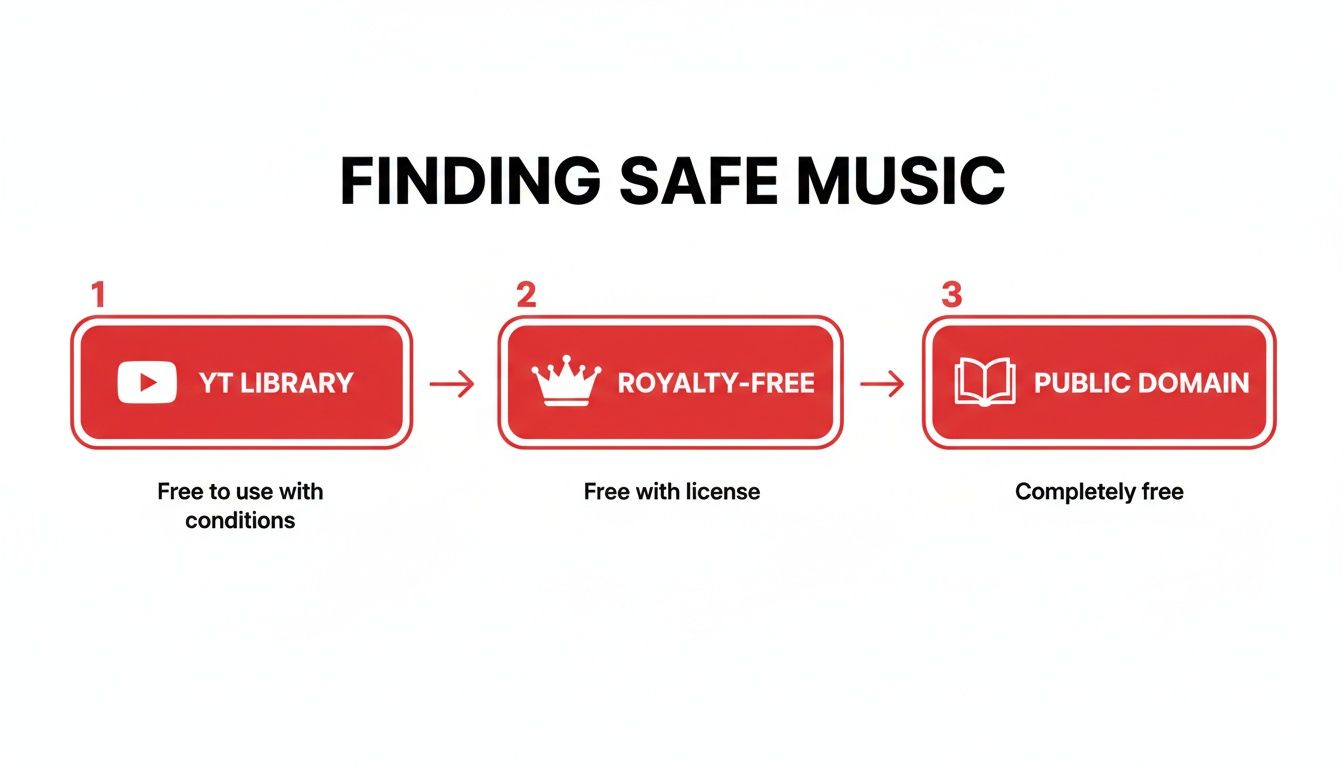
Stick with these three—the YouTube Audio Library, a reputable royalty-free service, or legitimately public domain recordings—and you'll build your content on a rock-solid foundation.
Create Your Pre-Upload Checklist
With your music in hand, it's time to build a habit. Run through this simple checklist for every single video you make. It's the key to a bulletproof copyright strategy that keeps your channel in good standing.
- Read the License Terms Carefully: Never assume "royalty-free" means a free-for-all. Every track comes with a license agreement, and you need to actually read it. Does it require you to credit the artist in your description? Can you use it in a sponsored video? Always verify the terms.
- Use YouTube’s "Checks" Tool: As you upload your video, YouTube gives you a free tool called "Checks." It automatically scans your video for potential copyright issues before you publish. Think of it as your last line of defense. It flags likely Content ID claims so you can fix them before your video goes public.
- Keep Records of Your Licenses: This is so important. When you download a track from a licensing site, save the license agreement or the receipt. Create a dedicated folder for these files. If a claim ever pops up, this paperwork is your proof that you have the rights, which is everything when you file a dispute. For more on how service provider obligations work, you can review our https://monetizedprofiles.com/terms-of-service.
Following these steps turns copyright compliance from a guessing game into a simple, repeatable process. It gives you the confidence to create and upload, knowing you've done your homework to protect your channel.
Know How to Respond to a Claim
Even when you do everything right, a claim can still slip through. Content ID makes mistakes. The key is not to panic. If you get a claim on a video and you know you have a valid license, you have the right to file a dispute right from your YouTube Studio.
When you file, you'll need to explain why the claim is wrong. This is where your organized license folder becomes your best friend. Clearly state that you have a license, attach the proof, and submit it. In most cases where you have the proper documentation, the claim will be released.
Once you've found the right music, the final step is adding it to your content. The process is a bit different for Shorts, so it's a good idea to learn how to add music to YouTube Shorts to stay within the platform's guidelines. By combining a solid pre-upload routine with the knowledge of how to handle the occasional claim, you can manage music copyrights with confidence and get back to what you do best: creating great videos.
Busting the Biggest Myths About YouTube Music Copyright
Even with a good grasp of the rules, there's a ton of bad advice and old myths still floating around the YouTube community. Getting these wrong can be just as bad as not knowing the rules at all.
Let's cut through the noise. Think of this as a rapid-fire myth-busting session where we tackle the most common misunderstandings head-on, so you can pick music for your videos with confidence.
"If I Give Credit to the Artist, I Can Use Their Music, Right?"
This is probably the biggest and most dangerous myth out there. The answer is a hard no.
Putting "Music by [Artist Name]" or "No copyright infringement intended" in your description does absolutely nothing legally. Copyright isn't about being polite; it's about legal permission. Giving credit is a nice gesture, but it’s not a license.
Here's an analogy: you can't just take your neighbor's car for a spin by leaving a note on the windshield saying, "Borrowed by [Your Name]." You need their actual permission—the keys. It's the same with music. Unless the license specifically requires attribution (like some Creative Commons licenses), giving credit won't stop a Content ID claim or a copyright strike.
"What About the 10-Second Rule? Is That Fair Use?"
This is another myth that lands creators in hot water. There is no magic "10-second rule" or "30-second rule" that gives you a free pass for fair use. The length of the clip is just one tiny piece of a much bigger, more complicated legal puzzle.
Fair use is a legal defense, not a right, and it’s judged on four main factors:
- The purpose of your use: Are you critiquing, parodying, or reporting on the music? Or is it just background audio for your travel vlog?
- The nature of the work: Using a clip from a factual news report is viewed differently than using a highly creative piece of art like a song.
- The amount you used: How much of the song did you actually take?
- The effect on the market: Does your video stop people from buying or streaming the original song?
Simply put, using a short snippet of a pop song for background music almost never qualifies as fair use. YouTube's Content ID system is an automated machine that will flag it instantly, making this a terrible gamble for any monetized channel.
"Can I Use Covers or Remixes of Popular Songs Instead?"
You'd think a cover or a remix would be a clever workaround, but it’s often even more complicated than using the original. That's because every song actually has two separate copyrights.
One copyright is for the musical composition (the notes and lyrics written down). A second copyright is for the sound recording (the specific version you actually hear).
When someone makes a cover, they need a license from the original songwriter. If you want to use that cover, you'd need permission from the person who recorded the cover and the original songwriter's publisher. Remixes are even messier since they use pieces of the original recording. Unless you get a green light from every single person with a stake in that track, you're still infringing on copyright.
"What's the Deal with YouTube's Ad-Supported Music List?"
YouTube has a Music Policies library that shows you what will happen if you use a certain song. You might see a track listed as eligible for revenue sharing, which sounds promising. But hold on—it usually means the copyright owner will take a cut of your ad revenue. And that cut is often 100%.
On the plus side, this avoids a strike and keeps your video up, which is better than having it blocked worldwide. But it also means you won’t make a dime from that video. It can be a decent option for a passion project where money isn't the goal, but it's not a sustainable way to run a YouTube business. Always check the policy before you hit publish.
At MonetizedProfiles, we know that a clean copyright record is essential for a channel's long-term value and earning potential. Secure your success from day one by exploring our fully approved and monetized social media accounts. Visit https://monetizedprofiles.com to find the perfect foundation for your content creation business.


