


So, you're at a crossroads: should you buy a TikTok account or start one from the ground up? This is a huge decision, and honestly, there’s no single right answer. Buying can feel like a cheat code to immediate reach, but it's a risky play. Building it yourself is the "safer" route, but it demands a serious commitment of time and creativity.
Should You Buy a TikTok Account or Start Fresh?
It’s easy to see the appeal of buying. Why spend months grinding away for your first 10,000 followers when you could just log into an account that already has them? For a brand with a new product or an influencer trying to branch out, getting that instant audience can feel like winning the lottery. You get to skip straight past the difficult early days.
But let's be real—this path is full of potential traps. With TikTok's audience now hovering around 1.8 billion monthly active users, established accounts have become hot commodities. The problem? TikTok's terms of service explicitly forbid selling or transferring accounts. That means any purchase you make comes with the built-in risk of getting the account shut down.
The Case for Buying an Account
The biggest, most obvious reason to buy is speed. You're not just getting followers; you're getting a pre-built community. This is a massive advantage in a few key situations:
- Quick Market Entry: Imagine a new sustainable fashion brand. Instead of starting from zero, they could buy an account already popular within the eco-conscious community and start connecting with the right people on day one.
- Time-Sensitive Promotions: Got a product launching next month? You don't have the luxury of spending a year building a following. An existing account gives you an immediate platform.
- Faceless Creators: For anyone looking to run a monetized channel without being on camera, buying a ready-made account is a fantastic shortcut. You can focus purely on the content and strategy.
You also inherit an audience that is already engaged and trusts the account's content. That built-in credibility can fast-track everything from brand deals to affiliate sales, putting you way ahead of someone starting with zero.
Key Takeaway: When you buy an account, you're not just buying a number. You're buying a history of engagement, a foundation of trust, and the algorithmic momentum that the original creator already built.
The Argument for Starting Fresh
On the other hand, there's a lot to be said for building an account organically. You have total control and your authenticity is never in question. Every single follower you earn chose to follow you and your unique content. That connection almost always leads to a stronger, more loyal community in the long run.
Starting from scratch also forces you to learn the platform inside and out. You'll figure out what works (and what doesn't) for your specific audience through experimentation. That hands-on experience is priceless and gives you the insights you need to become a successful TikTok influencer on your own terms.
Plus, the organic route is by far the safest. You completely eliminate the risk of getting banned for breaking the rules. You also don't have to worry about getting scammed with an account full of bots or fake engagement. It might take longer, but the foundation you lay is solid and 100% yours.
Buying vs. Building A TikTok Account Quick Comparison
To help you visualize the trade-offs, here’s a quick breakdown of the two paths.
| Factor | Buying an Account | Building an Account |
|---|---|---|
| Speed | Instant audience and reach | Slow, gradual growth over months or years |
| Cost | Significant upfront financial investment | "Sweat equity"—requires time and creative effort |
| Risk | High risk of scams and account suspension | Low risk; you own and control everything |
| Authenticity | Can be difficult to transition and maintain | 100% authentic connection with your audience |
| Learning Curve | Skip the initial grind, but miss key insights | Steep learning curve, but invaluable experience |
| Engagement | Inherited, but may decline with new owner | Organically grown and often more loyal |
Ultimately, whether you buy or build depends entirely on your goals, your budget, and how much risk you're willing to take.
How to Vet a TikTok Account Like a Pro
Alright, you've found a TikTok account that looks promising. Now comes the most critical part of the entire process: the deep dive. This is where you put on your detective hat and verify that what you're buying is the real deal.
A seller can say anything, but the data doesn't lie. Rushing this stage is the number one mistake people make, and it's how you end up with an account full of bots and dead weight.
First rule of vetting? Never, ever trust static screenshots of analytics. They are laughably easy to fake.
My Golden Rule: Always get the seller on a live, recorded video call. Have them share their screen and walk you through every corner of the analytics dashboard. If they hesitate or refuse, walk away. No exceptions. It's the biggest red flag there is.
This live session isn't just about glancing at the follower count. It’s about understanding the account's true health and spotting the difference between a real, thriving community and an artificially inflated one.
Digging into the Audience and Engagement
An account's value is in its community, period. A massive follower number is worthless if those followers are fake or haven't engaged in months. Your job is to make sure the audience is real, active, and right for your plans.
Start with the follower growth chart. You want to see a steady, natural climb over the last 60 to 90 days. Little bumps corresponding to viral videos are great. What you don't want to see are massive, vertical spikes that appeared out of nowhere—that screams "I bought bots."
Next, look at the core engagement numbers. The follower-to-like ratio is a quick, back-of-the-napkin test. An account with 100,000 followers that only gets a few hundred likes per video has a serious problem. It’s a ghost town.
Here’s my personal checklist for the live analytics review:
- Video Views: How consistent are they? Do older videos still pull in views, or do they flatline after 24 hours?
- Likes and Comments: What’s the ratio of likes to views? More importantly, what kind of comments are people leaving?
- Shares and Saves: These are gold. People only share and save content they genuinely find useful or entertaining. High numbers here are a fantastic sign.
Take a few minutes to actually read the comments on recent posts. Are they generic junk like "nice vid" and "cool"? Or are they real conversations and reactions to the video's content? A wall of generic comments is a tell-tale sign of bot activity. For a deeper understanding of what great interaction looks like, check out our guide on the ideal TikTok engagement rate.
Checking Demographics and Account Health
Beyond pure numbers, you have to confirm the audience is actually the one you want to reach. During the screen share, have the seller click into the "Followers" tab in their analytics. This is where you find out who you're really buying.
Look closely at the gender breakdown and the top territories (countries). If you plan to launch a makeup brand for women in the US, an account with an 80% male audience based in Brazil is completely wrong for you, no matter how cheap it is.
Finally, check for any skeletons in the closet. Ask the seller to show you their Account Status page. This is where TikTok lists any content violations or strikes. A history of violations is a major red flag because it can lead to a "shadowban," where the algorithm quietly tanks your reach, making it almost impossible to grow.
How to Value a TikTok Account for a Fair Price
Figuring out what a TikTok account is really worth is more of an art than a science, but it’s a crucial step before you even think about making an offer. Too many buyers get fixated on the follower count alone, but honestly, that number can be incredibly misleading.
A huge follower list means nothing if the audience is full of bots, located in the wrong country, or just plain disengaged. The real value is buried in the quality of the engagement and how profitable the niche is.
Let's put it this way: a highly engaged account with 50,000 followers in the personal finance space could easily be worth ten times more than a generic meme page with 200,000 followers. The finance audience has clear commercial intent, making it a goldmine for affiliate products, courses, or brand deals. The meme page? Much harder to monetize effectively.
Look Past the Follower Count: The Real Value Metrics
To get a realistic price, you need to dig into a combination of factors that paint the full picture of an account's health and potential. Don't just take the seller's asking price at face value; your valuation needs to be based on cold, hard data.
Here are the core metrics that truly determine what an account is worth:
- Engagement Rate: This is your number one indicator of a healthy, active community. I calculate this by taking the last 10-15 videos, adding up all the likes, comments, and shares, dividing that by the total views, and then multiplying by 100. A consistent rate of 4% or higher is what you’re looking for.
- Audience Quality: We've touched on this, but it’s critical. An account where 80% of the audience is in your target market (like the US or UK) is instantly more valuable than one with a scattered global following.
- Niche Profitability: Let's be real, some niches just make more money. Tech, finance, beauty, and health are proven winners. Entertainment or comedy niches can be fun, but connecting them to direct sales is often a much bigger challenge.
You have to stay objective here. It’s easy to get swept up in the excitement of a big account, but if the numbers don't add up, the price tag shouldn't either.
Pro Tip: Always ask the seller for proof of past earnings. This could be screenshots of Creator Fund payouts, affiliate dashboards, or invoices from brand deals. This is the ultimate proof that an account can actually make money.
Benchmarking and Common Pricing Models
Once you've gathered the data, you can start putting a dollar figure on it. While there’s no official rulebook, the market has established some general benchmarks that can guide you.
The market for buying and selling TikTok accounts has been exploding, growing by over 30% annually since 2022. From what I’ve seen, an account with around 50,000 followers and decent engagement usually lands somewhere between $300–$600. For accounts that break the 100,000 follower mark and have high engagement (over 5%), prices can quickly jump to $1,000–$3,000 or even more, especially in a hot niche. This analysis of digital advertising stats gives some good background on these trends.
A common starting point for valuation is a simple Cost Per Mille (CPM) model, where you assign a value for every 1,000 followers.
- Low-Tier Accounts: (General entertainment, low engagement) might go for $5-$10 per 1,000 followers.
- Mid-Tier Accounts: (Specific niche, good engagement) are often in the $10-$20 per 1,000 followers range.
- High-Tier Accounts: (Profitable niche, stellar engagement, proven income) can command $20-$50+ per 1,000 followers.
So, using that model, a strong finance account with 50,000 followers might be fairly valued at $1,000 (50 x $20), while a meme account of the same size could be worth just $250 (50 x $5). See the difference?
Negotiation Tips for Getting a Fair Deal
Armed with your valuation, it's time to talk numbers. A word of advice: never, ever accept the first price a seller throws at you. They almost always start high, fully expecting you to negotiate them down.
Kick off the conversation by presenting your data-backed valuation. Walk them through the numbers—the engagement rate, the audience demographics, the niche potential—and explain why you arrived at your offer. This shows you’re a serious buyer who has done their homework, not just someone trying to lowball them.
Be firm but fair. If the seller won't budge on a price that feels way off, be prepared to walk away. There are always other accounts out there. Overpaying is the fastest way to kill your ROI before you even get started.
You've done the hard work. You've vetted the account, dug into the analytics, and settled on a price that feels right. Now for the moment of truth: the actual transaction and transfer.
This is where things can get dicey. It’s the final step, and it's where your investment is most at risk. Getting this part right isn't just important; it's everything.
Securing the Transaction: Escrow is Non-Negotiable
Let’s be blunt: never, ever send money directly to a seller you met online. The second you do, you’ve lost all your power. If they ghost you, your money is gone. The only sane way to handle this is with a reputable third-party escrow service.
Think of an escrow service as a neutral referee. You put the money in their hands, and they hold it safely. Only when you've confirmed that you have full, undisputed control of the TikTok account do they release the funds to the seller. It protects you, and it protects them. Some marketplaces, like the Branditok platform, even build these services right into their process.
This entire process, from valuation to the final purchase, is a funnel. You're narrowing down from potential to proven value.
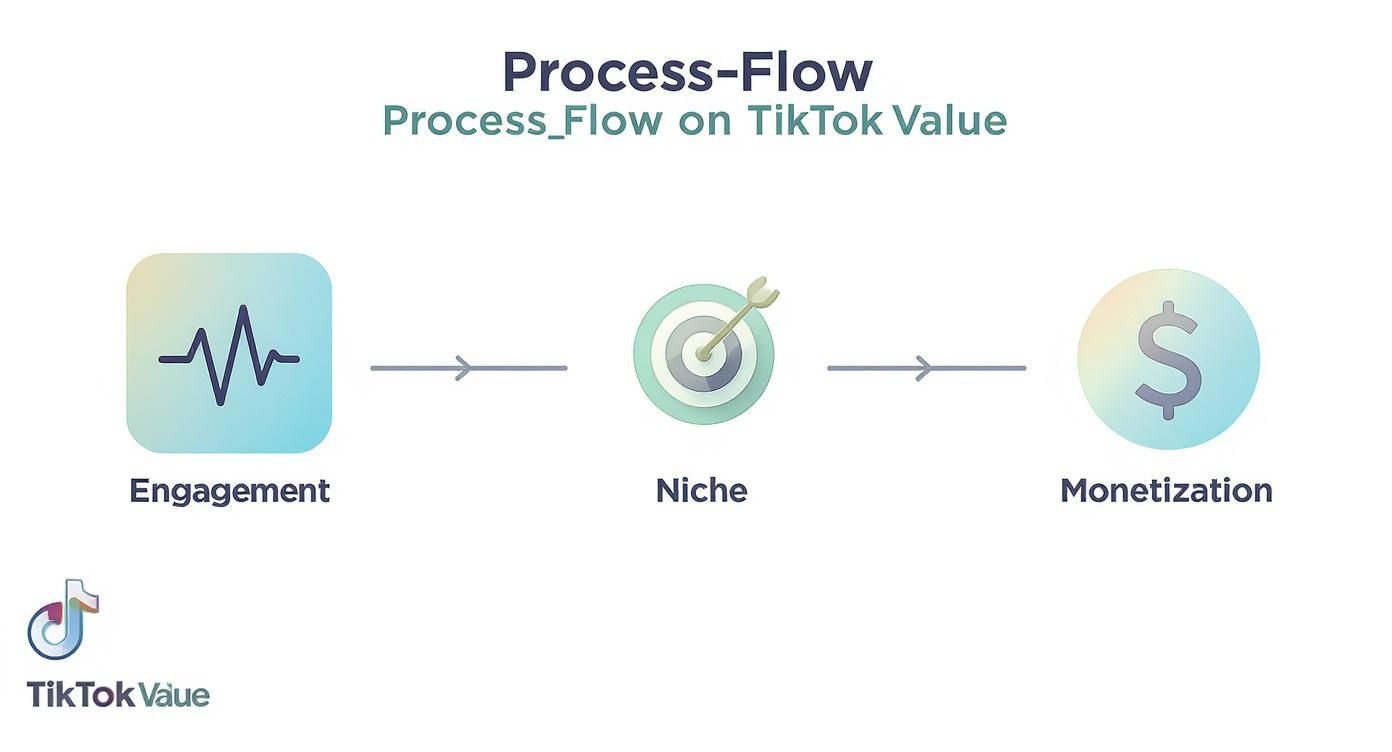
As you can see, a secure transaction is the capstone on a foundation of solid due diligence. It's the final lock on the door.
The Transfer: Your Immediate Action Checklist
Once the escrow is funded, the seller will hand over the keys—the account login details. This next part is a race against the clock. Before you even think about telling the escrow service to release the payment, you need to lock that account down so tightly that only you can get in.
It's exactly like buying a house. You get the keys, and the first thing you do is call a locksmith. You have no idea who else has a copy.
The moment you log in, follow these steps without delay:
- Change the Password: This one's a no-brainer. Make it strong and something you’ve never used before.
- Swap the Email Address: This is the most critical step. Change the associated email to one that you, and only you, control. This is the primary recovery method.
- Update the Phone Number: Get the seller's number out of there and put yours in.
- Disconnect All Linked Accounts: Sever any ties to the seller’s Facebook, Google, or other social profiles they might have used to log in.
Do not give the green light to the escrow service until every single one of these items is checked off. Once you've done this, the seller has been paid, and they have absolutely no way to reclaim the account. The mechanics are pretty similar on other platforms, too. We cover this in more detail in our guide on how to safely transfer ownership of a YouTube channel.
Putting it in Writing: The Simple Sale Agreement
While escrow protects the money, a simple sale agreement protects the deal itself. This doesn't need to be a 30-page document drafted by a lawyer. A basic, clear agreement gives both you and the seller a formal record of the terms.
Key Insight: A written agreement, even a simple one, turns a handshake deal into a documented transaction. It should clearly state the account handle, the final price, and confirm that the seller is transferring full ownership and access rights to you.
Make sure your agreement covers these bases:
- The Asset: The exact TikTok username (@handle).
- The Price: The final, agreed-upon purchase amount.
- The Transfer: A clear statement that the seller gives up all rights and access to the account once the sale is complete.
- The Guarantee: A line where the seller confirms the analytics provided were accurate and that the account is free of any violations.
Just having this documented in an email exchange that both parties reply "I agree" to can add a serious layer of professionalism and security. It ensures no one can claim "that's not what we agreed to" later on. This is what separates a savvy buyer from someone just rolling the dice.
Your First 30 Days After Taking Over
https://www.youtube.com/embed/xu7_gj-ZG_I
Alright, the deal is done. You’ve got the login, the account is yours, and you're ready to go. But hold on—this is where the real work starts, and your first 30 days are absolutely critical.
A clumsy takeover can send followers heading for the exits and kill the very momentum you just paid for. The goal isn't to tear everything down and start fresh. Think of it as a smooth, gradual handover where you respect the community the last owner built while slowly steering the ship in your direction.
Before you even think about posting, your first job is to listen. Dive into the account's history. What were the top-performing videos over the last 90 days? Pinpoint what they have in common. Is it a specific sound? A certain editing style? A recurring joke?
This analysis is your new roadmap. It’s the instruction manual that tells you exactly what this audience loves. Ignoring it is the fastest way to fail.
Phase 1: The First Week of Transition
Your first week is all about blending in. The absolute worst thing you can do is post something that feels completely out of place and alienates the audience on day one. Your first few videos should feel like they could have been posted by the original owner.
For instance, if you bought a popular cat account known for short, funny clips of a cat named Mittens doing silly things, your first post shouldn't be a polished, cinematic video about your own pet. Stick to the script.
Here's a simple game plan for your first seven days:
- Keep the Rhythm: If the account posted daily at 5 PM, you post daily at 5 PM. Don't break the established routine.
- Mirror What Works: Find the account’s biggest hits and create new content in that exact same format. Same style, same vibe, just a fresh take.
- Get in the Trenches (Comments): Spend real time replying to comments on new and old videos. Just be a positive, engaged part of the community.
- No Selling: Don't even think about dropping an affiliate link or promoting a product. Your only job right now is to build trust.
The single biggest mistake new owners make is trying to change too much, too fast. Your first week is for observation and gentle integration, not a radical rebranding. This builds a foundation for long-term success.
Once you’ve settled in, it's time to focus on building a sustainable TikTok presence that actually converts that hard-earned audience. This initial period truly sets the stage for everything that follows.
Phase 2: Introducing Your Brand Voice
After a week of keeping things steady, you can start to slowly introduce your own flavor. This isn’t a hard pivot; it’s more like a gradual lane change. The goal is to weave your unique style into the elements the audience already knows and loves.
A good rule of thumb is the 80/20 split. 80% of what you post should still feel familiar and comfortable to the existing followers. The other 20% is your space to experiment with new ideas, show a bit of your personality, or introduce your brand. This is especially crucial for faceless creators, where the content is the entire brand identity.
Here's how to do it without rocking the boat:
- Start a New Series: Kick off a weekly content theme that points toward your long-term vision. If you bought a personal finance account, you could launch a "Money Myth Monday" segment.
- Test New Formats: Did the old owner only post 15-second clips? Try a slightly longer, 60-second deep dive. Watch the analytics like a hawk to see how the audience responds.
- Gently Tweak the Bio: Make small updates to the bio to start reflecting the account's new direction. Maybe add a link to your website, but hold off on a complete rewrite for now.
Pay close attention to your analytics during this phase. If a new video format tanks, don't freak out. But if you see a consistent dip in engagement whenever you try something new, it's a clear signal that you're straying too far from what the audience wants. The data will always tell you the truth.
Got Questions About Buying a TikTok Account?
If you're thinking about buying a TikTok account, you've probably got a ton of questions floating around. That’s a good thing. Asking the right questions upfront is what separates a smart investment from a major headache.
Let's cut through the noise and get straight to the answers you actually need.
Is This Even Allowed?
Let's be direct: no. According to TikTok's Terms of Service, you're not supposed to "buy, sell, or rent any account." This is the biggest risk you take on. If TikTok figures out an account was sold, they can shut it down.
But here's the reality—these deals happen all the time. The trick is making the handover look completely natural. A successful transfer is a quiet one. That means changing the login info, of course, but also avoiding any jarring shifts in content that might trigger a review.
The Bottom Line: Buying an account is against the rules, and there's a real risk involved. But you can minimize that risk by making the ownership change as smooth and discreet as possible, so it flies under the radar.
How Do I Know if the Account Can Actually Make Money?
This is a critical step. You need to confirm the account is eligible for what TikTok now calls the Creator Rewards Program. An account that can't be monetized is worth a whole lot less.
Don't just take the seller's word for it, and definitely don't accept a screenshot. You need to see this live. Get them on a video call and have them share their screen.
Here’s what you're looking to verify:
- Followers: At least 10,000 followers.
- Views: A minimum of 100,000 video views within the last 30 days.
- Age: The original creator has to be 18 or older.
- Location: The account must be registered in an eligible country (like the US, UK, Germany, France, Spain, or Italy).
On the live call, ask the seller to go to Creator Tools and then tap on Creator Rewards Program. If you see an active dashboard with earnings, you're in the clear. If it shows they aren't eligible, you need to find out why before you even think about making an offer.
What if They Can't Change the Original Email?
Walk away. Seriously. This is the biggest red flag you can possibly encounter.
The original email (often called the "OG email") is the master key to the kingdom. If a seller says they can't change it because they lost access or it’s tied to their personal life, the deal is off.
Why? Because if they keep control of that email, they can reclaim the account whenever they want. All it takes is a simple "forgot password" request, and you're locked out with no way to get back in.
Here’s how a secure transfer should work:
- The Right Way: The seller should create a brand-new, dedicated email address. They then link that new email to the TikTok account and hand over the credentials for both the TikTok account and the new email.
- The Wrong Way: The seller makes excuses and says they can't transfer the original email.
Any legitimate seller will understand why this is non-negotiable. If they push back, they are either inexperienced or trying to scam you. Don't risk it.
Ready to skip the grind and start earning from day one? At MonetizedProfiles, we offer fully vetted, monetization-approved TikTok accounts, perfect for faceless creators and brands looking for an immediate audience. Check out our available accounts and jumpstart your social media journey.


