


Want a fast track to making money on YouTube? The quickest way is to buy a channel that's already monetized. This lets you skip the grueling startup phase and get straight to earning. For anyone searching for the best site to buy youtube channel, marketplaces like MonetizedProfiles are a solid bet, focusing on organically grown accounts ready for immediate revenue. Think of it as a strategic investment, not just a shortcut.
Why Smart Creators Buy Monetized YouTube Channels
Let's be honest, the road to YouTube monetization is a long haul for most creators. You have to hit YouTube's strict Partner Program goals: 1,000 subscribers and 4,000 watch hours in a 12-month window. That initial grind can take months—sometimes years—of pumping out content with zero income to show for it.
Buying a pre-monetized channel completely changes the game. Instead of pouring time and effort into hitting those benchmarks, you can jump right into creating great content that makes money from day one. This is a massive advantage for anyone running YouTube automation or faceless channels, where the channel is treated like a business asset.

Skip the Grind and Start Earning
The biggest win here is speed. You get to bypass the toughest part of a new channel's journey—that initial fight for eyeballs and subscribers. It frees you up to test content ideas, adjust your strategy, and grow your operation without the weight of a zero-subscriber count and no watch time.
Think about what it usually takes. Creators often find themselves posting videos multiple times a week for a year or more, just hoping the algorithm notices them. It’s a huge challenge, and it’s easy to lose steam. The numbers don't lie: out of billions of videos uploaded, only a little over 5 million channels have actually managed to monetize. It's a pretty exclusive club. You can find more stats on the YouTube ecosystem over at SQ Magazine.
A Strategic Business Decision
When you look at it as a business move, the logic is clear. You're buying an asset that's already primed to generate income. The benefits are straightforward:
- Immediate Revenue Potential: Start earning from ads, memberships, and Super Chat right away.
- Established Credibility: A channel with subscribers already on board looks more trustworthy to new viewers.
- Focus on Content: Put all your energy into making awesome videos instead of chasing metrics.
- Faster Scaling: You can reinvest your earnings to grow the channel even faster.
When you buy a monetized channel, you're really buying time. You get to skip the line and start running your business, turning a long shot into a clear path to profit.
Where to Buy a Monetized YouTube Channel: A Marketplace Comparison
Trying to find the right place to buy a YouTube channel can feel like navigating a minefield. Lots of platforms claim to be the best, but the truth is, the best site to buy a YouTube channel really boils down to what you need—security, channel quality, and support after you buy. Not all marketplaces are built the same. Some are like a wild west auction house, while others, like MonetizedProfiles, are more like a specialty shop, focusing only on high-quality, pre-vetted channels.
To make a smart decision, you have to look past the flashy subscriber counts. It’s about understanding where the channel came from, how secure your payment will be, and what happens after the keys are handed over.
Curated Suppliers vs. Open Marketplaces: What’s the Difference?
The first thing to get straight is the difference between a specialized supplier and a general, open marketplace. Think of a general marketplace as a massive digital flea market. Anyone can show up and list a channel for sale. This gives you tons of options, but the quality is all over the place. You'll find genuine gems right next to channels pumped up with bots and fake views.
A curated supplier, like MonetizedProfiles, is a completely different beast. They are the direct source of every channel they sell, and each one is grown organically to meet strict quality standards. This model takes the guesswork out of the equation because you aren't dealing with a random stranger—the platform itself stands behind the quality of its inventory.
It all comes down to risk. With an open marketplace, the burden of sniffing out fakes and scams is entirely on you. A curated supplier has already done that heavy lifting, offering a clean, verified channel for serious creators who can’t afford to roll the dice.
Marketplace Comparison for Buying YouTube Channels
Here's a side-by-side evaluation of top platforms based on key factors for a safe and successful purchase. Let's see how these different models really stack up when you compare them on what matters most. We'll look at a curated supplier (MonetizedProfiles) versus two common alternatives you'll find: a big, open marketplace (Marketplace A) and a smaller, forum-based community (Marketplace B).
| Feature | MonetizedProfiles | Marketplace A (General) | Marketplace B (Forum-Based) |
|---|---|---|---|
| Channel Origin | In-house, organically grown to meet monetization standards. | Varies by seller; can be organic, botted, or hacked. | Peer-to-peer sales; quality is entirely seller-dependent. |
| Verification Process | All channels are pre-vetted for authenticity and compliance. | Minimal to no vetting by the platform; buyer must verify. | No official verification; relies on community reputation. |
| Security & Escrow | Secure, in-house payment processing with a clear transfer protocol. | Often uses a third-party escrow, which can add fees and delays. | Risky; direct payments are common, with high scam potential. |
| Customer Support | Dedicated support team for purchase and transfer assistance. | Limited to transaction disputes; no channel-specific help. | No formal support; disputes handled between users. |
| Pricing Structure | Transparent, fixed pricing based on channel quality and niche. | Seller-defined pricing; can be inconsistent and inflated. | Highly variable; often requires negotiation. |
| Best For | Creators needing a reliable, safe, and fast path to monetization. | Experienced buyers who can perform deep due diligence. | Hobbyists or those willing to accept significant risk. |
As you can see, there's a clear trade-off. A general marketplace might tempt you with a huge selection, but that variety comes with the very real risk of buying a dud or getting scammed. You can learn more about how to spot legitimate opportunities in our guide on top account selling sites.
Situational Recommendations: Who Should Choose What?
So, which path is right for you? It really depends on your budget, your stomach for risk, and how much experience you have.
Choose a curated supplier like MonetizedProfiles if:
- Safety is your #1 concern. You need a guarantee that the channel is clean, organically grown, and has no strikes.
- You're running a business. Your goal is to get to work and start earning right away, not spend weeks investigating a seller.
- You want someone in your corner. Having a dedicated support team to walk you through the transfer process is important to you.
Consider a general marketplace (Marketplace A) if:
- You know your way around channel analytics. You're confident you can spot fake subscribers and doctored watch hours from a mile away.
- You're hunting for a very specific niche channel that might not pop up in curated inventories.
- You're okay with a long, drawn-out process. You have the time and patience to vet multiple sellers and channels.
A forum-based marketplace (Marketplace B) might be an option if:
- You have an extremely tight budget. The prices can be lower, but the chance of losing your money is much, much higher.
- You are buying from a legendary community member with a long, proven track record of legitimate sales.
In the end, choosing the best site is about matching the platform’s model to your personal goals. For any creator treating this purchase as a serious business investment, the security and quality assurance from a specialized supplier offer real value and crucial peace of mind.
Your Pre-Purchase Channel Verification Checklist
Buying a monetized YouTube channel without doing your homework is a massive gamble. Think of it like buying a used car without ever popping the hood—you might drive off the lot with a gem, or you could end up with a clunker that costs you a fortune. Having a solid, repeatable verification process is the single most important thing you can do to protect your investment.
This checklist is your game plan for telling the difference between a healthy, authentic channel and one that's been artificially inflated with fake engagement.
The infographic below really nails the three things you need to balance when looking at any marketplace or individual channel: quality, security, and price.
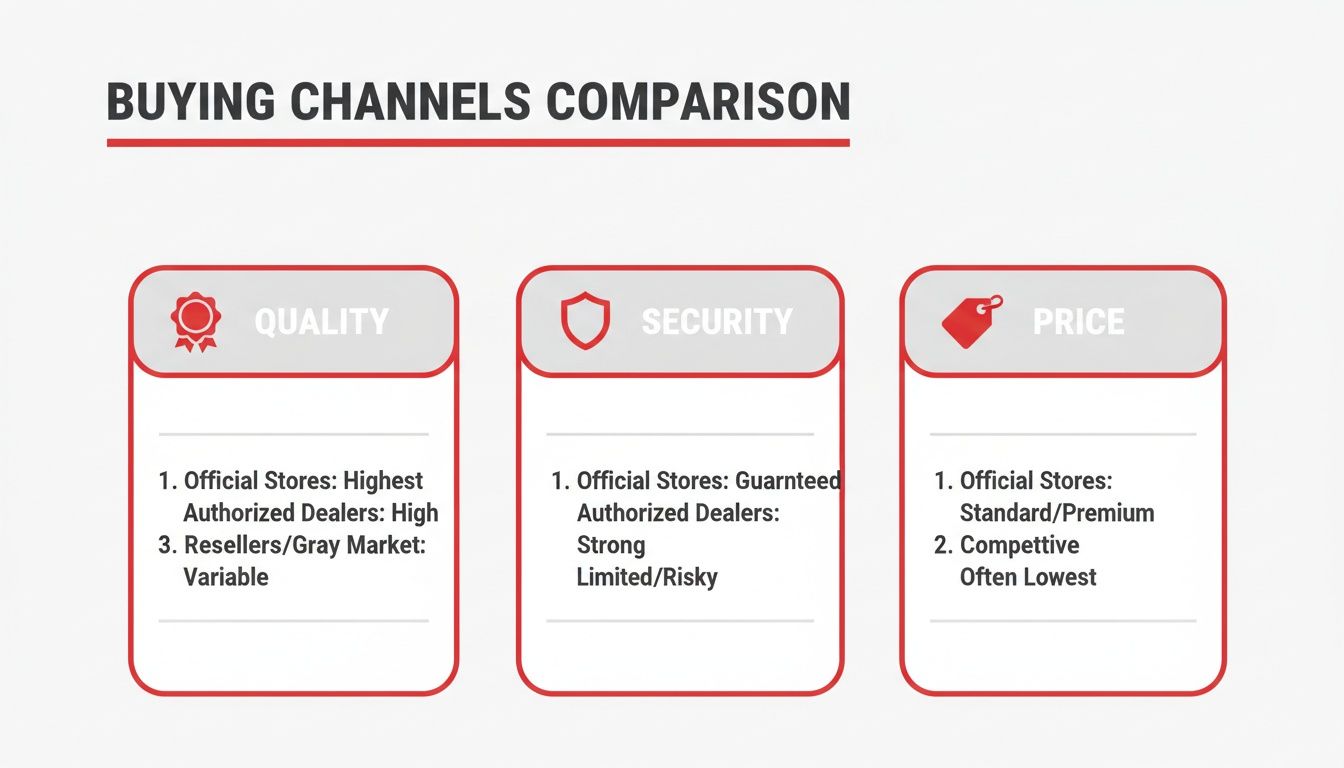
As you can see, it’s all about finding that sweet spot. A rock-bottom price is almost always a warning sign that you're sacrificing quality and security, which are the two things you absolutely can't compromise on if you want a long-term asset.
Step 1: Analyze Subscriber and View Velocity
Your first port of call should always be the channel's analytics, specifically the subscriber growth and view history. Any legitimate seller should have no problem granting you temporary, view-only access to their YouTube Studio. If they balk at this request, that’s a huge red flag.
What you're looking for is a steady, organic growth curve over the last several months. Watch out for sudden, massive spikes in subscribers or views that don’t line up with a specific video going viral—these are classic signs of bot activity. For instance, a channel that suddenly gains 50,000 subscribers in one day with no new content is almost certainly not legit.
A healthy channel's growth looks like rolling hills, not a single, sharp mountain peak. Consistency is the hallmark of genuine audience interest and a signal of a stable asset.
Make sure you check the lifetime analytics, too. Does the channel's history make sense? A channel that sat dormant for years and then magically blew up right before being put up for sale needs a much closer look.
Step 2: Scrutinize Audience Demographics and Engagement
Beyond the raw numbers, you need to know who is actually watching. This is where you dive deep into the audience demographics tab in YouTube Studio.
- Geographic Location: Do the top countries match your target audience? If you're planning to create English content, a channel with 80% of its audience from a non-English-speaking region won't do you much good.
- Age and Gender: Make sure the viewer profile fits the niche you want to operate in. You can’t exactly pivot a gaming channel with a mostly teenage male audience into a successful finance brand.
- Traffic Sources: A healthy channel has a good mix of traffic sources. If a channel is getting almost all its views from "Suggested Videos" off a single viral hit, it's in a precarious position. You want to see a blend of search, browse features, and suggested traffic.
Next, get in there and actually read the comments on recent videos. Are they all generic fluff like "nice video" or "good job"? Those are tell-tale signs of comment bots. Real engagement looks like specific questions, opinions, and actual conversations about the video's content. A channel’s true value is its community. For a deeper dive, our guide on how to https://monetizedprofiles.com/blog/check-youtube-channels-earnings can show you how to evaluate a channel's financial health.
Step 3: Verify Monetization and Compliance Status
Finally, you have to confirm the channel is in good standing with YouTube. This is absolutely non-negotiable. The last thing you want is to buy a channel that's already on thin ice.
Ask the seller for screenshots or, even better, a live screen-share of the "Earn" tab in YouTube Studio. This page will tell you flat-out if the channel is an active member of the YouTube Partner Program. You also need to check the "Channel" -> "Feature eligibility" section for any active Community Guideline or copyright strikes.
- One copyright strike can temporarily disable key features like uploading.
- Three strikes and the channel can get terminated permanently.
A clean bill of health is essential. If you’re dealing with a high-value channel and have serious concerns about video authenticity, you might even consider using specialized forensic video analysis software to spot sophisticated manipulations. Following these steps gives you the confidence to know you've thoroughly vetted your potential investment before putting any money down.
How the Channel Ownership Transfer Works
So, you've done your homework, picked out a channel, and are ready to seal the deal. The last piece of the puzzle is getting the keys to your new digital kingdom—the ownership transfer. This might sound intimidating, but it’s actually a well-defined process built right into YouTube’s system for what they call Brand Accounts.
Everything revolves around this Brand Account structure. A personal YouTube channel is locked to a single Google account, making it a nightmare to transfer. A Brand Account, however, is designed to have multiple managers and owners, which is exactly what makes a clean, secure sale possible. This is the only legitimate way to do it.
The Initial Invitation and Roles
The whole thing kicks off when the seller invites your Google account to manage the channel’s Brand Account. It’s really important to know the difference between the two main roles here:
- Primary Owner: This is the top dog. They have ultimate control—they can add or remove anyone, including other owners, and are the only person who can delete the channel.
- Owner: An Owner has almost all the same powers. They can upload videos, tweak channel settings, and see all the analytics. The key difference? They can't remove the Primary Owner or nuke the channel.
The seller will first invite you to become an Owner. As soon as you accept the invite from your email, you’ll have access to get in there and start managing the channel.
Navigating the 7-Day Security Period
Here's where you need a little patience. Once you're added as an Owner, YouTube enforces a mandatory 7-day waiting period before your status can be upgraded to Primary Owner. This isn't something the seller controls; it's a built-in security feature from YouTube to stop accounts from being hijacked.
Think of this week as a final inspection period. You can poke around the channel's backend, double-check everything, and get your content strategy ready. Just don't make any massive changes yet. And there's no way to speed it up. It's also a good time to get comfortable with various YouTube account verification strategies to lock things down later.
Critical Security Step: The moment you become the Primary Owner, do these three things immediately: remove the seller's access, turn on two-factor authentication (2FA), and link your own AdSense account. This is the trifecta that puts the channel officially and exclusively in your hands.
Finalizing the Handover
After that 7-day waiting period is up, it's time for the final step. The seller will log back in and promote you from "Owner" to "Primary Owner," giving you the ultimate control.
Here’s a simple rundown of the final handover:
- Promotion to Primary Owner: The seller makes you the new Primary Owner through the Brand Account settings.
- Remove Previous Owner: Your first job as Primary Owner is to immediately remove the seller's account from the channel. This cuts off their access for good.
- Secure Your Account: Lock it down. Change the Google account password and make absolutely sure 2FA is active.
- Update AdSense: Head over to the "Earn" tab in YouTube Studio and connect your own approved AdSense account. This is how you get paid.
Sticking to this official process is the only way to guarantee a safe transaction. Any reputable marketplace or seller will insist on it. If you want a deeper dive, our guide on the transfer process has all the nitty-gritty details you need. https://monetizedprofiles.com/blog/transfer-ownership-of-youtube-channel
Understanding the Rules and Compliance Issues
When you start looking into buying a YouTube channel, one of the first things you'll bump into is the question of whether it's even allowed. It’s a common gray area. The short answer is: it’s complicated, but yes, it can be done the right way. The entire process hinges on one critical distinction: the difference between a personal account and a Brand Account.
YouTube's Terms of Service are crystal clear on one thing—you can't sell your personal Google account. But they built a perfectly legitimate way to transfer channel ownership through what they call Brand Accounts. These were made for businesses and teams, and using this official process is the only way to buy a channel without breaking the rules.
If a seller ever suggests just giving you their login details, run. That's a huge red flag and a direct violation of YouTube's terms, putting your new channel at risk of being shut down immediately. Every legitimate marketplace and seller will use the official Brand Account transfer method, period.
The Role of Brand Accounts in Compliant Transfers
Think of a Brand Account as a separate entity from your personal Google profile. It can have multiple owners and managers, which is exactly what makes a clean, secure channel sale possible. When you buy a channel, you aren't actually buying someone's Google account; you're being made the new Primary Owner of the channel's Brand Account.
This is a crucial distinction for a few big reasons:
- It keeps you compliant. You're using the exact mechanism YouTube created for this purpose, so the transaction is completely above board.
- It's secure. The official transfer process includes a mandatory 7-day waiting period, which acts as a security buffer to stop hostile takeovers.
- You get full, legitimate control. Once you become the Primary Owner, the seller is out of the picture, and you can manage everything yourself.
It’s a lot like transferring the title of a car. You wouldn't just grab the keys and hope for the best; you'd sign the official paperwork to make the ownership change legal. The Brand Account transfer is that official paperwork for a YouTube channel.
Protecting Your Purchase with a Sales Agreement
While the Brand Account transfer handles the technical side of things, a solid sales agreement takes care of the business side. Even a simple contract formalizes the deal and can save you a world of headaches later. It’s a professional touch that the best marketplaces will help you with.
Your agreement should nail down the key details of the purchase.
- Channel Identity: The specific channel URL and name.
- Sale Price: The final, agreed-upon cost.
- Representations: A clause where the seller confirms the channel is clean—no strikes and grown organically.
- Transfer Timeline: The step-by-step plan, including that 7-day waiting period and when the final handover happens.
A written agreement isn't just for legal cover; it's about making sure everyone is on the same page. It eliminates any chance of a "he said, she said" situation by putting the entire deal in black and white.
At the end of the day, staying compliant means sticking to the established process. By making sure the channel is set up as a Brand Account and getting a clear sales agreement in place, you’re not just following the rules—you’re protecting your investment and setting yourself up for success from day one.
Common Questions About Buying YouTube Channels
Even when you've done your homework, buying a YouTube channel is a big move. It’s totally normal to have a few last-minute questions before you pull the trigger. Let's walk through the most common things people ask, so you can feel confident you're making the right call.
Think of this as your final gut check. We'll cover safety, how much you should really be paying, and what to do with the channel once it's yours.
Is It Actually Safe to Buy a Monetized YouTube Channel?
Yes, it absolutely can be, but only if you do it the right way. The safety of the whole deal comes down to where you buy it from. Finding the best site to buy a YouTube channel isn't about the cheapest price; it's about finding a marketplace that actually vets its channels and protects your money.
The real danger lies with random sellers on forums or unverified sites. You could end up with a channel built on bots, riddled with hidden community strikes, or the seller could just vanish the second they get your payment. A good marketplace acts as your shield, making sure every channel is grown organically and plays by YouTube's rules.
The gold standard for a safe purchase is using YouTube's official Brand Account transfer process. It has a mandatory 7-day security waiting period built right in. That delay is there for a reason—it stops fraudulent takeovers and makes sure the handover is legit.
How Much Should I Expect to Pay for a Monetized Channel?
This is the "how long is a piece of string?" question. Prices are all over the map because they're tied directly to the channel's performance. A channel that just barely scraped past the 1,000 subscriber and 4,000 watch hour mark is going to be on the cheaper end, often starting around a few hundred bucks.
But for more established channels, the price tag goes up. The things that really move the needle on cost are:
- Subscriber Count: More subs usually mean a higher price, especially if they're real, active people.
- Niche & CPM: A finance or tech channel has a much higher earning potential (CPM) than a prank channel, so it's going to cost more.
- Monthly Revenue: If the channel is already making consistent money, you're buying a proven asset, and the price will reflect that.
- Audience Engagement: Lots of comments, likes, and long watch times show a healthy community, which adds a ton of value.
For a channel in the 10,000 to 100,000 subscriber range, you could be looking at anything from $1,000 to over $10,000. The niche and performance history will make all the difference.
What Do I Do with the Old Videos After I Buy the Channel?
Once the channel is yours, you call the shots on all the old content. What you do next should be driven entirely by your game plan for the channel. You've really got three choices: keep them, private them, or delete them.
If the old videos fit the niche you're planning to stay in, keeping them is a no-brainer. They'll keep pulling in views and tell the YouTube algorithm that your channel is an authority on that topic.
On the other hand, a lot of people—especially those doing YouTube automation—want a completely blank canvas. The best move here is usually to set the old videos to "Private." This hides them from the public but keeps any algorithmic authority they've built up. Deleting them is permanent and should really only be a last resort, like if the content is way off-brand or could cause problems.
How Can I Avoid Getting Scammed?
This one's simple: never, ever buy directly from a seller you meet on a forum or social media. Always go through a trusted marketplace that offers a secure and transparent process. The single most important feature to look for is an escrow service. It holds your money safely until you confirm that you have full ownership of the channel.
And always do your own digging. A legit seller will have no problem giving you temporary, view-only access to the channel's analytics. Use this to check for red flags like sudden subscriber spikes, generic bot comments, or any existing copyright strikes.
Finally, just trust your gut. If a deal looks too good to be true, like a channel with 50,000 subscribers selling for a couple of hundred dollars, it is. Stick with platforms that have a solid reputation for quality and security.
Ready to skip the grind and start earning immediately? MonetizedProfiles is the largest and most trusted supplier of organically grown, pre-monetized YouTube channels. Find your perfect channel and launch your creator business today at https://monetizedprofiles.com.


