


So, you've heard about affiliate marketing on TikTok. It’s a bit of a powerhouse, letting creators earn a commission just by promoting products they love in their videos. The whole system works by blending authentic content with special trackable links, which you usually pop into your bio to drive sales from your audience. The real trick is to make content that feels real, not like some stuffy, old-school ad.
Why TikTok Is a Goldmine for Affiliate Marketers
If you're still thinking of TikTok as just a place for dance videos, you're seriously missing out on one of the best affiliate income streams out there right now. What sets TikTok apart from other social platforms is its algorithm. It's not all about how many followers you have; it's about the quality of your content and how people engage with it.
This creates a pretty level playing field. A killer video from an account with only 1,000 followers can genuinely go viral and reach millions. You just don't see that kind of organic opportunity as easily on Instagram or YouTube. The entire platform is built around discovery, which is perfect for affiliate marketers trying to find new, targeted audiences without spending a dime.
The Power of Authentic Engagement
TikTok's short-form video style is tailor-made for quick, honest product reviews that really connect with people. I've seen it time and again: a simple, unpolished video showing how a product actually works will almost always beat a glossy, over-produced commercial. Why? Because it builds trust. TikTok users can smell a fake sales pitch from a mile away; what they really want is authenticity.
And this isn't just a feeling—the numbers back it up. The average click-through rate (CTR) for an affiliate link on TikTok hovers around 5.2%. To put that in perspective, that’s more than 160% higher than what you'd see on other platforms. The stats are even crazier for smaller creators. If you have under 50,000 followers, you could see engagement rates as high as 30.1% on your links.
The secret to great affiliate marketing on TikTok isn’t about pushing a product. It's about sharing something you genuinely like. Your followers are there for your unique take on things, and the key is to weave products into that story naturally.
Capitalizing on Rapid Trends
To really make the most of TikTok, you have to get good at spotting what's next. Having a knack for trend forecasting gives you a massive edge. The entire culture of the app is built on fast-moving trends, from viral sounds to video formats.
When you can fit your affiliate products into these trending conversations, you're essentially hijacking a wave of attention that's already building. This is a fundamental part of a smart content strategy and one of the best ways to earn money from your account. If you want to dive deeper, we have a whole guide on how to monetize a TikTok account.
Finding Affiliate Programs That Actually Fit Your Brand
Let’s be real for a second. Grabbing the affiliate link with the highest commission rate is tempting, but it’s a rookie mistake. The real secret to making affiliate marketing for TikTok work is partnering with brands that actually make sense for your niche and the audience you’ve spent so much time building.
If your content doesn't line up with the products you're pushing, you’ll lose credibility faster than a TikTok trend disappears. It’s all about authenticity.
Think of affiliate programs on a spectrum. At one end, you have these giant, sprawling marketplaces like Amazon Associates, which have millions of products. At the other end are smaller, in-house affiliate programs run directly by a specific brand. Both have their pros and cons, and knowing which one to choose depends entirely on your goals.
Marketplaces Versus In-House Programs
Big affiliate networks—think Amazon, CJ Affiliate, or ShareASale—are a fantastic starting point, especially if you're new to the game. They offer a mind-boggling selection of products, so you're almost guaranteed to find something that fits your audience. Plus, the application process is usually pretty simple, and you get to manage all your different brand partnerships from one dashboard. Easy peasy.
The trade-off? The commission rates are often on the lower side, and you'll run into shorter cookie durations. That’s the little window of time after someone clicks your link where you still get credit for a sale. A short cookie window can really eat into your earnings.
On the flip side, in-house programs managed by individual brands usually come with juicier commissions, longer cookie durations, and a much more direct line of communication with the brand. It feels less like you're just a number and more like a genuine partnership.
The catch is you have to hunt these down and apply to each one individually, which definitely takes more legwork. A great pro-tip? Check the footer on the websites of brands you already love and use—you’ll often find a link to their affiliate or partner program right there.
Comparing Affiliate Program Types
Choosing between a massive marketplace and a direct in-house program can be tough. This table breaks down the key differences to help you figure out which model is the best fit for you and your goals.
| Program Type | Best For | Commission Rate | Pros | Cons |
|---|---|---|---|---|
| Marketplace (e.g., Amazon, CJ) | Beginners and creators with a broad audience. | Generally lower (1-10%). | Massive product selection, easy to join, centralized dashboard. | Lower commissions, short cookie life, less personal connection. |
| In-House Program (e.g., brand-specific) | Established creators with a focused niche. | Often much higher (10-30%+). | Higher commissions, longer cookie durations, direct brand relationship. | Requires individual applications, harder to find, managing multiple programs. |
Ultimately, many successful creators use a mix of both. They might use a marketplace for general recommendations and build a few key in-house partnerships with their absolute favorite brands.
What to Look For in an Affiliate Program
Before you sign on the dotted line, you have to do your homework and dig into the program's terms. The commission percentage is just one piece of the puzzle.
Here's what I always look for:
- Commission Structure: Are you getting a percentage of the sale or a flat fee for each conversion? Make sure you know how you're getting paid.
- Cookie Duration: This is a big one. A 30-day cookie is a pretty good standard, but some go as high as 90 days. A 24-hour cookie, on the other hand, is incredibly unforgiving and much harder to earn from.
- Payment Threshold: How much money do you need to earn before they’ll actually pay you? Some programs have a high minimum payout, which can be frustrating when you're starting out.
- Brand Reputation: Is this a company you can actually stand behind? Check their reviews. More importantly, would you recommend their product to a friend? If the answer is no, walk away.
Your personal brand is your most valuable asset. Promoting a shoddy product for a quick buck can destroy the trust you've built with your audience. It's never worth it in the long run.
Feeling a bit overwhelmed? This visual guide simplifies the whole decision-making process for affiliate marketing on TikTok, giving you a clear starting point.
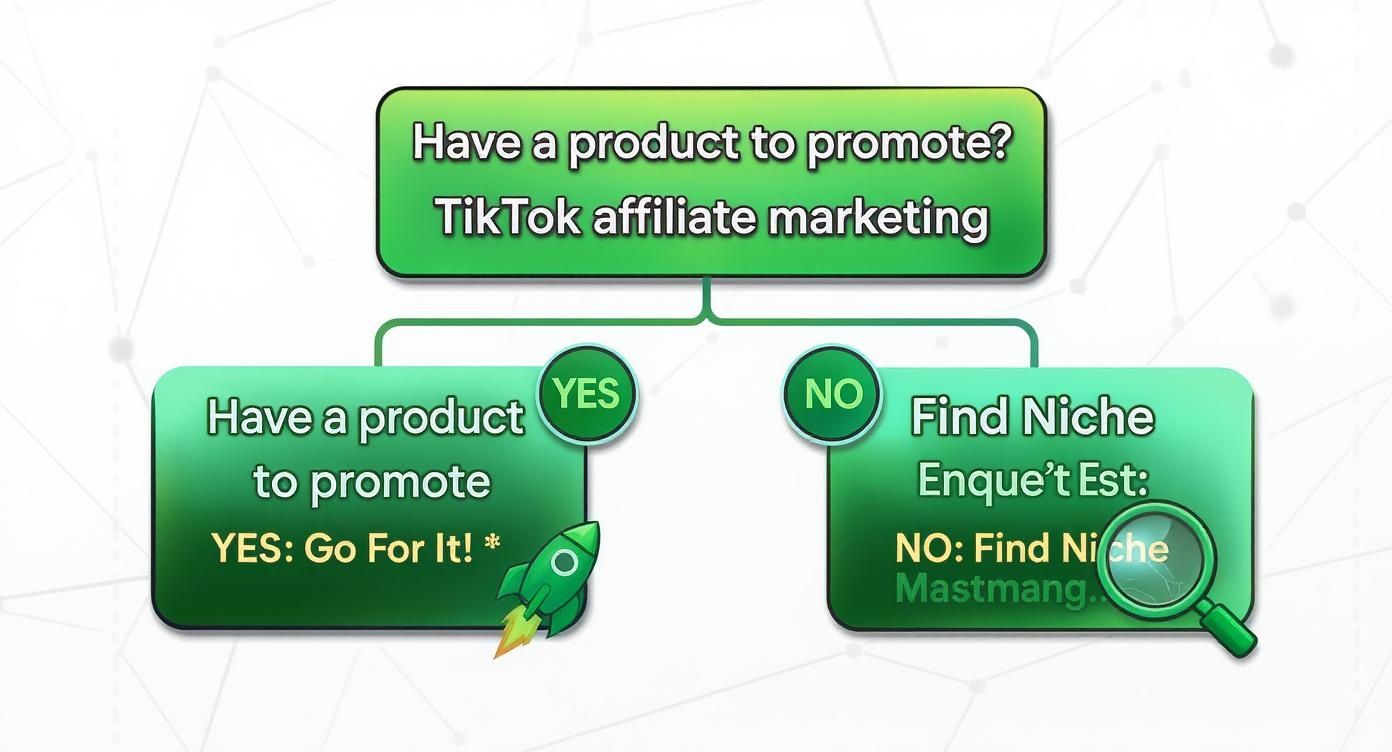
As the chart shows, it all boils down to one core choice: are you promoting something you created yourself, or are you finding a product that perfectly aligns with your niche? This just drives home the point that authenticity and relevance are the absolute cornerstones of a winning strategy.
You can also look for opportunities right inside the app. Our guide explains what is the TikTok Creator Marketplace and how it can connect you with official brand deals. At the end of the day, the goal is to choose partners your audience will genuinely thank you for introducing them to. That's how you build a sustainable income stream.
Turning Your TikTok Profile Into a Conversion Hub
Your TikTok videos might grab all the attention, but your profile is where the real conversions happen in affiliate marketing. Think of it as your personal storefront. If it's messy or confusing, you're just pushing potential customers away. A sharp, well-organized profile, on the other hand, makes it easy for people to buy what you recommend.
It all starts with your bio. This little blurb has a big job to do. In just a few words, you need to tell people who you are, what you're about, and why they should listen to your advice. Don't just list a category like "Lifestyle & Beauty." Get specific. Something like "Your go-to for affordable skincare that actually works" is way more compelling and immediately tells visitors what to expect.
Crafting the Perfect Call to Action
Just dropping a link in your bio and hoping for the best won't cut it. You need a powerful call-to-action (CTA) that tells people exactly what you want them to do. A simple CTA like "Shop my top finds 👇" is direct, clear, and incredibly effective. It takes the guesswork out of the equation and points your audience right where you want them to go.
Don't forget about your profile picture and pinned videos, either. Your picture should be a clear, high-quality photo of you—it helps build that human connection. Use those three valuable pinned video slots to show off your best work. Pin a viral review, a video that sparked a ton of questions, or your highest-performing affiliate content. This gives new visitors an instant taste of the value you provide.
The goal isn't just to get clicks; it's to build a seamless path from discovery to purchase. Every element of your profile should work together to build trust and make it incredibly easy for your followers to act on your recommendations.
When you nail these optimizations, the results are huge. I've seen creators boost their profile-to-click conversion rates by 200-300% just by clarifying their bio and adding a strong CTA. With affiliate content on TikTok reaching an average of 12,762 users per video in 2025, you can't afford to leave that money on the table. You can find more data on TikTok conversion rates at Napolify.
Centralize Your Links for Maximum Impact
TikTok only gives you one clickable link in your bio, so you have to make it count. This is where affiliate marketing for TikTok gets strategic, and tools like Linktree or Beacons become your best friend. They let you turn that single link into a clean, mobile-friendly landing page where you can house all your different affiliate links.
To get the most out of your link hub, organize it logically:
- Group items into categories: Create sections like "Skincare Favorites" or "Tech Gear."
- Write clear button text: Instead of a jumbled URL, label buttons with descriptive text like "My Favorite Vitamin C Serum."
- Feature your top products: Put your best-sellers or high-commission items right at the top where they can't be missed.
This kind of setup makes the shopping experience smooth and simple for your followers. Of course, you need to get people to your profile first. If you're still building your audience, check out our guide on how to get 10k followers on TikTok.
Creating TikToks That Sell Without Selling Out
If there’s one mistake I see over and over in affiliate marketing for TikTok, it’s making content that feels like a blatant ad. People don't open the app to be sold to. They're looking for entertainment, a sense of community, and maybe to discover something new. The real success comes when you can weave a product recommendation into a story that actually helps or entertains someone.
This is the art of "selling without selling." Instead of a video that screams, "You have to buy this amazing face cream!" you could film a "Get Ready With Me" (GRWM) clip. The cream is just a natural part of your routine. This feels like getting a tip from a trusted friend, not a pitch from a stranger.
Proven Video Formats That Actually Convert
Some video styles are just built for affiliate marketing because they put the story first. They let you show off a product’s benefits in a way that feels completely organic.
Here are a few formats that I’ve seen work time and again:
- Problem/Solution: Kick things off with a pain point your audience knows all too well. Think of a title like, "My hair was always so frizzy until I found this." It immediately hooks people with a shared problem and positions your affiliate product as the solution.
- Unboxings and First Impressions: This is pure gold. It plays on our natural curiosity. Your genuine, unfiltered reaction as you open a package and try a product for the first time is incredibly relatable and builds trust on the spot.
- "Get Ready With Me" or "Day in the Life": These vlog-style videos are perfect for showing products in their natural habitat. Maybe it's the specific coffee blend that gets your morning started or the backpack that actually fits all your gear. It's powerful, real-world proof.
The golden rule is to lead with value. Make sure your video is interesting on its own—the product is just there to make the story you’re telling even better.
Mastering TikTok's Creative Tools
What you say is important, but how you say it matters just as much. TikTok gives you a whole arsenal of creative tools that can make or break your video's reach. If you're ignoring them, you're leaving views (and money) on the table.
First up, trending audio is your secret weapon. The TikTok algorithm loves pushing content that uses popular sounds, giving your video an instant visibility boost. The key is to find a sound that actually matches the vibe of your video. Don’t just force a trending song onto your product review; make it feel like it belongs.
Text overlays are also non-negotiable. Use them to hook viewers within the first three seconds. A bold question or a shocking statement can stop the scroll. You can also use overlays to point out a key feature or add a clear call-to-action, like "Link in bio for this game-changer!"
Your authenticity is everything on TikTok. People follow you because they like your take on things. The moment you start making generic, salesy videos, you'll lose the trust you worked so hard to build. Just share what you genuinely love.
Finally, write captions that get people talking. Ask a question. If you’re promoting a travel gadget, you could ask, "What's the one travel item you absolutely can't live without?" This encourages comments, which tells the algorithm your content is engaging and should be shown to more people.
Tracking Earnings and Scaling Your Affiliate Strategy

Getting a video to go viral is a huge win, but let's be honest—the real goal with affiliate marketing for TikTok is turning those views into a steady, reliable income. Your earning potential isn't a lottery; it’s a direct result of your niche, how engaged your audience is, and the quality of the content you're putting out.
So, what's the financial reality? It varies wildly, but dedicated creators can see anywhere from a few hundred dollars to over $10,000 per month. It's totally realistic for someone in a popular niche like fashion or tech to be pulling in $3,000 to $5,000 monthly after their first year of consistent effort.
Mastering Your Affiliate Dashboard
Every affiliate program you join will give you access to a dashboard. Think of this as your command center. To really succeed, you need to get comfortable with the data it shows you. Don't just check the total commission and call it a day—the real insights are buried in the details.
These are the numbers that should become your obsession:
- Click-Through Rate (CTR): This tells you the percentage of viewers who saw your link and actually clicked on it. If your CTR is low, your call-to-action probably needs some work.
- Conversion Rate: Of all the people who clicked, how many followed through and bought something? This is the ultimate test of how convincing your video and the product itself really are.
- Earnings Per Click (EPC): This is your average income for every single click. EPC is a fantastic metric for quickly comparing which products are the most profitable to promote.
A huge part of growing your affiliate income is knowing how to measure marketing ROI for all your hard work. When you understand these metrics, you can see exactly which videos are making you money and which are duds. That's when you can start making smart decisions.
Smart Scaling Strategies
Once you’ve got a consistent trickle of commissions coming in, it's time to open the floodgates. Scaling isn't just about posting more; it's about working smarter to grow your revenue without burning yourself out.
A simple but effective first move is to diversify your partnerships. Putting all your eggs in one affiliate basket is a massive risk. What happens if that program changes its commission structure or disappears entirely? Your income vanishes overnight. Protect yourself by partnering with two or three other brands that fit your niche.
Once you've proven you can drive consistent sales for a brand, your value goes way up. Don't hesitate to reach out and negotiate a higher commission rate. The worst they can say is no.
Another key strategy is to become a student of your own success. Dig into your analytics and find your best-performing videos. What format did you use? Which products resonated most? What specific call-to-action did you use? Find those winning ingredients and build a recipe you can use again and again. This data-first approach is what separates a TikTok hobby from a sustainable business.
Common Questions About TikTok Affiliate Marketing
Jumping into TikTok affiliate marketing can feel like a lot. It's a fast-paced world, and it’s smart to get your questions answered before you dive in headfirst. I'll walk you through some of the most common things people ask, giving you straight, practical answers to get you started on the right foot.
Think of this as your quick guide to the essentials, from how many followers you really need to handling the legal stuff.
Do I Need a Lot of Followers to Start?
Not at all. This is easily the biggest myth out there. TikTok's algorithm is your best friend here because it cares more about great, engaging content than your follower count. A video can absolutely blow up from an account with 1,000 followers just as easily as it can from one with a million.
In my experience, smaller creators—often called micro-influencers—tend to have way better engagement rates. Their followers are usually a tight-knit community, which means they've built a level of trust that actually drives sales. The real goal is to create content that a specific group of people loves, not just to chase a huge follower number. You can genuinely start earning with just a few thousand loyal followers who hang on your every word.
How Do I Properly Disclose Affiliate Links on TikTok?
Be transparent. Always. It’s not just good practice; it's a legal requirement. Being upfront about your affiliate partnerships is how you build real, lasting trust with your audience. The simplest way to do this is by adding a clear hashtag right in your video caption.
Just use one of these:
- #ad
- #sponsored
- #affiliatelink
For good measure, you can even mention it out loud in your video. And if you're working with a brand through a formal partnership, make sure you use TikTok’s built-in "Branded content" toggle. This keeps you on the right side of FTC guidelines and shows your followers you're being honest.
When in doubt, over-disclose. People respect honesty, and it keeps you safe from any legal headaches. It’s a small step that pays off big in credibility.
What Is the Best Place for My Affiliate Links?
Your bio link is gold. Since you can't drop clickable links in TikTok video captions, your profile's bio is the single most important spot on your account. All roads should lead there.
In your videos, you need to tell people exactly where to go. Use a clear verbal cue or on-screen text to guide them. Simple phrases like "Link in bio to shop this look!" or "You can find this in my bio!" work wonders. The whole point is to make it as easy as possible for someone who's interested to find what you're talking about. If you have access to it, TikTok Shop is even better, as it lets you tag products right in your videos, creating a seamless path to purchase.
How Long Does It Realistically Take to Make Money?
There's no magic number here, and you should be wary of anyone who tells you otherwise. How quickly you start earning depends on your niche, how good your content is, and how often you post. I've seen some creators get their first commission in a couple of weeks, but for others, it might take a few months to build the kind of trust that leads to sales.
Consistency is everything. Your main job is to build a community that actually trusts your judgment. Pay close attention to your analytics to see what’s working, then do more of that. This isn't about guessing; it's about using data to figure out what your audience loves. That's the approach that will really speed up your journey to a steady affiliate income.
Ready to skip the slow grind of growing an account from scratch? MonetizedProfiles offers fully monetized TikTok and YouTube accounts that are ready to earn revenue from day one. Perfect for creators who want to jump straight into making money, you can find your ideal account today.


